When the Roman armies returned from these many victorious campaigns, they were received with great jubilation. Alas and alack! this sudden glory did not make the country any happier. On the contrary. The endless campaigns had ruined the farmers who had been obliged to do the hard work of Empire making. It had placed too much power in the hands of the successful generals (and their private friends) who had used the war as an excuse for wholesale robbery.
The old Roman Republic had been proud of the simplicity which had characterized the lives of her famous men. The new Republic felt ashamed of the shabby coats and the high principles which had been fashionable in the days of its grandfathers. It became a land of rich people ruled by rich people for the benefit of rich people. As such it was doomed to disastrous failure, as I shall now tell you.
Within less than a century and a half. Rome had become the mistress of practically all the land around the Mediterranean. In those early days of history, a prisoner of war lost their freedom and became a slave. The Roman regarded war as a very serious business and he showed no mercy to a conquered foe. After the fall of Carthage, the Carthaginian women and children were sold into bondage together with their own slaves. And a like fate awaited the obstinate inhabitants of Greece and Macedonia and Spain and Syria when they dared to revolt against the Roman power.
Two thousand years ago a slave was considered merely a piece of machinery. Nowadays a rich person invests their money in factories. The rich people of Rome (senators, generals and war profiteers) invested theirs in land and in slaves. The land they bought or took in the newly-acquired provinces. The slaves they bought in open market wherever they happened to be cheapest. During most of the third and second centuries before Christ there was a plentiful supply, and as a result the landowners worked their slaves until they dropped dead in their tracks, when they bought new ones at the nearest bargain-counter of Corinthian or Carthaginian captives.
And now behold the fate of the freeborn farmer!
He had done his duty toward Rome and he had fought her battles without complaint. But when he came home after ten, fifteen or twenty years, his lands were covered with weeds and his family had been ruined. But he was a strong man and willing to begin life anew. He sowed and planted and waited for the harvest. He carried his grain to the market together with his cattle and his poultry, to find that the large landowners who worked their estates with slaves could underbid him all along the line. For a couple of years, he tried to hold his own. Then he gave up in despair. He left the country and he went to the nearest city. In the city he was as hungry as he had been before on the land. But he shared his misery with thousands of other disinherited beings. They crouched together in filthy hovels in the suburbs of the large cities. They were apt to get sick and die from terrible epidemics. They were all profoundly discontented. They had fought for their country and this was their reward. They were always willing to listen to those plausible spell-binders who gather around a public grievance like so many hungry vultures, and soon they became a grave menace to the safety of the state.
But the class of the newly-rich shrugged its shoulders. “We have our army and our policemen,” they argued, “they will keep the mob in order.” And they hid themselves behind the high walls of their pleasant villas and cultivated their gardens and read the poems of a certain Homer which a Greek slave had just translated into very pleasing Latin hexameters.
In a few families however the old tradition of unselfish service to the Commonwealth continued. Cornelia, the daughter of Scipio Africanus, had been married to a Roman by the name of Gracchus. She had two sons, Tiberius and Gaius. When the boys grew up they entered politics and tried to bring about certain much-needed reforms. A census had shown that most of the land of the Italian peninsula was owned by two thousand noble families. Tiberius Gracchus, having been elected a Tribune, tried to help the freemen. He revived two ancient laws which restricted the number of acres which a single owner might possess. In this way he hoped to revive the valuable old class of small and independent freeholders. The newly-rich called him a robber and an enemy of the state. There were street riots. A party of thugs was hired to kill the popular Tribune. Tiberius Gracchus was attacked when he entered the assembly and was beaten to death. Ten years later his brother Gaius tried the experiment of reforming a nation against the expressed wishes of a strong privileged class. He passed a “poor law” which was meant to help the destitute farmers. Eventually it made the greater part of the Roman citizens into professional beggars.
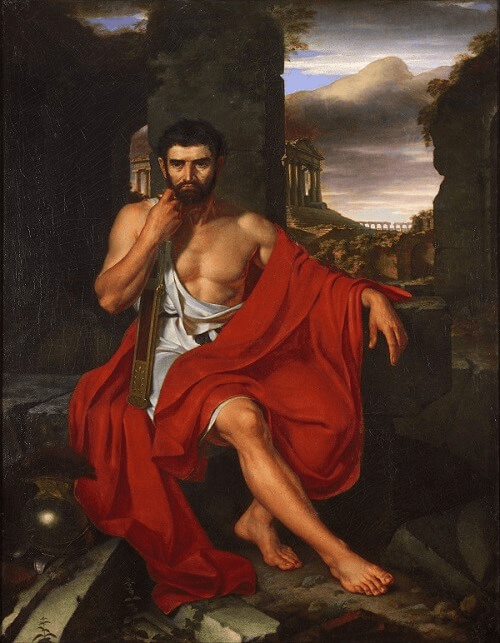
He established colonies of destitute people in distant parts of the empire, but these settlements failed to attract the right sort of people. Before Gaius Gracchus could do more harm he too was murdered and his followers were either killed or exiled. The first two reformers had been gentlemen. The two who came after were of a very different stamp. They were professional soldiers. One was called Marius. The name of the other was Sulla. Both enjoyed a large personal following.
Sulla was the leader of the landowners. Marius, the victor in a great battle at the foot of the Alps when the Teutons and the Cimbri had been annihilated, was the popular hero of the disinherited freemen.
Now it happened in the year 88 B.C. that the Senate of Rome was greatly disturbed by rumors that came from Asia. Mithridates, king of a country along the shores of the Black Sea, and a Greek on his mother’s side, had seen the possibility of establishing a second Alexandrian Empire. He began his campaign for world-domination with the murder of all Roman citizens who happened to be in Asia Minor, men, women and children. Such an act, of course, meant war. The Senate equipped an army to march against the King of Pontus and punish him for his crime. But who was to be commander-in-chief? “Sulla,” said the Senate, “because he is Consul.” “Marius,” said the mob, “because he has been Consul five times and because he is the champion of our rights.”
Possession is nine points of the law. Sulla happened to be in actual command of the army. He went west to defeat Mithridates. Marius fled to Africa. There he waited until he heard that Sulla had crossed into Asia. He then returned to Italy, gathered a motley crew of malcontents, marched on Rome and entered the city with his professional highwaymen, spent five days and five nights, slaughtering the enemies of the Senatorial party, got himself elected Consul and promptly died from the excitement of the last fortnight.
There followed four years of disorder. Then Sulla, having defeated Mithridates, announced that he was ready to return to Rome and settle a few old scores of his own. He was as good as his word. For weeks his soldiers were busy executing those of their fellow citizens who were suspected of democratic sympathies. One day they got hold of a young fellow who had been often seen in the company of Marius. They were going to hang him when someone interfered. “The boy is too young,” he said, and they let him go. His name was Julius Caesar. You shall meet him again in the next lesson.
Teach children that the numbers 1-12 mark the hours, the minutes, and the seconds depending on which hand is pointing at the number. Point to each number on the clock image shown below and have children recite the following:
Pointing to 1 means 1 o’clock for the hour hand, 5 minutes past the hour for the minute hand, and 5 seconds past the hour for the second hand.
Pointing to 2 means 2 o’clock for the hour hand, 10 minutes past the hour for the minute hand, and 10 seconds past the hour for the second hand.
Pointing to 3 means 3 o’clock for the hour hand, 15 minutes past the hour for the minute hand, and 15 seconds past the hour for the second hand.
Pointing to 4 means 4 o’clock for the hour hand, 20 minutes past the hour for the minute hand, and 20 seconds past the hour for the second hand.
Pointing to 5 means 5 o’clock for the hour hand, 25 minutes past the hour for the minute hand, and 25 seconds past the hour for the second hand.
Pointing to 6 means 6 o’clock for the hour hand, 30 minutes past the hour for the minute hand, and 30 seconds past the hour for the second hand.
Pointing to 7 means 7 o’clock for the hour hand, 35 minutes past the hour for the minute hand, and 35 seconds past the hour for the second hand.
Pointing to 8 means 8 o’clock for the hour hand, 40 minutes past the hour for the minute hand, and 40 seconds past the hour for the second hand.
Pointing to 9 means 9 o’clock for the hour hand, 45 minutes past the hour for the minute hand, and 45 seconds past the hour for the second hand.
Pointing to 10 means 10 o’clock for the hour hand, 50 minutes past the hour for the minute hand, and 50 seconds past the hour for the second hand.
Pointing to 11 means 11 o’clock for the hour hand, 55 minutes past the hour for the minute hand, and 55 seconds past the hour for the second hand.
Pointing to 12 means 12 o’clock for the hour hand, 0 minutes past the hour for the minute hand, and 0 seconds past the hour for the second hand.
STEP 2
Note to children that they may multiply the numbers 1-12 in black by 5 to determine the number of minutes and/or seconds in red.
Have them calculate and recite the number of minutes and seconds.
Children separate a larger group of up to 19 objects into two smaller groups.
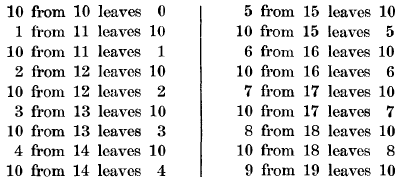
Repeatedly separate a group of objects into smaller groups per the table below. For example, 10 pencils from 10 pencils leaves 0 pencils, 8 coins from 18 coins leaves 10 coins, and 9 cars from 19 cars leaves 10 cars, etc.
When children are ready, have them separate the object groups themselves.
Children must perfectly master the operations listed in the table before proceeding to the next phase of the lesson.
Step 2
Children separate groups of objects they can’t see, but can imagine (bears, mountains, trees).
Using the table above as a guide, ask children to call out the answer to questions such as, ‘How many are one shoe from eleven shoes?’ and ‘How many are nine frogs from nineteen frogs?’
Give numerous exercises on each number, with constant reviews, until children can recite each operation in the table with great accuracy and rapidity.
Step 3
In this phase, do not mention objects. Children subtract numbers directly.
Using the table above as a guide, ask children to call out the answer to questions such as, ‘How many are one from eleven?’ and ‘How many are four from fourteen?’
Give numerous exercises on each number, with constant reviews, until children can perform each operation with great accuracy and rapidity.
Step 4
Direct children to practice writing and reciting the subtraction problems listed in the table above. For example, they would write and then recite:
9 from 19 leaves 10
19 minus 9 is 10
19 – 9 = 10
Repeat for each combination in the table until the children master the tasks.
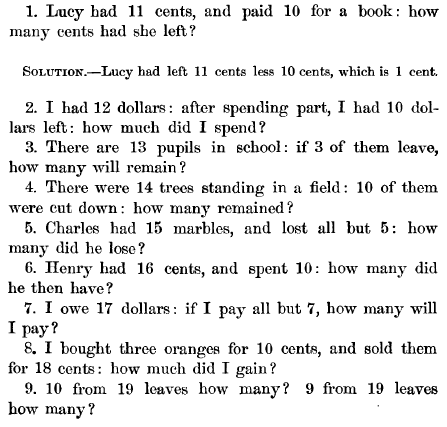
Assess mastery by reading aloud the word problems below and having the children mentally compute and recite the solutions. If children have difficulties, repeat the prior phases and then reassess.
In certain parts of the East it is the custom for a man when he is married to bring home his bride at night, and for his relatives and friends to go out with lamps and torches and music to meet him.
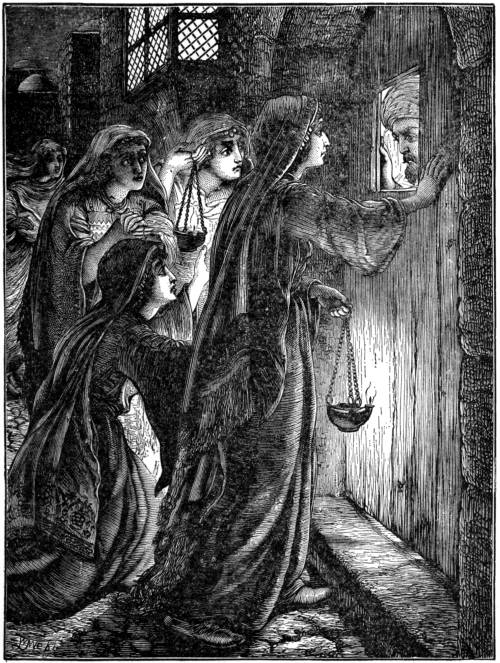
Ten young women had been invited to meet the bridegroom with their lamps burning and to sit down with him at the wedding-feast. Five of them were wise and five were foolish. The wise ones took a supply of oil in case their lamps should burn out before the bridegroom arrived; the foolish five took no oil but what was in their lamps. But before the bridegroom came they all fell asleep.
At midnight there was a cry, “Behold, the bridegroom cometh; go ye out to meet him.” But five lamps had almost burnt out, and the foolish virgins said unto the wise, “Give us of your oil, for our lamps are gone out.” But the wise ones answered, “Not so; lest there be not enough for us and for you. Go ye, rather, to them that sell, and buy for yourselves.” And while they went to buy, the bridegroom came, and they that were ready went in with him to the marriage-feast, and the door was shut.
Afterwards, came also the other virgins, saying, “Lord, Lord, open the door to us.” But he answered and said, “Verily I say unto you, I know you not,” and would not open the door to them.
In this parable the bridegroom means Jesus returning to earth, on the Day of Judgment. The ten virgins are the people of this world, some of whom have their hearts full of the love of God and keep their lamps burning with a steady and bright light; that is, they fulfil God’s commandments and obey the teachings of Christ. The others have not this love in their hearts and are not prepared for Christ’s coming. Their lamps give out a feeble light and soon will go out.
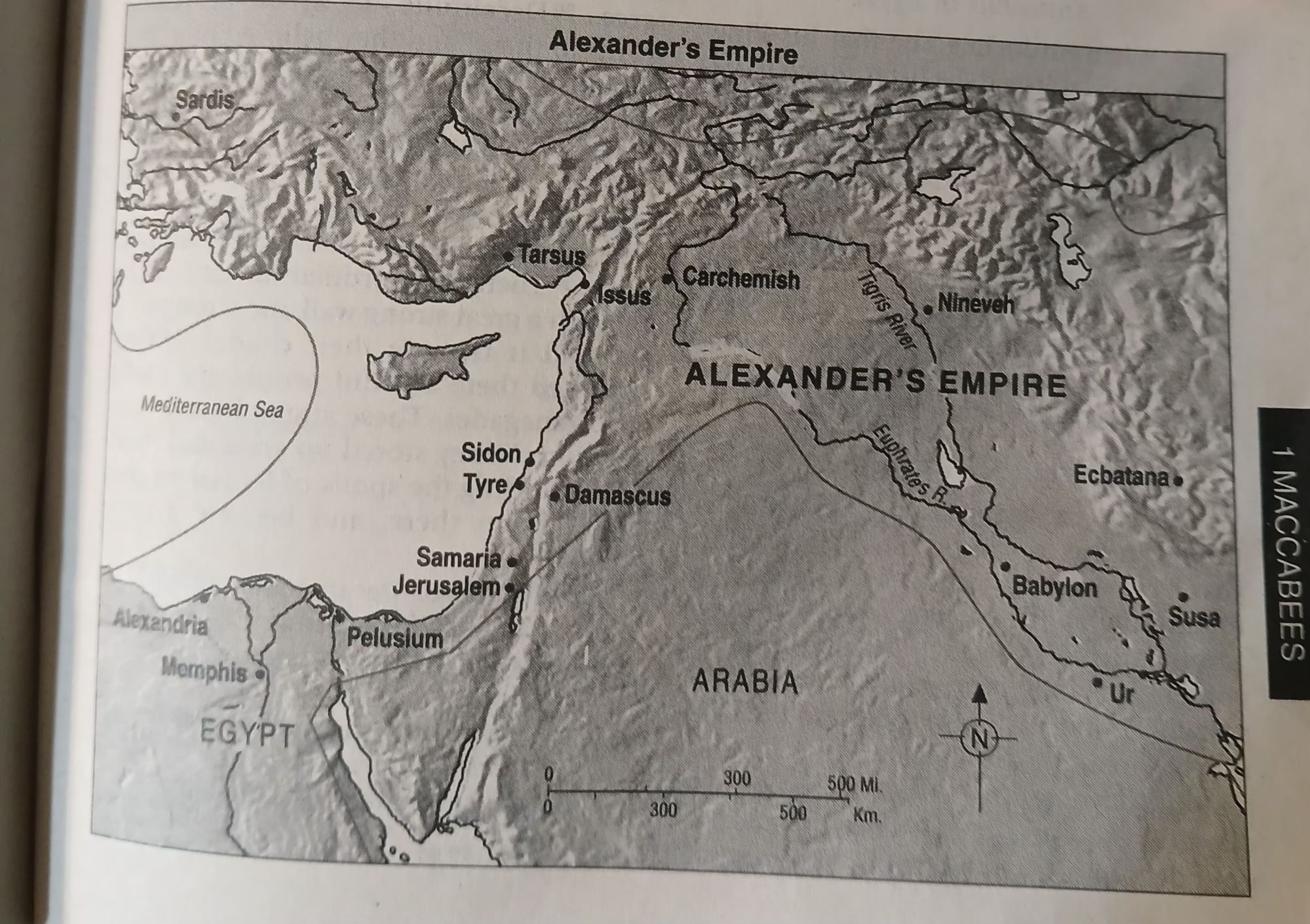
1 Maccabees 1:1-4 After Alexander of Macedon, the son of Philip, had come from the land of Kittim and defeated Darius, the king of the Persians and the Medes, he succeeded him as king, in addition to his position as king of Greece. He engaged in many campaigns, captured strongholds, and executed kings. In his advance to the ends of the earth, he plundered countless nations. When the earth was reduced to silence before him, his heart swelled with pride and arrogance. He recruited a very powerful army, and as provinces, nations, and rulers were conquered by him, they became his tributaries.
After defeating the Persians, Alexander the Great reached the Indian Ocean.
Alexander the Great Dies
1 Maccabees 1:5-9 However, when all this had been accomplished, Alexander became ill, and he realized that his death was imminent. Therefore, he summoned his officers, nobles who had been brought up with him from his youth, and he divided his kingdom among them while he was still alive. Then, in the twelfth year of his reign, Alexander died. After that, his officers assumed power in the kingdom, each in his own territory. They all put on royal crowns after his death, as did their heirs who succeeded them for many years, inflicting great evils on the world.
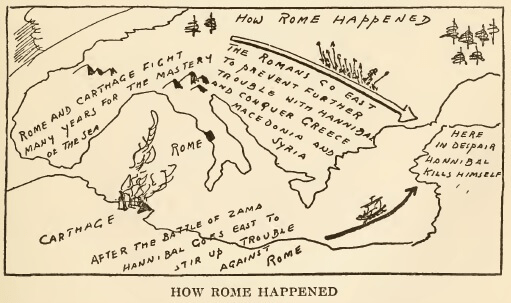
The Roman Empire was an accident. No one planned it. It “happened.” No famous general or statesman or cutthroat ever got up and said “Friends, Romans, Citizens, we must found an Empire. Follow me and together we shall conquer all the land from the Gates of Hercules to Mount Taurus.”
Rome produced famous generals and equally distinguished statesmen and cutthroats, and Roman armies fought all over the world. But the Roman empire-making was done without a preconceived plan. The average Roman was a very matter-of-fact citizen. He disliked theories about government. When someone began to recite “eastward the course of Roman Empire, etc., etc.,” he hastily left the forum. He just continued to take more and more land because circumstances forced him to do so. He was not driven by ambition or by greed. Both by nature and inclination he was a farmer and wanted to stay at home. But when he was attacked he was obliged to defend himself and when the enemy happened to cross the sea to ask for aid in a distant country then the patient Roman marched many dreary miles to defeat this dangerous foe and when this had been accomplished, he stayed behind to administer his newly conquered provinces lest they fall into the hands of wandering Barbarians and become themselves a menace to Roman safety. It sounds rather complicated and yet to the contemporaries it was so very simple, as you shall see in a moment.
In the year 203 B.C. Scipio had crossed the African Sea and had carried the war into Africa. Carthage had called Hannibal back. Badly supported by his mercenaries, Hannibal had been defeated near Zama. The Romans had asked for his surrender and Hannibal had fled to get aid from the kings of Macedonia and Syria, as I told you in my last chapter.
The rulers of these two countries (remnants of the Empire of Alexander the Great) just then were contemplating an expedition against Egypt. They hoped to divide the rich Nile valley between themselves. The king of Egypt had heard of this and he had asked Rome to come to his support. The stage was set for a number of highly interesting plots and counter-plots. But the Romans, with their lack of imagination, rang the curtain down before the play had been fairly started. Their legions completely defeated the heavy Greek phalanx which was still used by the Macedonians as their battle formation. That happened in the year 197 B.C. at the battle in the plains of Cynoscephalae, or “Dogs’ Heads,” in central Thessaly.
The Romans then marched southward to Attica and informed the Greeks that they had come to “deliver the Hellenes from the Macedonian yoke.” The Greeks, having learned nothing in their years of semi-slavery, used their new freedom in a most unfortunate way. All the little city-states once more began to quarrel with each other as they had done in the good old days. The Romans, who had little understanding and less love for these silly bickerings of a race which they rather despised, showed great forbearance. But tiring of these endless dissensions they lost patience, invaded Greece, burned down Corinth (to “encourage the other Greeks”) and sent a Roman governor to Athens to rule this turbulent province. In this way, Macedonia and Greece became buffer states which protected Rome’s eastern frontier.
Meanwhile right across the Hellespont lay the Kingdom of Syria, and Antiochus III, who ruled that vast land, had shown great eagerness when his distinguished guest, General Hannibal, explained to him how easy it would be to invade Italy and sack the city of Rome.
Lucius Scipio, a brother of Scipio the African fighter who had defeated Hannibal and his Carthaginians at Zama, was sent to Asia Minor. He destroyed the armies of the Syrian king near Magnesia (in the year 190 B.C.) Shortly afterwards, Antiochus was lynched by his own people. Asia Minor became a Roman protectorate and the small City-Republic of Rome was mistress of most of the lands which bordered upon the Mediterranean.


















 articlesforchristians