A place to grow your relationship with God

Posts tagged ‘homeschool’

Math: Review – US Money

Directions

Have children complete the problems below.

Have children practice until they perfectly master the task.

Steps

STEP 1

  • Direct children to mentally compute and recite the solutions.

STEP 2

  • If children have difficulties, work with physical objects and then have children retry the mental computation.

Subtract Numbers from Up to 13

STEP 1

  • Children separate a larger group of up to 13 objects into two smaller groups.
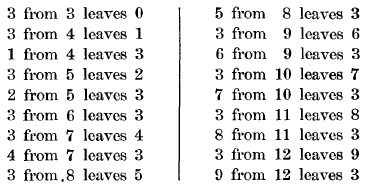
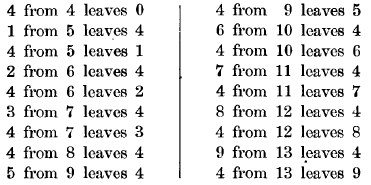
  • Repeatedly separate a group of objects into smaller groups per the table below. For example, 4 pencils from 4 pencils leaves 0 pencils, 8 coins from 12 coins leaves 4 coins, and 9 cars from 13 cars leaves 4 cars, etc.
  • When children are ready, have them separate the object groups themselves.
  • Children must perfectly master the operations listed in the table before proceeding to the next phase of the lesson.

STEP 2

  • Children separate groups of objects they can’t see, but can imagine (bears, mountains, trees).
  • Using the table above as a guide, ask children to call out the answer to questions such as, ‘How many are one shoe from five shoes?’ and ‘How many are nine frogs from thirteen frogs?’
  • Give numerous exercises on each number, with constant reviews, until children can recite each operation in the table with great accuracy and rapidity.

STEP 3

  • In this phase, do not mention objects. Children subtract numbers directly.
  • Using the table above as a guide, ask children to call out the answer to questions such as, ‘How many are one from five?’ and ‘How many are four from six?’
  • Give numerous exercises on each number, with constant reviews, until children can perform each operation with great accuracy and rapidity.

STEP 4

  • Direct children to practice writing and reciting the subtraction problems listed in the table above. For example, they would write and then recite:
  • 4 from 13 leaves 9
  • 13 minus 4 is 9
  • 13 – 4 = 9
  • Repeat for each combination in the table until the children master the tasks.

STEP 5

Have children copy, solve, and recite the following table:

  • 12 + 1 or 1 + 12 = ; therefore 13 – 1 = ; 13 – 12 =
  • 11 + 2 or 2 + 11 = ; therefore 13 – 2 = ; 13 – 11 =
  • 10 + 3 or 3 + 10 = ; therefore 13 – 3 = ; 13 – 10 =
  • 9 + 4 or 4 + 9 = ; therefore 13 – 4 = ; 13 – 9 =
  • 8 + 5 or 5 + 8 = ; therefore 13 – 5 = ; 13 – 8 =
  • 7 + 6 or 6 + 7 = ; therefore 13 – 6 = ; 13 – 7 =

STEP 6

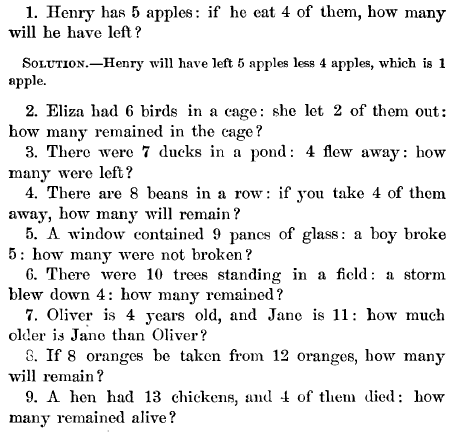
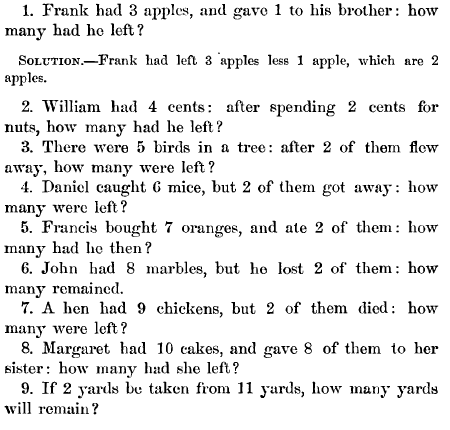
  • Assess mastery by reading aloud the word problems below and having the children mentally compute and recite the solutions. If children have difficulties, repeat the prior phases and then reassess.

1st grade week 21 out of 36

Subscribe to continue reading

Subscribe to get access to the rest of this post and other subscriber-only content.

Boyhood of Franklin

Benjamin Franklin, the youngest in a family of seventeen children, was born in Boston in 1706. Benjamin learned to read when he was very young, but he was only sent to school for two years. When he was ten years old he had to help his father. Franklin’s father made his living by boiling soap and making tallow candles. Little Benjamin had to cut wicks for the candles, fill the molds with the melted tallow, tend the shop, and run on errands. He did not like the soap and candle trade. Playing about the water, he had learned to swim and manage a boat. Like many other boys, he got the notion that it would be a fine thing to go to sea and be a sailor. But his father did not think so.

Franklin and his playmates used to fish for minnows in a millpond which had a salt marsh for a shore, so that the boys had to stand in the mud. He was a leader among the boys and already very ingenious. So he proposed that the boys should build a little wharf in this marsh to stand on. Near the marsh there was a pile of stones, put there to be used in building a new house. In the evening, when the workmen were gone, Franklin and the other boys tugged and toiled until they had managed to carry all these stones away and build them into a wharf or pier reaching out into the water.

In the morning, the workmen were very much surprised to find that their pile of stones had walked away during the night. They soon found out where the stones were and complained to the parents of the boys. Franklin and some of the other boys were punished for their mischief. Benjamin tried to make his father see that it was a very useful work to build such a pier, but the father soon showed him that “nothing was useful that was not honest.”

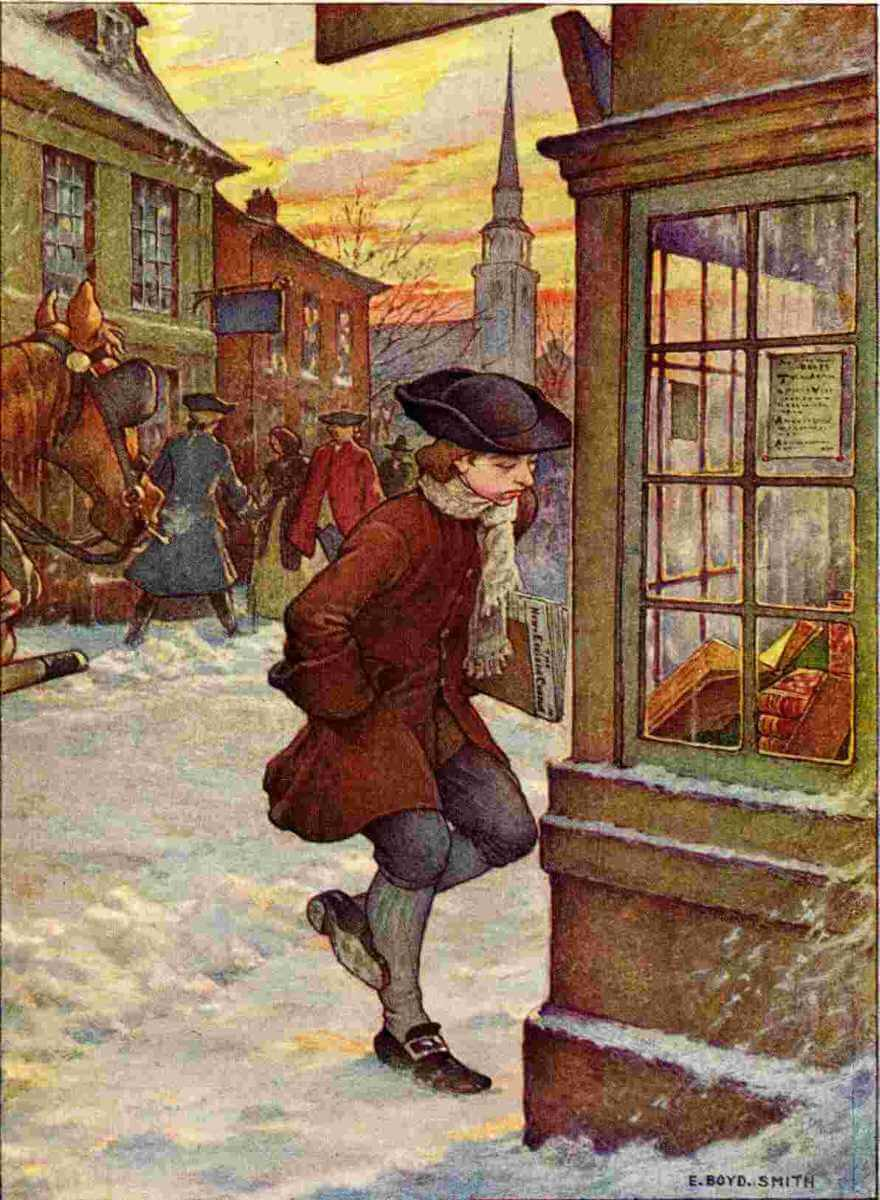
When Franklin had worked for two years with his father at the trade of making tallow candles, the father began to be afraid that Ben would run away and go to sea, as another of his sons had done before. So Franklin’s father took him walking with him sometimes to look at men working at their trades, such as bricklaying, turning, and joining, to see if the boy would not take a fancy to one of these occupations. Meantime, Benjamin became very fond of reading. He read his father’s books, which were very dull for children, and he sold some little things of his own to buy more. As the boy was so fond of books, Benjamin’s father could think of nothing better than to make him a printer. So Benjamin was apprenticed to his older brother, James Franklin, who already had a printing office. Benjamin liked this trade and learned very fast. As he was often sent to bookstores, he got a chance to borrow books. He sometimes sat up all night to read one of these, taking great care to keep the books clean and return them soon.

Benjamin took a fancy to write poetry about this time. His brother printed this “wretched stuff,” as Franklin afterward called it, and sent the boy around the town to peddle it. Ben was very proud of his poetry until his father made fun of it and told him that “verse makers were generally beggars.”

Franklin had a notion as a boy that it was wrong to eat meat, so he told his brother that if he would give him half of what his board cost, he would board himself. After this, Benjamin made his dinner on biscuit or a tart from the baker’s. In this way, he saved some of his board money to buy books and used the time while the other printers were at dinner to study.

James Franklin, Benjamin’s brother, printed a little newspaper. Franklin was printer’s boy and paper carrier, for after he had worked at printing the papers, he carried them around to the houses of the subscribers. But he also wanted to write for the paper. He did not dare propose so bold a thing to his brother, so he wrote some articles and put them under the printing office door at night. They were printed, and even Benjamin’s brother did not suspect that they were written by the boy.

The two brothers did not get on well together. The younger brother was rather saucy, and the older brother, who was high-tempered, sometimes gave him a whipping.

James Franklin once printed something in his newspaper which offended the government of the colony. He was arrested and put in prison for a month; for the press was not free in that day. Benjamin ran the little paper while his brother was in prison and put in the sharpest things he dared to say about the government. After James got out of prison, he was forbidden to print a newspaper any longer. So he made up his mind to print it in the name of his brother Benjamin. In order to do this, he was obliged to release Benjamin Franklin from his apprenticeship, though it was agreed that Ben was to remain at work for his brother, as though still an apprentice, till he was twenty-one years old. But Benjamin soon got into another quarrel with his brother, and now that he was no longer bound, Benjamin left him. This was not fair on his part, and he was afterward sorry for it.

Math: US Money – The Twenty-Dollar Bill

Directions

Gather one twenty-dollar bill, two ten-dollar bills, four five-dollar bills, and four one-dollar bills per child. Children might create their own pretend paper money with paper, pens, and crayons or markers.

Have children complete the steps below.

Have children practice until they perfectly master each task.

STEP 1 – WHAT IS A TWENTY-DOLLAR BILL?

Children identify the twenty-dollar bill.

  • Direct the children to examine the front and back of the twenty-dollar bill. Ask the children to verbally describe what they see. Tell children there are also less common, larger denominations such as fifty-dollar bills, but we will not cover those.
  • Have children hold up the twenty-dollar bill and recite, ‘1 twenty-dollar bill is worth 20 one-dollar bills.’

STEP 2 – COMBINE AND SEPARATE

Children combine and separate groups of one, five, ten, and twenty-dollar bills.

  • Tell children to move 2 ten-dollar bills next to the twenty-dollar bill. Have them recite, ‘1 twenty-dollar bill is worth 2 ten-dollar bills.’
  • Tell children to move 4 five-dollar bills next to the twenty-dollar bill. Have them recite, ‘1 twenty-dollar bill is worth 4 five-dollar bills.’

STEP 3 – PLAY STORE

  • Give each child 1 twenty-dollar bill, 1 ten-dollar bill, 1 five-dollar bill, and 4 one-dollar bills. Say to children, ‘A hair dryer costs 38 dollars. Show me which bills you must give to the cashier to purchase the dryer.’
  • Give each child 1 twenty-dollar bill, 1 ten-dollar bill, 1 five-dollar bill, and 4 one-dollar bills. Say to children, ‘A garden hose costs 36 dollars. Show me which bills you must give to the cashier to purchase the hose.’
  • Give each child 1 twenty-dollar bill, 1 ten-dollar bill, 1 five-dollar bill, and 4 one-dollar bills. Say to children, ‘A small plastic pool costs 34 dollars. Show me which bills you must give to the cashier to purchase the pool.’

Understanding Hair Growth: The Role of Roots and Blood for Kids

Facts about hair:

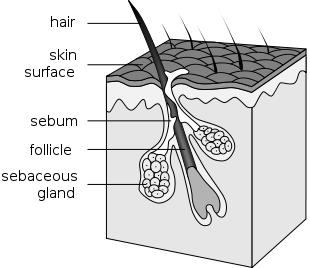
  1. Hair grows from ‘roots’ beneath our skin.
  2. Blood flowing through our bodies feeds the hair roots and makes the hair grow.
  3. Blood vessels carry the blood to the hair roots.

Study and Sketch Hair and Hair Roots

Objective:

Examine human hair. Sketch the root of a hair.

Materials:

Pencil and paper.

Procedure:

  • Examine another person’s scalp. Look at where the hair exits the skin.
  • Look for blood vessels under the scalp that carry blood to feed the hair roots.
  • Use the picture from above as a guide to draw a hair root. Draw a hair sprouting from the root.

Subtract Numbers from Up to 12

STEP 1

  • Children separate a larger group of up to 12 objects into two smaller groups.
  • Repeatedly separate a group of objects into smaller groups per the table below. For example, 3 pencils from 4 pencils leaves 1 pencil, 8 coins from 11 coins leaves 3 coins, and 9 cars from 12 cars leaves 3 cars, etc.
  • When children are ready, have them separate the object groups themselves.
  • Children must perfectly master the operations listed in the table before proceeding to the next phase of the lesson.

STEP 2

  • Children separate groups of objects they can’t see, but can imagine (bears, mountains, trees).
  • Using the table above as a guide, ask children to call out the answer to questions such as, ‘How many are one shoe from four shoes?’ and ‘How many are nine frogs from twelve frogs?’
  • Give numerous exercises on each number, with constant reviews, until children can recite each operation in the table with great accuracy and rapidity.

STEP 3

  • In this phase, do not mention objects. Children subtract numbers directly.
  • Using the table above as a guide, ask children to call out the answer to questions such as, ‘How many are one from four?’ and ‘How many are four from seven?’
  • Give numerous exercises on each number, with constant reviews, until children can perform each operation with great accuracy and rapidity.

STEP 4

  • Direct children to practice writing and reciting the subtraction problems listed in the table above. For example, they would write and then recite:
  • 3 from 12 leaves 9
  • 12 minus 3 is 9
  • 12 – 3 = 9
  • Repeat for each combination in the table until the children master the tasks.

STEP 5

Have children copy, solve, and recite the following table:

  • 11 + 1 or 1 + 11 = ; therefore 12 – 1 = ; 12 – 11 =
  • 10 + 2 or 2 + 10 = ; therefore 12 – 2 = ; 12 – 10 =
  • 9 + 3 or 3 + 9 = ; therefore 12 – 3 = ; 12 – 9 =
  • 8 + 4 or 4 + 8 = ; therefore 12 – 4 = ; 12 – 8 =
  • 7 + 5 or 5 + 7 = ; therefore 12 – 5 = ; 12 – 7 =
  • 6 + 6 = ; therefore 12 – 6 = ;

STEP 6

  • Assess mastery by reading aloud the word problems below and having the children mentally compute and recite the solutions. If children have difficulties, repeat the prior phases and then reassess.

Bacon and his Men

In 1676, just a hundred years before the American Revolution, the people of Virginia were very much oppressed by Sir William Berkeley, the governor appointed by the king of England. Their property was taken away by unjust taxes and in other ways. The governor had managed to get all the power into his own hands and those of his friends.

This was the time of King Philip’s War in New England. The news of this war made the American Indians of Virginia uneasy, and at length the Susquehannas and other tribes attacked the frontiers. Governor Berkeley would not do anything to protect the people on the frontier, because he was making a great deal of money out of the trade with friendly Indians. If troops were sent against them, this profitable trade would be stopped.

When many hundreds of people on the frontier had been put to death, some three hundred men formed themselves into a company to fight the Indians. But Berkeley refused to allow anyone to take command of this troop or to let them go against the Indians.

There was a young gentleman named Nathaniel Bacon, who had come from England three years before. He was a member of the governor’s council and an educated man. He begged the governor to let him lead this company of three hundred men against the Indians, but the old governor refused.

Bacon disagreed and wished to fight the Indians. He went to the camp of these men, to see and encourage them. But when they saw him, they set up a cry, “A Bacon! A Bacon! A Bacon!” This was the way of cheering a man at that day and choosing him for a leader.

Bacon knew that the governor might put him to death if he disobeyed orders, but he wished to defend his fellow colonists.

Berkeley gathered his friends and started after Bacon, declaring that he would hang Bacon for going to war without orders. While the old governor was looking for Bacon, the people down by the coast rose in favor of Bacon. The governor had to make peace with them by promising to let them choose a new legislature.

When Bacon got back from the Indian country, the frontier people cheered him as their deliverer. They kept guard night and day over his house. They were afraid the angry governor would send men to kill him.

The people of his county elected Bacon a member of the new Legislature. But they were afraid the governor might harm him. Forty of them with guns went down to Jamestown with him in a sloop. With the help of two boats and a ship, the governor captured Bacon’s sloop, and brought Bacon into Jamestown. But as the angry people were already rising to defend their leader, Berkeley was afraid to hurt him. He made him apologize, and restored him to his place in the Council.

But that night, Bacon was warned that the next day he would be seized again, and that the roads and river were guarded to keep him from getting away. So Bacon took horse suddenly and galloped out of Jamestown in the darkness. The next morning, the governor sent men to search the house where Bacon had stayed. Berkeley’s men stuck their swords through the beds, thinking Bacon hidden there.

But Bacon was already among friends. When the country people heard that Bacon was in danger, they seized their guns and vowed to kill the governor and all his party. Bacon was quickly marching on Jamestown with five hundred angry men at his back. The people refused to help the governor, and Bacon and his men entered Jamestown. It was their turn to guard the roads and keep Berkeley in.

The old governor offered to fight the young captain single-handed, but Bacon told him he would not harm him. Bacon forced the governor to sign a commission appointing Bacon a general. Bacon also made the Legislature pass good laws for the relief of the people. These laws were remembered long after Nathaniel Bacon’s death, and were known as “Bacon’s Laws.”

While this work of doing away with bad laws and making good ones was going on, the Indians attacked at a place only about twenty miles from Jamestown. General Bacon promptly started for the Indian country with his little army. But, just as he was leaving the settlements, he heard that the governor was raising troops to take him when he should get back; so he turned around and marched swiftly back to Jamestown.

The governor had called out the militia, but when they learned that instead of taking them to fight the Indians they were to go against Bacon, they all began to murmur, “Bacon! Bacon! Bacon!” Then they left the field and went home, and the old governor fainted with disappointment. He was forced to flee for safety to the eastern shore of Chesapeake Bay, and the government fell into the hands of General Bacon.

Bacon had an enemy on each side of him. No sooner had Berkeley gone than the Indians again attacked. Bacon once more marched against them and killed many. He and his men lived on horseflesh and chinquapin nuts during this expedition.

When Bacon got back to the settlements and had dismissed all but one hundred and thirty-six of his men, he heard that Governor Berkeley had gathered together seventeen vessels and six hundred sailors and others, and with these had taken possession of Jamestown. Worn out as they were with fatigue and hunger, Bacon persuaded his band to march straight for Jamestown, so as to take Berkeley by surprise.

As the weary and dusty veterans of the Indian war hurried onward to Jamestown, the people cheered the company. The women called after Bacon, “General, if you need help, send for us!” So fast did these men march that they reached the narrow neck of sand that connected Jamestown with the mainland before the governor had heard of their coming. Bacon’s men dug trenches in the night and shut in the governor and his people.

After a while, Bacon got some cannon. He wanted to put them up on his breastworks without losing the life of any of his brave soldiers. So he sent to the plantations nearby and brought to his camp the wives of the chief men in the governor’s party. These ladies he had sit in front of his works until his cannon were in place. He knew that the enemy would not fire on the ladies. When he had finished, he sent the ladies home.

Great numbers of the people now flocked to General Bacon’s standard, and the governor and his followers left Jamestown in their vessels. Knowing that they would try to return, Bacon ordered the town to be burned to the ground. Almost all of the people except those on the eastern shore sided with Bacon, who now did his best to put the government in order. But the hardships he had been through were too much for him. He sickened and died. His friends knew that Berkeley would soon get control again, now that their leader was dead. They knew that his enemies would dig up Bacon’s body and hang it, after the fashion of that time. No one knows where they buried Bacon’s body, but as they put stones in his coffin, they must have sunk it in the river.

Governor Berkeley got back his power and hanged many of Bacon’s friends. But the king of England removed Berkeley in disgrace, and he died of a broken heart. The governors who came after were generally careful not to oppress the people too far. They were afraid another Bacon might rise up against them.
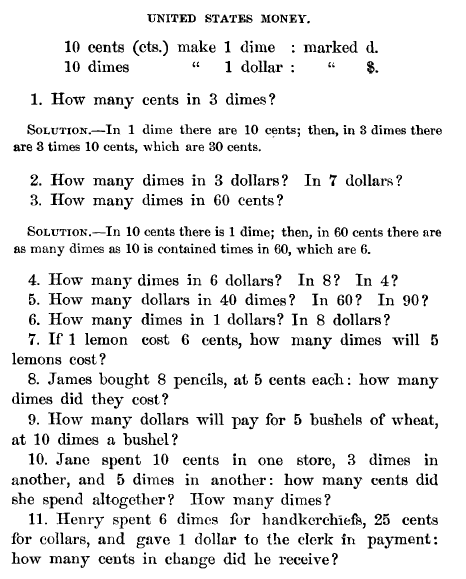
Math: US Money – The Ten-Dollar Bill

Directions

Gather one ten-dollar bill, one five-dollar bill, and ten one-dollar bills per child. Children might create their own pretend paper money with paper, pens, and crayons or markers.

Have children complete the steps below.

Have children practice until they perfectly master each task.

STEP 1 – WHAT IS A TEN-DOLLAR BILL?

Children identify the ten-dollar bill.

  • Direct the children to examine the front and back of the ten-dollar bill. Ask the children to verbally describe what they see.
  • Have children hold up the ten-dollar bill and recite, ‘1 ten-dollar bill is worth 10 one-dollar bills.’

STEP 2 – COMBINE AND SEPARATE

Children combine and separate groups of one, five, and ten-dollar bills.

  • Ask children to group 10 one-dollar bills together.
  • Tell children to move 1 ten-dollar bill next to the 10 one-dollar bills. Have them recite, ‘1 ten-dollar bill is worth 10 one-dollar bills.’
  • Tell children to remove the one-dollar bills and add two five-dollar bills next to the 1 ten-dollar bill. Have them recite, ‘1 ten-dollar bill is worth 2 five-dollar bills.’

STEP 3 – PLAY STORE

  • Give each child 1 ten-dollar bill, 1 five-dollar bill, and 4 one-dollar bills. Say to children, ‘A beach chair costs 18 dollars. Show me which bills you must give to the cashier to purchase the chair.’
  • Give each child 1 ten-dollar bill, 1 five-dollar bill, and 4 one-dollar bills. Say to children, ‘A Christmas wreath costs 16 dollars. Show me which bills you must give to the cashier to purchase the wreath.’
  • Give each child 1 ten-dollar bill, 1 five-dollar bill, and 4 one-dollar bills. Say to children, ‘A lawn gnome costs 14 dollars. Show me which bills you must give to the cashier to purchase the gnome.’

Subtract Numbers from Up to 11

STEP 1

  • Children separate a larger group of up to 11 objects into two smaller groups.
  • Repeatedly separate a group of objects into smaller groups per the table below. For example, 2 pencils from 2 pencils leaves 0 pencils, 8 coins from 10 coins leaves 2 coins, and 9 cars from 11 cars leaves 2 cars, etc.
  • When children are ready, have them separate the object groups themselves.
  • Children must perfectly master the operations listed in the table before proceeding to the next phase of the lesson.

STEP 2

  • Children separate groups of objects they can’t see, but can imagine (bears, mountains, trees).
  • Using the table above as a guide, ask children to call out the answer to questions such as, ‘How many are one shoe from three shoes?’ and ‘How many are nine frogs from eleven frogs?’
  • Give numerous exercises on each number, with constant reviews, until children can recite each operation in the table with great accuracy and rapidity.

STEP 3

  • In this phase, do not mention objects. Children subtract numbers directly.
  • Using the table above as a guide, ask children to call out the answer to questions such as, ‘How many are one from three?’ and ‘How many are four from six?’
  • Give numerous exercises on each number, with constant reviews, until children can perform each operation with great accuracy and rapidity.

STEP 4

  • Direct children to practice writing and reciting the subtraction problems listed in the table above. For example, they would write and then recite:
  • 2 from 11 leaves 9
  • 11 minus 2 is 9
  • 11 – 2 = 9
  • Repeat for each combination in the table until the children master the tasks.

STEP 5

Have children copy, solve, and recite the following table:

  • 10 + 1 or 1 + 10 = ; therefore 11 – 1 = ; 11 – 10 =
  • 9 + 2 or 2 + 9 = ; therefore 11 – 2 = ; 11 – 9 =
  • 8 + 3 or 3 + 8 = ; therefore 11 – 3 = ; 11 – 8 =
  • 7 + 4 or 4 + 7 = ; therefore 11 – 4 = ; 11 – 7 =
  • 6 + 5 or 5 + 6 = ; therefore 11 – 5 = ; 11 – 6 =

STEP 6

  • Assess mastery by reading aloud the word problems below and having the children mentally compute and recite the solutions. If children have difficulties, repeat the prior phases and then reassess.