Oh, goody, goody!” Peter cried, when he saw the sawdust. “I am sure that we shall have ice cream. I shall not get back into the carriage. It is nicer here. I am going to see what is around that corner.”
Peter was gone a long, long time. Polly called to him. He did not answer. At last she jumped down, too. She ran around the corner to find him.
There he was, looking through a fence.
“What do you think that is?” he asked. “Don’t you see? Over there back of the big rock. I have watched and watched.”
“I see it now,” said Polly. “I am going to climb the fence and see what it is.”
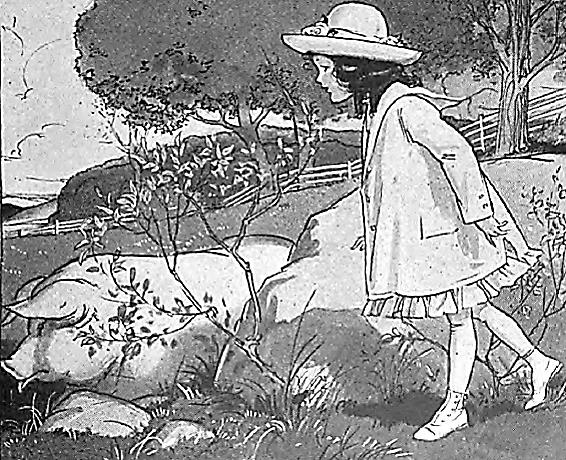
Over she climbed. There was a puddle near the fence. But she took care not to step into it. She ran to the rock. She peeped on the other side.
It was an ear that Peter had been watching. The ear belonged to the largest pig that Polly ever saw. He was so large that she just looked and looked.
By and by the pig saw her. He began to get up. Then Polly felt sure that he was as large as an elephant, at least.
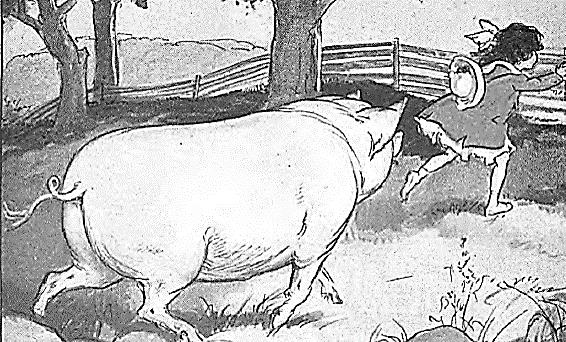
He was so large that she would rather see him from the other side of the fence. So she turned and began to run.
Peter saw the pig come from behind the rock. He saw the pig begin to trot after Polly. Perhaps the pig wished to be fed. Perhaps he wished to look at his visitor.
Polly did not stop to look around. She just ran toward the fence as fast as she could. Peter screamed to her, “Run, Polly! He will get you! Run! Run!”
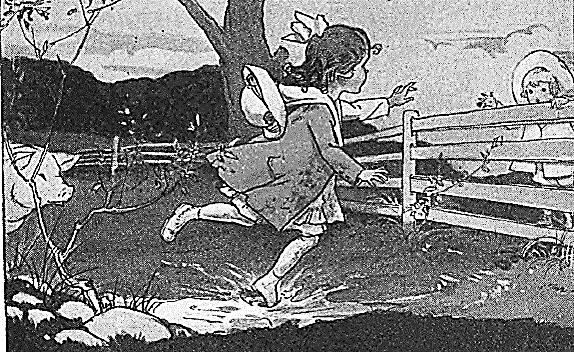
Polly heard Peter. She thought that the pig must be very near. She was close to the puddle. Should she go around it? If she did, the pig might catch her.
So, she jumped into it and scrambled up on the fence. The muddy water splashed over her. It spoiled her shoes and stockings. It spoiled her dress, too.
She looked back. The pig had stopped before it reached the puddle. It was poking the ground with its snout.
“Oh Peter!” cried Polly. “Look at me! Why did you shout, ‘Run, run’? I thought that the pig was close to me. I thought that I did not have time to go around the puddle. Look at my clothes!”
Just then Polly heard father say, “‘Handsome is that handsome does,’ Polly. Are you handsome now?”
“Why didn’t you stay in the carriage? The wedding is over. I went out to get you, but you were gone, and I could not stop to look for you.
“Come now, both of you. You may have ice cream and other things to eat.”
“Oh, oh, oh!” cried Polly. “I have missed the wedding. Oh, dear! Oh, dear! And I cannot even go in. I am too dirty.”
“Well, climb into the carriage then,” said father. “I will bring you out something to eat. Peter may come in.”
“No,” said Peter. “I must stay with Polly. She went over the fence for me. And I made her jump into the puddle. So I must stay out with her.”
“Very well,” said father. “That is only fair. Now I will go and tell why you cannot come in.” And he walked toward the house.
“Tell them that it is the very biggest pig in the world,” shouted Peter.
When Polly heard the people laugh she said, “There! Father has told them. I shall remember this wedding for a long time. And I shall remember, ‘Handsome is that handsome does,’ too.”
The morning of the first day of every year we enter into a contest. We see who will be the first to give that day’s greeting. Before I was awake this morning my boy ran into my room shouting, “Happy New Year! Happy New Year!” He won in the contest.
Now, however, you are in Church and it is not proper for you to speak out loud, so I am able to get ahead of you. A Happy New Year to you, every one.
Well, what will make this year a happy year for you? I will tell you. Let us take this word Happy, and instead of writing it across the page let us write it straight up and down.
H stands for Helpful. You cannot have a happy year unless you are helpful. He who does not try to be helpful is never very happy.
A for Active. I want your year to be full of activity. I hope you will be able to skate and slide down hill many days this winter, and that you will enter into all the spring and summer sports with zest and joy.
P for Playful. All work and no play makes Jack a dull boy. You will want to do something other than play, of course. You will have some home responsibilities, but sandwiched in with the work may there be a good measure of play.
P for Purposeful. Yes, early hi life you should form a purpose. Two questions will help you gain that purpose. 1st—What is it that I want to do? 2nd—What is it that God wants me to do?
Y for Youth.
Helpful Active Playful Purposeful Youth.
MEMORY VERSE, Psalm 19:14
“Let the words of my mouth, and the meditation of my heart, be acceptable in thy sight, O Lord, my strength and my redeemer.”
MEMORY HYMN
“Break, newborn year, on glad eyes break.”
1 Break, new-born year, on glad eyes break, Melodious voices move; On, rolling time; thou canst not make The Father cease to love.
2 The parted year had wingèd feet; The Saviour still doth stay: The new year comes; but, Spirit sweet, Thou goest not away.
3 Our hearts in tears may oft run o’er; But, Lord, Thy smile still beams: Our sins are swelling evermore, But pardoning grace still streams.
4 Lord, from this year more service win, More glory, more delight: O make it hours less sad with sin, Its days with Thee more bright.
5 Then we may bless its precious things If earthly cheer should come, Or gladsome mount on angel wings, If Thou wouldst take us home.
6 O golden them the hours must be; The year must needs be sweet; Yes, Lord, with happy melody Thine opening grace we greet.
Amen.
The Hymnal: Published by the authority of the General Assembly of the Presbyterian Church in the U.S.A., 1895
“My story,” she began, “will not be long. I might make it in two words, you have lost me, and you have found me. I have every reason to thank Heaven for a circumstance, which has proved to me how dear I am to you, and has given me the happiness of gaining a friend and two dear daughters. Can one complain of an event which has produced such consequences, even though it was attended with some violence? But I ought to do the natives justice, this violence was as gentle as it could be. I need only tell you Parabery was there, to convince you I was well treated, and it was solely the sorrow of being parted from you that affected my health. I shall be well now, and as soon as Jack can walk, I shall be ready to embark for our happy island. I will now tell you how I was brought away.
“Six natives with terrible countenances, landed and surrounded us.”
“When you and our three sons left, to make the tour of the island, I was very comfortable; you had told me you might return late, or probably not till next day, and when the evening passed away without seeing you, I was not uneasy. Francis was constantly with me; we went together to water the garden, and rested in the Grotto Ernestine; then I returned to the house, took my wheel, and placed myself in my favourite colonnade, where I should be the first to see your return. Francis, seeing me at work, asked if he might go as far as the bridge to meet you; to which I readily consented. He set out, and I was sitting, thinking of the pleasure I should have in seeing you again, and hearing you relate your voyage, when I saw Francis running, crying out, ’Mamma! mamma! there is a canoe on the sea; I know it is ours; it is full of men, perhaps natives.’
“‘Silly little fellow!’ said I, ’it is your father and brothers; if they are in the canoe, there can be no doubt of it. Your father told me he would bring it, and they would return by water; I had forgotten this when I let you go. Now you can go and meet them on the shore; give me your arm, and I will go too,’ and we set off very joyfully to meet our captors. I soon, alas! saw my error; it was, indeed, our canoe, but, instead of my dear ones, there were in it six half-naked natives, with terrible countenances, who landed and surrounded us. My blood froze with fright, and if I had wished to flee, I was unable. I fell on the shore, nearly insensible; still, I heard the cries of my dear Francis, who clung to me, and held me with all his strength; at last my senses quite failed me, and I only recovered to find myself lying at the bottom of the canoe. My son, weeping over me, was trying to recover me, assisted by one of the natives, of less repulsive appearance than his companions, and who seemed the chief; this was Parabery. He made me swallow a few drops of a detestable fermented liquor, which, however, restored me. I felt, as I recovered, the extent of my disaster, and your grief, my dears, when you should find me missing. I should have been wholly disconsolate, but that Francis was left to me, and he was continually praying me to live for his sake. I received some comfort from a vague notion that as this was our canoe, the natives had already carried you off, and were taking us to you.
“I was confirmed in this hope, when I saw that the natives, instead of making to sea, continued to coast the island, till they came to the Great Bay. I had then no doubt but that we should meet with you; but this hope was soon destroyed. Two or three more of the natives were waiting there on the shore; they spoke to their friends in the canoe; and I understood from their gestures, that they were saying they could not find anybody there. I have since learnt from Canda, that part of them landed at the Great Bay, with instructions to search that side of the island for inhabitants, whilst the rest proceeded with the canoe to examine the other side, and had succeeded but too well. The night came on, and they were anxious to return, which, doubtless, prevented them pillaging our house. I believe, moreover, that none of them could have reached Tent House, defended by our strong palisade, and hidden by the rocks amidst which it is built; and the other party, finding us on the shore, would not penetrate further.
“When all had entered the canoe, they pushed off, by the light of the stars, into the open sea. I think I must have sunk under my sorrow, but for Francis, and, I must confess it, my dear dog Flora, who had never left me. Francis told me, that she had tried to defend me, and flew at the natives; but one of them took my apron, tore it, and tied it over her mouth like a muzzle, bound her legs, and then threw her into the canoe, where the poor creature lay at my feet, moaning piteously. She arrived with us in this island, but I have not seen her since; I have often inquired of Parabery, but he could not tell me what had become of her.”
“But I know,” said Fritz, “and have seen her. We brought Turk with us, and the natives had carried Flora to that desert part of the island, from whence Jack was carried off; so the two dogs met. When I had the misfortune to wound Jack, I quite forgot them; they were rambling off, in chase of kangaroos; we left them, and no doubt they are there still. But we must not abandon the poor beasts; if my father will permit me, I will go and seek them in Parabery’s canoe.”
As we were obliged to wait a few days for Jack’s recovery, I consented, on condition that Parabery accompanied them, and the next day was fixed for the expedition. Ernest begged to be of the party, that he might see the beautiful trees and flowers they had described. I then requested the narration might be continued, which had been interrupted by this episode of the two dogs. Francis resumed it where his mother had left off.
“We had a favourable passage the sea was calm, and the boat went so smoothly, that both mamma and I went to sleep. You must have come a much longer round than necessary, papa, as your voyage lasted three days, and we arrived here the day after our departure. Mamma was then awake, and wept constantly, believing she should never more see you or my brothers. Parabery seemed very sorry for her, and tried to console her; at last, he addressed to her two or three words of German, pointing to heaven. His words were very plain Almighty God, good; and then black friend, and white lady; adding the words Canda, bear, and Minou-minou. We did not understand what he meant; but he seemed so pleased at speaking these words, that we could not but be pleased too; and to hear him name God in German gave us confidence, though we could, not comprehend where or how he had learnt the words. ‘Perhaps,’ said mamma, ‘he has seen your papa and brothers,’ I thought so too; still, it appeared strange that, in so short a time, he could acquire and remember these words. However it might be, mamma was delighted to have him near her, and taught him to pronounce the words father, mother, and son, which did not seem strange to him, and he soon knew them. She pointed to me and to herself, as she pronounced the words, and he readily comprehended them, and said to us, with bursts of laughter, showing his large ivory teeth, Canda, mother; Minou-minou, son; Parabery, father; white lady, mother. Mamma thought he referred to her, but it was to Madame Emily. He tried to pronounce this name and two others, but could not succeed; at last, he said, girls, girls, and almost convinced us he must know some Europeans, which was a great comfort to us.
“When I saw mamma more composed, I took out my flageolet to amuse her, and played the air to Ernest’s verses. This made her weep again very much, and she begged me to desist; the natives, however, wished me to continue, and I did not know whom to obey. I changed the air, playing the merriest I knew. They were in ecstasies; they took me in their arms one after the other, saying, Bara-ourou, Bara-ourou. I repeated the word after them, and they were still more delighted. But mamma was so uneasy to see me in their arms, that I broke from them, and returned to her.
“At last we landed. They carried mamma, who was too weak to walk. About a hundred yards from the shore, we saw a large building of wood and reeds, before which there was a crowd of natives. One who was very tall came to receive us. He was dressed in a short tunic, much ornamented, and wore a necklace of pierced shells. He was a little disfigured by a white bone passed through his nostrils. But you saw him, papa, when he wanted to adopt me; it was Bara-ourou, the king of the island. I was presented to him, and he was pleased with me, touched the end of my nose with his, and admired my hair very much. My conductors ordered me to play on the flageolet. I played some lively German airs, which made them dance and leap, till the king fell down with fatigue, and made a sign for me to desist. He then spoke for some time to the natives, who stood in a circle round him. He looked at mamma, who was seated in a corner, near her protector Parabery. He called the latter, who obliged mamma to rise, and presented her to the king. Bara-ourou looked only at the red and yellow India handkerchief which she wore on her head; he took it off, very unceremoniously, and put it on his own head, saying, miti, which means beautiful. He then made us re-embark in the canoe with him, amusing himself with me and my flageolet, which he attempted to play by blowing it through his nose, but did not succeed. After turning round a point which seemed to divide the island into two, we landed on a sandy beach. Parabery and another native proceeded into the interior, carrying my mother, and we followed. We arrived at a hut similar to the king’s, but not so large. There we were received by Mr. Willis, whom we judged to be the black friend, and from that time we had no more fears. He took us under his protection, first speaking to the king and to Parabery in their own language. He then addressed mamma in German, mixed with a few English words, which we understood very well. He knew nothing of you and my brothers; but, from what mamma told him, he promised to have you sought for, and brought as soon as possible to the island. In the mean time, he offered to lead us to a friend who would take care of us, and nurse poor mamma, who looked very ill. She was obliged to be carried to the grotto; but, after that, her cares were over, and her pleasure without alloy; for theblack friend had promised to seek you. The white lady received us like old friends, and Sophia and Matilda took me at first for their own brother, and still love me as if I was. We only wished for you all. Madame Mimi made mamma lie down on the bear-skin, and prepared her a pleasant beverage from the milk of the cocoa-nut. Sophia and Matilda took me to gather strawberries, and figs, and beautiful flowers; and we caught fish in the brook, between two osier hurdles. We amused ourselves very well with Minou–minou, while Canda and Madame Emily amused mamma.
“The king came the next day to see his little favourite; he wished me to go with him to another part of the island, where he often went to hunt; but I would not leave mamma and my new friends. I was wrong, papa; for you were there, and my brothers; it was there Jack was wounded and brought away. I might have prevented all that, and you would then have returned to us. How sorry I have been for my obstinacy! It was I, more than Fritz, who was the cause of his being wounded.
“Bara-ourou returned in the evening to the grotto; and think, papa, of our surprise, our delight, and our distress, when he brought us poor Jack, wounded and in great pain, but still all joy at finding us again! The king told Mr. Willis he was sure Jack was my brother, and he made us a present of him, adding, that he gave him in exchange for mamma’s handkerchief. Mamma thanked him earnestly, and placed Jack beside her. From him she learned all you had done to discover us. He informed Mr. Willis where he had left you, and he promised to seek and bring you to us. He then examined the wound, which Jack wished him to think he had himself caused with Fritz’s gun; but this was not probable, as the ball had entered behind, and lodged in the shoulder. Mr. Willis extracted it with some difficulty, and poor Jack suffered a good deal; but all is now going on well. What a large party we shall be, papa, when we are all settled in our island; Sophia and Matilda, Minou–Minou, Canda, Parabery, you, papa, and two mammas, and Mr. Willis!”
My wife smiled as the little orator concluded. Mr. Willis then dressed Jack’s wound, and thought he might be removed in five or six days.
“Now, my dear Jack,” said I, “it is your turn to relate your history. Your brother left off where you were entertaining the natives with your buffooneries; and certainly they were never better introduced. But how did they suddenly think of carrying you away?”
“Parabery told me,” said Jack, “that they were struck with my resemblance to Francis as soon as I took my flageolet. After I had played a minute or two, the native who wore mamma’s handkerchief, whom I now know to be the king, interrupted me by crying out and clapping his hands. He spoke earnestly to the others, pointing to my face, and to my flageolet, which he had taken; he looked also at my jacket of blue cotton, which one of them had tied round his shoulders like a mantle; and doubtless he then gave orders for me to be carried to the canoe. They seized upon me; I screamed like a madman, kicked them and scratched them; but what could I do against seven or eight great natives? They tied my legs together, and my hands behind me, and carried me like a parcel. I could then do nothing but cry out for Fritz; and the knight of the gun came rather too soon. In attempting to defend me, some way or other, off went his gun, and the ball took up its abode in my shoulder. I can assure you an unpleasant visitor is that same ball; but here he is, the scoundrel! Father Willis pulled him out by the same door as that by which he went in; and since his departure, all goes on well.
“Now for my story. When poor Fritz saw that I was wounded, he fell down as if he had been shot at the same time. The natives, thinking he was dead, took away his gun, and carried me into the canoe. I was in despair more for the death of my brother than from my wound, which I almost forgot, and was wishing they would throw me into the sea, when I saw Fritz running at full speed to the shore; but we pushed off, and I could only call out some words of consolation. The natives were very kind to me, and one of them held me up seated on the out-rigger; they washed my wound with sea-water, sucked it, tore my pocket-handkerchief to make a bandage, and as soon as we landed, squeezed the juice of some herb into it. We sailed very quickly, and passed the place where we had landed in the morning. I knew it again, and could see Ernest standing on a sand-bank; he was watching us, and I held out my arms to him. I thought I also saw you, papa, and heard you call; but the natives yelled, and though I cried with all my strength, it was in vain. I little thought they were taking me to mamma. As soon as we had disembarked, they brought me to this grotto; and I thought I must have died of surprise and joy when I was met by mamma and Francis, and then by Sophia, Matilda, mamma Emily, and Mr. Willis, who is a second father to me. This is the end of my story. And a very pretty end it is, that brings us all together. What matters it to have had a little vexation for all this pleasure? I owe it all to you, Fritz; if you had let me sink to the bottom of the sea, instead of dragging me out by the hair, I should not have been here so happy as I am; I am obliged to the gun, too; thanks to it, I was the first to reach mamma, and see our new friends.”
In spite of the greatest effort, Peter could not stop himself, and kept rolling on. But his fright and terror were still more terrible than his bumps and blows. This stranger was the policeman, that was a certain fact! At last, being thrown against a bush, he clutched it wildly.
“Good, here’s another one!” a voice near Peter said. “I wonder who is going to be pushed down tomorrow, looking like a half-open potato-bag?” The village baker was making fun of him. For a little rest after his weary work, he had quietly watched the boy.
Peter regained his feet and slunk away. How did the baker know the chair had been pushed? He longed to go home to bed and hide, for there alone he felt safe. But he had to go up to the goats, and the uncle had clearly told him to come back as quickly as he could. Groaning, he limped away up to the Alp. How could he run now, with his fear and all his poor, sore limbs?
Mr. Sesemann had reached the hut soon after meeting Peter, and felt reassured. Climbing further, with renewed courage, he at last saw his goal before him, but not without long and weary exertion. He saw the Alm-hut above him, and the swaying fir-trees. Mr. Sesemann eagerly hurried to encounter his beloved child. They had seen him long ago from the hut, and a treat was prepared for him that he never suspected.
As he made the last steps, he saw two forms coming towards him. A tall girl, with light hair and rosy face, was leaning on Heidi, whose dark eyes sparkled with keen delight. Mr. Sesemann stopped short, staring at this vision. Suddenly big tears rushed from his eyes, for this shape before him recalled sweet memories. Clara’s mother had looked exactly like this fair maiden. Mr. Sesemann at this moment did not know if he was awake or dreaming.
“Papa, don’t you know me any more?” Clara called with beaming eyes. “Have I changed so much?”
Mr. Sesemann rushed up to her, folding her in his arms. “Yes, you have changed. How is it possible? Is it really true? Is it really you, Clara?” asked the over-joyed father, embracing her again and again, and then gazing at her, as she stood tall and firm by his side.
His mother joined them now, for she wanted to see the happiness of her son.
“What do you say to this, my son? Isn’t our surprise finer than yours?” she greeted him. “But come over to our benefactor now,—I mean the uncle.”
“Yes, indeed, I also must greet our little Heidi,” said the gentleman, shaking Heidi’s hand. “Well? Always fresh and happy on the mountain? I guess I don’t need to ask, for no Alpine rose can look more blooming. Ah, child, what joy this is to me!”
With beaming eyes the child looked at the kind gentleman who had always been so good to her. Her heart throbbed in sympathy with his joy. While the two men, who had at last approached each other, were conversing, grandmama walked over to the grove. There, under the fir-trees, another surprise awaited her. A beautiful bunch of wondrously blue gentians stood as if they had grown there.
“How exquisite, how wonderful! What a sight!” she exclaimed, clapping her hands. “Heidi, come here! Have you brought me those? Oh, they are beautiful!”
The children had joined her, Heidi assuring her that it was another person’s deed.
“Oh grandmama, up on the pasture it looks just like that,” Clara remarked. “Just guess who brought you the flowers?”
At that moment a rustle was heard, and they saw Peter, who was trying to sneak up behind the trees to avoid the hut. Immediately the old lady called to him, for she thought that Peter himself had picked the flowers for her. He must be creeping away out of sheer modesty, the kind lady thought. To give him his reward, she called:
“Come here, my boy! don’t be afraid.”
Petrified with fear, Peter stood still. What had gone before had robbed him of his courage. He thought now that all was over with him. With his hair standing up on end and his pale face distorted by anguish, he approached.
“Come straight to me, boy,” the old lady encouraged him. “Now tell me, boy, if you have done that.”
In his anxiety, Peter did not see the grandmama’s finger that pointed to the flowers. He only saw the uncle standing near the hut, looking at him penetratingly, and beside him the policeman, the greatest horror for him in the world. Trembling in every limb, Peter answered, “Yes!”
“Well, but what are you so frightened about?”
“Because—because it is broken and can never be mended again,” Peter said, his knees tottering under him.
The grandmama now walked over to the hut: “My dear uncle,” she asked kindly, “is this poor lad out of his mind?”
“Not at all,” was the reply; “only the boy was the wind which blew away the wheel-chair. He is expecting the punishment he well deserves.”
Grandmama was very much surprised, for she vowed that Peter looked far from wicked. Why should he have destroyed the chair? The uncle told her that he had noticed many signs of anger in the boy since Clara’s advent on the Alp. He assured her that he had suspected the boy from the beginning.
“My dear uncle,” the old lady said with animation, “we must not punish him further. We must be just. It was very hard on him when Clara robbed him of Heidi, who is and was his greatest treasure. When he had to sit alone day after day, it roused him to a passion which drove him to this wicked deed. It was rather foolish, but we all get so when we get angry.”
The lady walked over to the boy again, who was still quivering with fear.
Sitting down on the bench, she began:
“Come, Peter, I’ll tell you something. Stop trembling and listen. You pushed the chair down, to destroy it. You knew very well that it was wicked and deserved punishment. You tried very hard to conceal it, did you not? But if somebody thinks that nobody knows about a wicked deed, he is wrong; God always knows it. As soon as He finds that a man is trying to conceal an evil he has done, He wakens a little watchman in his heart, who keeps on pricking the person with a thorn till all his rest is gone. He keeps on calling to the evildoer: ‘Now you’ll be found out! Now your punishment is near!’—His joy has flown, for fear and terror take its place. Have you not just had such an experience, Peter?”
Peter nodded, all contrite. He certainly had experienced this.
“You have made a mistake,” the grandmama continued, “by thinking that you would hurt Clara by destroying her chair. It has so happened that what you have done has been the greatest good for her. She would probably never have tried to walk, if her chair had been there. If she should stay here, she might even go up to the pasture every single day. Do you see, Peter? God can turn a misdeed to the good of the injured person and bring trouble on the offender. Have you understood me, Peter? Remember the little watchman when you long to do a wicked deed again. Will you do that?”
“Yes, I shall,” Peter replied, still fearing the policeman, who had not left yet.
“So now that matter is all settled,” said the old lady in conclusion. “Now tell me if you have a wish, my boy, for I am going to give you something by which to remember your friends from Frankfurt. What is it? What would you like to have?”
Peter, lifting his head, stared at the grandmama with round, astonished eyes. He was confused by this sudden change of prospect.
Being again urged to utter a wish, he saw at last that he was saved from the power of the terrible man. He felt as if the most crushing load had fallen off him. He knew now that it was better to confess at once, when something had gone wrong, so he said: “I have also lost the paper.”
The day before her visit the grandmama had sent a letter to announce her coming. Peter brought it up with him next morning. The grandfather was already before the hut with the children and his merry goats. His face looked proud, as he contemplated the rosy faces of the girls and the shining hair of his two goats.
Peter, approaching, neared the uncle slowly. As soon as he had delivered the letter, he sprang back shyly, looking about him as if he was afraid. Then with a leap he started off.
“I should like to know why Peter behaves like the Big Turk when he is afraid of the rod,” said Heidi, watching his strange behavior.
“Maybe Peter fears a rod that he deserves,” said the old man.
All the way Peter was tormented with fear. He could not help thinking of the policeman who was coming from Frankfurt to fetch him to prison.
It was a busy morning for Heidi, who put the hut in order for the expected visitor. The time went by quickly, and soon everything was ready to welcome the good grandmama.
The grandfather also returned from a walk, on which he had gathered a glorious bunch of deep-blue gentians. The children, who were sitting on the bench, exclaimed for joy when they saw the glowing flowers.
Heidi, getting up from time to time to spy down the path, suddenly discovered grandmama, sitting on a white horse and accompanied by two men. One of them carried plenty of wraps, for without those the lady did not dare to pay such a visit.
The party came nearer and nearer, and soon reached the top.
“What do I see? Clara, what is this? Why are you not sitting in your chair? How is this possible?” cried the grandmama in alarm, dismounting hastily. Before she had quite reached the children she threw her arms up in great excitement:
“Clara, is that really you? You have red, round cheeks, my child! I hardly know you any more!” Grandmama was going to rush at her grandchild, when Heidi slipped from the bench, and Clara, taking her arm, they quietly took a little walk. The grandmama was rooted to the spot from fear. What was this? Upright and firm, Clara walked beside her friend. When they came back their rosy faces beamed. Rushing toward the children, the grandmother hugged them over and over again.
Looking over to the bench, she beheld the uncle, who sat there smiling. Taking Clara’s arm in hers, she walked over to him, continually venting her delight. When she reached the old man, she took both his hands in hers and said:
“My dear, dear uncle! What have we to thank you for! This is your work, your care and nursing—”
“But our Lord’s sunshine and mountain air,” interrupted the uncle, smiling.
Then Clara called, “Yes, and also Schwänli’s good, delicious milk. Grandmama, you ought to see how much goat-milk I can drink now; oh, it is so good!”
“Indeed I can see that from your cheeks,” said the grandmama, smiling. “No, I hardly recognize you any more. You have become broad and round! I never dreamt that you could get so stout and tall! Oh, Clara, is it really true? I cannot look at you enough. But now I must telegraph your father to come. I shan’t tell him anything about you, for it will be the greatest joy of all his life. My dear uncle, how are we going to manage it? Have you sent the men away?”
“I have, but I can easily send the goatherd.”
So they decided that Peter should take the message. The uncle immediately whistled so loud that it resounded from all sides. Soon Peter arrived, white with fear, for he thought his doom had come. But he only received a paper that was to be carried to the post-office of the village.
Relieved for the moment, Peter set out. Now all the happy friends sat down round the table, and grandmama was told how the miracle had happened. Often the talk was interrupted by exclamations of surprise from grandmama, who still believed it was all a dream. How could this be her pale, weak little Clara? The children were in a constant state of joy, to see how their surprise had worked.
Meanwhile Mr. Sesemann, having finished his business in Paris, was also preparing a surprise. Without writing his mother he traveled to Ragatz on a sunny summer morning. He had arrived on this very day, some hours after his mother’s departure, and now, taking a carriage, he drove to Mayenfeld.
The long ascent to the Alp from there seemed very weary and far to the traveller. When would he reach the goat-herd’s hut? There were many little roads branching off in several directions, and sometimes Mr. Sesemann doubted if he had taken the right path. But not a soul was near, and no sound could be heard except the rustling of the wind and the hum of little insects. A merry little bird was singing on a larch-tree, but nothing more.
Standing still and cooling his brow, he saw a boy running down the hill at topmost speed. Mr. Sesemann called to him, but with no success, for the boy kept at a shy distance.
“Now, my boy, can’t you tell me if I am on the right path to the hut where Heidi lives and the people from Frankfurt are staying?”
A dull sound of terror was the only reply. Peter shot off and rushed head over heels down the mountain-side, turning wild somersaults on his perilous way. His course resembled the course his enemy had taken some days ago.
“What a funny, bashful mountaineer!” Mr. Sesemann remarked to himself, thinking that the appearance of a stranger had upset this simple son of the Alps. After watching the downward course of the boy a little while, he soon proceeded on his way.
In spite of the greatest effort, Peter could not stop himself, and kept rolling on. But his fright and terror were still more terrible than his bumps and blows. This stranger was the policeman, that was a certain fact! At last, being thrown against a bush, he clutched it wildly.
“Good, here’s another one!” a voice near Peter said. “I wonder who is going to be pushed down tomorrow, looking like a half-open potato-bag?” The village baker was making fun of him. For a little rest after his weary work, he had quietly watched the boy.
The 10 Plagues that occurred in Egypt was designed to prove to the Egyptians that God is the Lord.
Exodus 7:5 And the Egyptians shall know that I am the Lord, when I stretch forth mine hand upon Egypt, and bring out the children of Israel from among them.
Each plague was designed to prove that the Egyptian gods have no power over the judgments of the Hebrew God.
Plague sent from God
Attack Against the Egyptian Idol
the rivers and water judged (Exod. 7:14-25)
Hapi: god of the Nile
frogs (Exod. 8:1-15)
Heket: god of fertility (Heket looked like a frog)
Polly was very much excited. She was going to a wedding. So was Peter. But he did not care so much about it. Father and mother were going, too.
Every morning at breakfast Polly talked about that wedding.
“Now there are only five days to wait. Now there are only four days to wait,” she would say.
And at last she said, “Oh, goody, goody! It is tomorrow!”
Mother said, “Yesterday I bought some new ribbon for your hair, Polly. See, here it is.”
“It is wide, isn’t it, mother? Thank you very much. And I am going to wear my white dress and my white shoes and stockings.”
“Yes,” said mother, “and your coat is all clean. You may wear that.”
“I think that I shall look very well,” said Polly.
“Perhaps you will,” father said. “But remember, ‘Handsome is that handsome does.’ It means that if you behave well, you will look well. And if you do not behave well, you will not look well.”
The day of the wedding came. Mother dressed Peter and Polly. Both had on their best clothes. How well they did look!
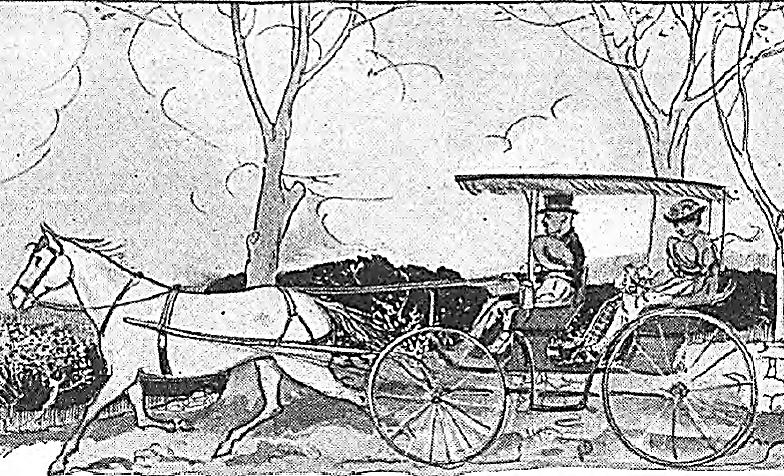
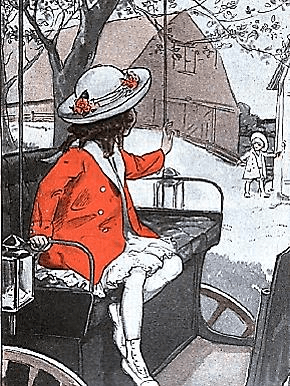
Father harnessed Mary to the two-seated carriage. Then off they went.
It was not many miles to the house. Soon they were there.
“I am glad that we are early,” said mother. “I promised to help see to the things in the dining room.”
“Oh, are there things to eat?” asked Peter. “I am hungry now.”
“Yes, there are things to eat,” said mother. “But they come after the wedding. So you must wait.”
“I will unharness the horse,” said father. “Then I will see if I can help. What shall Peter and Polly do? We must not let them get in the way.”
“Let me see,” said mother. “Why, Peter and Polly may sit right here in the carriage. By and by we will come out for them.”
“Goodbye, children,” said father. “‘Handsome is that handsome does,’ you know, Polly.”
Peter and Polly sat in the carriage. At first, they played that they were driving. But, after a short time, they wished to do something else.
Then they looked around. They saw the barn, the henhouses, and another small building.
“Maybe that is the icehouse,” said Polly.
“Do you think that they will have ice cream?” asked Peter. “Oh, I hope so! I hope so!”
“Perhaps they will, if that is really an ice house,” said Polly.
“Then I must see if it is, Polly. Mother will not care.” And down he jumped.
He ran to the little house. A padlock was on the door. He could not open it. But he saw sawdust about. So he felt sure that it was an icehouse.
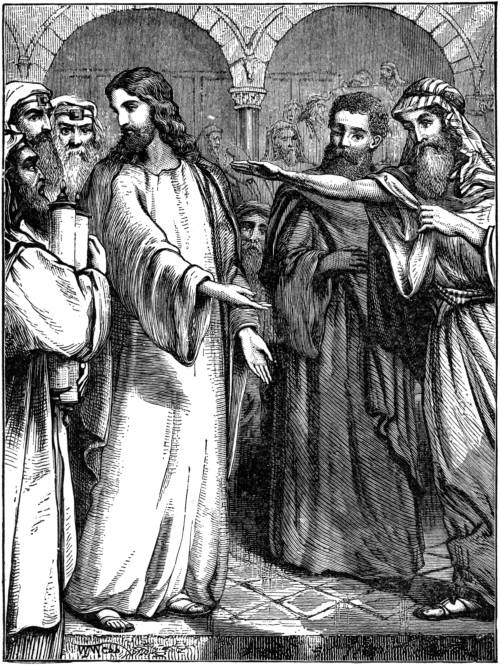
One Sabbath-day Jesus went into the synagogue, and there He saw a man that had a withered hand. By some means the muscles had lost their power, and he could neither use his hand nor stretch it out. And the Pharisees watched Jesus, to see if He would heal this man on the Sabbath, that they might bring a charge against Him of breaking the law. They asked Him, “Is it lawful to heal on the Sabbath-day?” and He replied by asking who among them, if he had a sheep which had fallen into a pit on the Sabbath-day, would not lay hold on it, and lift it out. “How much then is a man better than a sheep? Wherefore it is lawful to do good on the Sabbath-day.”
Then said He to the man, “Stretch forth thine hand.” And he stretched it forth, and it was made whole and healthy like the other.
Then the Pharisees went out and held a council against Him, to consider how they might destroy Him; but when Jesus knew it, He withdrew Himself from that part, and great multitudes followed Him, and He healed them all.
“We had been more than an hour under the tree, when I heard cries again; but this time I was not alarmed, for I distinguished the voice of the disconsolate mother, and I knew that I could comfort her. Her grief brought her back to the spot where she thought her child had been devoured; she wished, as she afterwards told us, when we could understand her, to search for some remains of him, his hair, his bones, or even a piece of the bark that bound him; and here he was, full of life and health. She advanced slowly, sobbing, and her eyes turned to the ground. She was so absorbed in her search, that she did not see us when we were but twenty yards from her. Suddenly, Sophia darted like an arrow to her, took her hand, and said, ‘Come,Minou is here.’
“Canda neither knew what she saw nor what she heard; she took my daughter for something supernatural, and made no resistance, but followed her to the fig-tree. Even then she did not recognize the little creature, released from his bonds, half-clothed, covered with flowers, and surrounded by three divinities, for she took us for such, and wished to prostrate herself before us. She was still more convinced of it when I took up her son, and placed him in her arms: she recognized him, and the poor little infant held out his arms to her. I can never express to you the transport of the mother; she screamed, clasped her child till he was half-suffocated, rapidly repeating words which we could not understand, wept, laughed, and was in a delirium of delight that terrified Minou. He began to cry, and held out his arms to Sophia, who, as well as Matilda, was weeping at the sight. Canda looked at them with astonishment; she soothed the child, and put him to her breast, which he rejected at first, but finally seized it, and his mother was happy. I took the opportunity to try and make her comprehend, that the great animal had brought him here; that we had found him, and taken care of him; and I made signs for her to follow me, which she did without hesitation, till we reached the grotto, when, without entering, she fled away with her infant with such rapidity, that it was impossible to overtake her, and was soon out of sight.
“I had some difficulty in consoling my daughters for the loss of Minou; they thought they should see him no more, and that his mother was very ungrateful to carry him off, without even letting them take leave of him. They were still weeping and complaining, when we saw the objects of our anxiety approaching; but Canda was now accompanied by a man, who was carrying the child. They entered the grotto, and prostrated themselves before us. You know Parabery; his countenance pleased and tranquillized us. As a relation of the king, he was distinguished by wearing a short tunic of leaves; his body was tattooed and stained with various colours; but not his face, which expressed kindness and gratitude, united with great intelligence. He comprehended most of my signs. I did not succeed so well in understanding him; but saw he meant kindly. In the mean time my daughters had a more intelligible conversation with Canda and Minou; they half-devoured the latter with caresses, fed him with figs and honey, and amused him so much, that he would scarcely leave them. Canda was not jealous of this preference, but seemed delighted with it; she, in her turn, caressed my daughters, admired their glossy hair and fair skin, and pointed them out to her husband; she repeated Minou after them, but always added anotherMinou, and appeared to think this name beautiful. After some words with Parabery, she placed Minou–Minou in Sophia’s arms, and they both departed, making signs that they would return; but we did not see them for some time after. Sophia and Matilda had their full enjoyment of their favourite; they wished to teach him to walk and to speak, and they assured me he was making great progress. They were beginning to hope his parents had left him entirely, when they came in sight, Parabery bending under the weight of two bear-skins, and a beautiful piece of matting to close the entrance to my grotto; Canda carried a basket on her head filled with fine fruit; the cocoa, the bread-fruit (which they call rima), pine-apples, figs, and, finally, a piece of bear’s flesh, roasted at the fire, which I did not like; but I enjoyed the fruits and the milk of the cocoa-nut, of which Minou–Minou had a good share. They spread the bear-skins in the midst of the grotto; Parabery, Canda, and the infant, between them, took possession of one without ceremony, and motioned to us to make our bed of the other. But the bears having only been killed the evening before, these skins had an intolerable smell. I made them comprehend this, and Parabery immediately carried them off and placed them in the brook, secured by stones. He brought us in exchange a heap of moss and leaves, on which we slept very well.
“From this moment we became one family. Canda remained with us, and repaid to my daughters all the care and affection they bestowed on Minou–Minou. There never was a child had more indulgence; but he deserved it, for his quickness and docility. At the end of a few months he began to lisp a few words of German, as well as his mother, of whom I was the teacher, and who made rapid progress. Parabery was very little with us, but he undertook to be our purveyor, and furnished us abundantly with everything necessary for our subsistence. Canda taught my daughter to make beautiful baskets, some, of a flat form, served for our plates and dishes. Parabery made us knives from sharp stones. My daughters, in return, taught Canda to sew. At the time of our shipwreck we had, each of us, in her pocket, a morocco housewife, with a store of needles and thread. By means of these we had mended our linen, and we now made dresses of palm-leaves. The bear-skins, washed in the stream, and thoroughly dried in the burning sun, have been very useful to us in the cold and rainy season. Now that we had guides, we made, in the fine season, excursions to different parts of the island.Minou–Minou soon learned to walk, and being strong, like all these islanders, would always accompany us. We went one day to the sea-shore. I shuddered at the sight, and Canda, who knew that my husband and child had perished in the sea, wept with me. We now spoke each other’s language well enough to converse. She told me that a black friend (Emily bowed to Mr. Willis) had arrived in a neighbouring island, to announce to them that there was a Being, almighty and all-merciful, who lived in Heaven, and heard all they said. Her comprehension of this truth was very confused, and I endeavoured to make it more clear and positive.
“‘I see very well,’ said she, ’that you know him. Is it to Him that you speak every morning and evening, kneeling as we do before our king Bara-ourou?’
“‘Yes, Canda,’ said I, ’it is before Him who is the King of Kings, who gave us our life, who preserves it, and bestows on us all good, and who promises us still more when this life is past.’
“’Was it he who charged you to take care of Minou–Minou, and to restore him to me?’ asked she.
“’Yes, Canda; all that you or I do that is good, is put into our hearts by Him.’
“I thus tried to prepare the simple mind of Canda for the great truths that Mr. Willis was to teach her.”
“You left me little to do,” said Mr. Willis. “I found Parabery and Canda prepared to believe, with sincere faith, the holy religion I came to teach the God of the white people was the only one they adored. I knew Parabery, he had come to hunt seals in the island where I was established, and I was struck by his appearance. What was my astonishment to find, that when I spoke to him of the one true God, he was no stranger to the subject. He had even some ideas of a Saviour, and of future rewards and punishments.
“‘It was the white lady,’ said he, ’who taught me this; she teaches Canda and Minou–minou, whose life she saved, and whom she is bringing up to be good like herself.’
“I had a great desire,” continued Mr. Willis, “to become acquainted with my powerful assistant in the great work of my mission. I told Parabery this, who offered to bring me here in his canoe; I came and found, in a miserable cave, or rather in a bear’s den, all the virtues of mature age united to the charms of youth; a resigned and pious mother, bringing up her children, as women should be brought up, in simplicity, forbearance, and love of industry; teaching them, as the best knowledge, to love God with all their heart, and their neighbour as themselves. Under the inspection of their mother, they were educating the son of Parabery. This child, then four years and a half old, spoke German well, and knew his alphabet, which Madame Hirtel traced on the floor of the grotto; in this way she taught her daughters to read; they taught Minou–minou, who, in his turn, teaches his parents. Parabery often brings his friends to the grotto, and Madame Hirtel, having acquired the language, casts into their hearts the good seed, which I venture to hope will not be unfruitful.
“Finding these people in such a good state, and wishing to enjoy the society of a family, like myself, banished to a remote region, I decided to take up my abode in this island.
“Parabery soon built me a hut in the neighbourhood of the grotto; Madame Hirtel compelled me to take one of her bear-skins. I have by degrees formed my establishment, dividing with my worthy neighbour the few useful articles I brought from Europe, and we live a tranquil and happy life.
“And now comes the time that brought about our meeting. Some of our islanders, in a fishing expedition, were driven by the wind on your island. At the entrance of a large bay, they found a small canoe of bark, carefully moored to a tree. Either their innate propensity for theft, or the notion that it had no owner, prevailed over them, and they brought it away. I was informed of this, and was curious to see it; I recognized at once that it was made by Europeans: the careful finish, the neat form, the oars, rudder, mast, and triangular sail, all showed that it had not been made by natives. The seats of the rowers were made of planks, and were painted, and what further convinced me was, that I found in it a capital gun, loaded, and a horn of powder in a hole under one of the seats. I then made particular inquiries about the island from whence they had brought the canoe; and all their answers confirmed my idea that it must be inhabited by a European, from whom they had perhaps taken his only means of leaving it.
“Restless about this fancy, I tried to persuade them to return and discover if the island was inhabited. I could not prevail on them to restore the canoe; but, seeing me much agitated, they resolved secretly to procure me a great pleasure as they thought, by returning to the island and bringing away any one they could meet with, whether he would or not. Parabery, always the leader in perilous enterprises, and who was so attached to me, would not be left out in one which was to produce me such pleasure. They set out, and you know the result of their expedition. I leave it to your wife to tell you how she was brought away, and pass on to the time of their arrival. My people brought them to me in triumph, and were vexed that they had only found one woman and a child, whom I might give to the white lady. This I did promptly. Your wife was ill and distressed, and I carried her immediately to the grotto. There she found a companion who welcomed her with joy; Francis replaced her own lost Alfred, and the two good mothers were soon intimate friends. But, notwithstanding this solace, your Elizabeth was inconsolable at the separation from her husband and children, and terrified at the danger to which you would expose yourself in searching for her. We were even afraid she would lose her reason, when the king came to take away Francis. He had seen him on his arrival, and was much taken with his appearance; he came again to see him, and resolved to adopt him as his son. You know what passed on this subject; and now you are once more united to all those who are dear to you.
“Bless God, brother, who knows how to produce good from what we think evil, and acknowledge the wisdom of his ways. You must return all together to your island; I am too much interested in the happiness of Emily to wish to detain her; and if God permits me, when my missions are completed, I will come to end my days with you, and to bless your rising colony.”
I suppress all our reflections on this interesting history, and our gratitude for the termination of our trials, and hasten to the recital, which, at my particular entreaty, my wife proceeded to give us.
The next day dawned cloudless and fair. The grandfather was still with the children, when Peter came climbing up; his goats kept at a good distance from him, to evade the rod, which was striking right and left. The truth was that the boy was terribly embittered and angry by the changes that had come. When he passed the hut in the morning, Heidi was always busy with the strange child, and in the evening it was the same. All summer long Heidi had not been up with him a single time; it was too much! And to-day she was coming at last, but again in company with this hateful stranger.
It was then that Peter noticed the rolling-chair standing near the hut. After carefully glancing about him, he rushed at the hated object and pushed it down the incline. The chair fairly flew away and had soon disappeared.
Peter’s conscience smote him now, and he raced up the Alp, not daring to pause till he had reached a blackberry bush. There he could hide, when the uncle might appear. Looking down, he watched his fallen enemy tumbling downwards, downwards.
Sometimes it was thrown high up into the air, to crash down again the next moment harder than ever. Pieces were falling from it right and left, and were blown about. Now the stranger would have to travel home and Heidi would be his again! But Peter had forgotten that a bad deed always brings a punishment.
Heidi just now came out of the hut. The grandfather, with Clara, followed. Heidi at first stood still, and then, running right and left, she returned to the old man.
“What does this mean? Have you rolled the chair away Heidi?” he asked.
“I am just looking for it everywhere, grandfather. You said it was beside the shop door,” said the child, still hunting for the missing object. A strong wind was blowing, which at this moment violently closed the shop-door.
“Grandfather, the wind has done it,” exclaimed Heidi eagerly. “Oh dear! if it has rolled all the way down to the village, it will be too late to go to-day. It will take us a long time to fetch it.”
“If it has rolled down there, we shall never get it any more, for it will be smashed to pieces,” said the old man, looking down and measuring the distance from the corner of the hut.
“I don’t see how it happened,” he remarked.
“What a shame! now I’ll never be able to go up to the pasture,” lamented Clara. “I am afraid I’ll have to go home now. What a pity, what a pity!”
“You can find a way for her to stay, grandfather, can’t you?”
“We’ll go up to the pasture to-day, as we have planned. Then we shall see what further happens.”
The children were delighted, and the grandfather lost no time in getting ready. First he fetched a pile of covers, and seating Clara on a sunny spot on the dry ground, he got their breakfast.
“I wonder why Peter is so late to-day,” he said, leading his goats out of the shed. Then, lifting Clara up on one strong arm, he carried the covers on the other.
“Now, march!” he cried. “The goats come with us.”
That suited Heidi, and with one arm round Schwänli and the other round Bärli, she wandered up. Her little companions were so pleased at having her with them again that they nearly crushed her with affection.
What was their astonishment when, arriving on top, they saw Peter already lying on the ground, with his peaceful flock about him.
“What did you mean by going by us like that? I’ll teach you!” called the uncle to him.
Peter was frightened, for he knew the voice.
“Nobody was up yet,” the boy retorted.
“Have you seen the chair?” asked the uncle again.
“Which?” Peter growled.
The uncle said no more. Unfolding the covers, he put Clara down on the dry grass. Then, when he had been assured of Clara’s comfort, he got ready to go home. The three were to stay there till his return in the evening. When dinner time had come, Heidi was to prepare the meal and see that Clara got Schwänli’s milk.
The sky was a deep blue, and the snow on the peaks was glistening. The eagle was floating above the rocky crags. The children felt wonderfully happy. Now and then one of the goats would come and lie down near them. Tender little Snowhopper came oftener than any and would rub her head against their shoulders.
They had been sitting quietly for a few hours, drinking in the beauty about them, when Heidi suddenly began to long for the spot where so many flowers grew. In the evening it would be too late to see them, for they always shut their little eyes by then.
“Oh, Clara,” she said hesitatingly, “would you be angry if I went away from you a minute and left you alone? I want to see the flowers; But wait!—” Jumping away, she brought Clara some bunches of fragrant herbs and put them in her lap. Soon after she returned with little Snowhopper.
“So, now you don’t need to be alone,” said Heidi. When Clara had assured her that it would give her pleasure to be left alone with the goats, Heidi started on her walk. Clara slowly handed one leaf after another to the little creature; it became more and more confiding, and cuddling close to the child, ate the herbs out of her hand. It was easy to see how happy it was to be away from the boisterous big goats, which often annoyed it. Clara felt a sensation of contentment such as she had never before experienced. She loved to sit there on the mountain-side with the confiding little goat by her. A great desire rose in her heart that hour. She longed to be her own master and be able to help others instead of being helped by them. Many other thoughts and ideas rushed through her mind. How would it be to live up here in continual sunshine? The world seemed so joyous and wonderful all of a sudden. Premonitions of future undreamt-of happiness made her heart beat. Suddenly she threw both arms about the little goat and said: “Oh, little Snowhopper how beautiful it is up here! If I could always stay with you!”
Heidi in the meantime had reached the spot, where, as she had expected, the whole ground was covered with yellow rock-roses. Near together in patches the bluebells were nodding gently in the breeze. But all the perfume that filled the air came from the modest little brown flowers that hid their heads between the golden flower-cups. Heidi stood enraptured, drawing in the perfumed air.
Suddenly she turned and ran back to Clara, shouting to her from far: “Oh, you must come, Clara, it is so lovely there. In the evening it won’t be so fine any more. Don’t you think I could carry you?”
“But Heidi,” Clara said, “of course you can’t; you are much smaller than I am. Oh, I wish I could walk!”
Heidi meditated a little. Peter was still lying on the ground. He had been staring down for hours, unable to believe what he saw before him. He had destroyed the chair to get rid of the stranger, and there she was again, sitting right beside his playmate.
Heidi now called to him to come down, but as reply he only grumbled: “Shan’t come.”
“But you must; come quickly, for I want you to help me. Quickly!” urged the child.




 articlesforchristians