The Roman Empire was an accident. No one planned it. It “happened.” No famous general or statesman or cutthroat ever got up and said “Friends, Romans, Citizens, we must found an Empire. Follow me and together we shall conquer all the land from the Gates of Hercules to Mount Taurus.”
Rome produced famous generals and equally distinguished statesmen and cutthroats, and Roman armies fought all over the world. But the Roman empire-making was done without a preconceived plan. The average Roman was a very matter-of-fact citizen. He disliked theories about government. When someone began to recite “eastward the course of Roman Empire, etc., etc.,” he hastily left the forum. He just continued to take more and more land because circumstances forced him to do so. He was not driven by ambition or by greed. Both by nature and inclination he was a farmer and wanted to stay at home. But when he was attacked he was obliged to defend himself and when the enemy happened to cross the sea to ask for aid in a distant country then the patient Roman marched many dreary miles to defeat this dangerous foe and when this had been accomplished, he stayed behind to administer his newly conquered provinces lest they fall into the hands of wandering Barbarians and become themselves a menace to Roman safety. It sounds rather complicated and yet to the contemporaries it was so very simple, as you shall see in a moment.
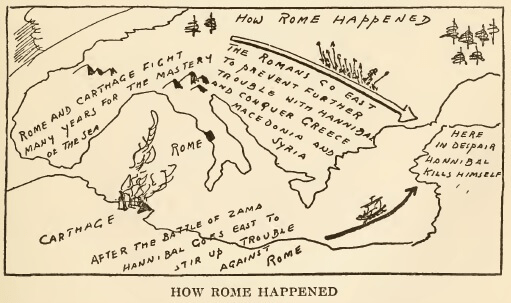
In the year 203 B.C. Scipio had crossed the African Sea and had carried the war into Africa. Carthage had called Hannibal back. Badly supported by his mercenaries, Hannibal had been defeated near Zama. The Romans had asked for his surrender and Hannibal had fled to get aid from the kings of Macedonia and Syria, as I told you in my last chapter.
The rulers of these two countries (remnants of the Empire of Alexander the Great) just then were contemplating an expedition against Egypt. They hoped to divide the rich Nile valley between themselves. The king of Egypt had heard of this and he had asked Rome to come to his support. The stage was set for a number of highly interesting plots and counter-plots. But the Romans, with their lack of imagination, rang the curtain down before the play had been fairly started. Their legions completely defeated the heavy Greek phalanx which was still used by the Macedonians as their battle formation. That happened in the year 197 B.C. at the battle in the plains of Cynoscephalae, or “Dogs’ Heads,” in central Thessaly.
The Romans then marched southward to Attica and informed the Greeks that they had come to “deliver the Hellenes from the Macedonian yoke.” The Greeks, having learned nothing in their years of semi-slavery, used their new freedom in a most unfortunate way. All the little city-states once more began to quarrel with each other as they had done in the good old days. The Romans, who had little understanding and less love for these silly bickerings of a race which they rather despised, showed great forbearance. But tiring of these endless dissensions they lost patience, invaded Greece, burned down Corinth (to “encourage the other Greeks”) and sent a Roman governor to Athens to rule this turbulent province. In this way, Macedonia and Greece became buffer states which protected Rome’s eastern frontier.
Meanwhile right across the Hellespont lay the Kingdom of Syria, and Antiochus III, who ruled that vast land, had shown great eagerness when his distinguished guest, General Hannibal, explained to him how easy it would be to invade Italy and sack the city of Rome.
Lucius Scipio, a brother of Scipio the African fighter who had defeated Hannibal and his Carthaginians at Zama, was sent to Asia Minor. He destroyed the armies of the Syrian king near Magnesia (in the year 190 B.C.) Shortly afterwards, Antiochus was lynched by his own people. Asia Minor became a Roman protectorate and the small City-Republic of Rome was mistress of most of the lands which bordered upon the Mediterranean.
Sicknesses are infectious when they spread from person to person.
Colds and flus are illnesses caused by viruses, which are so tiny that they can only be seen with special tools called microscopes.
Food poisoning and strep throat are illnesses caused by bacteria. While bacteria are bigger than viruses, they’re still tiny and can’t be seen without a microscope. Doctors might prescribe antibiotics to fight bacterial infections, but these medicines don’t work on viruses.
We can help to prevent sickness by washing our hands, especially after using the restroom.
Many bacteria are helpful to people. For example, we use bacteria to turn milk into yogurt and cheese.
There are millions of benign (not harmful) and helpful bacteria living on your skin right now. Even more bacteria live inside you. But don’t worry. These bacteria are harmless and many are even helpful.
Look at the pictures below. One picture shows an example of bacteria. The other picture shows an example of viruses.
The picture shows many bacteria. It was taken using a special tool, an electron microscope.
Diagram of the families of viruses that include human, animal and zoonotic pathogens.
Would you like to see pictures of other viruses? Click here.
Children separate a larger group of up to 18 objects into two smaller groups.
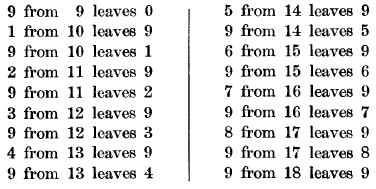
Repeatedly separate a group of objects into smaller groups per the table below. For example, 9 pencils from 9 pencils leaves 0 pencils, 8 coins from 17 coins leaves 9 coins, and 9 cars from 17 cars leaves 8 cars, etc.
When children are ready, have them separate the object groups themselves.
Children must perfectly master the operations listed in the table before proceeding to the next phase of the lesson.
STEP 2
Children separate groups of objects they can’t see, but can imagine (bears, mountains, trees).
Using the table above as a guide, ask children to call out the answer to questions such as, ‘How many are one shoe from ten shoes?’ and ‘How many are nine frogs from eleven frogs?’
Give numerous exercises on each number, with constant reviews, until children can recite each operation in the table with great accuracy and rapidity.
STEP 3
In this phase, do not mention objects. Children subtract numbers directly.
Using the table above as a guide, ask children to call out the answer to questions such as, ‘How many are one from ten?’ and ‘How many are four from thirteen?’
Give numerous exercises on each number, with constant reviews, until children can perform each operation with great accuracy and rapidity.
STEP 4
Direct children to practice writing and reciting the subtraction problems listed in the table above. For example, they would write and then recite:
9 from 18 leaves 9
18 minus 9 is 9
18 – 9 = 9
Repeat for each combination in the table until the children master the tasks.
STEP 5
Have children copy, solve, and recite the following table:
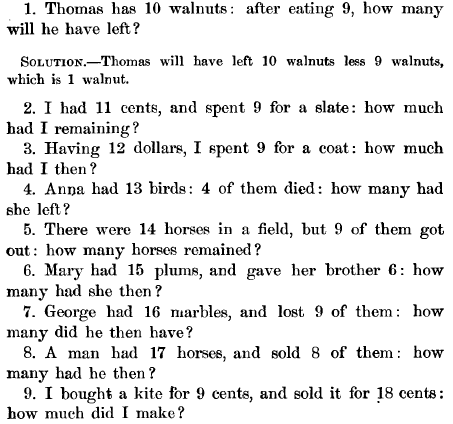
Assess mastery by reading aloud the word problems below and having the children mentally compute and recite the solutions. If children have difficulties, repeat the prior phases and then reassess.
There was a certain King who gave a great feast upon the occasion of his son’s wedding. And he sent out his servants to bring in those that had been invited, but they would not come. Then he sent forth other servants, saying, “Tell them which were bidden, ‘Behold, I have prepared my dinner; my oxen and my fatlings are killed, and all things are ready. Come unto the feast.'” But they made light of the message and went their ways, one to his farm, another to his warehouse; others took the servants and slew them.
When the King heard what had been done, he was very angry, and sent out his army to destroy the murderers, and burn up their city. Then said he to the servants, “The wedding is ready, but they which were bidden were not worthy. Go ye therefore into the highways, and all ye shall find, bid them come to the marriage.” So they gathered together as many as they could find. And upon each one, as he entered the house, was put a beautiful marriage garment, which the King had prepared. But when the people were all seated, and the King had entered the house, he saw there a man that had not on a wedding garment, and he said unto him, “Friend, how camest thou in hither without a wedding garment?” And the man was speechless, for the garment had been offered to him at first, but he had refused it. Then said the King to the servants, “Bind him hand and foot, and take him away and cast him into outer darkness.”
In this parable, the King means God, who gave the feast for His Son, Jesus Christ. Those who were first asked were the Jews, who refused to believe in Christ. Those who were afterwards brought in, signify the people who have since listened to His Word, and believed in Him. The one without the wedding garment is anyone that pretends to accept the invitation to be one of God’s people, but in his heart does not believe in Christ.
When the frost is on the punkin and the fodder’s in the shock, And you hear the kyouck and gobble of the struttin’ turkey-cock, And the clackin’ of the guineys, and the cluckin’ of the hens, And the rooster’s hallylooyer as he tiptoes on the fence; O, it’s then’s the times a feller is a-feelin’ at his best, With the risin’ sun to greet him from a night of peaceful rest, As he leaves the house, bareheaded, and goes out to feed the stock, When the frost is on the punkin and the fodder’s in the shock.
They’s something kindo’ harty-like about the atmusfere When the heat of summer’s over and the coolin’ fall is here- Of course we miss the flowers, and the blossums on the trees, And the mumble of the hummin’-birds and buzzin’ of the bees; But the air’s so appetizin’; and the landscape through the haze Of a crisp and sunny morning of the airly autumn days Is a pictur’ that no painter has the colorin’ to mock- When the frost is on the punkin and the fodder’s in the shock.
The husky, russel of the tossels of the corn, And the raspin’ of the tangled leaves, as golden as the morn; The stubble in the furries-kindo’ lonesome-like, but still A-preachin’ sermuns to us of the barns they growed to fill; The strawstack in the medder, and the reaper in the shed; The hosses in theyr stalls below-the clover over-head!- O, it sets my hart a-clickin’ like the tickin’ of a clock, When the frost is on the punkin and the fodder’s in the shock!
Then your apples all is gethered, and the ones a feller keeps Is poured around the celler-floor in red and yeller heaps; And your cider-makin’ ‘s over, and your wimmern-folks is through With their mince and apple-butter, and theyr souse and saussage, too! … I don’t know how to tell it-but ef sich a thing could be As the Angels wantin’ boardin’, and they’d call around on me- I’d want to ‘commodate ’em-all the whole-indurin’ flock- When the frost is on the punkin and the fodder’s in the shock!
This short account of the early history of Rome shows you the enormous difference between the Roman ideal of a healthy state, and that of the ancient world which was embodied in the town of Carthage. The Romans counted upon the cheerful and hearty co-operation between a number of “equal citizens.” The Carthaginians, following the example of Egypt and western Asia, insisted upon the unreasoning (and therefore unwilling) obedience of “Subjects” and when these failed they hired professional soldiers to do their fighting for them.
You will now understand why Carthage was bound to fear such a clever and powerful enemy and why the plutocracy of Carthage was only too willing to pick a quarrel that they might destroy the dangerous rival before it was too late.
But the Carthaginians, being good business men, knew that it never pays to rush matters. They proposed to the Romans that their respective cities draw two circles on the map and that each town claim one of these circles as her own “sphere of influence” and promise to keep out of the other fellow’s circle. The agreement was promptly made and was broken just as promptly when both sides thought it wise to send their armies to Sicily where a rich soil and a bad government invited foreign interference.
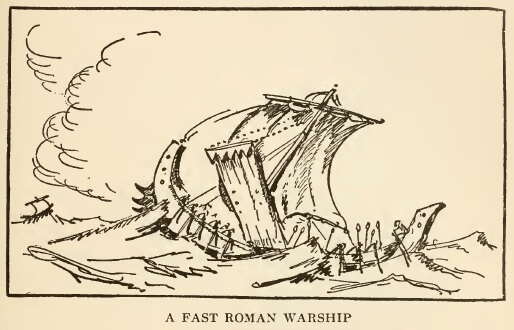
The war which followed (the so-called first Punic War) lasted twenty-four years. It was fought out on the high seas and in the beginning it seemed that the experienced Carthaginian navy would defeat the newly created Roman fleet. Following their ancient tactics, the Carthaginian ships would either ram the enemy vessels or by a bold attack from the side they would break their oars and would then kill the sailors of the helpless vessel with their arrows and with fire balls. But Roman engineers invented a new craft which carried a boarding bridge across which the Roman infantrymen stormed the hostile ship. Then there was a sudden end to Carthaginian victories. At the battle of Mylae their fleet was badly defeated. Carthage was obliged to sue for peace, and Sicily became part of the Roman domains.
Twenty-three years later new trouble arose. Rome (in quest of copper) had taken the island of Sardinia. Carthage (in quest of silver) thereupon occupied all of southern Spain. This made Carthage a direct neighbor of the Romans. The latter did not like this at all and they ordered their troops to cross the Pyrenees and watch the Carthaginian army of occupation.
The stage was set for the second outbreak between the two rivals. Once more a Greek colony was the pretext for a war. The Carthaginians were besieging Saguntum on the east coast of Spain. The Saguntians appealed to Rome and Rome, as usual, was willing to help. The Senate promised the help of the Latin armies, but the preparation for this expedition took some time, and meanwhile Saguntum had been taken and had been destroyed. This had been done in direct opposition to the will of Rome. The Senate decided upon war. One Roman army was to cross the African sea and make a landing on Carthaginian soil. A second division was to keep the Carthaginian armies occupied in Spain to prevent them from rushing to the aid of the home town. It was an excellent plan and everybody expected a great victory. But the gods had decided otherwise.
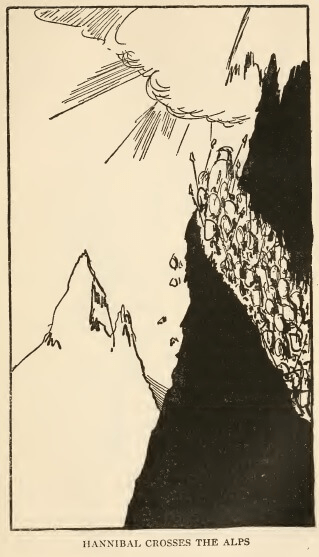
It was the fall of the year 218 before the birth of Christ and the Roman army which was to attack the Carthaginians in Spain had left Italy. People were eagerly waiting for news of an easy and complete victory when a terrible rumor began to spread through the plain of the Po. Wild mountaineers, their lips trembling with fear, told of hundreds of thousands of brown men accompanied by strange beasts “each one as big as a house,” who had suddenly emerged from the clouds of snow which surrounded the old Graian pass through which Hercules, thousands of years before, had driven the oxen of Geryon on his way from Spain to Greece. Soon an endless stream of bedraggled refugees appeared before the gates of Rome, with more complete details. Hannibal, the son of Hamilcar, with fifty thousand soldiers, nine thousand horsemen and thirty-seven fighting elephants, had crossed the Pyrenees. He had defeated the Roman army of Scipio on the banks of the Rhone and he had guided his army safely across the mountain passes of the Alps although it was October and the roads were thickly covered with snow and ice. Then he had joined forces with the Gauls and together they had defeated a second Roman army just before they crossed the Trebia and laid siege to Placentia, the northern terminus of the road which connected Rome with the province of the Alpine districts.
The Senate, surprised but calm and energetic as usual, hushed up the news of these many defeats and sent two fresh armies to stop the invader. Hannibal managed to surprise these troops on a narrow road along the shores of the Trasimene Lake and there he killed all the Roman officers and most of their men. This time there was a panic among the people of Rome, but the Senate kept its nerve. A third army was organized and the command was given to Quintus Fabius Maximus with full power to act “as was necessary to save the state.”
Fabius knew that he must be very careful lest all be lost. His raw and untrained men, the last available soldiers, were no match for Hannibal’s veterans. He refused to accept battle but forever he followed Hannibal, destroyed everything eatable, destroyed the roads, attacked small detachments and generally weakened the morale of the Carthaginian troops by a most distressing and annoying form of guerilla warfare.
Such methods however did not satisfy the fearsome crowds who had found safety behind the walls of Rome. They wanted “action.” Something must be done and must be done quickly. A popular hero by the name of Varro, the sort of man who went about the city telling everybody how much better he could do things than slow old Fabius, the “Delayer,” was made commander-in-chief by popular acclamation. At the battle of Cannae (216) he suffered the most terrible defeat of Roman history. More than seventy thousand men were killed. Hannibal was master of all Italy.
He marched from one end of the peninsula to the other, proclaiming himself the “deliverer from the yoke of Rome” and asking the different provinces to join him in warfare upon the mother city. Then once more the wisdom of Rome bore noble fruit. With the exceptions of Capua and Syracuse, all Roman cities remained loyal. Hannibal, the deliverer, found himself opposed by the people whose friend he pretended to be. He was far away from home and did not like the situation. He sent messengers to Carthage to ask for fresh supplies and new men. Alas, Carthage could not send him either.
The Romans with their boarding-bridges, were the masters of the sea. Hannibal must help himself as best he could. He continued to defeat the Roman armies that were sent out against him, but his own numbers were decreasing rapidly and the Italian peasants held aloof from this self-appointed “deliverer.”
After many years of uninterrupted victories, Hannibal found himself besieged in the country which he had just conquered. For a moment, the luck seemed to turn. Hasdrubal, his brother, had defeated the Roman armies in Spain. He had crossed the Alps to come to Hannibal’s assistance. He sent messengers to the south to tell of his arrival and ask the other army to meet him in the plain of the Tiber. Unfortunately, the messengers fell into the hands of the Romans and Hannibal waited in vain for further news until his brother’s head, neatly packed in a basket, came rolling into his camp and told him of the fate of the last of the Carthaginian troops.
With Hasdrubal out of the way, young Publius Scipio easily reconquered Spain and four years later the Romans were ready for a final attack upon Carthage. Hannibal was called back. He crossed the African Sea and tried to organize the defenses of his home-city. In the year 202 at the battle of Zama, the Carthaginians were defeated. Hannibal fled to Tyre. From there he went to Asia Minor to stir up the Syrians and the Macedonians against Rome. He accomplished very little but his activities among these Asiatic powers gave the Romans an excuse to carry their warfare into the territory of the east and annex the greater part of the Aegean world.
Driven from one city to another, a fugitive without a home, Hannibal at last knew that the end of his ambitious dream had come. His beloved city of Carthage had been ruined by the war. She had been forced to sign a terrible peace. Her navy had been sunk. She had been forbidden to make war without Roman permission. She had been condemned to pay the Romans millions of dollars for endless years to come. Life offered no hope of a better future. In the year 190 B.C. Hannibal took poison and killed himself.
Forty years later, the Romans forced their last war upon Carthage. Three long years the inhabitants of the old Phoenician colony held out against the power of the new republic. Hunger forced them to surrender. The few men and women who had survived the siege were sold as slaves. The city was set on fire. For two whole weeks the store-houses and the palaces and the great arsenal burned. Then a terrible curse was pronounced upon the blackened ruins and the Roman legions returned to Italy to enjoy their victory.
For the next thousand years, the Mediterranean remained a European sea. But as soon as the Roman Empire had been destroyed, Asia made another attempt to dominate this great inland sea, as you will learn when I tell you about Mohammed.
Teach children a clock face is a circle numbered with 1 to 12 in specific positions.
Show the clock below.’
Have children first copy and then draw their own clocks until they can draw a clock quickly and perfectly from memory, without errors.
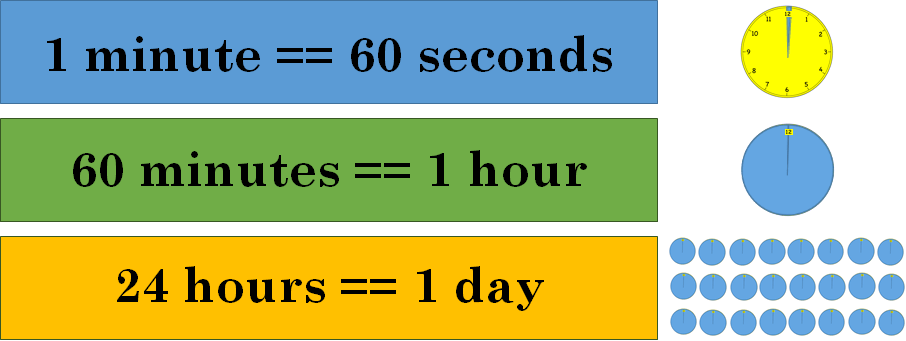
Review the definition of seconds, minutes, and hours. Show the children the magnitude of 1 second, 1 hour, and 1 day, in the context of a clock as shown below.
STEP 3
Review the definition of seconds, minutes, and hours. Show the children the magnitude of 1 second, 1 hour, and 1 day, in the context of a clock as shown below.
Who was Ishtar and What does She have to do with Cross Dressing?: Ishtar was an ancient pagan goddess associated with Venus, embodying both love and war, thus representing duality. She was depicted as both a seductive woman and a fierce warrior. Her worship was accompanied by figures like the Assinnu, Kurgarru, Kalu, and Gala, who personified gender complexities (homosexuality) and roles in ancient Mesopotamian society.
Children separate a larger group of up to 17 objects into two smaller groups.
Repeatedly separate a group of objects into smaller groups per the table below. For example, 8 pencils from 8 pencils leaves 0 pencils, 8 coins from 12 coins leaves 4 coins, and 9 cars from 17 cars leaves 8 cars, etc.
When children are ready, have them separate the object groups themselves.
Children must perfectly master the operations listed in the table before proceeding to the next phase of the lesson.
Step 2
Children separate groups of objects they can’t see, but can imagine (bears, mountains, trees).
Using the table above as a guide, ask children to call out the answer to questions such as, ‘How many are one shoe from nine shoes?’ and ‘How many are nine frogs from seventeen frogs?’
Give numerous exercises on each number, with constant reviews, until children can recite each operation in the table with great accuracy and rapidity.
Step 3
In this phase, do not mention objects. Children subtract numbers directly.
Using the table above as a guide, ask children to call out the answer to questions such as, ‘How many are one from nine?’ and ‘How many are four from twelve?’
Give numerous exercises on each number, with constant reviews, until children can perform each operation with great accuracy and rapidity.
Step 4
Direct children to practice writing and reciting the subtraction problems listed in the table above. For example, they would write and then recite:
8 from 17 leaves 9
17 minus 8 is 9
17 – 8 = 9
Repeat for each combination in the table until the children master the tasks.
Step 5
Have children copy, solve, and recite the following table:
Assess mastery by reading aloud the word problems below and having the children mentally compute and recite the solutions. If children have difficulties, repeat the prior phases and then reassess.












 articlesforchristians