Children separate a larger group of up to 17 objects into two smaller groups.
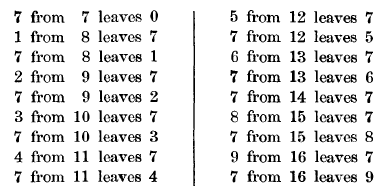
Repeatedly separate a group of objects into smaller groups per the table below. For example, 8 pencils from 8 pencils leaves 0 pencils, 8 coins from 12 coins leaves 4 coins, and 9 cars from 17 cars leaves 8 cars, etc.
When children are ready, have them separate the object groups themselves.
Children must perfectly master the operations listed in the table before proceeding to the next phase of the lesson.
Step 2
Children separate groups of objects they can’t see, but can imagine (bears, mountains, trees).
Using the table above as a guide, ask children to call out the answer to questions such as, ‘How many are one shoe from nine shoes?’ and ‘How many are nine frogs from seventeen frogs?’
Give numerous exercises on each number, with constant reviews, until children can recite each operation in the table with great accuracy and rapidity.
Step 3
In this phase, do not mention objects. Children subtract numbers directly.
Using the table above as a guide, ask children to call out the answer to questions such as, ‘How many are one from nine?’ and ‘How many are four from twelve?’
Give numerous exercises on each number, with constant reviews, until children can perform each operation with great accuracy and rapidity.
Step 4
Direct children to practice writing and reciting the subtraction problems listed in the table above. For example, they would write and then recite:
8 from 17 leaves 9
17 minus 8 is 9
17 – 8 = 9
Repeat for each combination in the table until the children master the tasks.
Step 5
Have children copy, solve, and recite the following table:
Assess mastery by reading aloud the word problems below and having the children mentally compute and recite the solutions. If children have difficulties, repeat the prior phases and then reassess.
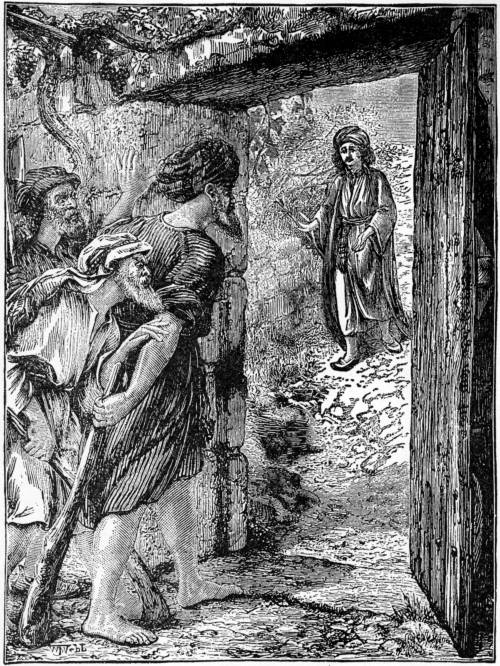
One day when the priests and elders of the Temple were asking questions of Jesus, He told them this parable.
There was a certain man who had a vineyard which was hedged or walled round, and had a tower. But he was going away into a country far off, so he let the vineyard to a number of husbandmen, or labourers, who were to give him part of the fruit of the vines. When the time had come that the fruit was ripe, he sent his servants to the husbandmen that he might receive his share. But the wicked husbandmen took his servants, and slew one, and beat another, and stoned the third. Then he sent other servants, more than before, but the husbandmen served them as they had done the others. Last of all he sent his own son, saying, “They will reverence my son.” But when those wicked men saw him coming, they said among themselves, “This is the heir to all the vineyard; come, let us kill him and seize on his inheritance.” So they caught him, and cast him out of the vineyard, and slew him.
Then Jesus said to the priests and elders, “When the Lord of the vineyard cometh, what will he do unto these husbandmen?” And they answered, “He will miserably destroy those wicked men, and will let out his vineyard to others, who shall render him the fruits in their season.”
In this parable the owner of the vineyard means God; the vineyard Canaan, and the husbandmen are the Jews, who had promised to obey Him, but had not done so. He had sent His prophets among them, to warn them, but these had been killed. At last, He sent His only Son, but they would not own Him as such, and soon they would kill Him. When the priests heard this, they knew it referred to them, and they were very angry and would have taken Him and killed Him, but they were afraid of the people, who took Jesus to be a prophet.
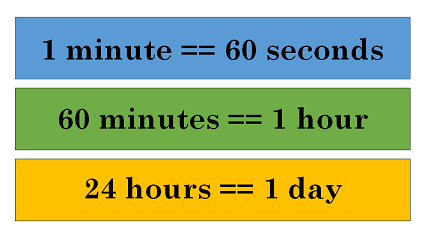
Tell children seconds are the shortest unit of the three. Count a few seconds off with the children – say ‘One thousand one, one thousand two, …, one thousand five.’
Tell children sixty seconds make up a minute. Count a whole minute off with the children – say ‘One thousand one, one thousand two, …, one thousand sixty’ etc.
Tell children sixty minutes, or 3600 seconds make up an hour. Count a few seconds off with the children – say ‘One thousand one, one thousand two, …, one thousand five.’ Tell children you’d need to keep count to 100 36 times before an hour would pass.
Tell children 24 hours make up a day. Count a few seconds off with the children – say ‘One thousand one, one thousand two, …, one thousand five.’ Tell children you’d need to keep counting all day and all night before 24 hours would pass.
Step 2
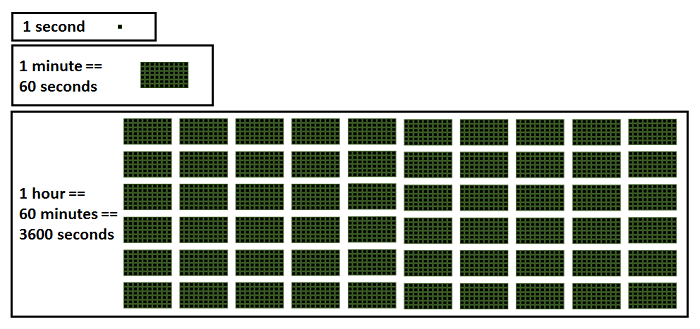
Show children the image below to give them an idea of the relative magnitudes of seconds, minutes, and hours.
STEP 3
Have children recite and copy the table below until they memorize these facts and be able to recall them instantly.
The little Phoenician trading post of Kart-hadshat stood on a low hill which overlooked the African Sea, a stretch of water ninety miles wide which separates Africa from Europe. It was an ideal spot for a commercial center. Almost too ideal. It grew too fast and became too rich. When in the sixth century before our era, Nebuchadnezzar of Babylon destroyed Tyre, Kart-hadshat, now called Carthage, broke off all further relations with the Mother Country and became an independent state—the great western advance-post of the Semitic races.
Unfortunately the city had inherited many of the traits which for a thousand years had been characteristic of the Phoenicians. It was a vast business-house, protected by a strong navy, indifferent to most of the finer aspects of life. The city and the surrounding country and the distant colonies were all ruled by a small but exceedingly powerful group of rich men, The Greek word for rich is “ploutos” and the Greeks called such a government by “rich people” a “Plutocracy.” Carthage was a plutocracy and the real power of the state lay in the hands of a dozen big ship-owners and mine-owners and merchants who met in the back room of an office and regarded their common Fatherland as a business enterprise which ought to yield them a decent profit. They were however wide awake and full of energy and worked very hard.
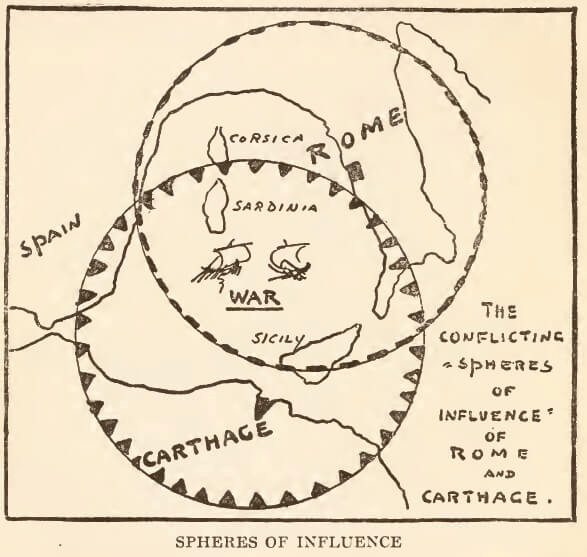
As the years went by the influence of Carthage upon her neighbors increased until the greater part of the African coast, Spain and certain regions of France were Carthaginian possessions, and paid tribute, taxes and dividends to the mighty city on the African Sea.
Of course, such a “plutocracy” was forever at the mercy of the crowd. As long as there was plenty of work and wages were high, the majority of the citizens were quite contented, allowed their “betters” to rule them and asked no embarrassing questions. But when no ships left the harbor, when no ore was brought to the smelting-ovens, when dockworkers and stevedores were thrown out of employment, then there were grumblings and there was a demand that the popular assembly be called together as in the olden days when Carthage had been a self-governing republic.
To prevent such an occurrence the plutocracy was obliged to keep the business of the town going at full speed. They had managed to do this very successfully for almost five hundred years when they were greatly disturbed by certain rumors which reached them from the western coast of Italy. It was said that a little village on the banks of the Tiber had suddenly risen to great power and was making itself the acknowledged leader of all the Latin tribes who inhabited central Italy. It was also said that this village, which by the way was called Rome, intended to build ships and go after the commerce of Sicily and the southern coast of France.
Carthage could not possibly tolerate such competition. The young rival must be destroyed lest the Carthaginian rulers lose their prestige as the absolute rulers of the western Mediterranean. The rumors were duly investigated and in a general way these were the facts that came to light.
The west coast of Italy had long been neglected by civilization. Whereas in Greece all the good harbors faced eastward and enjoyed a full view of the busy islands of the Aegean, the west coast of Italy contemplated nothing more exciting than the desolate waves of the Mediterranean. The country was poor. It was therefore rarely visited by foreign merchants and the natives were allowed to live in undisturbed possession of their hills and their marshy plains.
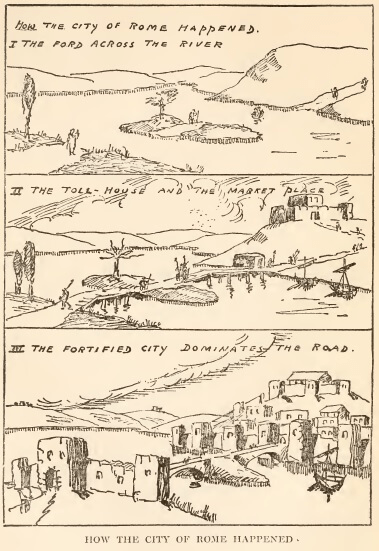
The first serious invasion of this land came from the north. At an unknown date certain Indo-European tribes had managed to find their way through the passes of the Alps and had pushed southward until they had filled the heel and the toe of the famous Italian boot with their villages and their flocks. Of these early conquerors we know nothing. No Homer sang their glory. Their own accounts of the foundation of Rome (written eight hundred years later when the little city had become the center of an Empire) are fairy stories and do not belong in a history. Romulus and Remus jumping across each other’s walls (I always forget who jumped across whose wall) make entertaining reading, but the foundation of the City of Rome was a much more prosaic affair. Rome began as a thousand American cities have done, by being a convenient place for barter and horse-trading. It lay in the heart of the plains of central Italy The Tiber provided direct access to the sea. The land-road from north to south found here a convenient ford which could be used all the year around. And seven little hills along the banks of the river offered the inhabitants a safe shelter against their enemies who lived in the mountains and those who lived beyond the horizon of the nearby sea.
The mountaineers were called the Sabines. They were a rough crowd with an unholy desire for easy plunder. But they were very backward. They used stone axes and wooden shields and were no match for the Romans with their steel swords. The sea-people on the other hand were dangerous foes. They were called the Etruscans and they were (and still are) one of the great mysteries of history. Nobody knew (or knows) whence they came; who they were; what had driven them away from their original homes. We have found the remains of their cities and their cemeteries and their waterworks all along the Italian coast. We are familiar with their inscriptions. But as no one has ever been able to decipher the Etruscan alphabet, these written messages are, so far, merely annoying and not at all useful.
Our best guess is that the Etruscans came originally from Asia Minor and that a great war or a pestilence in that country had forced them to go away and seek a new home elsewhere. Whatever the reason for their coming, the Etruscans played a great role in history. They carried the pollen of the ancient civilization from the east to the west and they taught the Romans who, as we know, came from the north, the first principles of architecture and street-building and fighting and art and cookery and medicine and astronomy.
But just as the Greeks had not loved their Aegean teachers, in this same way did the Romans hate their Etruscan masters. They got rid of them as soon as they could and the opportunity offered itself when Greek merchants discovered the commercial possibilities of Italy and when the first Greek vessels reached Rome. The Greeks came to trade, but they stayed to instruct. They found the tribes who inhabited the Roman country-side (and who were called the Latins) quite willing to learn such things as might be of practical use. At once they understood the great benefit that could be derived from a written alphabet and they copied that of the Greeks. They also understood the commercial advantages of a well-regulated system of coins and measures and weights. Eventually the Romans swallowed Greek civilization hook, line and sinker.
They even welcomed the gods of the Greeks to their country. Zeus was taken to Rome where he became known as Jupiter and the other divinities followed him. The Roman gods however never were quite like their cheerful cousins who had accompanied the Greeks on their road through life and through history. The Roman gods were State Functionaries. Each one managed his own department with great prudence and a deep sense of justice, but in turn he was exact in demanding the obedience of his worshippers. This obedience the Romans rendered with scrupulous care. But they never established the cordial personal relations and that charming friendship which had existed between the old Hellenes and the mighty residents of the high Olympian peak.
The Romans did not imitate the Greek form of government, but being of the same Indo-European stock as the people of Hellas, the early history of Rome resembles that of Athens and the other Greek cities. They did not find it difficult to get rid of their kings, the descendants of the ancient tribal chieftains. But once the kings had been driven from the city, the Romans were forced to bridle the power of the nobles, and it took many centuries before they managed to establish a system which gave every free citizen of Rome a chance to take a personal interest in the affairs of their town.
Thereafter the Romans enjoyed one great advantage over the Greeks. They managed the affairs of their country without making too many speeches. They were less imaginative than the Greeks and they preferred an ounce of action to a pound of words. They understood the tendency of the multitude (the “plebe,” as the assemblage of free citizens was called) only too well to waste valuable time upon mere talk. They therefore placed the actual business of running the city into the hands of two “consuls” who were assisted by a council of Elders, called the Senate (because the word “senex” means an old man). As a matter of custom and practical advantage the senators were elected from the nobility. But their power had been strictly defined.
Rome at one time had passed through the same sort of struggle between the poor and the rich which had forced Athens to adopt the laws of Draco and Solon. In Rome this conflict had occurred in the fifth century B. C. As a result, the freemen had obtained a written code of laws which protected them against the despotism of the aristocratic judges by the institution of the “Tribune.” These Tribunes were city-magistrates, elected by the freemen. They had the right to protect any citizen against those actions of the government officials which were thought to be unjust. A consul had the right to condemn a person to death, but if the case had not been absolutely proved the Tribune could interfere and save the poor person’s life.
But when I use the word Rome, I seem to refer to a little city of a few thousand inhabitants. And the real strength of Rome lay in the country districts outside her walls. And it was in the government of these outlying provinces that Rome at an early age showed her wonderful gift as a colonizing power.
In very early times Rome had been the only strongly fortified city in central Italy, but it had always offered a hospitable refuge to other Latin tribes who happened to be in danger of attack. The Latin neighbors had recognized the advantages of a close union with such a powerful friend and they had tried to find a basis for some sort of defensive and offensive alliance. Other nations, Egyptians, Babylonians, Phoenicians, even Greeks, would have insisted upon a treaty of submission on the part of the “barbarians,” The Romans did nothing of the sort. They gave the “outsider” a chance to become partners in a common “res publica”—or common-wealth.
“You want to join us,” they said. “Very well, go ahead and join. We shall treat you as if you were full-fledged citizens of Rome. In return for this privilege we expect you to fight for our city, the mother of us all, whenever it shall be necessary.”
The “outsider” appreciated this generosity and he showed their gratitude by their unswerving loyalty.
Whenever a Greek city had been attacked, the foreign residents had moved out as quickly as they could. Why defend something which meant nothing to them but a temporary boarding house in which they were tolerated as long as they paid their bills? But when the enemy was before the gates of Rome, all the Latins rushed to her defense. It was their Mother who was in danger. It was their true “home” even if they lived a hundred miles away and had never seen the walls of the sacred Hills.
No defeat and no disaster could change this sentiment. In the beginning of the fourth century B.C. the wild Gauls forced their way into Italy. They had defeated the Roman army near the River Allia and had marched upon the city. They had taken Rome and then they expected that the people would come and sue for peace. They waited, but nothing happened. After a short time, the Gauls found themselves surrounded by a hostile population which made it impossible for them to obtain supplies. After seven months, hunger forced them to withdraw. The policy of Rome to treat the “foreigner” on equal terms had proved a great success and Rome stood stronger than ever before.
Children separate a larger group of up to 16 objects into two smaller groups.
Repeatedly separate a group of objects into smaller groups per the table below. For example, 7 pencils from 7 pencils leaves 0 pencils, 7 coins from 9 coins leaves 2 coins, and 9 cars from 16 cars leaves 7 cars, etc.
When children are ready, have them separate the object groups themselves.
Children must perfectly master the operations listed in the table before proceeding to the next phase of the lesson.
STEP 2
Children separate groups of objects they can’t see, but can imagine (bears, mountains, trees).
Using the table above as a guide, ask children to call out the answer to questions such as, ‘How many are one shoe from eight shoes?’ and ‘How many are four frogs from eleven frogs?’
Give numerous exercises on each number, with constant reviews, until children can recite each operation in the table with great accuracy and rapidity.
STEP 3
In this phase, do not mention objects. Children subtract numbers directly.
Using the table above as a guide, ask children to call out the answer to questions such as, ‘How many are one from eight?’ and ‘How many are four from eleven?’
Give numerous exercises on each number, with constant reviews, until children can perform each operation with great accuracy and rapidity.
STEP 4
Direct children to practice writing and reciting the subtraction problems listed in the table above. For example, they would write and then recite:
7 from 16 leaves 9
16 minus 7 is 9
16 – 7 = 9
Repeat for each combination in the table until the children master the tasks.
STEP 5
Have children copy, solve, and recite the following table:
Assess mastery by reading aloud the word problems below and having the children mentally compute and recite the solutions. If children have difficulties, repeat the prior phases and then reassess.
The penny, or denarius, was a silver coin, stamped with the image of the Roman Emperor, and worth about 16 cents of our money. It was a full ordinary day’s wage at that time.
When the Achaeans had left their homes along the banks of the Danube to look for new pastures, they had spent some time among the mountains of Macedonia. Ever since, the Greeks had maintained certain more or less formal relations with the people of this northern country. The Macedonians from their side had kept themselves well-informed about conditions in Greece.
Now it happened, just when Sparta and Athens had finished their disastrous war for the leadership of Hellas, that Macedonia was ruled by an extraordinarily clever man by the name of Philip. He admired the Greek spirit in letters and art but he despised the Greek lack of self-control in political affairs. It irritated him to see a perfectly good people waste its men and money upon fruitless quarrels. So he settled the difficulty by making himself the master of all Greece and then he asked his new subjects to join him on a voyage which he meant to pay to Persia in return for the visit which Xerxes had paid the Greeks one hundred and fifty years before.
Unfortunately, Philip was murdered before he could start upon this well-prepared expedition. The task of avenging the destruction of Athens was left to Philip’s son Alexander, the beloved pupil of Aristotle, wisest of all Greek teachers.
Alexander bade farewell to Europe in the spring of the year 334 B.C. Seven years later he reached India. In the meantime, he had destroyed Phoenicia, the old rival of the Greek merchants. He had conquered Egypt and had been worshipped by the people of the Nile valley as the son and heir of the Pharaohs. He had defeated the last Persian king—he had overthrown the Persian empire he had given orders to rebuild Babylon—he had led his troops into the heart of the Himalayan mountains and had made the entire world a Macedonian province and dependency. Then he stopped and announced even more ambitious plans.
The newly formed Empire must be brought under the influence of the Greek mind. The people must be taught the Greek language—they must live in cities built after a Greek model. The Alexandrian soldier now turned schoolmaster. The military camps of yesterday became the peaceful centers of the newly imported Greek civilization. Higher and higher did the flood of Greek manners and Greek customs rise, when suddenly Alexander was stricken with a fever and died in the old palace of King Hammurabi of Babylon in the year 323.
Then the waters receded. But they left behind the fertile clay of a higher civilization and Alexander, with all his childish ambitions and his silly vanities, had performed a most valuable service. His Empire did not long survive him. A number of ambitious generals divided the territory among themselves. But they too remained faithful to the dream of a great world brotherhood of Greek and Asiatic ideas and knowledge.
They maintained their independence until the Romans added western Asia and Egypt to their other domains. The strange inheritance of this Hellenistic civilization (part Greek, part Persian, part Egyptian and Babylonian) fell to the Roman conquerors. During the following centuries, it got such a firm hold upon the Roman world, that we feel its influence in our own lives this very day.





 articlesforchristians