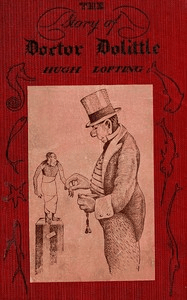
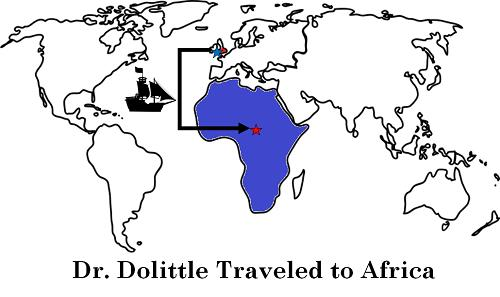
“The Story of Doctor Dolittle” by Hugh Lofting is a children’s novel published in 1920. When a kindly physician learns to speak with animals, he abandons his failing medical practice to become a veterinarian. His new calling leads him on an extraordinary voyage to Africa to cure a monkey epidemic. Along the way, he faces shipwrecks, imprisonment, pirates, and exotic creatures—including the rare pushmi-pullyu. This tale of adventure and animal communication became the first in a beloved series, though it has sparked controversy for its colonial-era themes.
Warning to Parents: Chapters 11 and 12 of the original Dr. Dolittle contain objectionable content. These chapters were modernized by Under the Home, but the Gutenberg link on the textbook page leads to an original copy of Dr. Dolittle with the objectionable content.
VII The Bridge of Apes VIII The Leader of the Lions IX The Monkeys’ Council X The Rarest Animal of All XI The Black Prince XII Medicine and Magic XIII Red Sails and Blue Wings XIV The Rats’ Warning XV The Barbary Dragon XVI Too-Too, the Listener XVII The Ocean Gossips XVIII Smells XIX The Rock XX The Fisherman’s Town XXI Home Again
Gather 25 pennies, 5 nickels, 2 dimes, and 3 quarters per child.
Have children complete the steps below.
Have children practice until they perfectly master each task.
STEP 1 – WHAT IS A QUARTER?
Children identify the quarter.
Direct the children to examine the front and back of a quarter. Ask the children to verbally describe what they see.
Have children hold up a penny and recite, ‘1 penny is worth 1 cent.’
Have children hold up a nickel and recite, ‘1 nickel is worth 5 cents.’
Have children hold up a dime and recite, ‘1 dime is worth 10 cents.’
Have children hold up a quarter and recite, ‘1 quarter is worth 25 cents.’
STEP 2 – COMBINE AND SEPARATE
Children combine and separate groups of pennies, nickels, dimes, and quarters.
Ask children to group 25 pennies together.
Tell children to move 1 quarter next to the 25 pennies. Have them recite, ‘1 quarter is worth 25 pennies.’
Tell children to remove the pennies and to move 5 nickels next to the quarter. Have them recite, ‘5 nickels are worth 1 quarter.’
Tell children to remove the nickels and to move 2 dimes and 1 nickel next to the 1 quarter. Have them recite, ‘2 dimes and 1 nickel are worth 1 quarter.’
STEP 3 – PLAY STORE
Play store with children, where children show the amount of money required to buy pretend items.
Give each child 1 quarter, 1 dime, 1 nickel, and 5 pennies. Say to children, ‘A pen costs 42 cents. Show me which coins you must give to the cashier.’
Give each child 2 quarters, 1 dime, 1 nickel, and 5 pennies. Say to children, ‘A toy boat costs 63 cents. Show me which coins you must give to the cashier.’
Give each child 3 quarters, 1 dime, 1 nickel, and 5 pennies. Say to children, ‘A bell pepper costs 84 cents. Show me which coins you must give to the cashier.’
Nuts are actually a type of fruit, defined as dry, single-seeded fruits with high oil content, usually encased in a leathery or hard outer shell. In botanical terms, a true nut has a single seed, a hard shell, and a protective husk—like chestnuts, hazelnuts, pecans, and walnuts. Peanuts and almonds, however, aren’t true nuts; peanuts are legumes, and almonds are surrounded by a fleshy coating similar to a plum. True nut or not, these tasty fruits are enjoyed by people all over the world.
Facts about nuts:
Types of nuts include hazelnuts, birch nuts, chestnuts, acorns, and hickory nuts.
Peanuts are not nuts. They are legumes, like peas and beans.
Coconuts, almonds, macadamia, pistachio, pecan, walnuts, and cashews are also not true nuts.
Acorns
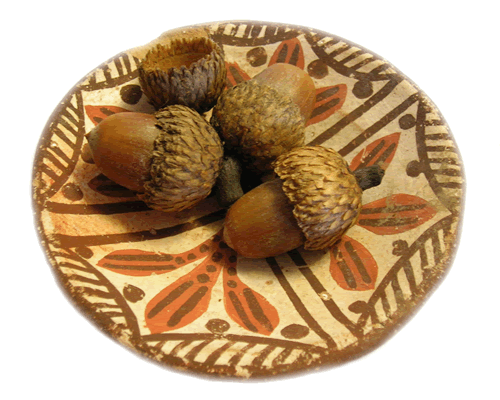
Acorns are the nuts that come from oak trees (Quercus spp.) and were once a staple food for many indigenous peoples of North America. They were especially important in California, where multiple oak species grow in the same areas.
Acorns were a great food source for Native Americans because they could be stored for many years. Photo by Teresa Prendusi.
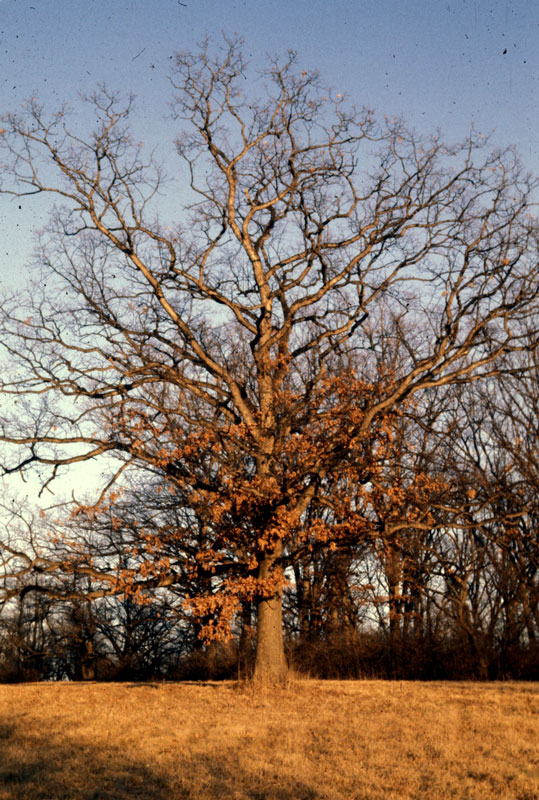
White Oak (Quercus alba). Photo by Larry Stritch.
These hard-shelled fruits were an important food source because if properly treated in the sun, they could be stored for several years and used when needed. Acorns were stored in caches or on tall poles to protect them from being eaten by squirrels. When prepared for use in foods the ground acorn flower was rinsed in a stream to remove bitter tasting tannins.
Native American tribes used fire to promote the production of acorns within oak groves.
Ground fires were used to kill the larvae of acorn moths and acorn weevils that can prove disastrous to the acorn crop.
Burning occurred during the dormancy period in the soil, and the fires released nutrients bound in dead leaves and other plant debris into the soil.
Most North American oaks tolerate light fires, especially when consistent burning has eliminated woody fuel accumulation around their trunks.
Black Walnuts
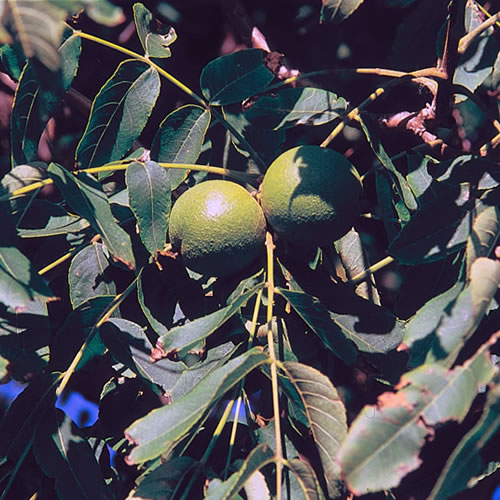
Black Walnuts (Juglans nigra) are native to North America. The nuts are primarily used in ice cream and candy.
Walnut trees are notorious for inhibiting growth of other plants around them. They produce chemicals in their leaves that are leached out by rain and soak into ground around the trunk.
Farmers planted these trees around farm animals to keep the flies away because they erroneously believed that the trees contained insecticides.
Black walnuts (Juglans nigra) have a strong taste and a very hard shell.
Pecans
Pecans (Carya illinoinensis) are a valuable nut species native to the American Southeast. Today, they’re widely cultivated across the southeastern United States and play a big role in the region’s cuisine.
In the past, native peoples and early American settlers enjoyed pecans because they were easy to find along major waterways and much simpler to shell than other North American nuts.
Pecan (Carya illinoinensis). Photo by Jerry A. Payne, USDA Agricultural Research Service, Bugwood.org.
It is very difficult to understand the people of bygone ages. Your own grandfather, whom you see every day, is a mysterious being who lives in a different world of ideas and clothes and manners. I am now telling you the story of some of your grandfathers who are twenty-five generations removed, and I do not expect you to catch the meaning of what I write without re-reading this chapter a number of times.
The average person of the Middle Ages lived a very simple and uneventful life. Even free citizens, able to come and go at will, rarely left their own neighborhoods. There were no printed books and only a few manuscripts. Here and there, a small band of industrious monks taught reading and writing and some arithmetic. But science and history and geography lay buried beneath the ruins of Greece and Rome.
Whatever people knew about the past they had learned by listening to stories and legends. Such information, which goes from parent to child, is often slightly incorrect in details, but it will preserve the main facts of history with astonishing accuracy. After more than two thousand years, the mothers of India still frighten their naughty children by telling them that “Iskander will get them,” and Iskander is none other than Alexander the Great, who visited India in the year 330 before the birth of Christ, but whose story has lived through all these ages.
The people of the early Middle Ages never saw a textbook of Roman history. They were ignorant of many things which every schoolboy today knows before he has entered the third grade. But the Roman Empire, which is merely a name to you, was to them something very much alive. They felt it. They willingly recognized the Pope as their spiritual leader because he lived in Rome and represented the idea of the Roman superpower. And they were profoundly grateful when Charlemagne, and afterwards Otto the Great, revived the idea of a world-empire and created the Holy Roman Empire, that the world might again be as it always had been.
But the fact that there were two different heirs to the Roman tradition placed the faithful burghers of the Middle Ages in a difficult position. The theory behind the medieval political system was both sound and simple. While the worldly master (the emperor) looked after the physical well-being of his subjects, the spiritual master (the Pope) guarded their souls.
In practice, however, the system worked very badly. The Emperor invariably tried to interfere with the affairs of the church and the Pope retaliated and told the Emperor how he should rule his domains. Then they told each other to mind their own business in very unceremonious language and the inevitable end was war.
Under those circumstances, what were the people to do, A good Christian obeyed both the Pope and his King. But the Pope and the Emperor were enemies. Which side should a dutiful subject and an equally dutiful Christian take?
It was never easy to give the correct answer. When the Emperor happened to be a man of energy and was sufficiently well provided with money to organize an army, he was very apt to cross the Alps and march on Rome, besiege the Pope in his own palace if need be, and force His Holiness to obey the imperial instructions or suffer the consequences.
But more frequently the Pope was the stronger. Then the Emperor or the King together with all his subjects was excommunicated. This meant that all churches were closed, that no one could be baptized, that no dying person could be given absolution—in short, that half of the functions of medieval government came to an end.
More than that, the people were absolved from their oath of loyalty to their sovereign and were urged to rebel against their master. But if they followed this advice of the distant Pope and were caught, they were hanged by their nearby Liege Lord and that too was very unpleasant.
Indeed, the poor fellows were in a difficult position and none fared worse than those who lived during the latter half of the eleventh century, when the Emperor Henry IV of Germany and Pope Gregory VII fought a two-round battle which decided nothing and upset the peace of Europe for almost fifty years.
In the middle of the eleventh century there had been a strong movement for reform in the church. The election of the Popes, thus far, had been a most irregular affair. It was to the advantage of the Holy Roman Emperors to have a well-disposed priest elected to the Holy See. They frequently came to Rome at the time of election and used their influence for the benefit of one of their friends.
In the year 1059 this had been changed. By a decree of Pope Nicholas II, the principal priests and deacons of the churches in and around Rome were organized into the so-called College of Cardinals, and this gathering of prominent churchmen (the word “Cardinal” meant principal) was given the exclusive power of electing the future Popes.
In the year 1073 the College of Cardinals elected a priest by the name of Hildebrand, the son of very simple parents in Tuscany, as Pope, and he took the name of Gregory VII. His energy was unbounded. His belief in the supreme powers of his Holy Office was built upon a granite rock of conviction and courage. In the mind of Gregory, the Pope was not only the absolute head of the Christian church, but also the highest Court of Appeal in all worldly matters. The Pope who had elevated simple German princes to the dignity of Emperor could depose them at will. He could veto any law passed by duke or king or emperor, but whosoever should question a papal decree, let him beware, for the punishment would be swift and merciless.
Gregory sent ambassadors to all the European courts to inform the potentates of Europe of his new laws and asked them to take due notice of their contents. William the Conqueror promised to be good, but Henry IV, who since the age of six had been fighting with his subjects, had no intention of submitting to the Papal will. He called together a college of German bishops, accused Gregory of every crime under the sun and then had him deposed by the council of Worms.
The Pope answered with excommunication and a demand that the German princes rid themselves of their unworthy ruler. The German princes, only too happy to be rid of Henry, asked the Pope to come to Augsburg and help them elect a new Emperor.
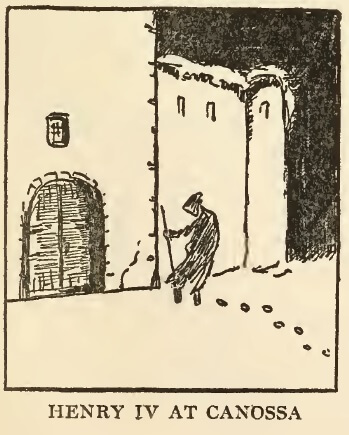
Gregory left Rome and travelled northward. Henry, who was no fool, appreciated the danger of his position. At all costs he must make peace with the Pope, and he must do it at once. In the midst of winter, he crossed the Alps and hastened to Canossa where the Pope had stopped for a short rest. Three long days, from the 25th to the 28th of January of the year 1077, Henry, dressed as a penitent pilgrim (but with a warm sweater underneath his monkish garb), waited outside the gates of the castle of Canossa. Then he was allowed to enter and was pardoned for his sins. But the repentance did not last long. As soon as Henry had returned to Germany, he behaved exactly as before. Again, he was excommunicated. For the second time a council of German bishops deposed Gregory, but this time, when Henry crossed the Alps, he was at the head of a large army, besieged Rome and forced Gregory to retire to Salerno, where he died in exile. This first violent outbreak decided nothing. As soon as Henry was back in Germany, the struggle between Pope and Emperor was continued.
The Hohenstaufen family which got hold of the Imperial German Throne shortly afterwards, were even more independent than their predecessors. Gregory had claimed that the Popes were superior to all kings because they (the Popes) at the Day of Judgement would be responsible for the behavior of all the sheep of their flock, and in the eyes of God, a king was one of that faithful herd.
Frederick of Hohenstaufen, commonly known as Barbarossa or Red Beard, set up the counter-claim that the Empire had been bestowed upon his predecessor “by God himself” and as the Empire included Italy and Rome, he began a campaign which was to add these “lost provinces” to the northern country. Barbarossa was accidentally drowned in Asia Minor during the second Crusade, but his son Frederick II, a brilliant young man who in his youth had been exposed to the civilization of the Muslims of Sicily, continued the war. The Popes accused him of heresy. It is true that Frederick seems to have felt a deep and serious contempt for the rough Christian world of the North, for the boorish German Knights and the intriguing Italian priests. But he held his tongue, went on a Crusade and took Jerusalem from the infidel and was duly crowned as King of the Holy City. Even this act did not placate the Popes. They deposed Frederick and gave his Italian possessions to Charles of Anjou, the brother of that King Louis of France who became famous as Saint Louis. This led to more warfare. Conrad V, the son of Conrad IV, and the last of the Hohenstaufens, tried to regain the kingdom, and was defeated and decapitated at Naples. But twenty years later, the French who had made themselves thoroughly unpopular in Sicily were all murdered during the so-called Sicilian Vespers, and so it went.
The quarrel between the Popes and the Emperors was never settled, but after a while the two enemies learned to leave each other alone.
In the year 1278, Rudolph of Hapsburg was elected Emperor. He did not take the trouble to go to Rome to be crowned. The Popes did not object and in turn they kept away from Germany. This meant peace but two entire centuries which might have been used for the purpose of internal organization had been wasted in useless warfare.
It is an ill wind however that bloweth no good to someone. The little cities of Italy, by a process of careful balancing, had managed to increase their power and their independence at the expense of both Emperors and Popes. When the rush for the Holy Land began, they were able to handle the transportation problem of the thousands of eager pilgrims who were clamoring for passage, and at the end of the Crusades they had built themselves such strong defenses of brick and of gold that they could defy Pope and Emperor with equal indifference.
Church and State fought each other and a third party—the medieval city—ran away with the spoils.
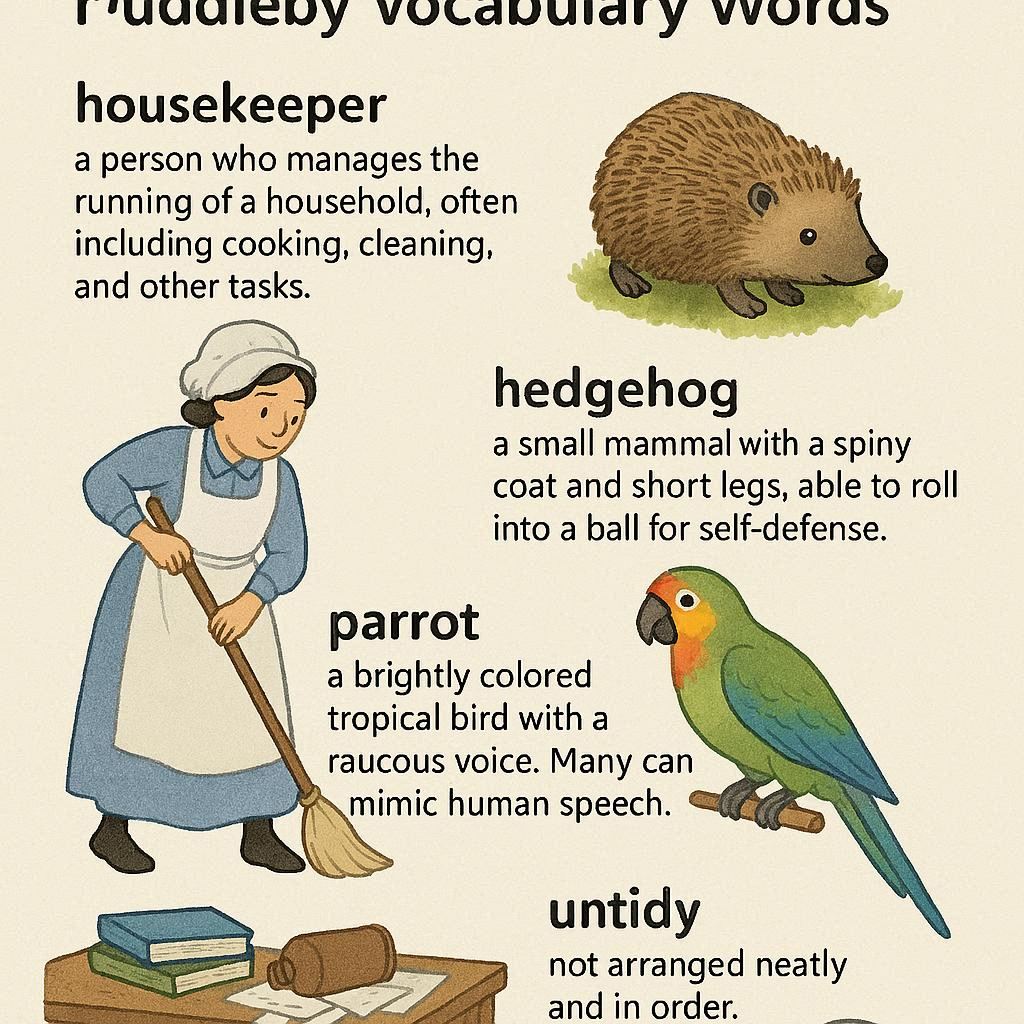
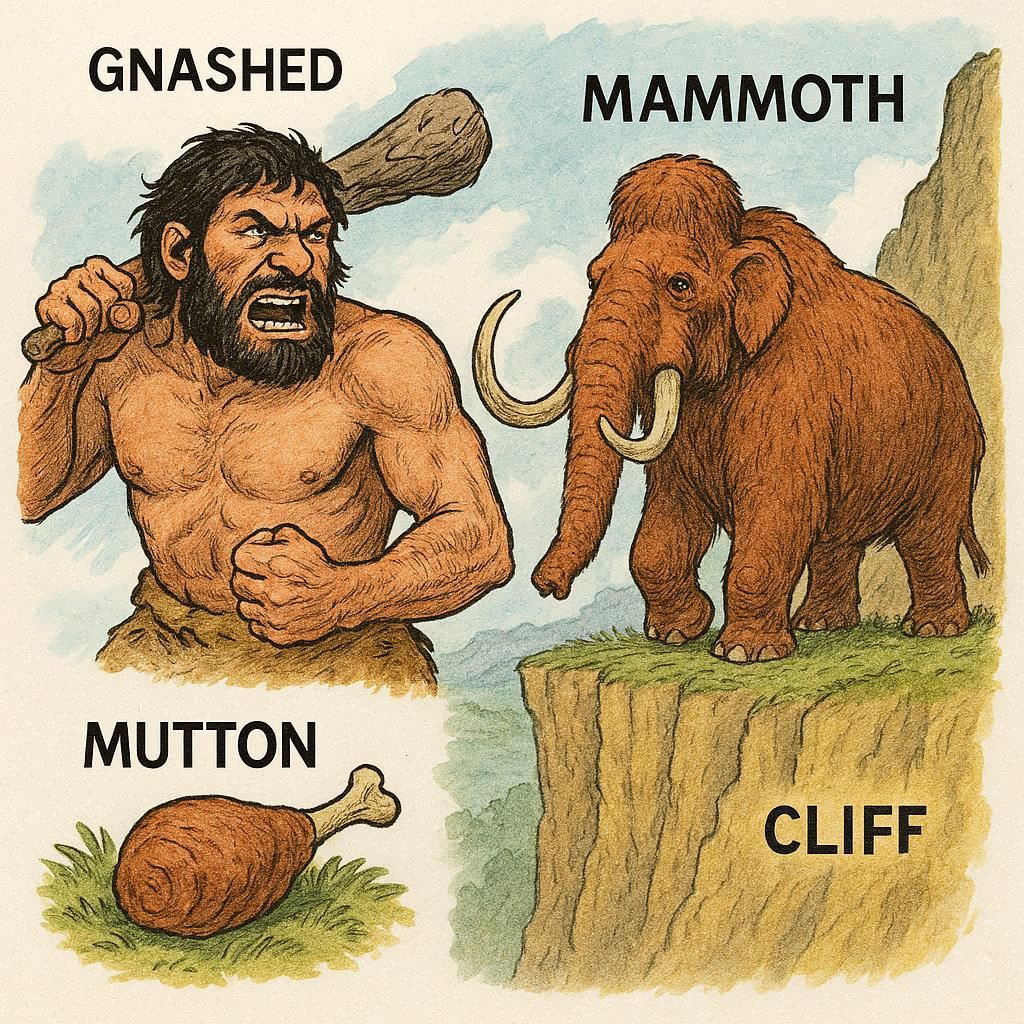
Gnashed: Grind (one’s teeth) together. Rage: Violent anger. Mutton: The meat of mature sheep. Mammoth: A large hairy extinct elephant with curved tusks. Cliff: A steep rock face.
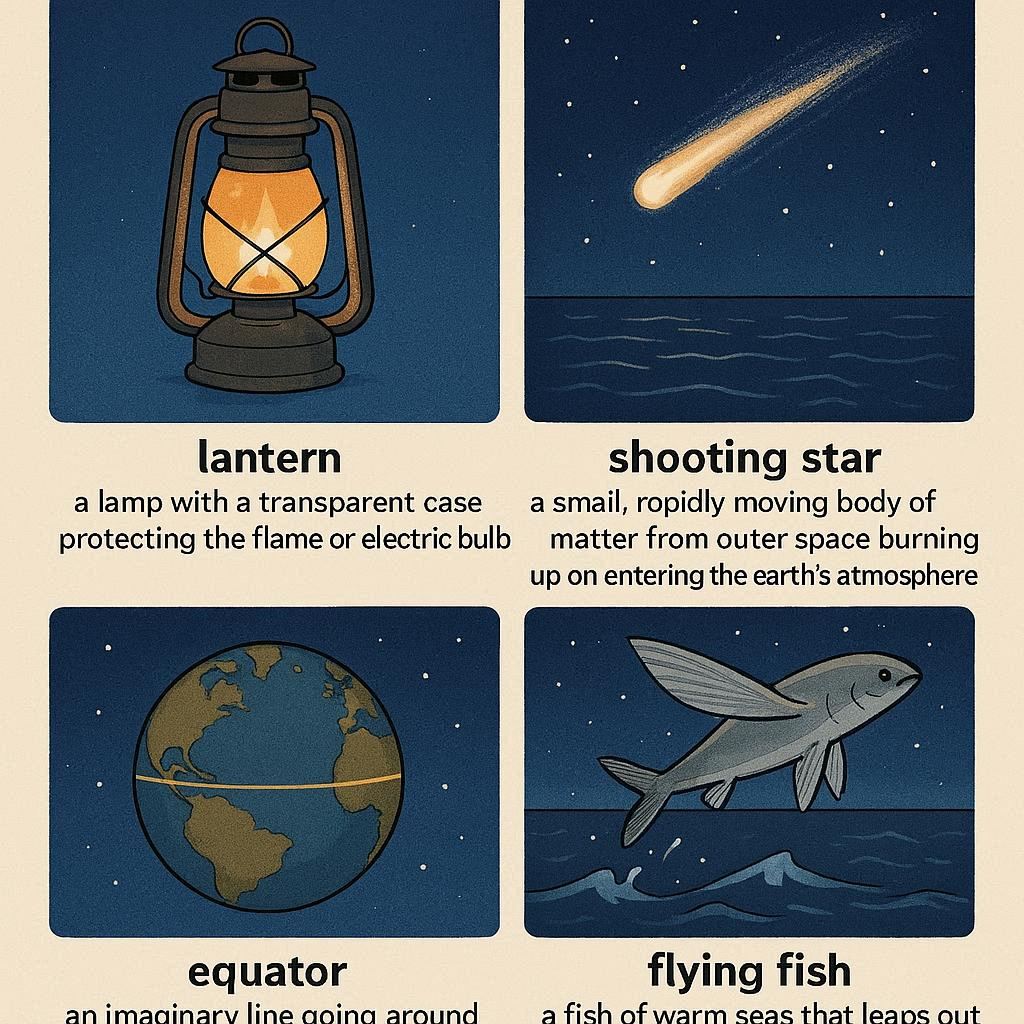
Lantern: A lamp with a transparent case protecting the flame or electric bulb Shooting Star: A small, rapidly moving body of matter from outer space burning up on entering the earth’s atmosphere Equator: An imaginary line going around the middle of the Earth. Flying Fish: A fish of warm seas that leaps out of the water and uses its winglike fins to glide over the surface for some distance. Porpoise: A small toothed whale Stowaway: A person who sneaks on a vessel, such as a ship or plane, to travel without noticed or paying the fare.
“The Story of Doctor Dolittle” by Hugh Lofting is a children’s novel published in 1920. When a kindly physician learns to speak with animals, he abandons his failing medical practice to become a veterinarian. His new calling leads him on an extraordinary voyage to Africa to cure a monkey epidemic. Along the way, he faces shipwrecks, imprisonment, pirates, and exotic creatures—including the rare pushmi-pullyu. This tale of adventure and animal communication became the first in a beloved series, though it has sparked controversy for its colonial-era themes.
Warning to Parents: Chapters 11 and 12 of the original Dr. Dolittle contain objectionable content. These chapters were modernized by Under the Home, but the Gutenberg link on the textbook page leads to an original copy of Dr. Dolittle with the objectionable content.
VI Polynesia and the King VII The Bridge of Apes VIII The Leader of the Lions IX The Monkeys’ Council X The Rarest Animal of All XI The Black Prince XII Medicine and Magic XIII Red Sails and Blue Wings XIV The Rats’ Warning XV The Barbary Dragon XVI Too-Too, the Listener XVII The Ocean Gossips XVIII Smells XIX The Rock XX The Fisherman’s Town XXI Home Again
Now for six whole weeks they went sailing on and on, over the rolling sea, following the swallow who flew before the ship to show them the way. At night she carried a tiny lantern, so they should not miss her in the dark; and the people on the other ships that passed said that the light must be a shooting star.
As they sailed further and further into the South, it got warmer and warmer. Polynesia, Chee-Chee and the crocodile enjoyed the hot sun no end. They ran about laughing and looking over the side of the ship to see if they could see Africa yet.
But the pig and the dog and the owl, Too-Too, could do nothing in such weather, but sat at the end of the ship in the shade of a big barrel, with their tongues hanging out, drinking lemonade.
Dab-Dab, the duck, used to keep herself cool by jumping into the sea and swimming behind the ship. And every once in a while, when the top of her head got too hot, she would dive under the ship and come up on the other side. In this way, too, she used to catch herrings on Tuesdays and Fridays-when everybody on the boat ate fish to make the beef last longer.
When they got near to the Equator they saw some flying-fishes coming towards them. And the fishes asked the parrot if this was Doctor Dolittle’s ship. When she told them it was, they said they were glad, because the monkeys in Africa were getting worried that he would never come. Polynesia asked them how many miles they had yet to go; and the flying-fishes said it was only fifty-five miles now to the coast of Africa.
And another time a whole school of porpoises came dancing through the waves; and they too asked Polynesia if this was the ship of the famous doctor. And when they heard that it was, they asked the parrot if the Doctor wanted anything for his journey.
And Polynesia said, “Yes. We have run short of onions.”
“There is an island not far from here,” said the porpoises, “where the wild onions grow tall and strong. Keep straight on-we will get some and catch up to you.”
So the porpoises dashed away through the sea. And very soon the parrot saw them again, coming up behind, dragging the onions through the waves in big nets made of seaweed.
The next evening, as the sun was going down, the Doctor said,
“Get me the telescope, Chee-Chee. Our journey is nearly ended. Very soon we should be able to see the shores of Africa.”
And about half an hour later, sure enough, they thought they could see something in front that might be land. But it began to get darker and darker and they couldn’t be sure.
Then a great storm came up, with thunder and lightning. The wind howled; the rain came down in torrents; and the waves got so high they splashed right over the boat.
Presently there was a big BANG! The ship stopped and rolled over on its side.
“What’s happened?” asked the Doctor, coming up from downstairs.
“I’m not sure,” said the parrot; “but I think we’re ship-wrecked. Tell the duck to get out and see.”
So Dab-Dab dived right under the waves. And when she came up she said they had struck a rock; there was a big hole in the bottom of the ship; the water was coming in; and they were sinking fast.
“We must have run into Africa,” said the Doctor. “Dear me, dear me!-Well-we must all swim to land.”
But Chee-Chee and Gub-Gub did not know how to swim.
“Get the rope!” said Polynesia. “I told you it would come in handy. Where’s that duck? Come here, Dab-Dab. Take this end of the rope, fly to the shore and tie it to a palm-tree; and we’ll hold the other end on the ship here. Then those that can’t swim must climb along the rope till they reach the land. That’s what you call a ‘life-line.'”
So they all got safely to the shore-some swimming, some flying; and those that climbed along the rope brought the Doctor’s trunk and hand-bag with them.
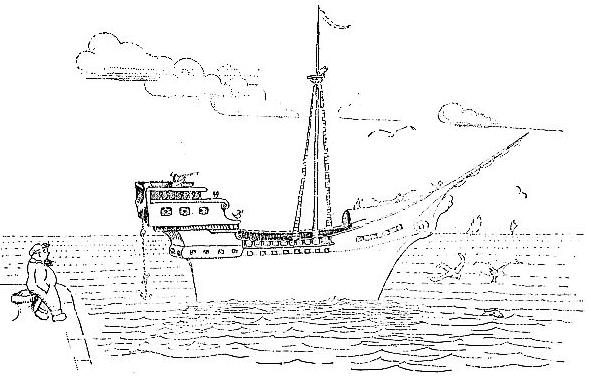
But the ship was no good anymore-with the big hole in the bottom; and presently the rough sea beat it to pieces on the rocks and the timbers floated away.
Then they all took shelter in a nice dry cave they found, high up in the cliffs, till the storm was over.
When the sun came out next morning they went down to the sandy beach to dry themselves.
“Dear old Africa!” sighed Polynesia. “It’s good to get back. Just think-it’ll be a hundred and sixty-nine years tomorrow since I was here! And it hasn’t changed a bit!-Same old palm-trees; same old red earth; same old black ants! There’s no place like home!”
And the others noticed she had tears in her eyes-she was so pleased to see her country once again.
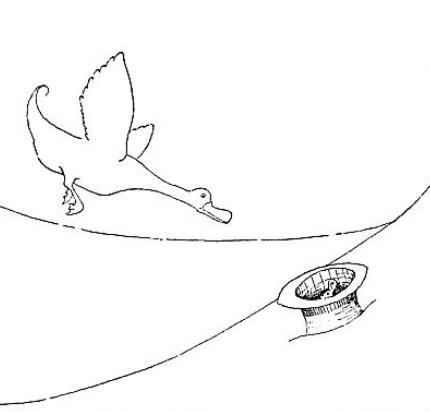
Then the Doctor missed his high hat; for it had been blown into the sea during the storm. So Dab-Dab went out to look for it. And presently she saw it, a long way off, floating on the water like a toy-boat.
When she flew down to get it, she found one of the white mice, very frightened, sitting inside it.
“What are you doing here?” asked the duck. “You were told to stay behind in Puddleby.”
“I didn’t want to be left behind,” said the mouse. “I wanted to see what Africa was like-I have relatives there. So I hid in the baggage and was brought on to the ship with the hard-tack. When the ship sank I was terribly frightened-because I cannot swim far. I swam as long as I could, but I soon got all exhausted and thought I was going to sink. And then, just at that moment, the old man’s hat came floating by; and I got into it because I did not want to be drowned.”
So the duck took up the hat with the mouse in it and brought it to the Doctor on the shore. And they all gathered round to have a look.
“That’s what you call a ‘stowaway,'” said the parrot.
Presently, when they were looking for a place in the trunk where the white mouse could travel comfortably, the monkey, Chee-Chee, suddenly said,
“Sh! I hear footsteps in the jungle!”
They all stopped talking and listened. And soon a black man came down out of the woods and asked them what they were doing there.
“My name is John Dolittle-M.D.,” said the Doctor. “I have been asked to come to Africa to cure the monkeys who are sick.”
“You must all come before the King,” said the black man.
“What king?” said the Doctor, who didn’t want to waste any time.
“The King of the Jolliginki,” the man answered. “All these lands belong to him; and all strangers must be brought before him. Follow me.”
So, they gathered up their baggage and went off, following the man through the jungle.
Gather 100 pennies, 2 nickels, and 10 dimes per child.
Have children complete the steps below.
Have children practice until they perfectly master each task.
STEP 1 – WHAT IS A DIME?
Children identify the dime.
Direct the children to examine the front and back of a dime. Ask the children to verbally describe what they see.
Have children hold up a penny and recite, ‘1 penny is worth 1 cent.’
Have children hold up a nickel and recite, ‘1 nickel is worth 5 cents.’
Have children hold up a dime and recite, ‘1 dime is worth 10 cents.’
STEP 2 – COMBINE AND SEPARATE
Children combine and separate groups of pennies, nickels, and dimes.
Ask children to group 10 pennies together.
Tell children to move 2 nickels next to the 10 pennies. Have them recite, ‘2 nickels are worth 10 pennies.’
Tell children to move 1 dime next to the 2 nickels and 10 pennies. Have them recite, ‘1 dime is worth 2 nickels’ and ‘1 dime is worth 10 pennies.’
Ask children to group 25 pennies together.
Tell children to move two dimes and 1 nickel next to the 25 pennies. Have them recite, ‘2 dimes and 1 nickel are worth 25 pennies.’
Ask children to group 100 pennies together.
Tell children to move 10 dimes next to the 100 pennies. Have them recite, ’10 dimes are worth 100 pennies.’
STEP 3 – PLAY STORE
Play store with children, where children show the amount of money required to buy pretend items.
Give each child 1 dime, 1 nickel, and 5 pennies. Say to children, ‘A carrot costs 18 cents. Show me which coins must you give to the cashier.’
Give each child 3 dimes, 1 nickel, and 5 pennies. Say to children, ‘A plum costs 36 cents. Show me which coins must you give to the cashier.’
Give each child 5 dimes, 1 nickel, and 5 pennies. Say to children, ‘A pear costs 59 cents. Show me which coins must you give to the cashier.’
Give each child 9 dimes, 1 nickel, and 5 pennies. Say to children, ‘An orange costs 97 cents. Show me which coins must you give to the cashier.’
Give each child 10 dimes. Say to children, ‘A toy dinosaur costs 24 cents. Show me how many dimes you must pay to the cashier. How many pennies and nickels should the cashier give to you as change?’
Give each child 10 dimes. Say to children, ‘An egg costs 45 cents. Show me how many dimes you must pay to the cashier. How many pennies and nickels should the cashier give to you as change?’
Give each child 10 dimes. Say to children, ‘A book costs 87 cents. Show me how many dimes you must pay to the cashier. How many pennies and nickels should the cashier give to you as change?’
Give each child 10 dimes. Say to children, ‘A bunch of grapes costs 90 cents. Show me how many dimes you must pay to the cashier. How many pennies and nickels should the cashier give to you as change?’
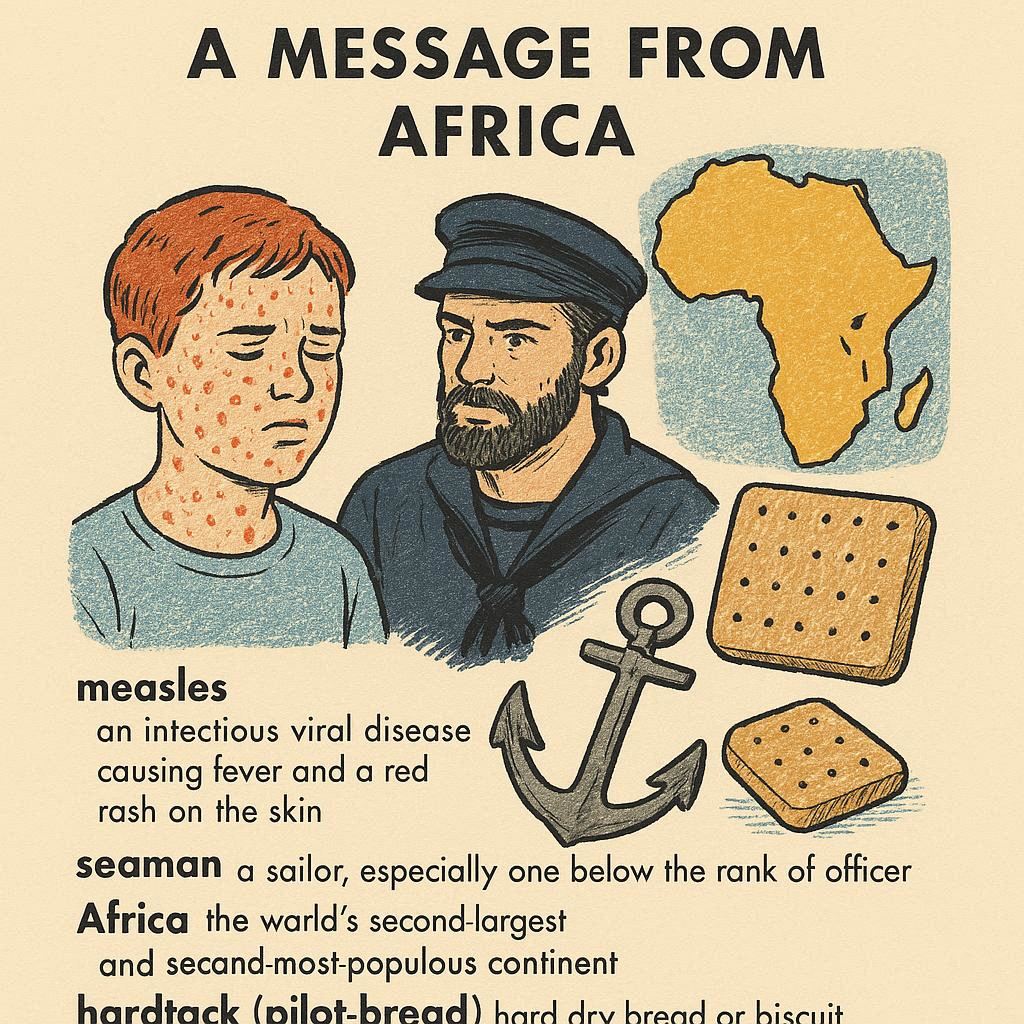
Measles: An infectious viral disease-causing fever and a red rash on the skin Seaman: A sailor, especially one below the rank of officer. Africa: The world’s second largest and second-most-populous continent Hardtack (pilot-bread): Hard dry bread or biscuit, especially as rations for sailors Anchor: A heavy object attached to a rope or chain and used to hold a ship in place to the sea bottom.




 articlesforchristians