A place to grow your relationship with God

Posts tagged ‘homeschooling’

Timeline of Key Events in Early Christianity

This timeline goes from the Disciples gathering to meet in the upper room through the writing of the Book of Revelations. A few other historical events will be added as additional information. There are some secular resources that links to other websites.

All Dates are Approximate.

  • 30 AD Matthias Chosen by Lot
    • Acts 1:12
  • 30 AD The Holy Spirit Comes at Pentecost
  • 30 AD Peter Heals and Preaches Acts 3
  • 30 AD Peter and John Arrested and Released
    • Acts 4
  • 30 AD Believers Share All
    • Acts 4:32
  • 30 AD Deaths of Ananias and Sapphira
    • Acts 5
  • 30 AD Apostles Preach and Heal
    • Acts 5:11
  • 31 AD Stephen’s Speech, Stoning and Death Acts 6, 7
  • 31 AD Saul Persecutes the Church
    • Acts 8
  • 31 AD Philip in Samaria
    • Acts 8:3
  • 31 AD Simon the Sorcerer
    • Acts 8:9
  • 31 AD Philip and the Ethiopian
    • Acts 8:26
  • 32 AD Birth of the Emperor Otho in the city of Ferentium.
  • 34 AD Saul’s Conversion
    • Acts 9
  • 37 AD Death of Tiberius on the island of Capri. Caligula ascends to the throne.
  • 37 AD Birth of the historian Flavius Josephus, in Jerusalem. Birth of the Emperor Nero, in the town of Antium.
  • 37 AD Peter Preaches to the Gentiles
    • Acts 10, 11
  • 39 AD Caligula marches with the legions to Germania in a ‘mock’ campaign.
  • 39 AD Caligula bridges the Bay of Naples with boats from Baiae to Puteoli
  • 40 AD Caligula marches to the English Channel with the intention of invading Britain. Instead, the legions collect seashells, and he returns to Rome to celebrate a fabricated triumph.
  • 40 AD Birth of the Emperor Titus. Birth of the Roman general Gn. Julius Agricola, in the province of Gallia Narbonesis.
  • 40 AD Emperor Caligula orders that a statue of himself is to be erected in the temple at Jerusalem. Herod delays implementation long enough to prevent wide-spread revolt in Judaea.
  • 41 AD Caligula is assassinated by the Praetorian Guard. Claudius, supposedly found hiding in the curtains of the palace is hailed the new Caesar.
  • 41 AD The Roman writer Seneca is banished to the island of Corsica after he is accused of committing adultery with Claudius’s niece Livilla.
  • 41 AD Livia, the wife of Augustus, is finally deified by the senate.
  • 42 AD Barnabas Sent to Antioch
    • Acts 11:22
  • 42 AD Peter Led from Prison by the Angel
    • Acts 12
  • 43 AD Claudius begins the first large-scale Roman invasion of Britain, at first under the command of general A. Plautius.
  • 43 AD Lycia is annexed into the empire.
  • 44 AD Herod Agrippa Dies
    • Acts 12:20
  • 44 AD Judaea is annexed as a Roman province after the death of Herod Agrippa.
  • 45 AD James Writes his Letter
    • James 1 – 5
  • 46 AD The client kingdom of Thrace is annexed into the empire as a province.
  • 47 AD The Roman general Gn. Domitius Corbulo defeats the Frisii.
  • 47 AD Claudius celebrates the Secular Games, as Rome celebrates the 800th anniversary of the founding of the city.
  • 48 AD Paul’s First Missionary Journey
    • Acts 13
  • 48 AD Paul preaches in Pisidian Antioch
    • Acts 13:14
  • 48 AD Paul and Barnabas in Iconium
    • Acts 14
  • 48 AD Paul and Barnabas in Lystra and Derbe
    • Acts 14:8
  • 48 AD Paul and Barnabas Return to Syrian Antioch
    • Acts 14:21
  • 48 AD Return to Syrian Antioch
    • Acts 14:24
  • 48 AD The Council at Jerusalem
    • Acts 15
  • 49 AD Claudius passes an edict expelling all Jews from Rome.
    • Acts 18:1-3 mentions this edict.
  • 49 AD Paul’s Second Missionary Journey
    • Acts 15:36
  • 49 AD Paul in Philippi
    • Acts 16
  • 49 AD Paul in Thessalonica, Berea, Athens
    • Acts 17
  • 50 AD Claudius adopts Nero as heir.
  • 51 AD Birth of the Emperor Domitian in Rome.
  • 51 AD Paul in Corinth
    • Acts 18
  • 51 AD Paul Writes to the Thessalonians
    • 1 Thess. 1 – 5
  • 52 AD Paul Writes again to the Thessalonians
    • 2 Thess. 1 – 3
  • 54 AD Death and deification of Claudius. Nero ascends to the throne.
  • 54 AD Paul in Ephesus
    • Acts 19
  • 54 AD Paul Writes to the Corinthians
    • 1 Corinthians 1 – 16
  • 54 AD Paul Writes to the Galatians
    • Galatians 1 – 6
  • 56 AD Birth of the great Roman historian Tacitus, probably in Rome.
  • 56 – 57 AD Nero expels actors from Rome and dictates reforms of circuses and festivals.
  • 57 AD Paul in Macedonia and Greece
    • Acts 20
  • 57 AD Paul Writes to the Romans
    • Romans 1 – 16
  • 57 AD Paul Writes again to the Corinthians
    • 2 Corinthians 1 – 13
  • 58 AD The Roman general Gn. Domitius Corbulo conquers Armenia, after the capture of the capital Artaxata.
  • 59 AD Paul Returns to Jerusalem
    • Acts 21 – 23
  • 60 AD Paul imprisoned in Caesarea
    • Acts 24
  • 61 AD In BritainBoudicca, the queen of the Iceni tribe, leads a revolt against Roman occupation.
  • 62 AD Birth of the Roman historian Pliny the Younger in Italy.
  • 62 AD Suetonius Paullus defeats the Iceni revolt of Boudicca, who commits suicide.
  • 62 AD Lucius Caesennius Paetus in Armenia surrenders to invading Parthians after a defeat at Rhandeia. Gn. Domitius Corbulo returns and invades Parthia.
  • 62 AD Nero divorces his wife Octavia and marries his mistress Poppaea Sabina.
  • 62 AD The first signs of volcanic activity are recorded in Mt. Vesuvius, when an earthquake damages some nearby Campanian towns. (Much of which damage would never be repaired prior to its eruption some 18 years later.)
  • 62 AD Paul Before Festus
    • Acts 25
  • 62 AD Paul Before Agrippa
    • Acts 26
  • 62 AD Paul Sails for Rome
    • Acts 27
  • 62 AD The Shipwreck
    • Acts 27:13
  • 62 AD Paul Ashore at Malta
    • Acts 28
  • 62 AD Paul Preaches at Rome
    • Acts 28:11
  • 62 AD Paul Writes to the Ephesians
    • Ephesians 1 – 6
  • 62 AD Paul Writes to the Philippians
    • Philippians 1 – 4
  • 62 AD Paul Writes to the Colossians
    • Colossians 1 – 4
  • 62 AD Paul Writes to Philemon
    • Philemon 1
  • 63 AD Paul Writes to Timothy
  • 64 AD The Great Fire of Rome, speculated to have been started by Nero to make room for his palace. Christians Persecuted as scapegoats. Nero begins construction of the domus aurea (the Golden House).
  • 64 AD Peter Writes his First Letter
    • 1 Peter 1 – 5
  • 65 AD A plot against the Emperor Nero, known as the ‘Pisonian Conspiracy’, led by G. Calpurnius Piso. Nineteen men are executed or forced to commit suicide.
  • 65 AD Death of Nero’s wife, Poppaea, whom he kicked to death after an argument.
  • 66 AD Paul Writes to Titus
    • Titus 1 – 3
  • 67 AD The future Emperor Vespasian is sent to Judaea to put down a Jewish revolt.
  • 67 AD Nero enters the Olympic games and is named the winner of every he event he enters.
  • 67 AD Paul Writes Again to Timothy
    • 2 Timothy 1 – 4
  • 67 AD Peter Writes his Second Letter
    • 2 Peter 1 – 3
  • 67 AD Letter to the Hebrews
    • Hebrews 1 – 13
  • 67 AD Death of Paul the Apostle.
  • 68 AD Widespread revolt forces Nero to commit suicide, sparking civil war.
  • 68 – 69 AD Year of the four emperors.
  • 68 AD Jude Writes his Letter
    • Jude 1
  • 69 AD Death of the Emperor Galba. Executed by members of the Praetorian Guard.
  • 69 AD
  • The German legions proclaim Vitellius as emperor. He defeats rival Otho at Bedriacum and is victorious. Otho commits suicide.
  • 69 AD A fire breaks out on the Capitoline Hill, destroying much of Rome’s archives.
  • 69 AD Battle of Cremona, in which Emperor Vitellius is defeated (killed) by one of the armies of Vespasian.
  • 69 AD Birth of the Roman historian Suetonius, in Rome.
  • 69 AD Vespasian proclaimed emperor, and while consolidation would take another 6 months his reign marked the end of the civil wars.
  • 70 AD Titus, the son of Emperor Vespasian, captures Jerusalem after a four-month siege.
  • 71 – 74 AD Petilius Cerealis conquers the Brigantes in modern Yorkshire.
  • 73 AD The final Jewish stronghold, Masada, is captured after a long seige.
  • 73 AD The nomadic Sarmatians, the Alans, invade Parthia and Armenia.
  • 74 – 78 AD The governor of Britain, Julius Frontinus, defeats the Silures in modern South Wales.
  • 75 AD The construction of the Temple of Peace is completed. The temple of Jupiter Capitolinus is rebuilt.
  • 76 AD Parthian invasion of Syria is repulsed.
  • 76 AD Birth of the Emperor Hadrian, in Rome.
  • 77 – 84 AD Final conquest of Britain by Gn. Julius Agricola.
  • 77 AD The Roman writer Pliny the Elder completes his work Naturalis Historia (Natural History).
  • 79 AD Death of Vespasian. Ascension of his son, Titus.
  • 79 AD Mt. Vesuvius erupts burying the towns of Pompeii and Herculaneum. Pliny the Elder suffocates by getting too close in order to record the event.
  • 80 AD The Flavian Ampitheatre (Colosseum), begun by Vespasian, is completed by the Emperor Titus.
  • 80 AD Destruction of the Capitoline temple. The dedication of the Baths of Titus.
  • 81 AD Arch of Titus is constructed in Rome.
  • 81 AD Death of Titus, possibly at the hands of his brother Domitian. Domitian succeeds Titus as Emperor.
  • 81 AD The Roman general Gn. Julius Agricola campaigns in Caledonia.
  • 82 AD The Capitoline temple is restored and dedicated.
  • 83 AD Domitian campaigns in Germania.
  • 84 AD The Roman general Gn. Julius Agricola defeats the Caledonians under Calgacus at the battle of Mons Graupius.
  • 85 AD Invasion of Moesia by the Dacians under Decebalus.
  • 86 AD Emperor Antoninus Pius is born in the town of Lanuvium.
  • 87 AD Gn. Julius Agricola is recalled to Rome by Emperor Domitian, who seemed to be jealous of Agricola’s victories.
  • 88 AD Tettius Julianus defeats the Dacians at Tapae.
  • 89 AD A short-lived peace treaty is signed between Rome and Dacia by Emperor Domitian and King Decebalus.
  • 89 AD Domitian campaigns aganst the Chatti.
  • 90 AD The head of the Vestal Virgins, Cornelia, is buried alive as punishment for promiscuity. Her lovers are beaten to death.
  • 90 AD John Writes his First Letter
    • 1 John 1 – 5
  • 92 AD John Writes his Second Letter
    • 2 John 1
  • 93 AD Death of the Roman general Gn. Julius Agricola.
  • 93 – 96 AD ‘Reign of Terror’ of Domitian.
  • 94 AD John Writes his Third Letter
    • 3 John 1
  • 95 AD John’s Revelation on Patmos
    • Revelation 1 – 22
  • 96 AD Assassination of the Emperor Domitian.
  • 96 AD With the ascension of Nerva, the era of the “Five Good Emperors” begins.
  • 97 AD The future emperor Trajan is made governor in Germania and adopted as ‘Caesar’ or heir by Nerva.
  • 97 AD The alimenta (a form of social welfare for poor children and aid for farmers) is instituted.
  • 97 AD A Chinese embassy en route to Rome is perhaps turned back in Mesopotamia by the Parthians.
  • 98 AD Death of the Emperor Nerva who is succeeded by Trajan.
  • 98 AD Tacitus finishes two of his books, the Agricola and the Germania.
  • 98 AD Trajan defeats the Bructeri in Germania and returns to Rome as a hero.

The Story of Mankind: Charlemagne

The battle of Poitiers had saved Europe from the Muslims. But the enemy within—the hopeless disorder which had followed the disappearance of the Roman police officer—that enemy remained. It is true that the new converts of the Christian faith in Northern Europe felt a deep respect for the mighty Bishop of Rome. But that poor bishop did not feel any too safe when he looked toward the distant mountains. Heaven knew what fresh hordes of barbarians were ready to cross the Alps and begin a new attack on Rome. It was necessary—very necessary—for the spiritual head of the world to find an ally with a strong sword and a powerful fist who was willing to defend His Holiness in case of danger.


And so, the Popes, who were not only very holy but also very practical, cast about for a friend, and presently they made overtures to the most promising of the Germanic tribes who had occupied north-western Europe after the fall of Rome. They were called the Franks. One of their earliest kings, called Merovech, had helped the Romans in the battle of the Catalaunian fields in the year 451 when they defeated the Huns. His descendants, the Merovingians, had continued to take little bits of imperial territory until the year 486 when king Clovis (the old French word for “Louis”) felt himself strong enough to beat the Romans in the open. But his descendants were weak men who left the affairs of state to their Prime minister, the “Major Domus” or Master of the Palace.

Frankish Pepin the Short, the son of the famous Charles Martel, who succeeded his father as Master of the Palace, hardly knew how to handle the situation. His royal master was a devout theologian, without any interest in politics. Pepin asked the Pope for advice. The Pope, who was a practical person, answered that the “power in the state belonged to him who was actually possessed of it.” Pepin took the hint. He persuaded Childeric, the last of the Merovingians to become a monk and then made himself king with the approval of the other Germanic chieftains. But this did not satisfy the shrewd Pepin. He wanted to be something more than a barbarian chieftain. He staged an elaborate ceremony at which Boniface, the great missionary of the European northwest, anointed him and made him a “King by the grace of God.” It was easy to slip those words, “Del gratia,” into the coronation service. It took almost fifteen hundred years to get them out again.

Pepin was sincerely grateful for this kindness on the part of the church. He made two expeditions to Italy to defend the Pope against his enemies. He took Ravenna and several other cities away from the Longobards and presented them to His Holiness, who incorporated these new domains into the so-called Papal State, which remained an independent country until half a century ago.

After Pepin’s death, the relations between Rome and Aix-la-Chapelle or Nymwegen or Ingelheim, (the Frankish Kings did not have one official residence, but travelled from place to place with all their ministers and court officers,) became more and more cordial. Finally, the Pope and the King took a step which was to influence the history of Europe in a most profound way.

Charles, commonly known as Carolus Magnus or Charlemagne, succeeded Pepin in the year 768. He had conquered the land of the Saxons in eastern Germany and had built towns and monasteries all over the greater part of northern Europe. At the request of certain enemies of Abd-ar-Rahman, he had invaded Spain to fight the Moors. But in the Pyrenees he had been attacked by the wild Basques and had been forced to retire. It was upon this occasion that Roland, the great Margrave of Breton, showed what a Frankish chieftain of those early days meant when he promised to be faithful to his King, and gave his life and that of his trusted followers to safeguard the retreat of the royal army.

During the last ten years of the eighth century, however, Charles was obliged to devote himself exclusively to affairs of the South. The Pope, Leo III, had been attacked by a band of Roman rowdies and had been left for dead in the street. Some kind people had bandaged his wounds and had helped him to escape to the camp of Charles, where he asked for help. An army of Franks soon restored quiet and carried Leo back to the Lateran Palace which ever since the days of Constantine, had been the home of the Pope. That was in December of the year 799. On Christmas day of the next year, Charlemagne, who was staying in Rome, attended the service in the ancient church of St. Peter. When he arose from prayer, the Pope placed a crown upon his head, called him Emperor of the Romans and hailed him once more with the title of “Augustus” which had not been heard for hundreds of years.

Once more Northern Europe was part of a Roman Empire, but the dignity was held by a German chieftain who could read just a little and never learned to write. But he could fight and for a short while there was order and even the rival emperor in Constantinople sent a letter of approval to his “dear Brother.”

Unfortunately, this splendid old man died in the year 814. His sons and his grandsons at once began to fight for the largest share of the imperial inheritance. Twice the Carolingian lands were divided, by the treaties of Verdun in the year 843 and by the treaty of Mersen-on-the-Meuse in the year 870. The latter treaty divided the entire Frankish Kingdom into two parts. Charles the Bold received the western half. It contained the old Roman province called Gaul where the language of the people had become thoroughly Romanized. The Franks soon learned to speak this language, and this accounts for the strange fact that a purely Germanic land like France should speak a Latin tongue.

The other grandson got the eastern part, the land which the Romans had called Germania. Those inhospitable regions had never been part of the old Empire. Augustus had tried to conquer this “far east,” but his legions had been annihilated in the Teutoburg Wood in the year 9 and the people had never been influenced by the higher Roman civilization. They spoke the popular Germanic tongue. The Teuton word for “people” was “thiot.” The Christian missionaries therefore called the German language the “lingua theotisca” or the “lingua teutisca,” the “popular dialect” and this word “teutisca” was changed into “Deutsch” which accounts for the name “Deutschland.”

As for the famous Imperial Crown, it very soon slipped off the heads of the Carolingian successors and rolled back onto the Italian plain, where it became a sort of plaything of a number of little potentates who stole the crown from each other amidst much bloodshed and wore it (with or without the permission of the Pope) until it was the turn of some more ambitious neighbor. The Pope, once more sorely beset by his enemies, sent north for help. He did not appeal to the ruler of the west-Frankish kingdom, this time. His messengers crossed the Alps and addressed themselves to Otto, a Saxon Prince who was recognized as the greatest chieftain of the different Germanic tribes.

Otto, who shared his people’s affection for the blue skies and the gay and beautiful people of the Italian peninsula, hastened to the rescue. In return for his services, the Pope, Leo VIII, made Otto “Emperor,” and the eastern half of Charles’ old kingdom was henceforth known as the “Holy Roman Empire of the German Nation.”

This strange political creation managed to live to the ripe old age of eight hundred and thirty-nine years. In the year 1801, (during the presidency of Thomas Jefferson,) it was most unceremoniously relegated to the historical scrapheap. The brutal fellow who destroyed the old Germanic Empire was the son of a Corsican notary-public who had made a brilliant career in the service of the French Republic. He was ruler of Europe by the grace of his famous Guard Regiments, but he desired to be something more. He sent to Rome for the Pope and the Pope came and stood by while General Napoleon placed the imperial crown upon his own head and proclaimed himself heir to the tradition of Charlemagne. For history is like life. The more things change, the more they remain the same.

The Star-Spangled Banner

O say can you see, by the dawn’s early light,
What so proudly we hail’d at the twilight’s last gleaming,
Whose broad stripes and bright stars through the perilous fight
O’er the ramparts we watch’d were so gallantly streaming?
And the rocket’s red glare, the bombs bursting in air,
Gave proof through the night that our flag was still there,
O say does that star-spangled banner yet wave
O’er the land of the free and the home of the brave?

On the shore dimly seen through the mists of the deep
Where the foe’s haughty host in dread silence reposes,
What is that which the breeze, o’er the towering steep,
As it fitfully blows, half conceals, half discloses?
Now it catches the gleam of the morning’s first beam,
In full glory reflected now shines in the stream,
’Tis the star-spangled banner – O long may it wave
O’er the land of the free and the home of the brave!

And where is that band who so vauntingly swore,
That the havoc of war and the battle’s confusion
A home and a Country should leave us no more?
Their blood has wash’d out their foul footstep’s pollution.
No refuge could save the hireling and slave
From the terror of flight or the gloom of the grave,
And the star-spangled banner in triumph doth wave
O’er the land of the free and the home of the brave.

O thus be it ever when freemen shall stand
Between their lov’d home and the war’s desolation!
Blest with vict’ry and peace may the heav’n rescued land
Praise the power that hath made and preserv’d us a nation!
Then conquer we must, when our cause it is just,
And this be our motto – “In God is our trust,”
And the star-spangled banner in triumph shall wave
O’er the land of the free and the home of the brave.

Written by Frances Scott Key

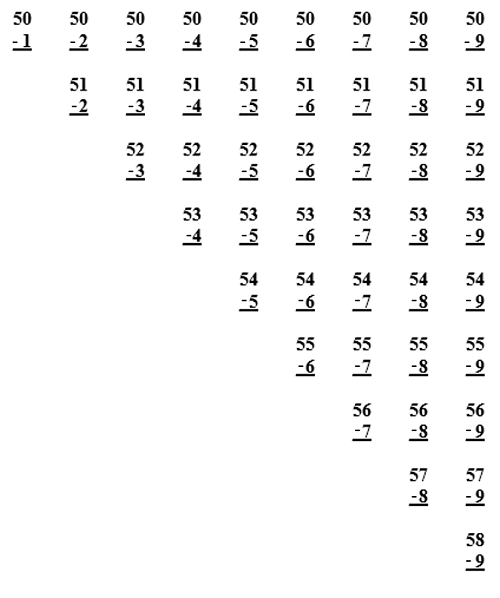
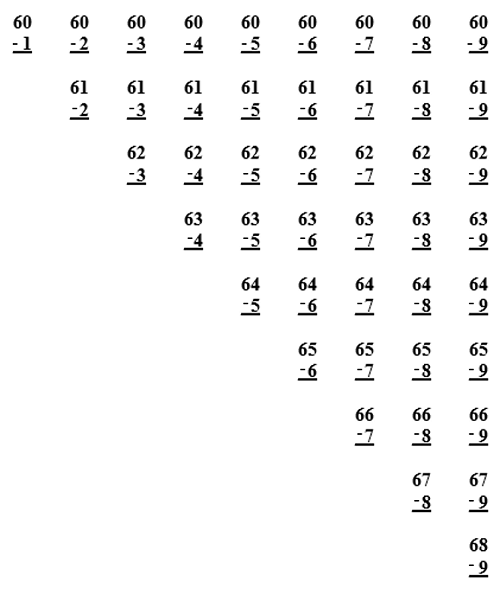
Math: Subtract Numbers Up to 70

STEP 1

  • Have the children write out and complete the subtraction exercises below on paper.

STEP 2

  • Assess mastery by reading aloud the listed problems and having the children mentally compute and recite the solutions.
  • If children have difficulties, have children redo their written practice with pencil and paper again and then reassess.

The Story of Doctor Dolittle Chapter 1: Puddleby

Chapter 1: Puddleby

Once upon a time, many years ago-when our grandfathers were little children-there was a doctor; and his name was Dolittle-John Dolittle, M.D. “M.D.” means that he was a proper doctor and knew a whole lot.

He lived in a little town called, Puddleby-on-the-Marsh. All the folks, young and old, knew him well by sight. And whenever he walked down the street in his high hat everyone would say, “There goes the Doctor!-He’s a clever man.” And the dogs and the children would all run up and follow behind him; and even the crows that lived in the church-tower would caw and nod their heads.

The house he lived in, on the edge of the town, was quite small; but his garden was very large and had a wide lawn and stone seats and weeping-willows hanging over. His sister, Sarah Dolittle, was housekeeper for him; but the Doctor looked after the garden himself.

He was very fond of animals and kept many kinds of pets. Besides the gold-fish in the pond at the bottom of his garden, he had rabbits in the pantry, white mice in his piano, a squirrel in the linen closet and a hedgehog in the cellar. He had a cow with a calf too, and an old lame horse-twenty-five years of age-and chickens, and pigeons, and two lambs, and many other animals. But his favorite pets were Dab-Dab the duck, Jip the dog, Gub-Gub the baby pig, Polynesia the parrot, and the owl Too-Too.

His sister used to grumble about all these animals and said they made the house untidy. And one day when an old lady with rheumatism came to see the Doctor, she sat on the hedgehog who was sleeping on the sofa and never came to see him anymore, but drove every Saturday all the way to Oxenthorpe, another town ten miles off, to see a different doctor.

Then his sister, Sarah Dolittle, came to him and said,

“John, how can you expect sick people to come and see you when you keep all these animals in the house? It’s a fine doctor would have his parlor full of hedgehogs and mice! That’s the fourth personage these animals have driven away. Squire Jenkins and the Parson say they wouldn’t come near your house again-no matter how sick they are. We are getting poorer every day. If you go on like this, none of the best people will have you for a doctor.”

“But I like the animals better than the ‘best people’,” said the Doctor.

“You are ridiculous,” said his sister, and walked out of the room.

So, as time went on, the Doctor got more and more animals; and the people who came to see him got less and less. Till at last he had no one left-except the Cat’s-meat-Man, who didn’t mind any kind of animals. But the Cat’s-meat-Man wasn’t very rich and he only got sick once a year-at Christmas-time, when he used to give the Doctor sixpence for a bottle of medicine.

Sixpence a year wasn’t enough to live on-even in those days, long ago; and if the Doctor hadn’t had some money saved up in his money-box, no one knows what would have happened.

And he kept on getting still more pets; and of course it cost a lot to feed them. And the money he had saved up grew littler and littler.

Then he sold his piano and let the mice live in a bureau-drawer. But the money he got for that too began to go, so he sold the brown suit he wore on Sundays and went on becoming poorer and poorer.

And now, when he walked down the street in his high hat, people would say to one another, “There goes John Dolittle, M.D.! There was a time when he was the best known doctor in the West Country-Look at him now-He hasn’t any money and his stockings are full of holes!”

But the dogs and the cats and the children still ran up and followed him through the town-the same as they had done when he was rich.

Chapter 1: The Riverbank

The Mole had been working very hard all the morning, spring-cleaning his little home. First with brooms, then with dusters; then on ladders and steps and chairs, with a brush and a pail of whitewash; till he had dust in his throat and eyes, and splashes of whitewash all over his black fur, and an aching back and weary arms. Spring was moving in the air above and in the earth below and around him, penetrating even his dark and lowly little house with its spirit of divine discontent and longing. It was small wonder, then, that he suddenly flung down his brush on the floor, and said ‘Bother!’ and ‘O blow!’ and also ‘Hang spring-cleaning!’ and bolted out of the house without even waiting to put on his coat. Something up above was calling him imperiously, and he made for the steep little tunnel which answered in his case to the gavelled carriage-drive owned by animals whose residences are nearer to the sun and air. So he scraped and scratched and scrabbled and scrooged and then he scrooged again and scrabbled and scratched and scraped, working busily with his little paws and muttering to himself, ‘Up we go! Up we go!’ till at last, pop! his snout came out into the sunlight, and he found himself rolling in the warm grass of a great meadow.

‘This is fine!’ he said to himself. ‘This is better than whitewashing!’ The sunshine struck hot on his fur, soft breezes caressed his heated brow, and after the seclusion of the cellarage he had lived in so long the carol of happy birds fell on his dulled hearing almost like a shout. Jumping off all his four legs at once, in the joy of living and the delight of spring without its cleaning, he pursued his way across the meadow till he reached the hedge on the further side.

‘Hold up!’ said an elderly rabbit at the gap. ‘Sixpence for the privilege of passing by the private road!’ He was bowled over in an instant by the impatient and contemptuous Mole, who trotted along the side of the hedge chaffing the other rabbits as they peeped hurriedly from their holes to see what the row was about. ‘Onion-sauce! Onion-sauce!’ he remarked jeeringly, and was gone before they could think of a thoroughly satisfactory reply. Then they all started grumbling at each other. ‘How STUPID you are! Why didn’t you tell him–‘ ‘Well, why didn’t YOU say–‘ ‘You might have reminded him–‘ and so on, in the usual way; but, of course, it was then much too late, as is always the case.

It all seemed too good to be true. Hither and thither through the meadows he rambled busily, along the hedgerows, across the copses, finding everywhere birds building, flowers budding, leaves thrusting-everything happy, and progressive, and occupied. And instead of having an uneasy conscience pricking him and whispering ‘whitewash!’ he somehow could only feel how jolly it was to be the only idle dog among all these busy citizens. After all, the best part of a holiday is perhaps not so much to be resting yourself, as to see all the other fellows busy working.

He thought his happiness was complete when, as he meandered aimlessly along, suddenly he stood by the edge of a full-fed river. Never in his life had he seen a river before-this sleek, sinuous, full-bodied animal, chasing and chuckling, gripping things with a gurgle and leaving them with a laugh, to fling on fresh playmates that shook themselves free, and were caught and held again. All was a-shake and a-shiver-glints and gleams and sparkles, rustle and swirl, chatter and bubble. The Mole was bewitched, entranced, fascinated. By the side of the river he trotted as one trots, when very small, by the side of a man who holds one spell-bound by exciting stories; and when tired at last, he sat on the bank, while the river still chattered on to him, a babbling procession of the best stories in the world, sent from the heart of the earth to be told at last to the insatiable sea.

As he sat on the grass and looked across the river, a dark hole in the bank opposite, just above the water’s edge, caught his eye, and dreamily he fell to considering what a nice snug dwelling-place it would make for an animal with few wants and fond of a bijou riverside residence, above flood level and remote from noise and dust. As he gazed, something bright and small seemed to twinkle down in the heart of it, vanished, then twinkled once more like a tiny star. But it could hardly be a star in such an unlikely situation; and it was too glittering and small for a glow-worm. Then, as he looked, it winked at him, and so declared itself to be an eye; and a small face began gradually to grow up round it, like a picture round a frame.

A brown little face, with whiskers.

A grave round face, with the same twinkle in its eye that had first attracted his notice.

Small neat ears and thick silky hair.

It was the Water Rat!

Then the two animals stood and regarded each other cautiously.

‘Hullo, Mole!’ said the Water Rat.

‘Hullo, Rat!’ said the Mole.

‘Would you like to come over?’ enquired the Rat presently.

‘Oh, it’s all very well to TALK,’ said the Mole, rather pettishly, he being new to a river and riverside life and its ways.

The Rat said nothing, but stooped and unfastened a rope and hauled on it; then lightly stepped into a little boat which the Mole had not observed. It was painted blue outside and white within, and was just the size for two animals; and the Mole’s whole heart went out to it at once, even though he did not yet fully understand its uses.

The Rat sculled smartly across and made fast. Then he held up his forepaw as the Mole stepped gingerly down. ‘Lean on that!’ he said. ‘Now then, step lively!’ and the Mole to his surprise and rapture found himself actually seated in the stern of a real boat.

‘This has been a wonderful day!’ said he, as the Rat shoved off and took to the sculls again. ‘Do you know, I’ve never been in a boat before in all my life.’

‘What?’ cried the Rat, open-mouthed: ‘Never been in a-you never-well I-what have you been doing, then?’

‘Is it so nice as all that?’ asked the Mole shyly, though he was quite prepared to believe it as he leant back in his seat and surveyed the cushions, the oars, the rowlocks, and all the fascinating fittings, and felt the boat sway lightly under him.

‘Nice? It’s the ONLY thing,’ said the Water Rat solemnly, as he leaned forward for his stroke. ‘Believe me, my young friend, there is NOTHING-absolute nothing-half so much worth doing as simply messing about in boats. Simply messing,’ he went on dreamily: ‘messing-about-in-boats; messing–‘

‘Look ahead, Rat!’ cried the Mole suddenly.

It was too late. The boat struck the bank full tilt. The joyous oarsman lay on his back at the bottom of the boat, his heels in the air.

‘-about in boats-or WITH boats,’ the Rat went on composedly, picking himself up with a pleasant laugh. ‘In ’em or out of ’em, it doesn’t matter. Nothing seems really to matter, that’s the charm of it. Whether you get away, or whether you don’t; whether you arrive at your destination or whether you reach somewhere else, or whether you never get anywhere at all, you’re always busy, and you never do anything in particular; and when you’ve done there’s always something else to do, and you can do it if you like, but you’d much better not. Look here! If you’ve really nothing else on hand this morning, supposing we drop down the river together, and have a long day of it?’

The Mole waggled his toes from sheer happiness, spread his chest with a sigh of full contentment, and leaned back blissfully into the soft cushions. ‘WHAT a day I’m having!’ he said. ‘Let us start at once!’

‘Hold hard a minute, there!’ said the Rat. He looped the painter through a ring in his landing-stage, climbed up into his hole above, and after a short interval reappeared staggering under a fat, wicker luncheon-basket.

‘Shove that under your feet,’ he observed to the Mole, as he passed it down into the boat. Then he untied the painter and took the sculls again.

‘What’s inside it?’ asked the Mole, wriggling with curiosity.

‘There’s cold chicken inside it,’ replied the Rat briefly; ‘coldtonguecoldhamcoldbeefpickledgherkinssaladfrenchrollscresssandwichespottedmeatgingerbeerlemonadesodawater–‘

‘O stop, stop,’ cried the Mole in ecstasies: ‘This is too much!’

‘Do you really think so?’ enquired the Rat seriously. ‘It’s only what I always take on these little excursions; and the other animals are always telling me that I’m a mean beast and cut it VERY fine!’

The Mole never heard a word he was saying. Absorbed in the new life he was entering upon, intoxicated with the sparkle, the ripple, the scents and the sounds and the sunlight, he trailed a paw in the water and dreamed long waking dreams. The Water Rat, like the good little fellow he was, sculled along steadily and forbore to disturb him.

‘I like your clothes awfully, old chap,’ he remarked after some half an hour or so had passed. ‘I’m going to get a black velvet smoking-suit myself someday, as soon as I can afford it.’

‘I beg your pardon,’ said the Mole, pulling himself together with an effort. ‘You must think me very rude; but all this is so new to me. So-this-is-a-River!’

‘THE River,’ corrected the Rat.

‘And you really live by the river? What a jolly life!’

‘By it and with it and on it and in it,’ said the Rat. ‘It’s brother and sister to me, and aunts, and company, and food and drink, and (naturally) washing. It’s my world, and I don’t want any other. What it hasn’t got isn’t worth having, and what it doesn’t know is not worth knowing. Lord! the times we’ve had together! Whether in winter, summer, spring or autumn, it’s always got its fun and its excitements. When the floods are on in February, and my cellars and basement are brimming with drink that’s no good to me, and the brown water runs by my best bedroom window; or again when it all drops away and, shows patches of mud that smells like plum-cake, and the rushes and weed clog the channels, and I can potter about dry shod over most of the bed of it and find fresh food to eat, and things careless people have dropped out of boats!’

‘But isn’t it a bit dull at times?’ the Mole ventured to ask. ‘Just you and the river, and no one else to pass a word with?’

‘No one else to-well, I mustn’t be hard on you,’ said the Rat with forbearance. ‘You’re new to it, and of course you don’t know. The bank is so crowded nowadays that many people are moving away altogether: O no, it isn’t what it used to be, at all. Otters, kingfishers, dabchicks, moorhens, all of them all about all day long and always wanting you to DO something-as if a fellow had no business of his own to attend to!’

‘What lies over THERE’ asked the Mole, waving a paw towards a background of woodland that darkly framed the water-meadows on one side of the river.

‘That? O, that’s just the Wild Wood,’ said the Rat shortly. ‘We don’t go there very much, we river-bankers.’

‘Aren’t they-aren’t they very NICE people in there?’ asked the Mole, a trifle nervously.

‘W-e-ll,’ replied the Rat, ‘let me see. The squirrels are all right. AND the rabbits-some of ’em, but rabbits are a mixed lot. And then there’s Badger, of course. He lives right in the heart of it; wouldn’t live anywhere else, either, if you paid him to do it. Dear old Badger! Nobody interferes with HIM. They’d better not,’ he added significantly.

‘Why, who SHOULD interfere with him?’ asked the Mole.

‘Well, of course-there’s the others,’ explained the Rat in a hesitating sort of way.

‘Weasels-and stoats-and foxes-and so on. They’re all right in a way-I’m very good friends with them-pass the time of day when we meet, and all that-but they break out sometimes, there’s no denying it, and then-well, you just can’t trust them, and that’s the fact.’

The Mole knew well that it is quite against animal-etiquette to dwell on possible trouble ahead, or even to allude to it; so he dropped the subject.

‘And beyond the Wild Wood again?’ he asked: ‘Where it’s all blue and dim, and one sees what may be hills or perhaps they mayn’t, and something like the smoke of towns, or is it only cloud-drift?’

‘Beyond the Wild Wood comes the Wide World,’ said the Rat. ‘And that’s something that doesn’t matter, either to you or me. I’ve never been there, and I’m never going, nor you either, if you’ve got any sense at all. Don’t ever refer to it again, please. Now then! Here’s our backwater at last, where we’re going to lunch.’

Leaving the main stream, they now passed into what seemed at first sight like a little land-locked lake. Green turf sloped down to either edge, brown snaky tree-roots gleamed below the surface of the quiet water, while ahead of them the silvery shoulder and foamy tumble of a weir, arm-in-arm with a restless dripping mill-wheel, that held up in its turn a grey-gabled mill-house, filled the air with a soothing murmur of sound, dull and smothery, yet with little clear voices speaking up cheerfully out of it at intervals. It was so very beautiful that the Mole could only hold up his forepaws and gasp, ‘O my! O my! O my!’

The Rat brought the boat alongside the bank, made her fast, helped the still awkward Mole safely ashore, and swung out the luncheon-basket. The Mole begged as a favour to be allowed to unpack it all by himself; and the Rat was very pleased to indulge him, and to sprawl at full length on the grass and rest, while his excited friend shook out the table-cloth and spread it, took out all the mysterious packages one by one and arranged their contents in due order, still gasping, ‘O my! O my!’ at each fresh revelation. When all was ready, the Rat said, ‘Now, pitch in, old fellow!’ and the Mole was indeed very glad to obey, for he had started his spring-cleaning at a very early hour that morning, as people WILL do, and had not paused for bite or sup; and he had been through a very great deal since that distant time which now seemed so many days ago.

‘What are you looking at?’ said the Rat presently, when the edge of their hunger was somewhat dulled, and the Mole’s eyes were able to wander off the table-cloth a little.

‘I am looking,’ said the Mole, ‘at a streak of bubbles that I see travelling along the surface of the water. That is a thing that strikes me as funny.’

‘Bubbles? Oho!’ said the Rat, and chirruped cheerily in an inviting sort of way.

A broad glistening muzzle showed itself above the edge of the bank, and the Otter hauled himself out and shook the water from his coat.

‘Greedy beggars!’ he observed, making for the provender. ‘Why didn’t you invite me, Ratty?’

‘This was an impromptu affair,’ explained the Rat. ‘By the way-my friend Mr. Mole.’

‘Proud, I’m sure,’ said the Otter, and the two animals were friends forthwith.

‘Such a rumpus everywhere!’ continued the Otter. ‘All the world seems out on the river today. I came up this backwater to try and get a moment’s peace, and then stumble upon you fellows!-At least-I beg pardon-I didn’t exactly mean that, you know.’

There was a rustle behind them, proceeding from a hedge wherein last year’s leaves still clung thick, and a stripy head, with high shoulders behind it, peered forth on them.

‘Come on, old Badger!’ shouted the Rat.

The Badger trotted forward a pace or two; then grunted, ‘H’m! Company,’ and turned his back and disappeared from view.

‘That’s JUST the sort of fellow he is!’ observed the disappointed Rat. ‘Simply hates Society! Now we shan’t see anymore of him today. Well, tell us, WHO’S out on the river?’

‘Toad’s out, for one,’ replied the Otter. ‘In his brand-new wager-boat; new togs, new everything!’

The two animals looked at each other and laughed.

‘Once, it was nothing but sailing,’ said the Rat, ‘Then he tired of that and took to punting. Nothing would please him but to punt all day and every day, and a nice mess he made of it. Last year it was house-boating, and we all had to go and stay with him in his house-boat, and pretend we liked it. He was going to spend the rest of his life in a house-boat. It’s all the same, whatever he takes up; he gets tired of it, and starts on something fresh.’

‘Such a good fellow, too,’ remarked the Otter reflectively: ‘But no stability-especially in a boat!’

From where they sat they could get a glimpse of the main stream across the island that separated them; and just then a wager-boat flashed into view, the rower-a short, stout figure-splashing badly and rolling a good deal, but working his hardest. The Rat stood up and hailed him, but Toad-for it was he-shook his head and settled sternly to his work.

‘He’ll be out of the boat in a minute if he rolls like that,’ said the Rat, sitting down again.

‘Of course he will,’ chuckled the Otter. ‘Did I ever tell you that good story about Toad and the lock-keeper? It happened this way. Toad….’

An errant May-fly swerved unsteadily athwart the current in the intoxicated fashion affected by young bloods of May-flies seeing life. A swirl of water and a ‘cloop!’ and the May-fly was visible no more.

Neither was the Otter.

The Mole looked down. The voice was still in his ears, but the turf whereon he had sprawled was clearly vacant. Not an Otter to be seen, as far as the distant horizon.

But again, there was a streak of bubbles on the surface of the river.

The Rat hummed a tune, and the Mole recollected that animal-etiquette forbade any sort of comment on the sudden disappearance of one’s friends at any moment, for any reason or no reason whatever.

‘Well, well,’ said the Rat, ‘I suppose we ought to be moving. I wonder which of us had better pack up the luncheon-basket?’ He did not speak as if he was frightfully eager for the treat.

‘O, please let me,’ said the Mole. So, of course, the Rat let him.

Packing the basket was not quite such pleasant work as unpacking’ the basket. It never is. But the Mole was bent on enjoying everything, and although just when he had got the basket packed and strapped up tightly he saw a plate staring up at him from the grass, and when the job had been done again the Rat pointed out a fork which anybody ought to have seen, and last of all, behold! the mustard pot, which he had been sitting on without knowing it-still, somehow, the thing got finished at last, without much loss of temper.

The afternoon sun was getting low as the Rat sculled gently homewards in a dreamy mood, murmuring poetry-things over to himself, and not paying much attention to Mole. But the Mole was very full of lunch, and self-satisfaction, and pride, and already quite at home in a boat (so he thought) and was getting a bit restless besides: and presently he said, ‘Ratty! Please, I want to row, now!’

The Rat shook his head with a smile. ‘Not yet, my young friend,’ he said-‘wait till you’ve had a few lessons. It’s not so easy as it looks.’

The Mole was quiet for a minute or two. But he began to feel more and more jealous of Rat, sculling so strongly and so easily along, and his pride began to whisper that he could do it every bit as well. He jumped up and seized the sculls, so suddenly, that the Rat, who was gazing out over the water and saying more poetry-things to himself, was taken by surprise and fell backwards off his seat with his legs in the air for the second time, while the triumphant Mole took his place and grabbed the sculls with entire confidence.

‘Stop it, you SILLY ass!’ cried the Rat, from the bottom of the boat. ‘You can’t do it! You’ll have us over!’

The Mole flung his sculls with a flourish, and made a great dig at the water. He missed the surface altogether, his legs flew up over his head, and he found himself lying on the top of the prostrate Rat. Greatly alarmed, he made a grab at the side of the boat, and the next moment-Sploosh!

Over went the boat, and he found himself struggling in the river.

O my, how cold the water was, and O, how VERY wet it felt. How it sang in his ears as he went down, down, down! How bright and welcome the sun looked as he rose to the surface coughing and spluttering! How black was his despair when he felt himself sinking again! Then a firm paw gripped him by the back of his neck. It was the Rat, and he was evidently laughing-the Mole could FEEL him laughing, right down his arm and through his paw, and so into his-the Mole’s-neck.

The Rat got hold of a scull and shoved it under the Mole’s arm; then he did the same by the other side of him and, swimming behind, propelled the helpless animal to shore, hauled him out, and set him down on the bank, a squashy, pulpy lump of misery.

When the Rat had rubbed him down a bit, and wrung some of the wet out of him, he said, ‘Now, then, old fellow! Trot up and down the towing-path as hard as you can, till you’re warm and dry again, while I dive for the luncheon-basket.’

So the dismal Mole, wet without and ashamed within, trotted about till he was fairly dry, while the Rat plunged into the water again, recovered the boat, righted her and made her fast, fetched his floating property to shore by degrees, and finally dived successfully for the luncheon-basket and struggled to land with it.

When all was ready for a start once more, the Mole, limp and dejected, took his seat in the stern of the boat; and as they set off, he said in a low voice, broken with emotion, ‘Ratty, my generous friend! I am very sorry indeed for my foolish and ungrateful conduct. My heart quite fails me when I think how I might have lost that beautiful luncheon-basket. Indeed, I have been a complete ass, and I know it. Will you overlook it this once and forgive me, and let things go on as before?’

‘That’s all right, bless you!’ responded the Rat cheerily. ‘What’s a little wet to a Water Rat? I’m more in the water than out of it most days. Don’t you think any more about it; and, look here! I really think you had better come and stop with me for a little while. It’s very plain and rough, you know-not like Toad’s house at all-but you haven’t seen that yet; still, I can make you comfortable. And I’ll teach you to row, and to swim, and you’ll soon be as handy on the water as any of us.’

The Mole was so touched by his kind manner of speaking that he could find no voice to answer him; and he had to brush away a tear or two with the back of his paw. But the Rat kindly looked in another direction, and presently as the Mole’s spirits revived again, he was even able to give some straight back-talk to a couple of moorhens who were sniggering to each other about his bedraggled appearance.

When they got home, the Rat made a bright fire in the parlor, and planted the Mole in an arm-chair in front of it, having fetched down a dressing-gown and slippers for him, and told him river stories till supper-time. Very thrilling stories they were, too, to an earth-dwelling animal like Mole. Stories about weirs, and sudden floods, and leaping pike, and steamers that flung hard bottles-at least bottles were certainly flung, and FROM steamers, so presumably BY them; and about herons, and how particular they were whom they spoke to; and about adventures down drains, and night-fishings with Otter, or excursions far a-field with Badger. Supper was a most cheerful meal; but very shortly afterwards a terribly sleepy Mole had to be escorted upstairs by his considerate host, to the best bedroom, where he soon laid his head on his pillow in great peace and contentment, knowing that his new-found friend the River was lapping the sill of his window.

This day was only the first of many similar ones for the emancipated Mole, each of them longer and fuller of interest as the ripening summer moved onward. He learnt to swim and to row, and entered into the joy of running water; and with his ear to the reed-stems he caught, at intervals, something of what the wind went whispering so constantly among them.
Chronological Events in the Life of Jesus and John the Baptist

This timeline goes from the Birth of John the Baptist to the Ascension of Jesus. It includes other historic events that were happening during this same time frame. There are some secular resources that links to other websites.

All Dates are Approximate.

  • 6 BC Birth of John the Baptist
    • Luke 1
    • John 1:6
  • 6 BC Augustus Taxes the Roman Empire
    • Luke 2
  • 5 BC Birth of Jesus
  • 5 BC Visit of the Magi
  • 5 BC Escape to Egypt
    • Matthew 2:13
  • 4 BC Slaughter of Infants
    • Matthew 2:16
  • 4 BC Return to Nazareth
    • Matthew 2:23
  • 4 AD Adoption of Tiberius as heir to Augustus after the deaths of Gaius and Lucius Caesar.
  • 5 AD Tiberius campaigns in Germania.
  • 6 AD Revolts in Pannonia and Illyricum.
  • 8 AD The future emperor Claudius is appointed an augur, his only official post under Augustus.
  • 8 AD The Boy Jesus at the Temple
    • Luke 2:41
  • 9 AD Birth of the Emperor Vespasian in the town of Reate.
  • 9 AD The Battle of Teutoburg Forest between P. Quintilius ending in a complete route (including the destruction of 3 legions) for Rome.
  • 9 AD The Ara Pacis (Altar of Peace) is completed by Augustus in Rome.
  • 14 AD Death of the Emperor Augustus, in the city of Nola in Italy. Ascension of Tiberius
  • 14 AD Mutiny of the Rhine legions upon the news of the death of Augustus which is quelled by Germanicus Caesar.
  • 14 – 16 AD Germanicus Caesar campaigns against the Germanic tribes.
  • 14 AD L. Aelius Sejanus is appointed as Praetorian Prefect.
  • 14 AD Death of the Roman historian Livy, in the city of Patavium, Italy.
  • 14 AD The aqueduct, the Pont du Gard, is completed near modern Nimes in Gaul.
  • 15 AD Emperor Tiberius transfers the elections from the popular assemblies to the Senate.
  • 15 AD Birth of the Emperor Vitellius.
  • 17 AD Death of the Roman writer Ovid, who died in Tomis, Moesia while exile, apparantly because of offenses to Augustus’ moral code.
  • 19 AD Death of Germanicus, possibly but not necessarily by the direct order of Tiberius.
  • 22 AD Construction of the Castra Praetoria (Praetorian barracks) by Sejanus is completed and the Praetorians are forever changed into a political force.
  • 23 AD Birth of the Roman historian Pliny the Elder, in the town of Novum Comum, in Italy.
  • 26 AD Pontius Pilate is appointed as the prefect of Judaea.
  • 26 AD Tiberius retires to his estate on Capri, effectively giving Sejanus unlimited imperial authority.
  • 26 AD John the Baptist Prepares the Way
    • Matthew 3
    • Mark 1:4
    • Luke 3
    • John 1:15
  • 26 AD The Baptism of Jesus
    • Matthew 3:13
    • Mark 1:9,
    • Luke 3:21
  • 27 AD Temptation of Jesus
    • Matthew 4,
    • Mark 1:12,
    • Luke 4
  • 27 AD Jesus Calls his First Disciples
    • Matthew 4:18,
    • Mark 1:16,
    • Luke 5
  • 27 AD Wedding at Cana
    • John 2
  • 27 AD Jesus Teaches Nicodemus
    • John 3
  • 27 AD Jesus Testifies to the Samaritan Woman
    • John 4
  • 27 AD Sermon on the Mount
    • Matthew 5 – 7
  • 28 AD Instructions on Prayer
    • Luke 11
  • 28 AD Jesus Ministers in Galilee
    • Matthew 8
    • Mark 2,
    • Luke 4:14
  • 28 AD The Pool of Bethesda
    • John 5
  • 28 AD Jesus Lord of the Sabbath
    • Matthew 12,
    • Mark 3,
    • Luke 6
  • 28 AD Jesus Answers John’s Disciples
    • Matthew 11,
    • Luke 7
  • 28 AD Jesus Speaks Many Parables
    • Matthew 13,
    • Mark 4,
    • Luke 8
  • 28 AD Jesus Heals a Demoniac
    • Matthew 8:28,
    • Mark 5,
    • Luke 8:26
  • 28 AD Jesus Heals a Paralytic
    • Matthew 9
  • 28 AD John the Baptist is executed by Herod Antipas, son of King Herod in Judaea.
    • Matthew 14,
    • Mark 6:14
  • 29 AD Livia, the wife of Augustus, dies in Rome at the age of 86.
  • 29 AD Jesus Sends out His Twelve Apostles
    • Matthew 10,
    • Mark 6
  • 29 AD Jesus Feeds the 5,000
    • Matthew 14:15,
    • Mark 6:30,
    • Luke 9,
    • John 6
  • 29 AD Teachings on Clean and Unclean
    • Matthew 15,
    • Mark 7
  • 29 AD Peter’s Confession of Christ
    • Matthew 16,
    • Mark 8,
    • Luke 9:18
  • 29 AD The Transfiguration
    • Matthew 17,
    • Mark 9,
    • Luke 9:28
  • 29 AD Greatest and Least in the Kingdom
    • Matthew 18
  • 29 AD Jesus Sends out the Seventy-two
    • Luke 10
  • 29 AD Jesus Teaches at the Feast of Tabernacles
    • John 7
  • 29 AD The Woman Caught in Adultery
    • John 8
  • 29 AD Jesus Affirms He is the Son of God
    • John 9
  • 29 AD The Shepherd and His Flock
    • John 10
  • 30 AD Birth of the Emperor Nerva in the city of Narnia.
  • 30 AD Jesus Speaks More Parables
    • Luke 12 – 16
  • 30 AD Jesus Cleanses the Ten Lepers
    • Luke 17
  • 30 AD Jesus Raises Lazarus
    • John 11
  • 30 AD Estimated date of the crucifixion of Jesus Christ.
    • 30 AD Final Journey to Jerusalem
      • Matthew 19, 20,
      • Mark 10,
      • Luke 18
    • 30 AD The Triumphal Entry
      • Matthew 21,
      • Mark 11,
      • Luke 19,
      • John 12
    • 30 AD Closing Ministry in Jerusalem
      • Matthew 22 – 25,
      • Mark 12, 13,
      • Luke 20, 21
    • 30 AD Thursday Before Passover
      • Matthew 26,
      • Mark 14,
      • Luke 22,
      • John 13
    • 30 AD Jesus Comforts His Disciples
      • John 14
    • 30 AD Jesus the True Vine
      • John 15
    • 30 AD Jesus Promises the Holy Spirit
      • John 16
    • 30 AD Jesus’ Intercessory prayers
      • John 17
    • 30 AD Jesus’ Betrayal, Trial, Crucifixion
      • Matthew 27,
      • Mark 15,
      • Luke 23,
      • John 18, 19
    • 30 AD Jesus’ Resurrection
      • Matthew 28,
      • Mark 16,
      • Luke 24,
      • John 20, 21
    • 30 AD The Ascension
      • Acts 1

How to Subtract Positive and Negative Numbers: A Step-by-Step Guide

To Subtract a positive number from positive number:

Step 1: Subtract the smaller number from the bigger number.
Step 2: I f the 1st number is the bigger number; the answer is positive.

  • example: 7-(6) = 1

If the 1st number is smaller, the answer is negative.

  • example: (64) – (72) =-8


To Subtract a negative number from a positive number:

Step 1: Add the two numbers.
Step 2: Remember the answer will always be a negative number.

  • example: -72-(+64) =-136
  • example: -5-(+6) = -11

To Subtract a positive number from a negative number:

Step 1: Get rid of the double negatives by replacing the two negatives with a plus sign and rewrite the problem accordingly.

  • Example: 72 – (-64) = 72+64

Step 2: Simple add the numbers together as normal.

  • example: 72 + 64 = 136
  • example: 2- (- 5) = 2 + 5 = 7

To subtract a negative number from a negative number:

Step 1: Get rid of the double negatives by replacing the two negatives with a plus sign and rewrite the problem accordingly.

  • Example -72 – (-64) = -72 + 64 =

Step 2: Subtract the smaller number from the bigger number.

  • Example -72 – (-64) = -72 + 64 =
    • 72-64 = 8

Step 3: Determine if the answer is negative or positive:

  • -72 + 64 = -8

Math:  Subtract Numbers Up to 60

STEP 1

  • Have the children write out and complete the subtraction exercises below on paper.

STEP 2

  • Assess mastery by reading aloud the listed problems and having the children mentally compute and recite the solutions.
  • If children have difficulties, have children redo their written practice with pencil and paper again and then reassess.

TIMOTHY AND HIS MOTHER EUNICE

TIMOTHY AND HIS MOTHER EUNICE

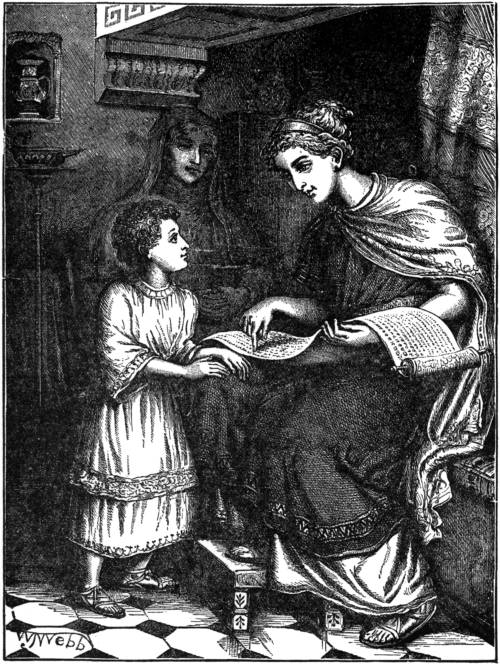
Timothy was a youthful and earnest disciple of Jesus Christ, whom Paul loved dearly. Paul had found him during one of his missionary journeys, and, discovering how highly he was esteemed as a Christian, had selected him as his assistant. Afterward Timothy became Paul’s companion in travel, and the first bishop of Ephesus. While Timothy was at Ephesus, Paul wrote two letters to him. They are contained in the Bible, and are called the Epistles to Timothy. In them Paul says many kind and wise things, giving Timothy directions how to act in his high Christian office. But Paul also speaks of Timothy’s early days, and of his mother and grandmother. These were both good women, who loved God, and diligently studied the Holy Scriptures. The mother’s name was Eunice. She was a Jewess. The grandmother’s name was Lois. Both loved the little boy Timothy, or Timotheus as he was called, and they sought to instil into his young mind and heart the love of God and the knowledge of His holy Word. In our picture we see Eunice teaching her son. She has not a bound Bible, but a manuscript, wound round small rollers. From this she reads to Timothy; while Lois, the aged grandmother, sits by.

Paul warned Timothy not to forget the teaching of his good mother and grandmother; and especially to value his knowledge of the Scriptures. Because, said Paul, “they are able to make thee wise unto salvation.” Many young folks have good mothers and grandmothers, who love to teach them about Jesus. Are they receiving this teaching as Timothy did, and being made wise unto salvation?

LOIS, EUNICE AND TIMOTHY