Have children use physical objects to demonstrate and solve these exercises, such as an abacus, toys, or beans.
STEP 2
Have children write out each problem and solution in equation form. For example, children write ’20, 18, 16, 14, 12, 10, 8, 6, 4, 2, 0′ for ‘Begin with 20, and subtract by 2’s to 0.’
STEP 3
Assess mastery by reading aloud the listed problems and having the children mentally compute and recite the solutions.
If children have difficulties, work with physical objects again and then reassess.
Remember it was not that very long ago that schools taught the 3 Rs. The taught reading, writing, and arithmetic. Now think 🤔 about what a child can do with the 3 Rs.
Reading
Once a child can read it opens up a world of possibilities for that child.
They can learn:
How to do almost anything with a How to book.
crafts
cooking
basic repair of
cars
bikes
homes
etc. the sky is the limit
History: it is mostly reading.
Science: in the lower grades there is more reading than anything else. Even for the upper grades there is a lot of reading. Think about Science Magazine, Scientific Reports, and Science Textbooks.
Writing
Once a child can write it allows them to:
organize information
take notes
share information
reports
book reports
science reports
history reports
explore new avenues of creativity by writing
stories
songs
poems
Arithmetic
Once a child understands adding, subtracting, multiplying, and dividing the child is now ready for using those same operations with higher level math.
Once a child can read charts and graphs, they are able to better organize information to better understand it.
Once a child learns how to count money, the child is better able to mange money.
Once a child learns to tell time, the child is better able to manage time.
So do your child a favor. Teach them how to think by teaching them the 3 Rs. Then guide them through the rest of the adventure of learning ✨️ by showing them the way. Don’t teach them what to think by simply giving them all the answers. Instead teach them how to obtain the answers.
Here is Blooms Taxonomy. Let it be your guide to asking better questions to aid you in your role as the guide in your child’s educational journey.
Instructor Note: No such letters as included in this lesson exist. This chapter features imaginary letters written by the book author, Van Loon, to convey his personal retelling of the story of Jesus.
In the autumn of the year of the city 783 (which would be 62 A.D., in our way of counting time) Aesculapius Cultellus, a Roman physician, wrote to his nephew who was with the army in Syria as follows:
My dear Nephew,
A few days ago I was called in to prescribe for a sick man named Paul. He appeared to be a Roman citizen of Jewish parentage, well-educated and of agreeable manners. I had been told that he was here in connection with a lawsuit, an appeal from one of our provincial courts, Caesarea or some such place in the eastern Mediterranean. He had been described to me as a “wild and violent” fellow who had been making speeches against the People and against the Law. I found him very intelligent and of great honesty.
A friend of mine who used to be with the army in Asia Minor tells me that he heard something about him in Ephesus where he was preaching sermons about a strange new god. I asked my patient if this were true and whether he had told the people to rebel against the will of our beloved Emperor. Paul answered me that the Kingdom of which he had spoken was not of this world and he added many strange utterances which I did not understand, but which were probably due to his fever.
His personality made a great impression upon me and I was sorry to hear that he was killed on the Ostian Road a few days ago. Therefore, I am writing this letter to you. When next you visit Jerusalem, I want you to find out something about my friend Paul and the strange Jewish prophet, who seems to have been his teacher. Our slaves are getting much excited about this so-called Messiah, and a few of them, who openly talked of the new kingdom (whatever that means) have been crucified. I would like to know the truth about all these rumors and I am
Your devoted Uncle,
AESCULAPIUS CULTELLUS.
Six weeks later, Gladius Ensa, the nephew, a captain of the VII Gallic Infantry, answered as follows:
My dear Uncle,
I received your letter and I have obeyed your instructions.
Two weeks ago our brigade was sent to Jerusalem. There have been several revolutions during the last century and there is not much left of the old city. We have been here now for a month and tomorrow we shall continue our march to Petra, where there has been trouble with some of the Arab tribes. I shall use this evening to answer your questions, but pray do not expect a detailed report.
I have talked with most of the older men in this city but few have been able to give me any definite information. A few days ago, a peddler came to the camp. I bought some of his olives and I asked him whether he had ever heard of the famous Messiah who was killed when he was young. He said that he remembered it very clearly, because his father had taken him to Golgotha (a hill just outside the city) to see the execution, and to show him what became of the enemies of the laws of the people of Judaea. He gave me the address of one Joseph, who had been a personal friend of the Messiah and told me that I had better go and see him if I wanted to know more.
This morning I went to call on Joseph. He was quite an old man. He had been a fisherman on one of the fresh-water lakes. His memory was clear, and from him at last I got a fairly definite account of what had happened during the troublesome days before I was born.
Tiberius, our great and glorious emperor, was on the throne, and an officer of the name of Pontius Pilatus was governor of Judaea and Samaria. Joseph knew little about this Pilatus. He seemed to have been an honest enough official who left a decent reputation as procurator of the province. In the year 755 or 756 (Joseph had forgotten when) Pilatus was called to Jerusalem on account of a riot. A certain young man (the son of a carpenter of Nazareth) was said to be planning a revolution against the Roman government. Strangely enough our own intelligence officers, who are usually well informed, appear to have heard nothing about it, and when they investigated the matter they reported that the carpenter was an excellent citizen and that there was no reason to proceed against him. But the old-fashioned leaders of the Jewish faith, according to Joseph, were much upset. They greatly disliked his popularity with the masses of the poorer Hebrews. The “Nazarene” (so they told Pilatus) had publicly claimed that a Greek or a Roman or even a Philistine, who tried to live a decent and honorable life, was quite as good as a Jew who spent his days studying the ancient laws of Moses. Pilatus does not seem to have been impressed by this argument, but when the crowds around the temple threatened to lynch Jesus, and kill all his followers, he decided to take the carpenter into custody to save his life.
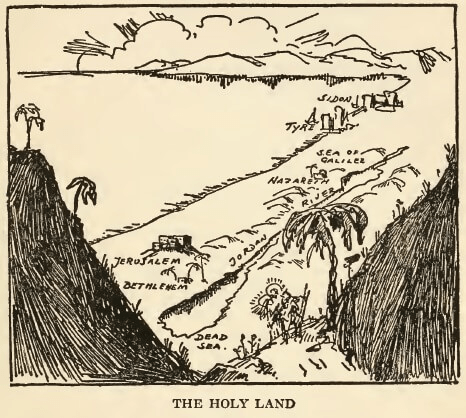
He does not appear to have understood the real nature of the quarrel. Whenever he asked the Jewish priests to explain their grievances, they shouted “heresy” and “treason” and got terribly excited. Finally, so Joseph told me, Pilatus sent for Joshua (that was the name of the Nazarene, but the Greeks who live in this part of the world always refer to him as Jesus) to examine him personally. He talked to him for several hours. He asked him about the “dangerous doctrines” which he was said to have preached on the shores of the sea of Galilee. But Jesus answered that he never referred to politics. He was not so much interested in the bodies of men as in Man’s soul. He wanted all people to regard their neighbors as their brothers and to love one single god, who was the father of all living beings.
Pilatus, who seems to have been well versed in the doctrines of the Stoics and the other Greek philosophers, does not appear to have discovered anything seditious in the talk of Jesus. According to my informant he made another attempt to save the life of the kindly prophet. He kept putting the execution off. Meanwhile the Jewish people, lashed into fury by their priests, got frantic with rage. There had been many riots in Jerusalem before this and there were only a few Roman soldiers within calling distance. Reports were being sent to the Roman authorities in Caesarea that Pilatus had “fallen a victim to the teachings of the Nazarene.” Petitions were being circulated all through the city to have Pilatus recalled, because he was an enemy of the Emperor. You know that our governors have strict instructions to avoid an open break with their foreign subjects. To save the country from civil war, Pilatus finally sacrificed his prisoner, Joshua, who behaved with great dignity and who forgave all those who hated him. He was crucified amidst the howls and the laughter of the Jerusalem mob.
That is what Joseph told me, with tears running down his old cheeks. I gave him a gold piece when I left him, but he refused it and asked me to hand it to one poorer than himself. I also asked him a few questions about your friend Paul. He had known him slightly. He seems to have been a tent maker who gave up his profession that he might preach the words of a loving and forgiving god, who was so very different from that Jehovah of whom the Jewish priests are telling us all the time. Afterwards, Paul appears to have travelled much in Asia Minor and in Greece, telling the slaves that they were all children of one loving Father and that happiness awaits all, both rich and poor, who have tried to live honest lives and have done good to those who were suffering and miserable.
I hope that I have answered your questions to your satisfaction. The whole story seems very harmless to me as far as the safety of the state is concerned. But then, we Romans never have been able to understand the people of this province. I am sorry that they have killed your friend Paul. I wish that I were at home again, and I am, as ever,
As for Sulla, he became “Dictator,” which meant sole and supreme ruler of all the Roman possessions. He ruled Rome for four years, and he died quietly in his bed, having spent the last year of his life tenderly raising his cabbages, as was the custom of so many Romans who had spent a lifetime killing their fellowmen.
But conditions did not grow better. On the contrary, they grew worse. Another general, Gnaeus Pompeius, or Pompey, a close friend of Sulla, went east to renew the war against the ever troublesome Mithridates. He drove that energetic potentate into the mountains where Mithridates took poison and killed himself, well knowing what fate awaited him as a Roman captive. Next, he re-established the authority of Rome over Syria, destroyed Jerusalem, roamed through western Asia, trying to revive the myth of Alexander the Great, and at last (in the year 62) returned to Rome with a dozen shiploads of defeated Kings and Princes and Generals, all of whom were forced to march in the triumphal procession of this enormously popular Roman who presented his city with the sum of forty million dollars in plunder.
It was necessary that the government of Rome be placed in the hands of a strong ruler. Only a few months before, the town had almost fallen into the hands of a good-for-nothing young aristocrat by the name of Catiline, who had gambled away his money and hoped to reimburse himself for his losses by a little plundering. Cicero, a public-spirited lawyer, had discovered the plot, had warned the Senate, and had forced Catiline to flee. But there were other young men with similar ambitions and it was no time for idle talk.
Pompey organized a triumvirate which was to take charge of affairs. He became the leader of this Vigilante Committee. Gaius Julius Caesar, who had made a reputation for himself as governor of Spain, was the second in command. The third was an indifferent sort of person by the name of Crassus. He had been elected because he was incredibly rich, having been a successful contractor of war supplies. Crassus soon went upon an expedition against the Parthians and was killed.
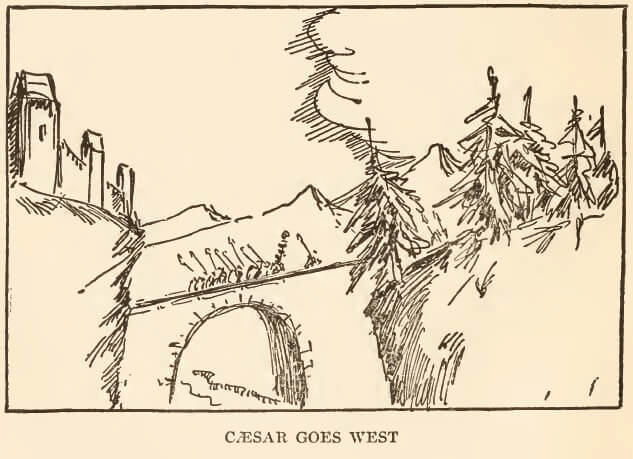
As for Caesar, who was by far the ablest of the three, he decided that he needed a little more military glory to become a popular hero. He crossed the Alps and conquered that part of the world which is now called France. Then he hammered a solid wooden bridge across the Rhine and invaded the land of the wild Teutons. Finally, he took ship and visited England. Heaven knows where he might have ended if he had not been forced to return to Italy. Pompey, so he was informed, had been appointed dictator for life. This of course meant that Caesar was to be placed on the list of the “retired officers,” and the idea did not appeal to him. He remembered that he had begun life as a follower of Marius. He decided to teach the Senators and their “dictator” another lesson. He crossed the Rubicon River which separated the province of Cis-alpine Gaul from Italy. Everywhere he was received as the “friend of the people.” Without difficulty Caesar entered Rome and Pompey fled to Greece. Caesar followed him and defeated his followers near Pharsalus. Pompey sailed across the Mediterranean and escaped to Egypt. When he landed he was murdered by order of young king Ptolemy. A few days later Caesar arrived. He found himself caught in a trap. Both the Egyptians and the Roman garrison which had remained faithful to Pompey, attacked his camp.
Fortune was with Caesar. He succeeded in setting fire to the Egyptian fleet. Incidentally the sparks of the burning vessels fell on the roof of the famous library of Alexandria (which was just off the water front,) and destroyed it. Next, he attacked the Egyptian army, drove the soldiers into the Nile, drowned Ptolemy, and established a new government under Cleopatra, the sister of the late king. Just then word reached him that Pharnaces, the son and heir of Mithridates, had gone on the war-path. Caesar marched northward, defeated Pharnaces in a war which lasted five days, sent word of his victory to Rome in the famous sentence “veni, vidi, vici,” which is Latin for “I came, I saw, I conquered,” and returned to Egypt where he fell desperately in love with Cleopatra, who followed him to Rome when he returned to take charge of the government, in the year 46. He marched at the head of not less than four different victory-parades, having won four different campaigns.
Then Caesar appeared in the Senate to report upon his adventures, and the grateful Senate made him “dictator” for ten years. It was a fatal step.
The new dictator made serious attempts to reform the Roman state. He made it possible for freemen to become members of the Senate. He conferred the rights of citizenship upon distant communities as had been done in the early days of Roman history. He permitted “foreigners” to exercise influence upon the government. He reformed the administration of the distant provinces which certain aristocratic families had come to regard as their private possessions. In short, he did many things for the good of the majority of the people but which made him thoroughly unpopular with the most powerful men in the state. Half a hundred young aristocrats formed a plot “to save the Republic.” On the Ides of March (the fifteenth of March according to that new calendar which Caesar had brought with him from Egypt) Caesar was murdered when he entered the Senate. Once more Rome was without a master.
There were two men who tried to continue the tradition of Caesar’s glory. One was Antony, his former secretary. The other was Octavian, Caesar’s grand-nephew and heir to his estate. Octavian remained in Rome, but Antony went to Egypt to be near Cleopatra with whom he too had fallen in love, as seems to have been the habit of Roman generals.
A war broke out between the two. In the battle of Actium, Octavian defeated Antony. Antony killed himself and Cleopatra was left alone to face the enemy. She tried very hard to make Octavian her third Roman conquest. When she saw that she could make no impression upon this very proud aristocrat, she killed herself, and Egypt became a Roman province.
As for Octavian, he was a very wise young man and he did not repeat the mistake of his famous uncle. He knew how people will shy at words. He was very modest in his demands when he returned to Rome. He did not want to be a “dictator.” He would be entirely satisfied with the title of “the Honorable.” But when the Senate, a few years later, addressed him as Augustus—the Illustrious—he did not object and a few years later the person in the street called him Caesar, or Kaiser, while the soldiers, accustomed to regard Octavian as their Commander-in-chief referred to him as the Chief, the Imperator or Emperor. The Republic had become an Empire, but the average Roman was hardly aware of the fact.
In 14 A.D. his position as the Absolute Ruler of the Roman people had become so well established that he was made an object of that divine worship which hitherto had been reserved for the gods. And his successors were true “Emperors”—the absolute rulers of the greatest empire the world had ever seen.
If the truth be told, the average citizen was sick and tired of anarchy and disorder. They did not care who ruled them provided the new master gave them a chance to live quietly and without the noise of eternal street riots. Octavian assured his subjects forty years of peace. Octavian had no desire to extend the frontiers of his domains, In the year 9 A.D. he had contemplated an invasion of the northwestern wilderness which was inhabited by the Teutons. But Varrus, his general, had been killed with all his men in the Teutoburg Woods, and after that the Romans made no further attempts to civilize these wild people.
The Roman people concentrated their efforts upon the gigantic problem of internal reform. But it was too late to do much good. Two centuries of revolution and foreign war had repeatedly killed the best people among the younger generations. It had ruined the class of the free farmers. It had introduced slave labor, against which no freeman could hope to compete. It had turned the cities into beehives inhabited by pauperized and unhealthy mobs of runaway peasants. It had created a large bureaucracy—petty officials who were underpaid and who were forced to take graft in order to buy bread and clothing for their families. Worst of all, it had accustomed people to violence, to bloodshed, to a barbarous pleasure in the pain and suffering of others.
Outwardly, the Roman state during the first century of our era was a magnificent political structure, so large that Alexander’s empire became one of its minor provinces. Underneath this glory there lived millions upon millions of poor and tired human beings, toiling like ants who have built a nest underneath a heavy stone. They worked for the benefit of someone else. They shared their food with the animals of the fields. They lived in stables. They died without hope.
It was the seven hundred and fifty-third year since the founding of Rome. Gaius Julius Caesar Octavianus Augustus was living in the palace of the Palatine Hill, busily engaged upon the task of ruling his empire.
In a little village of distant Syria, Mary, the wife of Joseph the Carpenter, was tending her little boy, born in a stable of Bethlehem.
This is a strange world.
Before long, the palace and the stable were to meet in open combat.





































 articlesforchristians