How Jamestown was Settled
After the total disappearance of Raleigh’s second colony, many years passed before another attempt was made. In 1602 Bartholomew Gosnold tried to plant a colony on the Island of Cuttyhunk, Massachusetts, in Buzzard’s Bay. If this had succeeded, New England would have been first settled, but the men that were to stay went back in the ship that brought them. In 1603 Queen Elizabeth died, and her cousin, James VI, King of Scotland, came to the throne of England as James I. In 1606, while Raleigh was shut up in the Tower of London, a company of merchants and others undertook to send a new colony to America. Some of the men who had been Raleigh’s partners in his last colony were members of this new “Virginia Company.”
It was in the stormy December of 1606 that the little colony set out. There were, of course, no steamships then; and the vessels they had were clumsy, small, and slow. The largest of the three ships that carried out the handful of people which began the settlement of the United States was named “Susan Constant.” She was of a hundred tons burden. Not many ships so small cross the ocean today. But the “Godspeed” which went along with her was not half so big, and the smallest of the three was a little pinnace of only twenty tons, called “Discovery.”
On account of storms, these feeble ships were not able to get out of sight of the English coast for six weeks. People in that time were afraid to sail straight across the unknown Atlantic Ocean; they went away south by the Canary Islands and the West Indies, and so made the distance twice as great as it ought to have been. It took the new colony about four months to get from London to Virginia. They intended to land on Roanoke Island, where Raleigh’s unfortunate colonies had been settled, but a storm drove them into a large river, which they called “James River,” in honor of the king. They arrived in Virginia in the month of April, when the banks of the river were covered with flowers. Great white dog-wood blossoms and masses of bright-colored red-bud were in bloom all along the James River. The newcomers said that heaven and earth had agreed together to make this a country to live in.
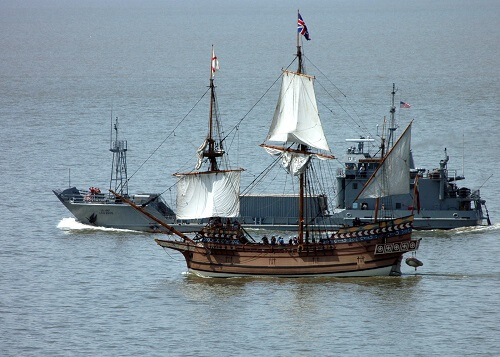 Replica Ship Susan Constant (In Front of Navy Vessel)
After sailing up and down the river they selected a place to live upon, which they called Jamestown.

They had now pretty well eaten up their supply of food, and they had been so slow in settling themselves that it was too late to plant even if they had cleared ground. One small ladleful of pottage made of worm-eaten barley or wheat was all that was given to a man for a meal. The settlers were attacked by the American Indians, who wounded seventeen men and killed one boy in the fight. Each man in Jamestown had to take his turn every third night in watching against the American Indians, lying on the cold, bare ground all night. The only water to drink was that from the river, which was bad. The people were soon nearly all of them sick; there were not five able-bodied men to defend the place had it been attacked. Sometimes as many as three or four died in a single night, and sometimes the living were hardly able to bury those who had died. There were about a hundred colonists landed at Jamestown, and one half of these died in the first few months. All this time the men in Jamestown were living in wretched tents and poor little hovels covered with earth, and some of them even in holes dug into the ground. As the sickness passed away, those who remained built themselves better cabins, and thatched the roofs with straw.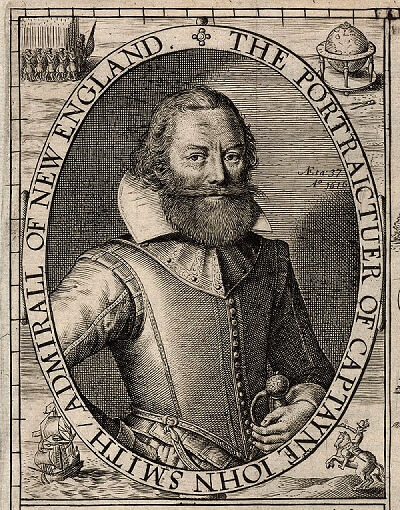 Captain John Smith
One of the most industrious men in the colony at this time was Captain John Smith, a young man who had had many adventures, of which he was fond of boasting. He took the little pinnace “Discovery” and sailed up and down the rivers and bays of Virginia, exploring the country, getting acquainted with many tribes of American Indians, and exchanging beads, bells, and other trinkets for corn, with which he kept the Jamestown people from starving. In one of these trips two of his men were killed, and he was made captive, and led from tribe to tribe a prisoner. But he managed so well that Powhatan [povv-at-tan’], the head chief of about thirty tribes, set him free and sent him back to Jamestown. It was in this captivity that he made the acquaintance of Pocahontas [po-ka-hun’-tas], a daughter of Powhatan. She was then about ten years old, and Captain Smith greatly admired her. Many years afterward he told a pretty story about her putting her arms about her neck and saving his life when Powhatan wished to put him to death.
John Smith explored Chesapeake Bay in two voyages, enduring many hardships with cheerfulness. He and his men would move their fire two or three times in a cold night, that they might have the warm ground to lie upon. He managed the American Indians well, put down mutinies at Jamestown, and rendered many other services to the colony. He was the leading man in the new settlement, and came at length to be governor. But when many hundreds of new settlers were brought out under men who were his enemies, and Smith had been injured by an explosion of gunpowder, he gave up the government and went back to England.
CAPTAIN JOHN SMITH
Captain John Smith was born in England in 1579. While yet little more than a boy, he went into the wars in the Netherlands. He was afterward shipwrecked, robbed at sea, and suffered great want in France. He fought against the Turks and slew three of them in single combat. He was at length made prisoner by the Turks and reduced to slavery. By killing his master, he got free, escaping into Russia, after sixteen days of wandering. He got back to England and soon departed with the first company to Jamestown. After leaving Virginia he was the first to examine carefully the coast of New England, and he received the title of “Admiral of New England.” He was a bold and able explorer and a brave man, with much practical wisdom. His chief faults were his vanity and boastfulness, which led him to exaggerate his romantic adventures. But without him the Jamestown colony would probably have perished. Like many other worthy men, he died poor and neglected.
 articlesforchristians