The Bible States over and over that the Jews would return to the desolate land and rebuild what was destroyed.
Isaiah 11:12 And it shall come to pass in that day, that the Lord shall set his hand again the second time to recover the remnant of his people, which shall be left, from Assyria, and from Egypt, and from Pathros, and from Cush, and from Elam, and from Shinar, and from Hamath, and from the islands of the sea.
Isaiah 43:5-6 Fear not: for I am with thee: I will bring thy seed from the east, and gather thee from the west; I will say to the north, Give up; and to the south, Keep not back: bring my sons from far, and my daughters from the ends of the earth;
Jeremiah 29:14 And I will be found of you, saith the Lord: and I will turn away your captivity, and I will gather you from all the nations, and from all the places whither I have driven you, saith the Lord; and I will bring you again into the place whence I caused you to be carried away captive.
Jeremiah 31:10 Hear the word of the Lord, O ye nations, and declare it in the isles afar off, and say, He that scattered Israel will gather him, and keep him, as a shepherd doth his flock.
Amos 9:14-15 And I will bring again the captivity of my people of Israel, and they shall build the waste cities, and inhabit them; and they shall plant vineyards, and drink the wine thereof; they shall also make gardens, and eat the fruit of them. And I will plant them upon their land, and they shall no more be pulled up out of their land which I have given them, saith the Lord thy God.
History
In 1882 there were 24,000 Jews in Palestine.
In 1914 there were 85,000 Jews in Palestine.
In 1948, at Israel’s declaration as a nation, there were 65,000.
The Redeemer’s Atoning Work; or The Price deficient balanced by the Price which covers.
In the first chapter of this book we saw that this Coming Seed of the woman was, among other things, to give up His life for others.
The second chapter is going to define and develope the manner and object of this death.
The name of the Sign, together with its three constellations and the names of the stars composing them, give the complete picture of this Redemption.
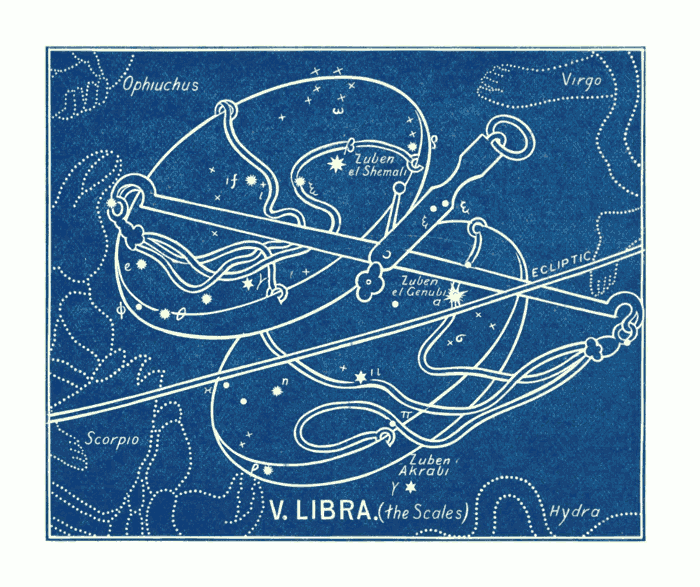
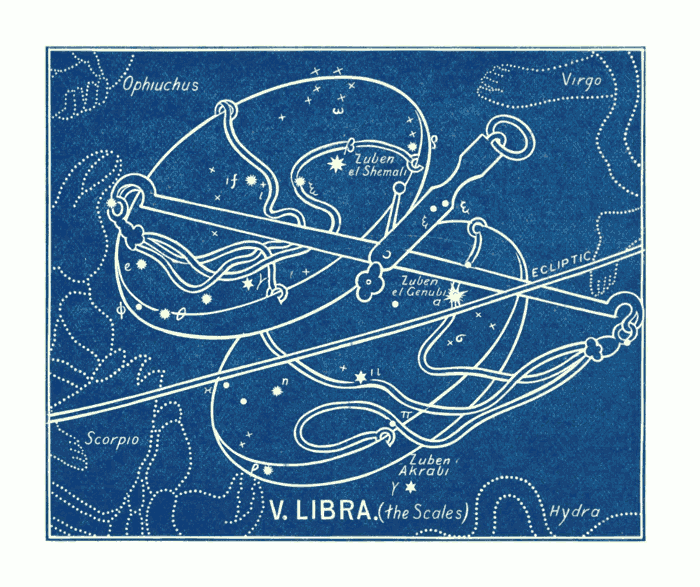
Plate 5: Libra (the Scales)
The Sign contains 51 stars, two of which are of the 2nd magnitude, one of the 3rd, eight of the 4th, etc.
The Hebrew name is Mozanaim, the Scales, weighing. Its name in Arabic is Al Zubena, purchase, or redemption. In Coptic, it is Lambadia, station of propitiation (from Lam, graciousness, and badia, branch). The name by which it has come down to us is the Latin, Libra, which means weighing, as used in the Vulgate (Isa. xl. 12).
Libra contains three bright stars whose names supply us with the whole matter. The brightest, α (in the lower scale), is named Zuben al Genubi, which means the purchase, or price which is deficient. This points to the fact that man has been utterly ruined. He is “weighed in the balances and found wanting.”
“None of them can by any means redeem his brother,
Nor give to God a ransom for him;
For the redemption of their soul is costly,
And must be let alone forever.”
(Ps. xlix. 7, r.v.)
“Surely men of low degree are vanity (Heb. a breath),
And men of high degree are a lie;
In the balances they go up;
They are altogether lighter than vanity” (Heb. a breath).
(Ps. lxii. 9, r.v.)
This is the verdict pronounced and recorded by this star Zuben al Genubi.
Is there then no hope? Is there no one who can pay the price?
Yes; there is “the Seed of the woman.” He is not merely coming as a child, but He is coming as an atoning sacrifice.
He is coming for the purpose of Redemption! He can pay the price which covers! Hence in the upper scale we have another bright star with this very name Zuben al Chemali—THE PRICE WHICH COVERS! Praised be God! “They sang a new song, saying, Thou art worthy … for Thou wast slain, and hast redeemed us to God by thy blood.” (Rev. v. 9.) This is the testimony of β, the second brightest star! It has another name, al Gubi, heaped up, or high, telling of the infinite value of this redemption price. But there is a third star, γ, below, towards Centaurus and the Victim slain, telling, by that and by its name, of the conflict by which that redemption would be accomplished. It is called Zuben Akrabi or Zuben al Akrab, which means the price of the conflict!
There is, however, some reason to suppose that Libra is a very ancient Egyptian corruption, bringing in human merit instead of Divine righteousness; “the way of Cain” instead of the way of God. In the more ancient Akkadian the months were called after the names of the signs,38 and the sign of the seventh month is the sign that we now call Libra. The Akkadian name for it was Tulku. Tul means mound (like dhul and dul), and ku means sacred; hence, Tulku means the sacred mound, or the holy altar.
Not only is the name and its meaning different, but the teaching is infinitely greater and more important, if we may believe that the original picture of this sign was not a pair of scales, but the representation of a holy altar. This would agree still better with the three constellations which follow.
The names of the stars would also be more appropriate, for it is the Sacrifice of Christ which they foreshadowed, and here it was that the price which covered was paid, and outweighed the price which was deficient. What that price was to be, and how it was to be paid, and what was to be the result in the Person of the Redeemer, is set forth in detail in the three sections of this chapter by the constellations of The Cross endured, The Victim slain, and The Crown bestowed.
The letter to the church of Thyatira is found in Revelation 2:18-29.
Jesus has good and bad things to say about this church.
Jesus says,
I know thy works, and charity, and service, and faith, and thy patience, and thy works; and the last to be more than the first.
I have a few things against thee,
You let that woman Jezebel, which calleth herself a prophetess, to teach and to seduce my servants to commit fornication, and to eat things sacrificed unto idols.
I gave her space to repent of her fornication; and she repented not.
Behold, I will cast her into a bed, and them that commit adultery with her into great tribulation, except they repent of their deeds.
I will kill her children with death; and all the churches shall know that I am he which searcheth the reins and hearts: and I will give unto every one of you according to your works.
But unto you I say, and unto the rest in Thyatira, as many as have not this doctrine, and which have not known the depths of Satan, as they speak; I will put upon you none other burden.
But that which ye have already hold fast till I come.
he that overcometh, and keepeth my works unto the end, to him will I give power over the nations: and he shall rule them with a rod of iron; as the vessels of a potter shall they be broken to shivers: even as I received of my Father.
I will give him the morning star.
This church was being infiltrated by a woman called Jezebel. This woman is named after another famous woman. Remember King Ahab married a woman, Jezebel. By marrying her he was able to seal a trade agreement with the Phoenicians. Thyatira was known as a great center of commerce (place of trading). Jezebel, the wife of Ahab, was able to introduce the abomination of Astarte worship to the Israelites. Here we see history repeating itself. Some in the church were making compromises to get a better position (trade deal) by allowing this woman to teach. Since Thyatira was famous for its magnificent Temple of Artemis (another name for the goddess Diana), it is believed that this Jezebel was a devotee of Diana.
Today we need to make sure we are not allowing compromises to the truth to come into our lives. God did not approve when Israel allowed corruptions to come in. God did not approve when the church of Thyatira allowed the corruption to come in. Look at Hebrews 13:8 Jesus Christ the same yesterday, and to day, and for ever. In light of this verse, it is safe to say that God does not approve today. If you are guilty of compromise, Repent Now!
Jairus was one of the rulers of the Jewish church, or synagogue, and he had a daughter who had been very ill and was now at the point of death. She was an only daughter, and was twelve years of age. So hearing that Jesus was near, he came to Him, and, falling down before Him, implored Jesus to come and see her.
And Jesus arose, and followed him, and so did His disciples. Soon there came running to them a messenger from the ruler’s house, who said to Jairus, “Thy daughter is already dead; do not trouble the master.” But when Jesus heard it He turned to Jairus and said, “Fear not. Only believe, and she shall be restored to life.”
When they came to the ruler’s house they saw the minstrels and many people who were making much noise and lamentation for the dead girl, as was the custom. Jesus said unto them, “Make way; weep not, for the maiden is not dead, but sleepeth;” but they laughed Him to scorn, knowing that she was dead. And He put them all out of the room, all but Peter and James and John, and the mother and father of the maiden. Then He took her by the hand, and called to her, saying, “Maid, arise.” And her spirit came again, and she arose straightway; and He commanded her parents to give her food.
Her parents were astonished when they saw their daughter raised to life and able to eat, but Jesus charged them that they should tell no man what He had done. But the fame of the miracle He had wrought went abroad unto all that land.
Jesus went into Capernaum, followed by a great crowd of people, and among them was a woman who for twelve years had suffered from a disease which no doctor could cure, though she had consulted many, and spent all her wealth upon them. She had said within herself, “If I could but touch His garment I should be made well.” So she pressed through the crowd, and put out her arm and touched the hem of His garment, and immediately she was made well.
Then Jesus, turning round to His disciples, said, “Who touched Me?” But they all denied that they had done so, and Peter and they that were with him said, “Master, the multitude throng Thee and press Thee, and yet Thou sayest, Who touched Me!” They were surprised that Jesus should make such an enquiry, seeing that so many were crowding round Him, and pressing against Him. But Jesus said, “Somebody hath touched Me, for I perceive that healing virtue hath gone out of Me.”
When the woman saw that Jesus knew what she had done, and that she could not be hidden in the crowd, she came trembling, and, falling down before Him, she declared unto Him before all the people why she had touched Him, and how she had been healed at once. And He said unto her, “Daughter, be of good comfort; thy faith hath made thee whole. Go in peace, and be healed of thy illness.”
Jesus wishes us to trust in Him. We suffer from a terrible disease—the disease of sin, which no doctor can cure; but Jesus will heal us and take away our sin if we trust in Him.
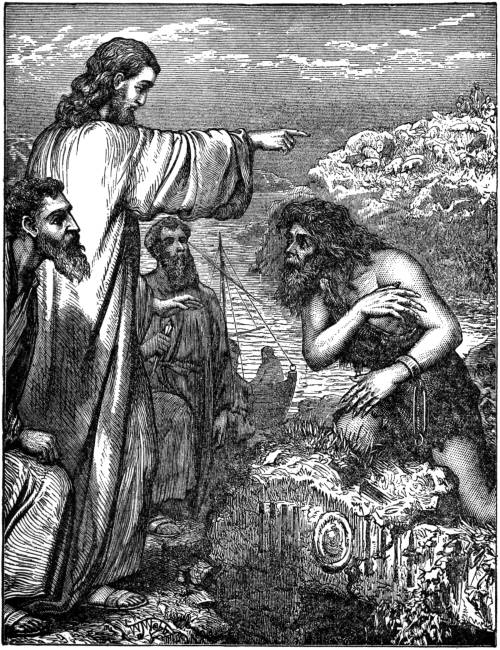
One day Jesus came with His disciples in a boat to the country of the Gadarenes, near Galilee. They landed near the tombs, that is, caverns cut into the rock, where the dead were buried. And there met them a man, who, for a long time, had been possessed by many unclean spirits. He lived in the tombs and wore no clothes. He had been so fierce and wild that his friends had been obliged to chain him up, but he had burst his fetters, and the devils had driven him out to the tombs.
Jesus bade the unclean spirits to come out of the man. And when the man caught sight of Jesus, he cried out, and fell down before Him, saying, “What have I to do with Thee, Jesus, Thou Son of God most high? I beseech Thee to torment me not.”
And Jesus asked him his name. And he said, “Legion,” because many devils were in him. They besought Jesus that He would not make them go into the sea, but would let them enter into a herd of swine that were feeding on the cliffs close by. He suffered them to do so, and the devils went out of the man and entered into the pigs, and the whole herd ran violently over the cliff into the water and were drowned. And when the herdsmen saw what was done, they fled into the city and told all the people. Then the people came out to Jesus, and they saw the man that had been possessed, clothed and in his right mind, sitting at the feet of Jesus. And they that had seen it told them by what means the man had been healed, and they were afraid. The man out of whom the devils had departed, besought Him that he might stay with Jesus, but He sent him away, saying, “Return to thy house, and show what great things God hath done unto thee.” And he went his way and published throughout the city what great things Jesus had done unto him.
These fishermen have just returned to shore with their net full of fish. Now this is not a casting-net, which is thrown out from the boat and drawn in again, but a drag-net which is of great length, and which is drawn constantly through the water until it is well filled with fish. It is then hauled up to the shore, and the fishermen sit around it, and take out the fish. Many of these, of course, are unfit for food, or not liked. They cast those into the sea again, but the good fish which they can sell for food are carefully placed in vessels brought for the purpose.
Christ said, “The kingdom of heaven is like unto a net, that was cast into the sea, and gathered every kind (of fish): which, when it was full, they drew to shore, and sat down, and gathered the good into vessels, but cast the bad away. So shall it be at the end of the world: the angels shall come forth, and sever the wicked from among the just, and cast them into the furnace of fire. There shall be wailing and gnashing of teeth.”
At another time Jesus taught His disciples the same truth; when He spake of His coming and of the gathering of all nations before Him, the good entering into eternal life, but the wicked being cast away. “When the Son of Man shall come in His glory,” said Jesus, “and all the holy angels with Him, then shall He sit upon the throne of His glory. And before Him shall be gathered all nations; and He shall separate them one from another, as a shepherd divideth his sheep from the goats. And He shall set the sheep on His right hand, but the goats on the left.”
Very similar to the parable of the Hidden Treasure is this one of the merchant seeking goodly pearls.
“The kingdom of heaven is like unto a merchantman seeking goodly pearls, who, when he had found one pearl of great price, went and sold all that he had, and bought it.”
In the picture we see the merchant on the sea-shore, where he has waited for the landing of these sailors from another country. He asks them if they have any goodly pearls for sale, and one man opens his box and takes out this “pearl of great price.” It is just the kind of pearl the merchant had been seeking, so he quickly produces his two bags of gold and offers them to the man for his pearl. But the man smiles. “What! part with so large and so beautiful a pearl for two bags of gold?” He could not think of it. The pearl is again placed in its box, and the merchant has to go away disappointed. But the longing to have that pearl is too great. A thought occurs to him. He will go home and sell all that is his, and the money he shall thus obtain, added to his two bags of gold, will surely buy the precious jewel.
And so, it is with men when they seek that pearl of pearls, the forgiveness of God. They will give up a great deal in order to obtain it, but they find that God requires them to give up everything that is sinful or worldly. And if their hearts are really set upon obtaining it, they will do as this merchant did, and part with everything that would hinder them from coming to God or walking in the way that leads to heaven.
The people of Canaan, both in ancient and modern days, have made a practice of hiding their treasures. This they have done to secure them in times of danger. When invaders flocked into the land, the people buried their gold and jewels and fled. And often they died, or were overtaken by their enemies and killed, so that they were unable to return and regain their buried riches. Earthquakes also have taken place, destroyed towns and villages, and burying all the riches in them beneath their ruins. Thus, there is much hidden treasure in Canaan, and numbers of the inhabitants spend their time seeking diligently and anxiously for it.
Our artist shows us a man who is thus seeking. He has heard that in old times a great treasure was hidden in a particular field. So, he digs away patiently in various places until, at last, he finds out that what he heard is quite true. He is sure the treasure is there; and his desire is to become possessed of the field, so that he may obtain the buried riches. He is willing to sell all that he has if by so doing he may buy that field. So, he hastens home and gathers together the whole of his property and sells it. Then he takes his money to the man who has the land for sale and buys the field of him. Thus, he becomes possessed of the treasure he has sought after. Jesus says that the Kingdom of Heaven is like that treasure. It is so precious, that when a man finds out its value, and knows how it can be obtained, he will be willing to give up everything he has for it—all his companions, pleasures, sins, riches—indeed everything he possesses, in order to gain this great treasure.




 articlesforchristians