Exodus 12:40 Now the sojourning of the children of Israel, who dwelt in Egypt, was four hundred and thirty years.
This seems like a contradiction because the children of Israel only lived in Egypt for about 3 generations. However, it is helpful to look at the original prophecy of the 400 Years prediction.
And he said unto Abram, Know of a surety that thy seed shall be a stranger in a land that is not theirs, and shall serve them; and they shall afflict them four hundred years. (KJV, Genesis 15:13)
It basically says that the seed (descendants) of Abraham would be a stranger in a land that is not theirs and shall server them and afflicted them 400 years.
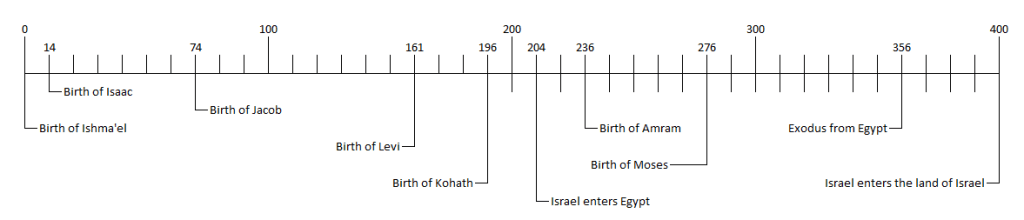
If we call the year of Ishma’el’s birth “0,” as he is Abram’s first seed, we can then use various passages to calculate how many years from then until Israel entered the land of Canaan.
Birth of Isaac:
Abraham is 100 (Gen 17:17; 21:5)
Ishmael is 13 the year before Isaac’s birth (Gen 17:25)
Birth of Jacob:
Isaac is 60 (Gen 25:26)
Birth of Joseph:
Jacob is 91 – Jacob was 130 when entering Egypt (Gen 47:9)
Joseph was 30 when entering Pharoahs service (Gen 41:46)
7 years of plenty (Gen 41:53,54)
2 years of famine when Jacob came to Egypt (Gen 45:6)
Joseph was 39 (30+7+2) when Jacob entered Egypt
Jacob was 91 at birth of Joseph (130-39)
Birth of Levi: Jacob is 87
Jacob is 91 at birth of Joseph who was born in the 14 year of service to Laban (Gen 30:25,26)
Jacob is 77 when arrives at Labans (91-14)
Jacob serves 7 years and recieves Leah (Gen 29:27) who bears Levi, her third son approximately 3 years after being with Jacob.
Jacob is approximately 87 at birth of Levi (77+7+3).
The Children of Israel enter the land of Egypt 17 years before the death of Jacob (Gen 47:28) and when Levi is 87 years old.
Birth of Kohath:
Levi is ~35 – Levi was younger than 40 when Kohath was born as Levi was 43 when he went to Egypt with his 3 sons (Gen 46:8,11)
if this is correct Kohath would be 8 when entering Egypt.
Birth of Amram: Kohath is ~40 (an average generaton)
Birth of Moses: Amram is ~40 (an average generaton)
Israel leaves Egypt when Moses is 80 years old.
The children of Israel enter the land of Israel after the 40 years of wandering, which is 400 years after the birth of Ishmael.
These numbers are approximate calculations. The other 30 years can be time getting to the promise land and how much time that it should have taken to take the land. Instead, they are wandering in the wilderness for 40 Years. They still were journeying in a land that was not their own.
Los cereales son uno de los principales grupos de alimentos. Antiguamente, se ubicaban en la base de la Pirámide Alimenticia, ya que se recomendaba consumir más cereales que otros alimentos. Muchos de nuestros alimentos básicos de consumo diario provienen de este grupo. Según el diccionario, el pan es el “alimento básico; especialmente: el pan”. Así como el pan es importante hoy en día, era una fuente de alimento vital en tiempos de Jesús. Para la mayoría de las personas de aquella época, los cereales eran el alimento principal que consumían a diario. Jesús les dijo: «Yo soy el pan de vida; el que a mí viene, nunca tendrá hambre; y el que en mí cree, no tendrá sed jamás» (Juan 6:35). Esta fue una declaración trascendental.
Cuando los israelitas viajaban por el desierto, comieron maná del cielo. El maná era un tipo de pan que Dios les proporcionó. Lo recogían seis días a la semana. El sexto día recogían suficiente para el sábado, ya que no se les permitía trabajar en el día de reposo. Jesús dijo: «Yo soy el pan que descendió del cielo» (Juan 6:41).
Más tarde, Jesús dice: «Yo soy el pan vivo que descendió del cielo; si alguno come de este pan, vivirá para siempre; y el pan que yo daré es mi carne, la cual daré por la vida del mundo» (Juan 6:51). Aquí Jesús se refiere al pan espiritual. Una manera de comer este pan espiritual es leyendo la Biblia. «En el principio era el Verbo, y el Verbo estaba con Dios, y el Verbo era Dios» (Juan 1:1). En el libro de Marcos, «Jesús tomó pan, y lo bendijo, y lo partió, y les dio, y dijo: Tomad, comed; esto es mi cuerpo» (Marcos 14:22). Dado que Jesús es la Palabra, podemos “comer” su cuerpo estudiando su palabra y desarrollando una relación más cercana con Él. Es maravilloso saber que Jesús es nuestro pan de cada día. Él nos proveerá de pan físico y espiritual, porque Él es «el mismo ayer, y hoy, y por los siglos» (Hebreos 13:8).
And Bilhah Rachel’s maid conceived again, and bare Jacob a second son. And Rachel said, With great wrestlings have I wrestled with my sister, and I have prevailed: and she called his name Naphtali.
Naphtali had four sons:
Jahzeel
Guni
Jezer
Shillem
When the census was taken in Numbers 26:48-49, the descendants of Naphtali was great.
Of the sons of Naphtali after their families:
of Jahzeel, the family of the Jahzeelites:
of Guni, the family of the Gunites:
Of Jezer, the family of the Jezerites:
of Shillem, the family of the Shillemites.
These are the families of Naphtali according to their families: and they that were numbered of them were forty and five thousand and four hundred.
Jacob gave a prophecy of Naphtali’s descendants in Genesis 49:21.
Naphtali is a hind let loose: he giveth goodly words.
He Giveth goodly words is an interesting prophecy.
Goodly
שֶׁפֶרshepher, sheh’-fer; from H8231; beauty:—× goodly.
Words
אֵמֶרʼêmer, ay’-mer; from H559; something said:—answer, × appointed unto him, saying, speech, word.
Naphtali was the northern most tribe of Israel occupying a long, narrow piece of land about 80 kil. (50 miles) north to south and 16 to 24 Kil (10 to 15 miles) from east to west. The land of Naphtali was mountainous and very fertile.
Isaiah 9:1-7
Nevertheless the dimness shall not be such as was in her vexation, when at the first he lightly afflicted the land of Zebulun and the land of Naphtali, and afterward did more grievously afflict her by the way of the sea, beyond Jordan, in Galilee of the nations.
The people that walked in darkness have seen a great light: they that dwell in the land of the shadow of death, upon them hath the light shined.
Thou hast multiplied the nation, and not increased the joy: they joy before thee according to the joy in harvest, and as men rejoice when they divide the spoil.
For thou hast broken the yoke of his burden, and the staff of his shoulder, the rod of his oppressor, as in the day of Midian.
For every battle of the warrior is with confused noise, and garments rolled in blood; but this shall be with burning and fuel of fire.
For unto us a child is born, unto us a son is given: and the government shall be upon his shoulder: and his name shall be called Wonderful, Counsellor, The mighty God, The everlasting Father, The Prince of Peace.
Of the increase of his government and peace there shall be no end, upon the throne of David, and upon his kingdom, to order it, and to establish it with judgment and with justice from henceforth even for ever. The zeal of the Lord of hosts will perform this.
Jesus fulfilled this prophecy about Nathali seeing a great light when Jesus spent most of his ministry in the land that Nathali was given after the Exodus.
Matthew 4:12-6
When Jesus learned that John had been arrested, he withdrew to Galilee.
Departing from Nazareth, he settled in Capernaum by the sea, in the region of Zebulun and Naphtali,
in order that what had been spoken through the prophet Isaiah might be fulfilled:
“Land of Zebulun and land of Naphtali, the passageway to the sea, beyond the Jordan, Galilee of the Gentiles:
The people who lived in darkness have seen a great light, and for those who dwell in a land darkened by the shadow of death light has dawned.”
Naphtali was a tribe of brave warriors people.
Members of the tribe fought bravely under Deborah.
Judges 4:4-6
Now Deborah, the wife of Lappidoth, a prophetess, was then a judge in Israel.
She used to sit underneath the palm tree of Deborah between Ramah and Bethel in the hill country of Ephraim. The Israelites would come up to her for judgment there.
She summoned Barak, the son of Ahinoam, from Kadesh of Naphtali, and she said to him, “The Lord, the God of Israel, commands you, ‘Go, take ten thousand men from Naphtali and Zebulun with yourself and march toward Mount Tabor.
Judges 4:10
Barak had summoned Zebulun and Naphtali to Kedesh. Ten thousand men were under his command, and Deborah went up with him.
Judges 5:18
The people of Zebulun risked their lives, as did Naphtali on the heights of the field.
They responded to Gideon’s Call
Judges 6:35
He sent messengers all throughout Manasseh, summoning them to follow him. He also sent messengers to Asher, Zebulun, and Naphtali, so that they too gathered around him.
Judges 7:23
The men of Israel from out of Naphtali, from out of Asher, and from out of Manasseh gathered together and pursued the Midianites.
When Saul’s son Ishbosheth challenged David for the throne 37,000 fighting men who were led by 1,000 captains joined David.
Chronicles 12:34
From Naphtali there were one thousand captains along with thirty-seven thousand men armed with shield and spear.
When the tribes divided into 2 kingdoms, it was part of the 10 Northern Tribes.
Descendants
The speculative descendants of Naphtali include:
Ethiopian Jews, or Beta Israel, trace their ancestry to the Tribe of Dan, whose members, along with those from the tribes of Gad, Asher, and Naphtali, migrated south to the Kingdom of Kush—present-day Ethiopia and Sudan—during the destruction of the First Temple.
The Mountain Jews of the Caucasus.
The Bukharian Jews of Central Asia.
Nordisk Israel identify the Tribe of Naphtali with Norway.
What does the Bible say about Idolatry and paganism in the Old Testament? How does that compare to what the New Testament Says? Read on to find out. This is part 3 of a multiple part series.
Laws of Idolatry and Paganism
Not to prophesize in the name of idolatry, Not to listen to a false Prophet, Not to prophesize falsely in the name of God, and Not to be afraid of killing the false prophet
Deut. 18:20 (ESV)
But the prophet who presumes to speak a word in my name that I have not commanded him to speak, or who speaks in the name of other gods, that same prophet shall die.’
Deuteronomy 18:20-22 ESV
But the prophet who presumes to speak a word in my name that I have not commanded him to speak, or who speaks in the name of other gods, that same prophet shall die.’ And if you say in your heart, ‘How may we know the word that the Lord has not spoken?’— when a prophet speaks in the name of the Lord, if the word does not come to pass or come true, that is a word that the Lord has not spoken; the prophet has spoken it presumptuously. You need not be afraid of him.
Matthew 7:15 ESV
“Beware of false prophets, who come to you in sheep’s clothing but inwardly are ravenous wolves.
2 Peter 2:1 ESV
But false prophets also arose among the people, just as there will be false teachers among you, who will secretly bring in destructive heresies, even denying the Master who bought them, bringing upon themselves swift destruction.
1 John 4:1 ESV
Beloved, do not believe every spirit, but test the spirits to see whether they are from God, for many false prophets have gone out into the world.
Acts 20:29-30 ESV
I know that after my departure fierce wolves will come in among you, not sparing the flock; and from among your own selves will arise men speaking twisted things, to draw away the disciples after them.
1 Timothy 4:1 ESV
Now the Spirit expressly says that in later times some will depart from the faith by devoting themselves to deceitful spirits and teachings of demons,
2 Corinthians 11:13-15 ESV
For such men are false apostles, deceitful workmen, disguising themselves as apostles of Christ. And no wonder, for even Satan disguises himself as an angel of light. So it is no surprise if his servants, also, disguise themselves as servants of righteousness. Their end will correspond to their deeds.
Galatians 1:8-9 ESV
But even if we or an angel from heaven should preach to you a gospel contrary to the one we preached to you, let him be accursed. As we have said before, so now I say again: If anyone is preaching to you a gospel contrary to the one you received, let him be accursed.
Not to swear in the name of an idol
Exodus 23:13 ESV
“Pay attention to all that I have said to you, and make no mention of the names of other gods, nor let it be heard on your lips.
Matthew 5:34-37 ESV
But I say to you, Do not take an oath at all, either by heaven, for it is the throne of God, or by the earth, for it is his footstool, or by Jerusalem, for it is the city of the great King. And do not take an oath by your head, for you cannot make one hair white or black. Let what you say be simply ‘Yes’ or ‘No’; anything more than this comes from evil.
James 5:12 ESV
But above all, my brothers, do not swear, either by heaven or by earth or by any other oath, but let your “yes” be yes and your “no” be no, so that you may not fall under condemnation.
1 Corinthians 10:14 ESV
Therefore, my beloved, flee from idolatry.
2 Corinthians 6:16 ESV
What agreement has the temple of God with idols? For we are the temple of the living God; as God said, “I will make my dwelling among them and walk among them, and I will be their God, and they shall be my people.
1 John 5:21 ESV
Little children, keep yourselves from idols.
Not to perform ov (medium)
Leviticus 19:31 ESV
“Do not turn to mediums or necromancers; do not seek them out, and so make yourselves unclean by them: I am the Lord your God.
Leviticus 20:6 ESV
“If a person turns to mediums and necromancers, whoring after them, I will set my face against that person and will cut him off from among his people.
Deuteronomy 18:10-12 ESV
There shall not be found among you anyone who burns his son or his daughter as an offering, anyone who practices divination or tells fortunes or interprets omens, or a sorcerer or a charmer or a medium or a necromancer or one who inquires of the dead, for whoever does these things is an abomination to the Lord. And because of these abominations the Lord your God is driving them out before you.
Acts 16:16-18 ESV
As we were going to the place of prayer, we were met by a slave girl who had a spirit of divination and brought her owners much gain by fortune-telling. She followed Paul and us, crying out, “These men are servants of the Most High God, who proclaim to you the way of salvation.” And this she kept doing for many days. Paul, having become greatly annoyed, turned and said to the spirit, “I command you in the name of Jesus Christ to come out of her.” And it came out that very hour.
Not to perform yidoni (magical seer)
Leviticus 19:31 ESV
“Do not turn to mediums or necromancers; do not seek them out, and so make yourselves unclean by them: I am the Lord your God.
Acts 19:19 ESV
And a number of those who had practiced magic arts brought their books together and burned them in the sight of all. And they counted the value of them and found it came to fifty thousand pieces of silver.
Galatians 5:19-21 ESV
Now the works of the flesh are evident: sexual immorality, impurity, sensuality, idolatry, sorcery, enmity, strife, jealousy, fits of anger, rivalries, dissensions, divisions, envy, drunkenness, orgies, and things like these. I warn you, as I warned you before, that those who do such things will not inherit the kingdom of God.
Not to pass your children through the fire to Molech
Leviticus 18:21 ESV
You shall not give any of your children to offer them to Molech, and so profane the name of your God: I am the Lord.
Leviticus 20:2-5 ESV
“Say to the people of Israel, Any one of the people of Israel or of the strangers who sojourn in Israel who gives any of his children to Molech shall surely be put to death. The people of the land shall stone him with stones. I myself will set my face against that man and will cut him off from among his people, because he has given one of his children to Molech, to make my sanctuary unclean and to profane my holy name. And if the people of the land do at all close their eyes to that man when he gives one of his children to Molech, and do not put him to death, then I will set my face against that man and against his clan and will cut them off from among their people, him and all who follow him in whoring after Molech.
Not to erect a column in a public place of worship and not to plant a tree in the Temple courtyard
Deut. 16:21-22
“You shall not plant for yourself an Asherah of any kind of tree or wood beside the altar of the Lord your God, which you shall make. You shall not set up for yourself a sacred pillar which the Lord your God hates.
Deuteronomy 12:3 ESV
You shall tear down their altars and dash in pieces their pillars and burn their Asherim with fire. You shall chop down the carved images of their gods and destroy their name out of that place.
Leviticus 26:1 ESV
“You shall not make idols for yourselves or erect an image or pillar, and you shall not set up a figured stone in your land to bow down to it, for I am the Lord your God.
You shall not make idols for yourselves, nor shall you erect an image, a sacred pillar or an obelisk, nor shall you place any figured stone in your land so that you may bow down to it; for I am the Lord your God.
Acts 17:29 ESV
Being then God’s offspring, we ought not to think that the divine being is like gold or silver or stone, an image formed by the art and imagination of man.
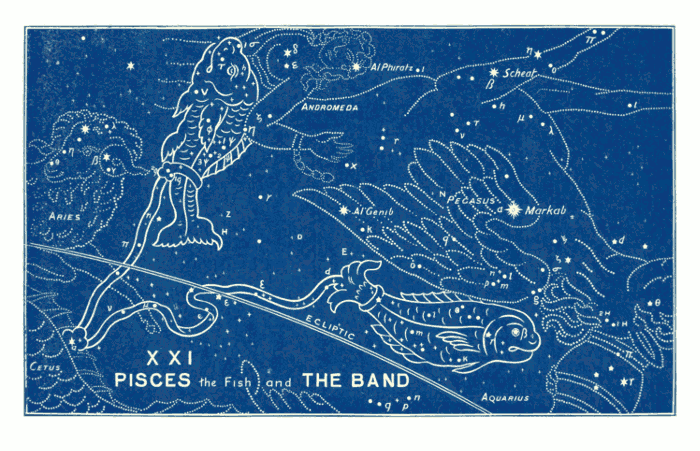
The band that unites these two fishes has always formed a separate constellation. It is shown in Plate XXI. The Arabian poems of Antarah frequently mention it as distinct from the Sign with which it is so closely connected. Antarah was an Arabian poet of the sixth century.
Its ancient Egyptian name was U-or, which means He cometh. Its Arabic name is Al Risha, the band, or bridle.
It speaks of the Coming One, not in His relation to Himself, or to His enemies, but in His relation to the Redeemed. It speaks of Him who says:
“I drew them with cords of a man,
With bands of love;
And I was to them as they that take off the yoke on their jaws.”
(Hosea xi. 4, r.v.)
But it speaks also of His unloosing the bands with which they have been so long bound.
In the picture these fishes are bound. One end of the band is fastened securely round the tail of one fish, and it is the same with the other. Moreover, this band is fastened to the neck of Cetus, the sea monster, while immediately above is seen a woman chained as a captive. These both tell the same story, and, indeed, all are required to set forth the whole truth. The fishes are bound to Cetus; the woman (Andromeda) is chained; but the Deliverer of both is near. Cepheus, the Crowned King, the Redeemer, “the Breaker,” the Branch, is seen coming quickly for the deliverance of His redeemed. These are the three constellations of this sign, and all three are required to set forth the story.
Israel now is bound. The great enemy still oppresses, but deliverance is sure. Aries, the Ram, is seen with his paws on this band, as though about to loosen the bands and set the captives free, and to fast bind their great oppressor.
What does the Bible say about Idolatry and paganism in the Old Testament? How does that compare to what the New Testament Says? Read on to find out. This is part 2 of a multiple part series.
Laws of Idolatry and Paganism
Not to turn a city to idolatry
Ex. 23:13 Now concerning everything which I have said to you, be on your guard; do not mention the name of other gods [either in a blessing or in a curse]; do not let such speech be heard [coming] from your mouth.
1 Corinthians 10:14 ESV
Therefore, my beloved, flee from idolatry.
1 John 5:21 ESV
Little children, keep yourselves from idols.
To burn a city that has turned to idol worship, not to rebuild it as a city, not to derive benefit from it
Deut. 13:12-18 amp
“If you hear [it said] in one of your cities, which the Lord your God gives you to live in,
that some worthless and evil men have gone out from among you and have tempted the inhabitants of their city [to sin], saying, ‘Let us go and serve other gods’ (whom you have not known),
then you shall investigate and search out [witnesses] and ask thorough questions. If it is true and the matter is established that this loathsome thing has been done among you,
you shall most certainly strike the inhabitants of that city with the edge of the sword, utterly destroying it and all that is in it, even its livestock with the edge of the sword.
Then you shall collect all its spoil (plunder) into the middle of its open square and burn the city and set fire to the spoil as a whole burnt offering to the Lord your God. It shall be a ruin forever. It shall not be built again.
Nothing from that which is put under the ban (designated for destruction) shall cling to your hand, so that the Lord may turn away from His burning anger and show mercy to you, and have compassion on you and make you increase, just as He swore to your fathers,
because you have listened to and obeyed the voice of the Lord your God, keeping all His commandments which I am commanding you today, and doing what is right in the eyes of the Lord your God.
Acts 19:18-20
Many of those who had become believers were coming, confessing and disclosing their [former sinful] practices.
And many of those who had practiced magical arts collected their books and [throwing book after book on the pile] began burning them in front of everyone. They calculated their value and found it to be 50,000 pieces of silver.
So, the word of the Lord [concerning eternal salvation through faith in Christ] was growing greatly and prevailing.
Today we can’t burn cities for sinful practices, however, as you learn that something that you own is wrong, it is a great idea to destroy it.
Here are two article that deal with things that have a connection with evil.
“If a prophet arises among you, or a dreamer of dreams, and gives you a sign or a wonder,
and the sign or the wonder which he spoke (foretold) to you comes to pass, and if he says, ‘Let us follow after other gods (whom you have not known) and let us serve and worship them,’
you shall not listen to the words of that prophet or that dreamer of dreams; for the Lord your God is testing you to know whether you love the Lord your God with all your heart and mind and all your soul [your entire being].
Not to love the missionary (one who teaches idol worship), Not to cease hating the missionary, not to save the missionary, not to say anything in his defense, Not to refrain from incriminating him
Deut. 13:5-11
But that prophet or that dreamer of dreams shall be put to death, because he has counseled rebellion against the Lord your God who brought you from the land of Egypt and redeemed you from the house of slavery, to draw you away from the way in which the Lord your God has commanded you to walk. So, you shall remove the evil from among you.
“If your brother, the son of your mother, or your son or daughter, or [a]the wife you cherish, or your friend who is as [precious to you as] your own life (soul), entices you secretly, saying, ‘Let us go and serve other gods’ (gods whom neither you nor your fathers have known,
of the gods of the peoples who are around you, near you or far from you, from one end of the earth to the other),
you shall not consent to him or listen to him; and your eye shall not pity him, nor shall you spare him or conceal him.
Instead, you shall most certainly execute him; your hand shall be first [to be raised] against him to put him to death, and afterwards the hand of all the people.
So, you shall stone him to death with stones, because he has tried to draw you away from the Lord your God who brought you from the land of Egypt, from the house of slavery.
Then all Israel will hear and be afraid, and will never again do such a wicked thing among you.
Today will are not to destroy the people. God will do that. Instead, we are to be aware of the false prophets and stay away from them.
Matthew 7:15 ESV
“Beware of false prophets, who come to you in sheep’s clothing but inwardly are ravenous wolves.
1 John 4:1 ESV
Beloved, do not believe every spirit, but test the spirits to see whether they are from God, for many false prophets have gone out into the world.
Galatians 1:9 amp
As we have said before, so I now say again, if anyone is preaching to you a gospel different from that which you received [from us], let him be condemned to destruction!
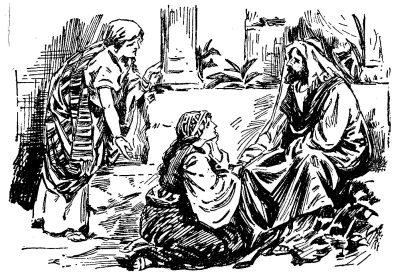
Llegó a Betania, donde vivían sus amigas Marta y María.
Desde Jericó, Jesús y sus discípulos subieron a las montañas y llegaron a Betania, donde vivían sus amigas Marta y María, y donde había resucitado a Lázaro. Mucha gente en Jerusalén se enteró de que Jesús estaba allí y salieron de la ciudad para verlo, ya que Betania estaba a solo dos millas de Jerusalén. Algunos también fueron a ver a Lázaro, a quien Jesús había resucitado; pero los líderes de los judíos se decían entre sí:
«No solo debemos matar a Jesús, sino también a Lázaro, porque por su causa mucha gente sigue a Jesús y cree en él».
Los amigos de Jesús en Betania le prepararon una cena en casa de un hombre llamado Simón. Se le conocía como «Simón el leproso», y quizás era uno de los que Jesús había curado de la lepra. Jesús y sus discípulos, junto con Lázaro, se reclinaron en los divanes alrededor de la mesa, como invitados; y Marta era una de las que los atendían. Mientras cenaban, María, la hermana de Lázaro, entró en la habitación con un frasco sellado de un perfume muy valioso. Abrió el frasco y derramó parte del perfume sobre la cabeza de Jesús y parte sobre sus pies; y le secó los pies con su largo cabello. Y toda la casa se llenó de la fragancia del perfume.
Pero uno de los discípulos de Jesús, Judas Iscariote, no se alegró de esto. Dijo: «¿Por qué se ha desperdiciado así este perfume? Podría haberse vendido por más de cuarenta y cinco dólares, y el dinero se habría dado a los pobres».
Esto lo dijo, no porque le importaran los pobres. Judas era quien guardaba el dinero de Jesús y los doce; y era un ladrón, y se apropiaba para sí mismo de todo el dinero que podía robar. Pero Jesús dijo:
«Dejadla en paz; ¿por qué la criticáis? Ha hecho una buena obra conmigo. A los pobres siempre los tendréis con vosotros, y cuando queráis, podéis darles. Pero a mí no me tendréis siempre. Ella ha hecho lo que pudo; pues ha venido a ungir mi cuerpo para la sepultura. Y de cierto os digo que dondequiera que se predique el evangelio en todo el mundo, también se contará lo que esta mujer ha hecho, en memoria de ella».
Ella le secó los pies con su cabello.
Quizás María sabía lo que otros no creían: que Jesús pronto moriría; y mostró su amor por él y su dolor por su inminente muerte con este valioso regalo. Pero Judas, el discípulo que llevaba la bolsa del dinero, estaba muy enojado con Jesús; y desde ese momento buscaba una oportunidad para traicionarlo o entregarlo a sus enemigos. Fue a ver a los sumos sacerdotes y les dijo: «¿Qué me darán si les entrego a Jesús?»
Ellos respondieron: «Te daremos treinta monedas de plata».
Y por treinta monedas de plata, Judas prometió ayudarlos a capturar a Jesús y hacerlo prisionero.
A la mañana siguiente de la cena en Betania, Jesús llamó a dos de sus discípulos y les dijo:
«Vayan al pueblo vecino, a un lugar donde se cruzan dos caminos; allí encontrarán un asno atado y un pollino con él. Desátenlos y tráiganmelos. Si alguien les pregunta: “¿Por qué hacen esto?”, respondan: “El Señor los necesita”, y los dejarán ir».
Fueron al lugar y encontraron el asno y el pollino, y los estaban desatando cuando el dueño les preguntó:
«¿Qué están haciendo, desatando el asno?»
Y ellos respondieron, como Jesús les había dicho:
«El Señor lo necesita».
Entonces el dueño les entregó el asno y el pollino para que Jesús los usara. Los llevaron a Jesús en el Monte de los Olivos; y pusieron algunas de sus vestiduras sobre el pollino a modo de cojín, y sentaron a Jesús sobre él. Entonces todos los discípulos y una gran multitud extendieron sus mantos en el suelo para que Jesús cabalgara sobre ellos. Otros cortaron ramas de los árboles y las pusieron en el suelo. Y mientras Jesús cabalgaba por la montaña hacia Jerusalén, muchos caminaban delante de él agitando ramas de palmera. Y todos gritaban a una sola voz:
Extendieron sus vestiduras en el suelo para que Jesús cabalgara sobre ellas.
«¡Hosanna al Hijo de David! ¡Bendito el que viene en el nombre del Señor! ¡Bendito sea el reino de nuestro padre David, que viene en el nombre del Señor! ¡Hosanna en las alturas!»
Esto decían porque creían que Jesús era el Cristo, el Rey ungido; y esperaban que ahora estableciera su trono en Jerusalén. Algunos fariseos entre la multitud, que no creían en Jesús, le dijeron:
«Maestro, ¡reprende a tus discípulos!»
Pero Jesús respondió:
«Les digo que si estos callaran, ¡las piedras mismas clamarían!»
Y cuando entró en Jerusalén con toda aquella multitud, toda la ciudad se llenó de asombro. Preguntaban: «¿Quién es este?»
Y la multitud respondía:
«Este es Jesús, el profeta de Nazaret de Galilea.»
Y Jesús entró en el Templo y lo recorrió con la mirada; pero no se quedó, porque ya era tarde. Regresó a Betania y pasó allí la noche con sus amigos.
Esto sucedió el domingo, el primer día de la semana; y ese domingo del año se llama Domingo de Ramos, por las ramas de palma que la gente llevaba delante de Jesús.
Muchos lo escuchaban con alegría, pero la gran ciudad permaneció sorda a sus súplicas. «¡Oh Jerusalén, Jerusalén!», exclamó, «tú que matas a los profetas, ¡cuántas veces quise reunir a tus hijos, como la gallina reúne a sus polluelos bajo sus alas, y no quisisteis!»
When Babylon captured Judah it took trophies – treasures from the house of God and Children (youth). The treasures from the house of God was placed in the treasure house of their god.
Daniel 1:1-5
In the third year of the reign of Jehoiakim king of Judah came Nebuchadnezzar king of Babylon unto Jerusalem, and besieged it.
And the Lord gave Jehoiakim king of Judah into his hand, with part of the vessels of the house of God: which he carried into the land of Shinar to the house of his god; and he brought the vessels into the treasure house of his god.
And the king spake unto Ashpenaz the master of his eunuchs, that he should bring certain of the children of Israel, and of the king’s seed, and of the princes;
Children in whom was no blemish, but well favoured, and skilful in all wisdom, and cunning in knowledge, and understanding science, and such as had ability in them to stand in the king’s palace, and whom they might teach the learning and the tongue of the Chaldeans.
5And the king appointed them a daily provision of the king’s meat, and of the wine which he drank: so nourishing them three years, that at the end thereof they might stand before the king.
Daniel and three of his friends were among the children taken.
Daniel 1:6
Now among these were of the children of Judah, Daniel, Hananiah, Mishael, and Azariah:
The goal of taken the children was to indoctrinate them into the belief of the Babylonians. They did this by:
Isolation
took the children away from everyone and everything that they knew.
Inculturation
Education
whom they might teach the learning and the tongue of the Chaldeans.
Integration
that at the end thereof they might stand before the king.
Identity changing
name changes: gave them new names that pointed away from who they were to who the Babylonians wanted them to be.
Old Name
Old Name Meaning
New Name
New Name Meaning
Daniel
“God is my judge”
Belteshazzar
“Bel protects the king” or “Bel’s prince”. ‘Bel’ referring to the Babylonian god Marduk and ‘Shazar’ meaning ‘treasurer’ or ‘steward’.
Hananiah
Yahweh is gracious
Shadrach
“servant of Aku” Aku was the Babylonian moon god.
Mishael
“Who belongs to God?”
Meshach
“guest of a king”
Azariah
“Yahweh has helped”
Abednego
“servant of Nego or Nebo”
Names in those days had major meaning. Your name told you who you were. Your name was your identity. Therefore, the Babylonians gave them a new identity (a new name).
Daniel was respectful. This is evident with the prince of the eunuchs showing Daniel favor. However, Daniel stayed true to God.
Daniel 1:8-9
But Daniel purposed in his heart that he would not defile himself with the portion of the king’s meat, nor with the wine which he drank: therefore he requested of the prince of the eunuchs that he might not defile himself.
Now God had brought Daniel into favour and tender love with the prince of the eunuchs.
Defile
גָּאַלgâʼal, gaw-al’; a primitive root, to soil or (figuratively) desecrate:—defile, pollute, stain.
Daniel chooses to stay pure and Holy before God. He does this by following God’s laws. The laws concerning food are linked to purity, holiness, and being clean.
Leviticus 11:46-47
This is the law of the beasts, and of the fowl, and of every living creature that moveth in the waters, and of every creature that creepeth upon the earth:
To make a difference between the unclean and the clean, and between the beast that may be eaten and the beast that may not be eaten.
Leviticus 10:9-10
And that ye may put difference between holy and unholy,and between unclean and clean;
Deuteronomy 14:2-3
For thou art an holy people unto the Lord thy God, and the Lord hath chosen thee to be a peculiar people unto himself, above all the nations that are upon the earth.
Thou shalt not eat any abominable thing.
Deuteronomy 14:21
Ye shall not eat of anything that dieth of itself: thou shalt give it unto the stranger that is in thy gates, that he may eat it; or thou mayest sell it unto an alien: for thou art an holy people unto the Lord thy God. Thou shalt not seethe a kid in his mother’s milk.
Today we are called to be in the world but not of the world. This is similar to the situation that Daniel found himself in. He was in the world (Babylon), but he refused to be of the world. He refused to defile himself by letting the world in him.
Here is a potation of a prayer that Jesus prayed before going to the cross. Notice how Jesus prays for us.
John 17:14-21
I have given them thy word; and the world hath hated them, because they are not of the world, even as I am not of the world.
I pray not that thou shouldest take them out of the world, but that thou shouldest keep them from the evil.
They are not of the world, even as I am not of the world.
Sanctify them through thy truth: thy word is truth.
As thou hast sent me into the world, even so have I also sent them into the world.
And for their sakes I sanctify myself, that they also might be sanctified through the truth.
Neither pray I for these alone, but for them also which shall believe on me through their word;
That they all may be one; as thou, Father, art in me, and I in thee, that they also may be one in us: that the world may believe that thou hast sent me.
A 10-day test period was granted to Daniel and his three friends. At the end of the test period, Daniel and his friends did better than the others.
Daniel 1:15-16
And at the end of ten days their countenances appeared fairer and fatter in flesh than all the children which did eat the portion of the king’s meat.
16 Thus Melzar took away the portion of their meat, and the wine that they should drink; and gave them pulse.
At the end of the three years, Daniel and his friends were still better than the rest.
Daniel 1:17-20
As for these four children, God gave them knowledge and skill in all learning and wisdom: and Daniel had understanding in all visions and dreams.
Now at the end of the days that the king had said he should bring them in, then the prince of the eunuchs brought them in before Nebuchadnezzar.
And the king communed with them; and among them all was found none like Daniel, Hananiah, Mishael, and Azariah: therefore stood they before the king.
And in all matters of wisdom and understanding, that the king enquired of them, he found them ten times better than all the magicians and astrologers that were in all his realm.
It is always better to be Holy and not defile yourself with the world than to fit in with the world.
“Behold, you are trusting in deceptive and useless words that bring no benefit. 9 Will you steal, murder, commit adultery, swear [oaths] falsely, offer sacrifices or burn incense to Baal, and follow after other gods that you have not known, 10 and [then dare to] come and stand before Me in this house, which is called by My Name, and say, ‘We are protected and set free [by this act of religious ritual]!’—only to go on with this wickedness and these disgusting and loathsome things? 11 Has this house, which is called by My Name, become a den of robbers in your eyes [a place of retreat for you between acts of violence]? Behold, I Myself have seen it,” says the Lord.
12 “But go now to My place which was in Shiloh [in Ephraim], where I first set My Name, and see what I did to it because of the wickedness of My people Israel.
Jeremiah 7:11
11 Has this house, which is called by My name, become a den of robbers in your sight? Behold, I Myself have seen it,” declares the Lord.
Isaiah 56:7
Even those I will bring to My holy mountain, And make them joyful in My house of prayer. Their burnt offerings and their sacrifices will be acceptable on My altar; For My house will be called a house of prayer for all the peoples.”
Matthew 21:10-17
When He entered Jerusalem, all the city was trembling [with excitement], saying, “Who is this?” 11 And the crowds were saying, “This is the prophet Jesus, from Nazareth in Galilee.”
Cleansing the Temple
12 And Jesus entered the temple [grounds] and drove out [with force] all who were buying and selling [birds and animals for sacrifice] in the temple area, and He turned over the tables of the moneychangers [who made a profit exchanging foreign money for temple coinage] and the chairs of those who were selling doves [for sacrifice]. 13 Jesus said to them, “It is written [in Scripture], ‘My house shall be called a house of prayer’; but you are making it a robbers’ den.”
14 And the blind and the lame came to Him in [the porticoes and courts of] the temple area, and He healed them. 15 But when the chief priests and the scribes saw the wonderful and miraculous things that Jesus had done, and heard the boys who were shouting in [the porticoes and courts of] the temple [in praise and adoration], “Hosanna to the Son of David (the Messiah),” they became indignant 16 and they said to Him, “Do You hear what these children are saying?” And Jesus replied to them, “Yes; have you never read [in the Scripture], ‘Out of the mouths of infants and nursing babies You have prepared and provided praise for Yourself’?” 17 Then He left them and went out of the city to Bethany and spent the night there.
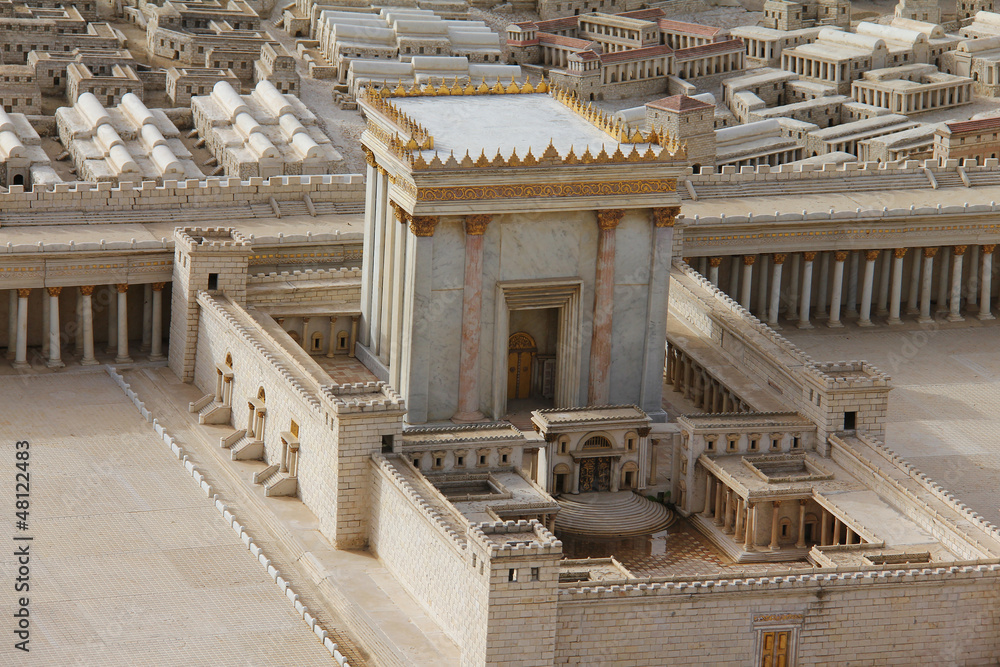
Jesus had just entered into the city. He went to the temple. He found that they had turned what should have been a Holy place of prayer and worship into a den of thieves (Jer. 7:11 and Mat. 21:13). This was the second time that he cleaned the temple. At the 1st Passover that Jesus attended after beginning his earthly ministry he cleaned the temple for the same reason. The people thought that they were good (Jer. 7:10) when in fact they were heading for destruction (Jer. 7:12). Jesus had come to earth to live and die in order to save the world from sin so that they could have eternal life. However, that involves the removal of some things. Even today we must allow Jesus to clean the temple (our body).
1 Corinthians 6:19-20
What? know ye not that your body is the temple of the Holy Ghost which is in you, which ye have of God, and ye are not your own?
For ye are bought with a price: therefore, glorify God in your body, and in your spirit, which are God’s.
First Passover—Cleansing the Temple
13 Now the Passover of the Jews was approaching, so Jesus went up to Jerusalem. 14 And in the temple [enclosure], He found the people who were selling oxen and sheep and doves, and the money changers sitting at their tables. 15 He made a whip of cords, and drove them all out of the temple, with the sheep and the oxen; and He scattered the coins of the money changers and overturned their tables; 16 then to those who sold the doves He said, “Take these things away! Stop making My Father’s house a place of commerce!” 17 His disciples remembered that it is written [in the Scriptures], “Zeal (love, concern) for Your house [and its honor] will consume Me.” 18 Then the Jews retorted, “What sign (attesting miracle) can You show us as [proof of] your authority for doing these things?” 19 Jesus answered them, “Destroy this temple, and in three days I will raise it up.” 20 Then the Jews replied, “It took forty-six years to build this temple, and You will raise it up in three days?” 21 But He was speaking of the temple which was His body. 22 So when He had risen from the dead, His disciples remembered what He had said. And they believed and trusted in and relied on the Scripture and the words that Jesus had spoken.
It was after cleaning the temple for the 1st time that he explained that His body was the temple. It is interesting to note that both cleaning were at the time of Passover.
Jesus is referred to as the Passover Lamb in the Bible, symbolizing his sacrifice for humanity
1 Corinthians 5:7: “For Christ, our Passover lamb, has been sacrificed.”
This verse emphasizes that Jesus’ sacrifice fulfills the role of the Passover lamb, which was central to the Passover celebration.
John 1:29: “The next day he saw Jesus coming toward him, and said, ‘Behold, the Lamb of God, who takes away the sin of the world!'”
This declaration by John the Baptist identifies Jesus as the sacrificial lamb, linking him to the Passover tradition.
Matthew 26:17: “Now on the first day of the Feast of the Unleavened Bread, the disciples came to Jesus, saying, ‘Where do You want us to prepare for You to eat the Passover?'”
This verse sets the context for the Last Supper, which was a Passover meal.
Exodus 12:13: “The blood shall be a sign for you on the houses where you live; and when I see the blood, I will pass over you, and no plague will befall you to destroy you when I strike the land of Egypt.”
This Old Testament verse establishes the significance of the Passover lamb’s blood, which is echoed in the New Testament through Jesus’ sacrifice.
Luke 22:15: “And He said to them, ‘I have eagerly desired to eat this Passover with you before I suffer.'”
This verse highlights Jesus’ intention to celebrate Passover with his disciples before his crucifixion, linking his impending sacrifice to the Passover celebration.
Jesus spent the night in Prayer before he was crucified. Here are three of the things that He prayed about before being betrayed.
The High Priestly Prayer
found in John 17:12
When Jesus had spoken these things, He raised His eyes to heaven [in prayer] and said, “Father, the hour has come. Glorify Your Son, so that Your Son may glorify You. Just as You have given Him power and authority over all mankind, [now glorify Him] so that He may give eternal life to all whom You have given Him [to be His—permanently and forever]. Now this is eternal life: that they may know You, the only true [supreme and sovereign] God, and [in the same manner know] Jesus [as the] Christ whom You have sent. I have glorified You [down here] on the earth by completing the work that You gave Me to do. Now, Father, glorify Me together with Yourself, with the glory and majesty that I had with You before the world existed.
“I have manifested Your name [and revealed Your very self, Your real self] to the people whom You have given Me out of the world; they were Yours and You gave them to Me, and they have kept and obeyed Your word. Now [at last] they know [with confident assurance] that all You have given Me is from You [it is really and truly Yours]. For the words which You gave Me I have given them; and they received and accepted them and truly understood [with confident assurance] that I came from You [from Your presence], and they believed [without any doubt] that You sent Me. I pray for them; I do not pray for the world, but for those You have given Me, because they belong to You; and all things that are Mine are Yours, and [all things that are] Yours are Mine; and I am glorified in them. I am no longer in the world; yet they are still in the world, and I am coming to You. Holy Father, keep them in Your name, the name which You have given Me, so that they may be one just as We are. While I was with them, I was keeping them in Your name which You have given Me; and I guarded them and protected them, and not one of them was lost except the son of destruction, so that the Scripture would be fulfilled.
The Disciples in the World
found in John 17:13-21
But now I am coming to You; and I say these things [while I am still] in the world so that they may experience My joy made full and complete and perfect within them [filling their hearts with My delight]. I have given to them Your word [the message You gave Me]; and the world has hated them because they are not of the world and do not belong to the world, just as I am not of the world and do not belong to it. I do not ask You to take them out of the world, but that You keep them and protect them from the evil one. They are not of the world, just as I am not of the world. Sanctify them in the truth [set them apart for Your purposes, make them holy]; Your word is truth. Just as You commissioned and sent Me into the world, I also have commissioned and sent them (believers) into the world. For their sake I sanctify Myself [to do Your will], so that they also may be sanctified [set apart, dedicated, made holy] in [Your] truth.
“I do not pray for these alone [it is not for their sake only that I make this request], but also for [all] those who [will ever] believe and trust in Me through their message, that they all may be one; just as You, Father, are in Me and I in You, that they also may be one in Us, so that the world may believe [without any doubt] that You sent Me.
Their Future Glory
John 17:22-26
I have given to them the glory and honor which You have given Me, that they may be one, just as We are one; I in them and You in Me, that they may be perfected and completed into one, so that the world may know [without any doubt] that You sent Me, and [that You] have loved them, just as You have loved Me. Father, I desire that they also, whom You have given to Me [as Your gift to Me], may be with Me where I am, so that they may see My glory which You have given Me, because You loved Me before the foundation of the world.
“O just and righteous Father, although the world has not known You and has never acknowledged You [and the revelation of Your mercy], yet I have always known You; and these [believers] know [without any doubt] that You sent Me; and I have made Your name known to them, and will continue to make it known, so that the love with which You have loved Me may be in them [overwhelming their heart], and I [may be] in them.”


 articlesforchristians