A place to grow your relationship with God

Posts tagged ‘Jesus’

LA HISTORIA DE LA TRAICIÓN

LA HISTORIA DE LA TRAICIÓN

Al pie del Monte de los Olivos, cerca del camino que subía hacia Betania, había un huerto de olivos llamado Getsemaní. La palabra “Getsemaní” significa “prensa de aceite”. Jesús solía ir a este lugar con sus discípulos, atraído por su tranquilidad y la sombra de los árboles. Al llegar al huerto, se detuvo y dejó a ocho de sus discípulos afuera, diciéndoles: “Siéntense aquí mientras yo voy adentro a orar”.

Tomó consigo a los tres discípulos elegidos: Pedro, Santiago y Juan, y entró en el huerto. Jesús sabía que dentro de poco Judas llegaría con un grupo de hombres para apresarlo; que en pocas horas sería golpeado, despojado de sus vestiduras y llevado a la muerte. La idea de lo que iba a sufrir lo abrumó y llenó su alma de profunda tristeza. Entonces les dijo a Pedro, Santiago y Juan:

“Mi alma está llena de tristeza, una tristeza que casi me mata. Quédense aquí y velen mientras yo rezo.”

Se adentró un poco más entre los árboles, se arrojó al suelo y exclamó:

«¡Oh, Padre mío, si es posible, aparta de mí esta copa; pero no se haga mi voluntad, sino la tuya!»

Tan intensa era su emoción y tan grande su sufrimiento que le brotaron del rostro grandes gotas de sudor, como de sangre, que caían al suelo. Después de orar un rato, se levantó y fue hacia sus tres discípulos, a quienes encontró dormidos. Los despertó y le dijo a Pedro: «¿Acaso no pudisteis velar conmigo ni una hora? Velad y orad para que no caigáis en tentación. El espíritu está dispuesto, pero la carne es débil».

Los dejó y se adentró por segunda vez en el bosque, se postró rostro en tierra y oró de nuevo, diciendo:

«¡Oh, Padre mío, si esta copa no puede pasar de mí sin que yo la beba, hágase tu voluntad!»

Volvió a donde estaban los tres discípulos y los encontró durmiendo; pero esta vez no los despertó. Se adentró de nuevo en el bosque y oró, usando las mismas palabras. Y un ángel del cielo se le apareció y le dio fuerzas. Ahora estaba preparado para el destino que pronto le esperaba, y su corazón estaba fortalecido. Una vez más, se acercó a los tres discípulos y les dijo: «Pueden seguir durmiendo y descansar, porque la hora ha llegado; y el Hijo del hombre ya ha sido entregado por el traidor en manos de los pecadores. Pero levántense y vámonos. ¡Miren, el traidor está aquí!».

Los discípulos despertaron; oyeron el ruido de una multitud y vieron el resplandor de las antorchas y el brillo de las espadas y las lanzas. Entre la multitud vieron a Judas, y comprendieron que él era el traidor del que Jesús les había hablado la noche anterior. Judas se adelantó corriendo y besó a Jesús, como si se alegrara de verlo. Esta era la señal que les había dado de antemano a los guardias; pues los soldados no conocían a Jesús, y Judas les había dicho:

«Aquel a quien yo bese es el hombre que debéis apresar; detenedlo y no lo dejéis escapar.»

Jesús le dijo a Judas: «Judas, ¿con un beso traicionas al Hijo del hombre?»

Luego se volvió hacia la multitud y preguntó: «¿A quién buscáis?»

Respondieron: «A Jesús de Nazaret.»

Jesús les dijo: «Yo soy.»

Cuando Jesús dijo esto, un miedo repentino se apoderó de sus enemigos; retrocedieron y cayeron al suelo.

Tras un instante, Jesús preguntó de nuevo: “¿A quién buscáis?”.

Y respondieron de nuevo: “A Jesús de Nazaret”.

Entonces Jesús, señalando a sus discípulos, dijo: “Ya os he dicho que soy yo. Si me buscáis a mí, dejad que estos se vayan”.
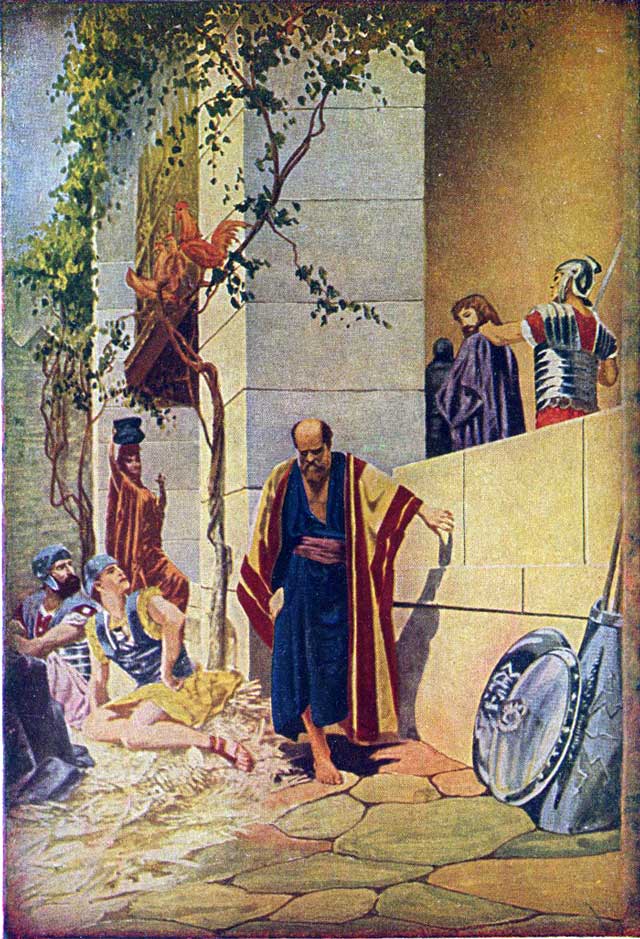
PEDRO NIEGA A CRISTO — Y Pedro se acordó de las palabras de Jesús, que le había dicho: «Antes de que cante el gallo, me negarás tres veces». (Mateo 26:75).

Pero cuando se acercaron para apresar a Jesús, Pedro desenvainó su espada, hirió a uno de los hombres que estaban delante y le cortó la oreja derecha. El hombre era siervo del sumo sacerdote y se llamaba Malco. Jesús le dijo a Pedro:

«Guarda la espada en su vaina; ¿acaso no he de beber la copa que mi Padre me ha dado? ¿No sabes que podría rogar a mi Padre, y él me enviaría legiones de ángeles?»

Luego se dirigió a la multitud: «Dejadme hacer esto». Y tocó el lugar donde le habían cortado la oreja, y esta se le restituyó y sanó. Jesús les dijo a los gobernantes y a los jefes de los hombres armados:

«¿Venís contra mí con espadas y palos como si fuera un ladrón? Estuve con vosotros todos los días en el Templo, y no levantasteis la mano contra mí. Pero es necesario que se cumplan las Escrituras; y esta es vuestra hora».

Cuando los discípulos de Jesús vieron que no les permitía luchar por él, no supieron qué hacer. En su repentino temor, huyeron todos y dejaron a su Maestro solo con sus enemigos. Estos hombres echaron mano a Jesús, lo ataron y lo llevaron a casa del sumo sacerdote. En aquel tiempo, había dos hombres a quienes los judíos llamaban sumos sacerdotes. Uno era Anás, quien había sido sumo sacerdote hasta que los romanos le quitaron el cargo y se lo dieron a Caifás, su yerno. Pero Anás aún tenía gran poder entre el pueblo; y llevaron a Jesús, atado como estaba, primero ante Anás.

Simón Pedro y Juan, el discípulo a quien Jesús amaba, habían seguido a la multitud que se llevaba a Jesús; y llegaron a la puerta de la casa del sumo sacerdote. Juan conocía al sumo sacerdote y entró; pero Pedro se quedó fuera al principio, hasta que Juan salió y lo hizo entrar. Entró, pero no se atrevió a entrar en la habitación donde Jesús estaba ante el sumo sacerdote Anás. En el patio de la casa, habían encendido una hoguera de carbón, y Pedro se quedó entre los que se calentaban junto al fuego. Anás, que se encontraba en la sala interior, le preguntó a Jesús sobre sus discípulos y sus enseñanzas. Jesús le respondió:

«Lo que he enseñado ha sido públicamente en las sinagogas y en el Templo. ¿Por qué me preguntas a mí? Pregúntales a quienes me oyeron; ellos saben lo que dije».

Entonces, uno de los guardias golpeó a Jesús en la boca, diciéndole:

«¿Así le respondes al sumo sacerdote?».

Jesús le respondió al guardia con calma y serenidad:

«Si he dicho algo malo, di qué es lo malo; pero si he dicho la verdad, ¿por qué me golpeas?»

Mientras Anás y sus hombres mostraban así su odio hacia Jesús, quien permanecía atado y solo entre sus enemigos, Pedro seguía en el patio, calentándose junto al fuego. Una mujer, sirvienta de la casa, miró fijamente a Pedro y finalmente le dijo:

«Tú eras uno de los que andaban con este Jesús de Nazaret».

Pedro, temeroso de decir la verdad, le respondió:

«Mujer, no conozco a ese hombre, ni sé de qué hablas».

Para alejarse de ella, salió al pórtico de la casa. Allí, otra sirvienta lo vio y dijo: «Este hombre era uno de los que andaban con Jesús».

Y Pedro juró que no conocía a Jesús en absoluto. Poco después, pasó un hombre, pariente de Malco, a quien Pedro le había cortado la oreja. Miró a Pedro, lo oyó hablar y dijo:

«Sin duda eres uno de los discípulos de este hombre, pues tu acento te delata como galileo».

Entonces Pedro comenzó de nuevo a maldecir y a jurar, declarando que no conocía a aquel hombre.

En ese preciso instante, el fuerte y agudo canto de un gallo sobresaltó a Pedro; y al mismo tiempo vio a Jesús, a quien arrastraban por el pasillo desde la casa de Anás hasta la sala del consejo de Caifás, el otro sumo sacerdote. Y el Señor, al pasar, se volvió y miró a Pedro.

Entonces, las palabras que Jesús había dicho la noche anterior resonaron en la mente de Pedro:

«Antes de que cante el gallo mañana por la mañana, me negarás tres veces».

Entonces Pedro salió de la casa del sumo sacerdote a la calle; y lloró amargamente por haber negado a su Señor.
Unlocking the Relevance of the Old Testament for Christians

The Old Testament is seen as a book of rules that are outdated and or not relevant to Christians today. However, the Bible tells us that all scripture is important.

2 Timothy 3:16 (amp)
All Scripture is God-breathed [given by divine inspiration] and is profitable for instruction, for conviction [of sin], for correction [of error and restoration to obedience], for training in righteousness [learning to live in conformity to God’s will, both publicly and privately—behaving honorably with personal integrity and moral courage];

This means that even the Old Testament is useful.

Here are some Bible Studies comparing what the Old Testament says to the New Testament.

Laws and regulations

  • The Oneness of God in Scripture: The content compares Old Testament laws regarding God with corresponding New Testament scriptures. It emphasizes the importance of recognizing one true God, loving Him, fearing Him, and keeping His name sacred. It also addresses listening to Jesus as a prophet and warns against testing Him. The scriptures provide moral guidelines for believers.
  • Character Laws in the Old Testament Explained: The content outlines biblical laws governing behavior and character found in the Old and New Testaments. Key themes include emulating God’s ways, loving others, avoiding hatred, refraining from revenge, and supporting the weak. It encourages believers to demonstrate kindness, forgiveness, and unity, reflecting Christ’s teachings in their conduct.
  • Biblical Wisdom: Old Testament Laws for Study: The content discusses the importance of studying the Bible, comparing insights from the Old and New Testaments. It emphasizes the Torah’s role in instruction and hope, as seen in Deuteronomy and Romans. Believers are encouraged to respect teachers of the law and share their faith with humility and readiness.
  • Paganism and Idolatry: Biblical Insights: (coming soon)
  • The Significance of Clean and Unclean Foods in the Bible: The food laws establish distinctions between clean and unclean animals, emphasizing holiness for God’s people through specific dietary restrictions, as outlined in biblical texts like Leviticus and Deuteronomy.

Worship

Prophecies of the Messiah (Jesus)

  • Understanding Zechariah 9:9 and Its Fulfillment in Jesus: Zechariah’s prophecy of a humble king entering Jerusalem is fulfilled by Jesus, recognized as the Messiah from David’s lineage, sparking hope and eventual betrayal.
  • The Prophecy of the Anointed One in Psalm 2

Other principles from the Old Testament

La profecía del Ungido en el Salmo 2

Salmos 2

  • ¿Por qué se amotinan las gentes, Y los pueblos piensan cosas vanas?
  •  Se levantarán los reyes de la tierra, Y príncipes consultarán unidos Contra Jehová y contra su ungido, diciendo:
  • Rompamos sus ligaduras, Y echemos de nosotros sus cuerdas.
  • El que mora en los cielos se reirá; El Señor se burlará de ellos.
  • Luego hablará a ellos en su furor, Y los turbará con su ira.
  • Pero yo he puesto mi rey Sobre Sion, mi santo monte.
  • Yo publicaré el decreto; Jehová me ha dicho: Mi hijo eres tú; Yo te engendré hoy.
  • Pídeme, y te daré por herencia las naciones, Y como posesión tuya los confines de la tierra.
  • Los quebrantarás con vara de hierro; Como vasija de alfarero los desmenuzarás.
  • Ahora, pues, oh reyes, sed prudentes; Admitid amonestación, jueces de la tierra.
  • Servid a Jehová con temor, Y alegraos con temblor.
  • Honrad al Hijo, para que no se enoje, y perezcáis en el camino; Pues se inflama de pronto su ira. Bienaventurados todos los que en él confían.

Notas:

  • La palabra traducida aquí como “gentiles” proviene de la palabra hebrea goyim y a menudo se refiere a las “naciones”, especialmente a las naciones no judías que rodeaban a Israel. Posteriormente, la palabra gentil se convirtió en sinónimo de la palabra goyim para la mayoría de los hebreos.
  • La palabra “imagen” es la palabra hebrea hagah. Es la misma palabra que en el Salmo 1 se traduce como meditar. Las naciones alrededor de Israel meditaban sobre cómo destruir al ungido de Dios.
  • La palabra “ungido” es la palabra hebrea מָשִׁיחַ māšîaḥ.
    • מָשִׁיחַ māšîaḥ
      • ungido, generalmente se refiere a verter o untar aceite sagrado sobre una persona en una ceremonia de dedicación, posiblemente simbolizando el empoderamiento divino para cumplir la tarea o el cargo; el Ungido, el Mesías, el elegido supremo de Dios, identificado en el Nuevo Testamento como Jesús:
  • Versículo 2: Sin embargo, yo he puesto a mi rey sobre mi santo monte de Sion.
    • David conquistó la fortaleza de Sion (véase 2 Samuel 5:7).
    • Más tarde, David construyó una tienda en el monte Sion (véase 1 Crónicas 15:1). Luego llevó el Arca del Pacto allí y la colocó en la tienda (véase 1 Crónicas 16:1). De esta manera, Dios había puesto a su Rey sobre el “Santo Monte de Sion”.
  • 2:7 Proclamaré el decreto: Jehová me ha dicho: Tú eres mi Hijo; yo te he engendrado hoy.
    • Este versículo se cita dos veces:
      • Hebreos 1:5
        • Porque ¿a cuál de los ángeles dijo Dios alguna vez: Tú eres mi Hijo, yo te he engendrado hoy? ¿Y otra vez: Yo seré para él Padre, y él será para mí Hijo?
      • Hebreos 5:5
        • Así tampoco Cristo se glorificó a sí mismo haciéndose sumo sacerdote, sino el que le dijo: Tú eres mi Hijo, yo te he engendrado hoy. Observe algunos detalles:
  • Observa algunas cosas.
    • La palabra Hijo se usa para identificar al Mesías, ya que a Cristo se le llamó el “Hijo de Dios” (véase Mateo 8:29; 14:33; 27:54; Marcos 1:1; 3:11; Lucas 1:35).
    • También se usa el término engendrado, proveniente de una palabra hebrea que significa “dar a luz a un hijo”.
      • Se usa en el Nuevo Testamento cuando a Jesús se le llama el “unigénito del Padre” (Juan 1:14).
      • La frase “unigénito” se refiere a “único hijo”.
  • 2:8 Pídeme, y te daré las naciones como herencia, y los confines de la tierra como posesión tuya.
    • Cuando el Mesías (Jesús) se convierta en Rey y establezca su trono en Jerusalén, será Rey sobre toda la tierra y todas las naciones estarán bajo su dominio; por lo tanto, heredará las naciones gentiles.
  • 2:9 Las quebrantarás con vara de hierro; las desmenuzarás como vasija de alfarero.
    • La promesa de que el Mesías gobernará con vara de hierro se encuentra en ambos Testamentos.
      • Isaías 11:4 Pero juzgará con justicia a los pobres, y con equidad reprenderá a los mansos de la tierra; y herirá la tierra con la vara de su boca, y con el aliento de sus labios matará al impío.
        • La “vara” son las palabras de la boca del Mesías que matan a los impíos.
      • Esta misma imagen se usa en Apocalipsis 19:15.
        • De su boca sale una espada aguda, para herir con ella a las naciones; y él las regirá con vara de hierro; y él pisa el lagar del vino del furor y de la ira del Dios Todopoderoso.
      • En el versículo anterior, es con su boca que Cristo herirá a las naciones y las regirá con vara de hierro.
    • Aquí, David dice que el Mesías las desmenuzará como una vasija de barro que se rompe con una vara. Esto se refiere a quebrantar:
      • el poder
      • la influencia
      • la voluntad de las naciones, haciendo que se sometan al Mesías. 2:10 Ahora, pues, oh reyes, sed prudentes; sed instruidos, jueces de la tierra.
  • 2:10 Sed sabios, pues, oh reyes; aprended, jueces de la tierra.
    • La sabiduría y la instrucción deben ser la base de todas las decisiones que tomen los líderes.
    • También deben ser la base de las decisiones de todos los cristianos.
  • 2:11 Servid al Señor con temor, y alegraos con temblor.
    • El temor del Señor es el principio de la sabiduría.
      • Salmo 111:10
        • El temor del Señor es el principio de la sabiduría; buen entendimiento tienen todos los que practican sus mandamientos; su alabanza permanece para siempre.
    • La palabra hebrea traducida aquí como “alegraos” es giyl y significa “girar con emoción” o “dar vueltas en círculo”.
      • En el pensamiento hebreo, “alegrarse” no significa simplemente ser feliz en el Señor. La alegría va acompañada de una respuesta como gritar, girar o incluso bailar.
  • 2:12 Besad al Hijo, no sea que se enoje, y perezcáis en el camino, cuando se encienda un poco su ira. Bienaventurados todos los que en él confían.
    • El “Hijo” aquí es el Rey Mesías (v. 6), el hijo engendrado (v. 7) y el que gobierna con vara de hierro (v. 9).
    • “Besad”: Era costumbre en la antigüedad besar a un amigo cercano en la mejilla, o besar el anillo o la mano del rey o líder como señal de gran honor.
      • Aquellos que no honren a Cristo en el Milenio experimentarán diversas formas de juicio sobre sus naciones (véase Zacarías 14:17-18).

Understanding Zechariah 9:9 and Its Fulfillment in Jesus

Zechariah 9:9 Rejoice greatly, O daughter of Zion; shout, O daughter of Jerusalem: behold, thy King cometh unto thee: he is just, and having salvation; lowly, and riding upon an ass, and upon a colt the foal of an ass.

This was fulfilled when Jesus entered the city of Jerusalem riding on a young donkey.

Matthew 21:1-9

  • And when they drew nigh unto Jerusalem, and were come to Bethphage, unto the mount of Olives, then sent Jesus two disciples,
  • Saying unto them, Go into the village over against you, and straightway ye shall find an ass tied, and a colt with her: loose them, and bring them unto me.
  • And if any man say ought unto you, ye shall say, The Lord hath need of them; and straightway he will send them.
  • All this was done, that it might be fulfilled which was spoken by the prophet, saying,
  • Tell ye the daughter of Sion, Behold, thy King cometh unto thee, meek, and sitting upon an ass, and a colt the foal of an ass.
  • And the disciples went, and did as Jesus commanded them,
  • And brought the ass, and the colt, and put on them their clothes, and they set him thereon.
  • And a very great multitude spread their garments in the way; others cut down branches from the trees, and strawed them in the way.
  • And the multitudes that went before, and that followed, cried, saying, Hosanna to the son of David: Blessed is he that cometh in the name of the Lord; Hosanna in the highest.

On that day, the people cried out, “Hosanna to the son of David” (21:9). By calling Christ the “son of David,” the people were speaking truth that He was their savior and the fulfillment of the Davidic prophecy; however, they turned against Him when He did not prove to their satisfaction that He was their King. Note that Zachariah said the King would have salvation. “Hosanna” means “save us.”

The Davidic prophecy encompasses biblical predictions regarding King David and his lineage, particularly the expectation of a Messiah who would come from David’s line, fulfilling God’s covenant promises.

  • The Davidic Covenant
    • The Davidic Covenant is a key part of the prophecy about David, found in 2 Samuel 7:12-16. In it, God promises David that his throne will last forever, saying He’ll raise up a descendant from David’s own family to build a house in His name. This covenant is unconditional, depending entirely on God’s faithfulness rather than on David’s or Israel’s actions.
  • Messianic Expectations
    • The prophecies about the Davidic line play a key role in both Jewish and Christian end-times beliefs. In Jewish tradition, there’s an expectation of a future Davidic king who will restore Israel and bring back God’s kingdom on earth. This figure, often called the Messiah (Hebrew: Mashiach), is believed to gather the twelve tribes of Israel and rebuild the Temple in Jerusalem.

Several key passages highlight the significance of the Davidic prophecy:

  • 2 Samuel 7:12-16:
    • And when thy days be fulfilled, and thou shalt sleep with thy fathers, I will set up thy seed after thee, which shall proceed out of thy bowels, and I will establish his kingdom.
    • He shall build an house for my name, and I will stablish the throne of his kingdom for ever.
    • I will be his father, and he shall be my son. If he commit iniquity, I will chasten him with the rod of men, and with the stripes of the children of men:
    • But my mercy shall not depart away from him, as I took it from Saul, whom I put away before thee.
    • And thine house and thy kingdom shall be established for ever before thee: thy throne shall be established for ever.
      • Establishes the Davidic Covenant and God’s promise of an everlasting throne.
  • Psalm 2:6:
    • Yet have I set my king upon my holy hill of Zion.
      • Speaks of God’s anointed king, interpreted as a reference to the Messiah.
  • Jeremiah 33:17:
    • For thus saith the Lord; David shall never want a man to sit upon the throne of the house of Israel;
      • Declares that David will never lack a man to sit on the throne of Israel, reinforcing the enduring nature of the Davidic line.

Later, Christ was arrested and crucified (see Matt. 26:47-68; 15), but He rose the third day, conquering death and hell (see 1 Cor. 15:4; Rev. 1:18).

Biblical Wisdom: Old Testament Laws for Study

What does the Bible say about studying it in the Old Testament? How does that compare to what the New Testament Says? Read on to find out.

Laws of Torah Study

  • To learn Torah
    • Deut. 6:7
      • And thou shalt teach them diligently unto thy children, and shalt talk of them when thou sittest in thine house, and when thou walkest by the way, and when thou liest down, and when thou risest up.
    • Romans 15:4 ESV
      • For whatever was written in former days was written for our instruction, that through endurance and through the encouragement of the Scriptures we might have hope.
    • 2 Timothy 3:16-17 ESV
      • All Scripture is breathed out by God and profitable for teaching, for reproof, for correction, and for training in righteousness, that the man of God may be complete, equipped for every good work.
    • Hebrews 4:12 ESV
      • For the word of God is living and active, sharper than any two-edged sword, piercing to the division of soul and of spirit, of joints and of marrow, and discerning the thoughts and intentions of the heart.
    • James 1:25 ESV
      • But the one who looks into the perfect law, the law of liberty, and perseveres, being no hearer who forgets but a doer who acts, he will be blessed in his doing.
    • 1 Peter 2:2 ESV
      • Like newborn infants, long for the pure spiritual milk, that by it you may grow up into salvation
    • Matthew 5:17-19 ESV
      • “Do not think that I have come to abolish the Law or the Prophets; I have not come to abolish them but to fulfill them. For truly, I say to you, until heaven and earth pass away, not an iota, not a dot, will pass from the Law until all is accomplished. Therefore whoever relaxes one of the least of these commandments and teaches others to do the same will be called least in the kingdom of heaven, but whoever does them and teaches them will be called great in the kingdom of heaven.
  • To honor those who teach and know Torah
    • Lev. 19:32
      • Thou shalt rise up before the hoary head, and honour the face of the old man, and fear thy God: I am the Lord.
    • Hebrews 13:17 ESV
      • Obey your leaders and submit to them, for they are keeping watch over your souls, as those who will have to give an account. Let them do this with joy and not with groaning, for that would be of no advantage to you.
    • 1 Thessalonians 5:12-13 ESV
      • We ask you, brothers, to respect those who labor among you and are over you in the Lord and admonish you, and to esteem them very highly in love because of their work. Be at peace among yourselves.

Notes:

Paul teaches us in Romans 15:4 (ESV) For whatever was written in former days was written for our instruction, that through endurance and through the encouragement of the Scriptures we might have hope. This means that the Old Testament including the Torah (1st five books of the Old Testament) in our instructions. Those things, when we learn it, gives us hope. Notice how it is written in the KJV: For whatsoever things were written aforetime were written for our learning, that we through patience and comfort of the scriptures might have hope. This clarifies that the Old Testament was written for our learning. We are supposed to learn and be instructed by the Old Testament so that we can have hope. That hope has many purposes. However, we have a commandment as to 1 thing we are to do with that hope.

  • 1 Peter 3:15 But sanctify the Lord God in your hearts: and be ready always to give an answer to every man that asketh you a reason of the hope that is in you with meekness and fear:

The word hope is the same in both 1 Peter 3:15 and Romans 15:4.

Hope

  • Strong’s G1680 – elpis
    • ἐλπίς elpís, el-pece’; from a primary ἔλπω élpō (to anticipate, usually with pleasure); expectation (abstractly or concretely) or confidence:—faith, hope.

We are to learn so that we can have hope and then be ready to give a reason of having the hope with meekness and fear.

The Church as the Lord’s Army: A Biblical Perspective

Biblical Foundation

The concept of the five-fold ministry originates from Ephesians 4:11-13, where the Apostle Paul describes these roles as gifts given by Christ to the church. The purpose of these ministries is to equip believers for service, promote unity in faith, and help the church reach maturity in Christ.

Ephesians

  • And he gave some, apostles; and some, prophets; and some, evangelists; and some, pastors and teachers;
  • For the perfecting of the saints, for the work of the ministry, for the edifying of the body of Christ:
  • Till we all come in the unity of the faith, and of the knowledge of the Son of God, unto a perfect man, unto the measure of the stature of the fulness of Christ:


Roles and Functions

Apostles: Often seen as foundational leaders, apostles are responsible for pioneering new works and establishing churches. They provide vision and direction, ensuring that the church remains aligned with God’s mission.

Prophets: Prophets are called to discern and declare God’s Word, guiding the church towards faithfulness and holiness. They serve as spiritual voices, often calling the community to repentance and deeper commitment to God.

Evangelists: Tasked with spreading the gospel, evangelists gather people into the church and encourage outreach efforts. They play a crucial role in expanding the church’s reach and bringing new believers into the faith.

Pastors: Pastors provide care and guidance to the congregation, nurturing spiritual growth and fostering community. They are often seen as shepherds who protect and lead their flock.

Teachers: Teachers are responsible for instructing and grounding believers in biblical truth. They help the church understand scripture and apply it to their lives, ensuring that the congregation is well-equipped for ministry.

The Lord’s Army

Now let’s put this another way. We are called to be soldiers in the Lord’s Army. That is why Paul tells us to put on the whole armor of God. Click here for more information on the Armor of God.

We are not called to be seat warmers in a building on Sunday Mornings. We are called to fight against the forces of darkness. Every part of the fivefold ministry is for the equipping of the saints to the work of God. Now I am going to loosely use the military rankings of the United States Army to put things into a military perspective so that you can better understand you job in the Lord’s Army.

Private: Everyone starts off as a private. This is the lowest level. It is at this point that you still have learning to do. You have just accepted Jesus as your Lord and Savior. Now it is time to start learning how to live as Christ would want you to live.

  • In the real army there are several levels of the rank of private. These levels are like you learning and growing in faith.
  • Some will rank up all the way into the five-fold ministry. Others will be the general soldiers.
    • Both are needed. General soldiers are the general workers. The others are the future leaders of the church community.
    • All are important to the body of Christ.

Drill Sergent: This would be the teachers. Now just because I am relating teachers to the rank of Drill Sergent does not mean I think teachers should act like a Drill Sergent is portrayed on television. Teachers are to be

  • patient
  • loving
  • kind
  • caring
  • knowledgeable

Remember that the teachers are in charge of training the next generation of soldiers and some of them will be all of the other rankings. This ranking and job should be taken seriously.

Colonel: This would be the pastor of the local church. They are also the shepherd of the congregation. They are the organizers of the local body. Their job is to ensure that everyone is where they are supposed to be.

  • They shepherd the privates into the various classes.
  • They look after the various groups within the congregation and see what needs to be done.
  • They have some helpers that we call deacons.
    • They organize them into sections and send them out to see to the needs of the church.
      • feeding the widows
      • feeding the orphans
      • making sure the teachers have what they need to teach

The Deacons would be like the Lieutenant Colonels. They are not the head of the church, but they sure help run the church and keep things running smoothly.

Commissioned officer: This would be the Evangelists and Apostles

  • The rank of a recruiting officer in the Army is typically classified as a commissioned officer. Commissioned officers are leaders who command Army units and make strategic decisions. The ranks of commissioned officers range from Lieutenant (O-1) to General (O-10), with each rank indicating a higher level of responsibility and command authority.

Their job is to go out and recruit others (find the new privates). They do this in various ways. The Evangelists usually does this closer to home. The Apostles are usually who we now call missionaries.

The Military Intelligence Officer: This would be the prophet. Their job is similar to that of the lookout guard. In the Bible, there would-be people positioned in the watch towers. Their job was to alert the people of approaching danger. In the military today that is similar to the job of the intelligence officer. They are responsible for gathering the information needed to guard the church body from false prophets, false teachings, and anything else that would hinder the work of God.

  • The rank of a Military Intelligence Officer in the U.S. Army typically starts at the rank of Captain (O-6). They are responsible for supervising the Military Intelligence process for unit commanders and leading intelligence operations. The rank progression for Military Intelligence Officers includes:
    Lieutenant (O-4)
    Captain (O-6)
    Major (O-5)
    Lieutenant Colonel (O-6)
    Colonel (O-7)
    Brigadier General (O-8)
    Major General (O-9)
    Lieutenant General (O-9)
    General (O-10)
    These ranks reflect the leadership capabilities and responsibilities of the officer in the intelligence field.

Everyone has a job in the army. Everyone has a job in the body of Christ. The Church needs to take their jobs just as seriously as the military takes it job.

Understanding the Stations of the Cross

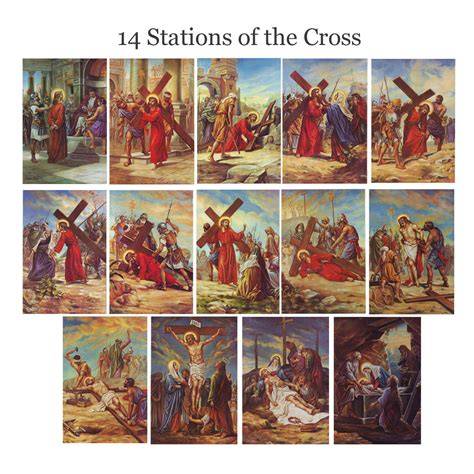
The Stations of the Cross, also called the Way of the Cross, Way of Suffering, or Via Dolorosa, is a series of fourteen images depicting scenes from the day of Jesus Christ’s crucifixion, each accompanied by prayers. It is inspired by the Via Dolorosa in Jerusalem, a traditional route symbolizing the path Jesus walked from the Lion’s Gate to Mount Calvary. Its purpose is to guide Christians on a spiritual journey through reflection on the Passion of Christ. This devotion is widely practiced and found in many Western Christian traditions, including the Roman Catholic, Lutheran, Anglican, and Methodist churches.

Typically, a set of fourteen images is arranged in numerical order along a path, where the faithful, alone or in procession, move from one station to the next, stopping at each one to pray and reflect on its meaning. These devotions are especially common during Lent, particularly on Good Friday, and express a spirit of reparation for the suffering and humiliations that Jesus endured during his Passion. As a physical act of devotion involving standing and kneeling, the Stations of the Cross are closely related to the Christian themes of repentance and self-denial.

The style, form, and location of the Stations of the Cross can vary considerably. Traditional versions typically consist of small plaques with reliefs or paintings arranged around the central part of a church. Modern, minimalist versions may be simple crosses with a number in the center. Sometimes, the Stations of the Cross are prayed without images, such as when the Pope leads the devotion around the Colosseum in Rome on Good Friday.

This devotion is not obligatory, but it is a good way to remember the supreme sacrifice Jesus made, offering his life to save us from our sins. This devotion helps foster gratitude for what Jesus did and encourages believers to carry their own crosses in life, enduring inevitable suffering.

Whether or not you participate in the Stations of the Cross, the Bible commands us to remember the Lord’s death until his return.

  • 1 Corintios 11:23-26
    • For I received from the Lord what I also passed on to you: The Lord Jesus, on the night he was betrayed, took bread,
    • and when he had given thanks, he broke it and said, “Take, eat; this is my body, which is broken for you; do this in remembrance of me.”
    • In the same way, after supper he took the cup, saying, “This cup is the new covenant in my blood; do this, whenever you drink it, in remembrance of me.”
    • For whenever you eat this bread and drink this cup, you proclaim the Lord’s death until he comes.

Here are the Stations of the Cross according to tradition. Biblical references are included whenever possible.

1. Jesus is condemned to death.

  • Luke 23:24-25
    • Then Pilate sentenced that their request should be granted; and he released to them the man who had been thrown into prison for sedition and murder, the one they had asked for; and he handed Jesus over to their will.

2. Jesus takes up his cross.

  • John 19:17
    • And he, carrying his cross, went out to the place called the Place of the Skull, which in Hebrew is called Golgotha;

3. Jesus falls for the first time (by inference from Stations 2 and 5).

4. Jesus meets his grieving mother (by inference from John 19:25-27).

  • John 19:25-27
    • Standing near the cross of Jesus were his mother, his mother’s sister, Mary the wife of Clopas, and Mary Magdalene.
    • When Jesus saw his mother and the disciple whom he loved standing nearby, he said to his mother, “Woman, here is your son.”
    • Then he said to the disciple, “Here is your mother.” From that hour on, the disciple took her into his home.

5. Simon of Cyrene helps carry the cross.

  • Matthew 27:32
    • As they were going out, they found a man from Cyrene named Simon, and they forced him to carry the cross.

6. Veronica wipes the face of Jesus (an episode not recorded in the Scriptures).

  • The Bible does not recount the story of Veronica wiping Jesus’ face on the way to Calvary. Instead, her story appears in a work called the “Acts of Pilate,” which identifies her as the woman who had suffered from hemorrhages for twelve years, approached Jesus from behind, touched the hem of his garment, and was healed (Matthew 9:20-22). This non-canonical text also claims that Jesus left the image of his face imprinted on the cloth she used. The story goes on to say that Veronica later traveled to Rome and healed Emperor Tiberius by showing him a painting of Christ that she had made after her own healing.

7. Jesus falls for the second time (this event is not recorded in the Scriptures).

8. Jesus meets the holy women of Jerusalem.

  • Luke 23:27-31
    • And a great multitude of the people followed him, and of women who were weeping and lamenting for him.
    • But Jesus, turning to them, said, “Daughters of Jerusalem, do not weep for me, but weep for yourselves and for your children.
    • For behold, the days are coming when they will say, ‘Blessed are the barren, and the wombs that never bore children, and the breasts that never nursed.’
    • Then they will begin to say to the mountains, ‘Fall on us!’ and to the hills, ‘Cover us!’
    • For if they do these things in the green wood, what will happen in the dry?”

9. Jesus falls for the third time (this event is not recorded in the Scriptures).

10. Jesus is stripped of his clothes.

  • John 19:23
    • When the soldiers had crucified Jesus, they took his clothes and divided them into four parts, one for each soldier. They also took his tunic, which was seamless, woven in one piece from top to bottom.

11. Jesus is nailed to the cross.

  • Mark 15:24
    • And when they had crucified him, they parted his garments, casting lots upon them, what every man should take.

12. Jesus dies on the cross.

  • Mark 15:37
    • And Jesus cried with a loud voice, and gave up the ghost.

13. Jesus’ body is taken down from the cross.

  • Luke 23:52-53
    • He went to Pilate and asked for the body of Jesus.
    • And taking it down, he wrapped it in a linen cloth and laid it in a tomb cut into the rock, where no one had yet been laid.

14. Jesus’ body is placed in the tomb.

  • Matthew 27:59-60
    • And Joseph took the body, wrapped it in a clean linen shroud,
    • and placed it in his own new tomb, which he had cut out of the rock; and after rolling a large stone to the entrance of the tomb, he went away.

Genesis 1:1 Explained: Alef, Tav and Creation

THE FIRST SEVEN PHRASES IN GENESIS (1:1)

In the English Bible, Genesis 1:1 reads, “In the beginning God created the heavens and the earth.” This ten-word statement consists of seven Hebrew words in the Hebrew text. Below is a chart with the verse with the Hebrew words and the English.

In the beginningרֵאשִׁית Bereshit
createdבָּרָא barah
Godאֱלֹהִים Elohim
This word is not translated. It is the 1st letter of the Hebrew alphabet.א (Aleph)
This word is not translated. It is the last letter of the Hebrew alphabet.ת  (Tav)
the heavens (in KJV it is translated heaven). The Hebrew word indicate the plural sense in other places.תשָׁמַיִם hashamayim
and theוְאֵ֥ת vehet
earthהָאָֽרֶץ haeretz

At the very center of this Hebrew phrase are the two letters Alef and Tav, left untranslated. These letters often pronounced “et,” appear throughout the Hebrew Scriptures and serve in grammar as a marker indicating that the word following is the definite direct object.


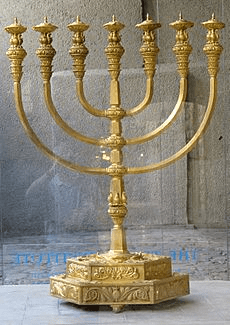
Some believe this seven-word Hebrew phrase depicts the ancient temple’s golden candlestick, the menorah.

The temple menorah had seven branches, with the central shaft known as the “servant branch.” In Revelation 1:8, Jesus is described as standing among seven golden candlesticks (a menorah) and declaring, “I am Alpha and Omega,” the first and last letters of the Greek alphabet. In Hebrew, He would have said, “I am the Alef and the Tav,” the first and last letters of the Hebrew alphabet. Reading Genesis 1:1 this way— “In the beginning God created the Alef-Tav”—suggests that God declared the end from the beginning, and that Christ was with God from the very start. Viewed as a menorah, the center represents the Alef-Tav, the same position as the “servant branch.” From Christ flows the anointing oil, as He promised to send the Holy Spirit to all believers. Remember that Jesus came not to be served but to serve.

  • Mark 10:45 For even the Son of man came not to be ministered unto, but to minister, and to give his life a ransom for many.

So, likening him to the “Servant Branch” describes what Jesus came to do according to Mark 10:45.

Understanding the Message to Philadelphia in Revelation

To the Church in Philadelphia:

Revelations 3:713

  • And to the angel of the church in Philadelphia write; These things saith he that is holy, he that is true, he that hath the key of David, he that openeth, and no man shutteth; and shutteth, and no man openeth;
  • I know thy works: behold, I have set before thee an open door, and no man can shut it: for thou hast a little strength, and hast kept my word, and hast not denied my name.
  • Behold, I will make them of the synagogue of Satan, which say they are Jews, and are not, but do lie; behold, I will make them to come and worship before thy feet, and to know that I have loved thee.
  • Because thou hast kept the word of my patience, I also will keep thee from the hour of temptation, which shall come upon all the world, to try them that dwell upon the earth.
  • Behold, I come quickly: hold that fast which thou hast, that no man take thy crown.
  • Him that overcometh will I make a pillar in the temple of my God, and he shall go no more out: and I will write upon him the name of my God, and the name of the city of my God, which is new Jerusalem, which cometh down out of heaven from my God: and I will write upon him my new name.
  • He that hath an ear, let him hear what the Spirit saith unto the churches.

History:

Philadelphia was located about 30 miles southeast of Bardia, about 30 miles southeast of Sardis and about 70 miles east of Smyrna, and lay at the upper end of a broad valley that passed through Sardis and near Smyrna. The city of Philadelphia was located at the foot of a mountain plateau in the area today known as West Central Turkey. It was built on an important travel route linking the city with Laodicea to the south.

Like Sardis Philadelphia was almost destroyed by the massive earthquakes in southwest Asia Minor in AD 17. The tremors continued for years. It was later rebuilt with the assistance of Emperor Tiberius.

When the Moslems overran Asia Minor in the fourteenth century A.D., Philadelphia resisted far longer than other cities and became an island for Christianity. The city exists today as the Turkish town of Alasehir and contains the ruins of many ancient churches.

Wine making, wool production, and agriculture were primary industries in the city.

Notes:

  • Its name means “Brotherly Love” and represents the faithful church in all ages.
  • The reference to the key of David is taken from Isaiah 22:22, where it relates messianic authority.
    • Isaiah 22:22
      • And the key of the house of David will I lay upon his shoulder; so he shall open, and none shall shut; and he shall shut, and none shall open.
  • The reference to “The open door”, which no man can shut, refers to an opportunity for testimony and service.
    • The city sat on a mountain pass which served as a doorway to the Anatolian hill country
  • Those who are of the synagogue of Satan are probably unbelieving Jews or Judaizers.
  • Because thou hast kept the word of my patience, I also will keep thee from the hour of temptation, which shall come upon all the world, to try them that dwell upon the earth.
    • This is saying that God will keep those who keeps His word from the temptation that everyone else must face.
      • 1 Corinthians 10:13
        • There hath no temptation taken you but such as is common to man: but God is faithful, who will not suffer you to be tempted above that ye are able; but will with the temptation also make a way to escape, that ye may be able to bear it.
      • The word “temptation” is from the same Greek word.
        • πειρασμός peirasmós, pi-ras-mos’; from G3985; a putting to proof (by experiment (of good), experience (of evil), solicitation, discipline or provocation); by implication, adversity:—temptation, × try.
  • Behold, I come quickly: hold that fast which thou hast, that no man take thy crown.
    • Jesus is coming back. So, hold tightly to the Word of God and you will receive a crown.
    • This is probably referring to the crown of life.
      • James 1:12
        • Blessed is the man that endureth temptation: for when he is tried, he shall receive the crown of life, which the Lord hath promised to them that love him.
  • Him that overcometh will I make a pillar in the temple of my God, and he shall go no more out: and I will write upon him the name of my God, and the name of the city of my God, which is new Jerusalem, which cometh down out of heaven from my God: and I will write upon him my new name.
    •  In Philadelphia, powerful earthquakes toppled buildings; temples withstood tremors because their pillars were massive and immovable.
      • Two bronze pillars—Jachin (“He establishes”) and Boaz (“In Him is strength”)—stood at Solomon’s temple entrance (1 Kings 7:15-22).
        • Believers familiar with those names would immediately hear stability and strength.
      • Pillars carried inscriptions honoring kings or donors; Jesus promises His own name instead.
    • What Being a Pillar Signifies for Believers Today
      • Permanent Residence in God’s Presence
        • John 14:3
          • And if I go and prepare a place for you, I will come again, and receive you unto myself; that where I am, there ye may be also.
      • Stability and Strength
        • God establishes and upholds us
          • Psalm 40:2
            • He brought me up also out of an horrible pit, out of the miry clay, and set my feet upon a rock, and established my goings.
      • Galatians 2:9 calls James, Cephas, and John “pillars,” believers God uses to support others.
        • And when James, Cephas, and John, who seemed to be pillars, perceived the grace that was given unto me, they gave to me and Barnabas the right hands of fellowship; that we should go unto the heathen, and they unto the circumcision.
      • Honor and Visibility
        • Pillars stand at the front; Christ publicly honors faithful believers
          • John 12:26
            • If any man serve me, let him follow me; and where I am, there shall also my servant be: if any man serve me, him will my Father honour.
      • Bearing God’s Name
        • Names signify ownership and character
          • Isaiah 43:1
            • But now thus saith the Lord that created thee, O Jacob, and he that formed thee, O Israel, Fear not: for I have redeemed thee, I have called thee by thy name; thou art mine.
        • Three inscriptions promised:
          • – the name of God (belonging to Him),
          • – the name of the New Jerusalem (citizenship),
          • – Christ’s “new name” (shared identity with the victorious King).
      • Participation in the Living Temple
        • Ephesians 2:19-22—believers built together into a dwelling of God.
          • Now therefore ye are no more strangers and foreigners, but fellowcitizens with the saints, and of the household of God;
          • And are built upon the foundation of the apostles and prophets, Jesus Christ himself being the chief corner stone;
          • In whom all the building fitly framed together groweth unto an holy temple in the Lord:
          • In whom ye also are builded together for an habitation of God through the Spirit.
        • 1 Peter 2:5—“living stones” offering spiritual sacrifices.
          •  Ye also, as lively stones, are built up a spiritual house, an holy priesthood, to offer up spiritual sacrifices, acceptable to God by Jesus Christ.
        • Revelation 21:22—God and the Lamb are the eternal temple; pillars share their glory forever.
          • And I saw no temple therein: for the Lord God Almighty and the Lamb are the temple of it.

Character Laws in the Old Testament Explained

In the Old Testament it gives laws about your behavior (Character). Have you ever wondered how those laws compare to what the New Testament says?

Laws of Character:

To emulate His (God’s) ways

  • Deut. 28:9
    • The Lord shall establish thee an holy people unto himself, as he hath sworn unto thee, if thou shalt keep the commandments of the Lord thy God, and walk in his ways.
  • Ephesians 5:1 ESV
    • Therefore be imitators of God, as beloved children.
  • Philippians 3:17 ESV
    • Brothers, join in imitating me, and keep your eyes on those who walk according to the example you have in us.
  • 1 Corinthians 11:1 ESV
    • Be imitators of me, as I am of Christ.
  • 3 John 1:11 ESV
    • Beloved, do not imitate evil but imitate good. Whoever does good is from God; whoever does evil has not seen God.
  • 1 John 2:6 ESV
    • Whoever says he abides in him ought to walk in the same way in which he walked.
  • 1 Peter 2:21 ESV
    • For to this you have been called, because Christ also suffered for you, leaving you an example, so that you might follow in his steps.
  • Hebrews 13:7 ESV
    • Remember your leaders, those who spoke to you the word of God. Consider the outcome of their way of life, and imitate their faith.
  • Hebrews 6:12 ESV
    • So that you may not be sluggish, but imitators of those who through faith and patience inherit the promises.
  • 1 Timothy 4:12 ESV
    • Let no one despise you for your youth, but set the believers an example in speech, in conduct, in love, in faith, in purity.
  • 1 Thessalonians 1:6 ESV
    • And you became imitators of us and of the Lord, for you received the word in much affliction, with the joy of the Holy Spirit,
  • Philippians 4:9 ESV
    • What you have learned and received and heard and seen in me—practice these things, and the God of peace will be with you.
  • Philippians 2:5 ESV
    • Have this mind among yourselves, which is yours in Christ Jesus,
  • Ephesians 4:32 ESV
    • Be kind to one another, tenderhearted, forgiving one another, as God in Christ forgave you.
  • Romans 15:5 ESV
    • May the God of endurance and encouragement grant you to live in such harmony with one another, in accord with Christ Jesus,

To cleave to those who know Him

  • Deut. 10:20
    • Thou shalt fear the Lord thy God; him shalt thou serve, and to him shalt thou cleave, and swear by his name.
  • Acts 11:22-24
    • Then tidings of these things came unto the ears of the church which was in Jerusalem: and they sent forth Barnabas, that he should go as far as Antioch. Who, when he came, and had seen the grace of God, was glad, and exhorted them all, that with purpose of heart they would cleave unto the Lord. For he was a good man, and full of the Holy Ghost and of faith: and much people was added unto the Lord.

To love Others

  • Lev. 19:18
    • Thou shalt not avenge, nor bear any grudge against the children of thy people, but thou shalt love thy neighbour as thyself: I am the Lord.
  • Matthew 22:39
    • And the second is like unto it, Thou shalt love thy neighbour as thyself.

To love converts

  • Deut. 10:19
    • Love ye therefore the stranger: for ye were strangers in the land of Egypt.
  • Acts 10:34-35 ESV
    • So Peter opened his mouth and said: “Truly I understand that God shows no partiality, but in every nation anyone who fears him and does what is right is acceptable to him.
  • Colossians 3:11 ESV
    • Here there is not Greek and Jew, circumcised and uncircumcised, barbarian, Scythian, slave, free; but Christ is all, and in all.
  • Romans 15:7 ESV
    • Therefore welcome one another as Christ has welcomed you, for the glory of God.
  • Acts 15:8-9 ESV
    • And God, who knows the heart, bore witness to them, by giving them the Holy Spirit just as he did to us, and he made no distinction between us and them, having cleansed their hearts by faith.
  • Galatians 3:28 ESV
    • There is neither Jew nor Greek, there is neither slave nor free, there is no male and female, for you are all one in Christ Jesus.
  • Ephesians 2:19 ESV
    • So, then you are no longer strangers and aliens, but you are fellow citizens with the saints and members of the household of God,

Not to hate fellow others

  • Lev. 19:17
    • Thou shalt not hate thy brother in thine heart: thou shalt in any wise rebuke thy neighbour, and not suffer sin upon him.
  • 1 John 3:15 ESV
    • Everyone who hates his brother is a murderer, and you know that no murderer has eternal life abiding in him.
  • Ephesians 4:31-32 ESV
    • Let all bitterness and wrath and anger and clamor and slander be put away from you, along with all malice. Be kind to one another, tenderhearted, forgiving one another, as God in Christ forgave you.
  • 1 John 4:20-21 ESV
    • If anyone says, “I love God,” and hates his brother, he is a liar; for he who does not love his brother whom he has seen cannot love God whom he has not seen. And this commandment we have from him: whoever loves God must also love his brother.
  • Matthew 5:22-24 ESV
    • But I say to you that everyone who is angry with his brother will be liable to judgment; whoever insults his brother will be liable to the council; and whoever says, ‘You fool!’ will be liable to the hell of fire. So if you are offering your gift at the altar and there remember that your brother has something against you, leave your gift there before the altar and go. First be reconciled to your brother, and then come and offer your gift.
  • Matthew 18:15 ESV
    • “If your brother sins against you, go and tell him his fault, between you and him alone. If he listens to you, you have gained your brother.
  • Colossians 3:13 ESV
    • Bearing with one another and, if one has a complaint against another, forgiving each other; as the Lord has forgiven you, so you also must forgive.
  • James 4:11-12 ESV
    • Do not speak evil against one another, brothers. The one who speaks against a brother or judges his brother, speaks evil against the law and judges the law. But if you judge the law, you are not a doer of the law but a judge. There is only one lawgiver and judge, he who is able to save and to destroy. But who are you to judge your neighbor?
  • Romans 12:9-10 ESV
    • Let love be genuine. Abhor what is evil; hold fast to what is good. Love one another with brotherly affection. Outdo one another in showing honor.
  • 1 Peter 2:1 ESV
    • So put away all malice and all deceit and hypocrisy and envy and all slander.
  • 1 Corinthians 13:4-7 ESV
    • Love is patient and kind; love does not envy or boast; it is not arrogant or rude. It does not insist on its own way; it is not irritable or resentful; it does not rejoice at wrongdoing, but rejoices with the truth. Love bears all things, believes all things, hopes all things, endures all things.
  • Galatians 5:14-15 ESV
    • For the whole law is fulfilled in one word: “You shall love your neighbor as yourself.” But if you bite and devour one another, watch out that you are not consumed by one another.
  • Mark 11:25 ESV
    • And whenever you stand praying, forgive, if you have anything against anyone, so that your Father also who is in heaven may forgive you your trespasses.”
  • Luke 6:27-28 ESV
    • “But I say to you who hear, Love your enemies, do good to those who hate you, bless those who curse you, pray for those who abuse you.

To reprove

  • Lev. 19:17 Thou shalt not hate thy brother in thine heart: thou shalt in any wise rebuke thy neighbour, and not suffer sin upon him.
  • Matthew 18:15 ESV / 5 helpful votes Helpful Not Helpful
    • “If your brother sins against you, go and tell him his fault, between you and him alone. If he listens to you, you have gained your brother.
  • Luke 17:3 ESV
    • Pay attention to yourselves! If your brother sins, rebuke him, and if he repents, forgive him,
  • 2 Timothy 4:2 ESV
    • Preach the word; be ready in season and out of season; reprove, rebuke, and exhort, with complete patience and teaching.
  • Galatians 6:1 ESV
    • Brothers, if anyone is caught in any transgression, you who are spiritual should restore him in a spirit of gentleness. Keep watch on yourself, lest you too be tempted.
  • James 5:19-20 ESV
    • My brothers, if anyone among you wanders from the truth and someone brings him back, let him know that whoever brings back a sinner from his wandering will save his soul from death and will cover a multitude of sins.

Not to embarrass others

  • Lev. 19:17
    • Thou shalt not hate thy brother in thine heart: thou shalt in any wise rebuke thy neighbour, and not suffer sin upon him.
  • Ephesians 4:29 ESV
    • Let no corrupting talk come out of your mouths, but only such as is good for building up, as fits the occasion, that it may give grace to those who hear.
  • Colossians 3:12-13 ESV
    • Put on then, as God’s chosen ones, holy and beloved, compassionate hearts, kindness, humility, meekness, and patience, bearing with one another and, if one has a complaint against another, forgiving each other; as the Lord has forgiven you, so you also must forgive.
  • James 1:19-20 ESV
    • Know this, my beloved brothers: let every person be quick to hear, slow to speak, slow to anger; for the anger of man does not produce the righteousness of God.
  • Matthew 7:12 ESV
    • “So, whatever you wish that others would do to you, do also to them, for this is the Law and the Prophets.
  • Philippians 2:3-4 ESV
    • Do nothing from selfish ambition or conceit, but in humility count others more significant than yourselves. Let each of you look not only to his own interests, but also to the interests of others.

Not to oppress the weak

  • Ex. 23:6
    • Thou shalt not wrest the judgment of thy poor in his cause.
  • James 1:27 ESV
    • Religion that is pure and undefiled before God the Father is this: to visit orphans and widows in their affliction, and to keep oneself unstained from the world.
  • Luke 12:33 ESV
    • Sell your possessions, and give to the needy. Provide yourselves with moneybags that do not grow old, with a treasure in the heavens that does not fail, where no thief approaches and no moth destroys.
  • 1 John 3:17 ESV
    • But if anyone has the world’s goods and sees his brother in need, yet closes his heart against him, how does God’s love abide in him?
  • 1 John 3:17-18 ESV
    • But if anyone has the world’s goods and sees his brother in need, yet closes his heart against him, how does God’s love abide in him? Little children, let us not love in word or talk but in deed and in truth.

Not to speak derogatorily of others

  • Lev. 19:16
    • Thou shalt not go up and down as a talebearer among thy people: neither shalt thou stand against the blood of thy neighbour; I am the Lord.
  • Matthew 12:36-37 ESV
    • I tell you, on the day of judgment people will give account for every careless word they speak, for by your words you will be justified, and by your words you will be condemned.”
  • 1 Peter 3:10 ESV
    • For “Whoever desires to love life and see good days, let him keep his tongue from evil and his lips from speaking deceit;
  • James 1:26 ESV
    • If anyone thinks he is religious and does not bridle his tongue but deceives his heart, this person’s religion is worthless.
  • Ephesians 4:29 ESV
    • Let no corrupting talk come out of your mouths, but only such as is good for building up, as fits the occasion, that it may give grace to those who hear.

Not to take revenge

  • Lev. 19:18 Thou shalt not avenge, nor bear any grudge against the children of thy people, but thou shalt love thy neighbour as thyself: I am the Lord.
  • Hebrews 10:30 ESV
    • For we know him who said, “Vengeance is mine; I will repay.” And again, “The Lord will judge his people.”
  • Romans 13:4 ESV
    • For he is God’s servant for your good. But if you do wrong, be afraid, for he does not bear the sword in vain. For he is the servant of God, an avenger who carries out God’s wrath on the wrongdoer.
  • Romans 12:19-21 ESV
    • Beloved, never avenge yourselves, but leave it to the wrath of God, for it is written, “Vengeance is mine, I will repay, says the Lord.” To the contrary, “if your enemy is hungry, feed him; if he is thirsty, give him something to drink; for by so doing you will heap burning coals on his head.” Do not be overcome by evil, but overcome evil with good.

Not to bear a grudge

  • Lev. 19:18
    • Thou shalt not avenge, nor bear any grudge against the children of thy people, but thou shalt love thy neighbour as thyself: I am the Lord.
  • Ephesians 4:26 ESV
    • Be angry and do not sin; do not let the sun go down on your anger,
  • Mark 11:25 ESV
    • And whenever you stand praying, forgive, if you have anything against anyone, so that your Father also who is in heaven may forgive you your trespasses.”
  • Matthew 6:14-15 ESV
    • For if you forgive others their trespasses, your heavenly Father will also forgive you, but if you do not forgive others their trespasses, neither will your Father forgive your trespasses.
  • Ephesians 4:31-32 ESV
    • Let all bitterness and wrath and anger and clamor and slander be put away from you, along with all malice. Be kind to one another, tenderhearted, forgiving one another, as God in Christ forgave you.