A place to grow your relationship with God

Posts tagged ‘Jesus’

THE STORY OF THE BETRAYAL

THE STORY OF THE BETRAYAL

At the foot of the Mount of Olives, near the path over the hill toward Bethany, there was an orchard of olive trees, called “The Garden of Gethsemane.” The word “Gethsemane” means “oil press.” Jesus often went to this place with his disciples, because of its quiet shade. At this garden he stopped, and outside he left eight of his disciples, saying to them, “Sit here while I go inside and pray.”

He took with him the three chosen ones, Peter, James, and John, and went within the orchard. Jesus knew that in a little while Judas would be there with a band of men to seize him; that in a few hours he would be beaten, and stripped, and led out to die. The thought of what he was to suffer came upon him and filled his soul with grief. He said to Peter and James and John:

“My soul is filled with sorrow, a sorrow that almost kills me. Stay here and watch while I am praying.”

He went a little further among the trees, and flung himself down upon the ground, and cried out:

“O my Father, if it be possible, let this cup pass away from me; nevertheless, not as I will, but as thou willest!”

So earnest was his feeling and so great his suffering that there came out upon his face great drops of sweat like blood, falling upon the ground. After praying for a time, he rose up from the earth and went to his three disciples, and found them all asleep. He awaked them, and said to Peter: “What, could you not watch with me one hour? Watch and pray that you may not go into temptation. The spirit indeed is willing, but the flesh is weak.”

He left them, and went a second time into the woods, and fell on his face, and prayed again, saying:

“O my Father, if this cup cannot pass away, and I must drink it, then thy will be done.”

He came again to the three disciples, and found them sleeping; but this time he did not awake them. He went once more into the woods, and prayed, using the same words. And an angel from heaven came to him and gave him strength. He was now ready for the fate that was soon to come, and his heart was strong. Once more he went to the three disciples, and said to them: “You may as well sleep on now, and take your rest, for the hour is at hand; and already the Son of man is given by the traitor into the hands of sinners. But rise up and let us be going. See, the traitor is here!”

The disciples awoke; they heard the noise of a crowd, and saw the flashing of torches and the gleaming of swords and spears. In the throng they saw Judas standing, and they knew now that he was the traitor of whom Jesus had spoken the night before. Judas came rushing forward, and kissed Jesus, as though he were glad to see him. This was a signal that he had given beforehand to the band; for the men of the guard did not know Jesus, and Judas had said to them:

“The one that I shall kiss is the man that you are to take; seize him and hold him fast.”

Jesus said to Judas, “Judas, do you betray the Son of man with a kiss?”

Then he turned to the crowd, and said, “Whom do you seek?”

They answered, “Jesus of Nazareth.”

Jesus said, “I am he.”

When Jesus said this, a sudden fear came upon his enemies; they drew back and fell upon the ground.

After a moment, Jesus said again, “Whom do you seek?”

And again they answered, “Jesus of Nazareth.”

And Jesus said, pointing to his disciples, “I told you that I am he. If you are seeking me, let these disciples go their own way.”
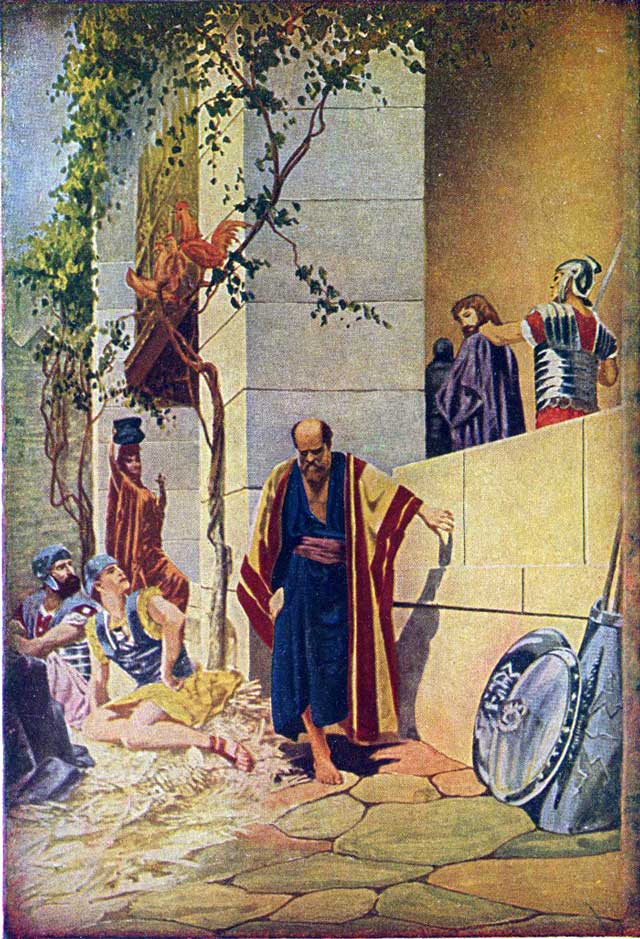
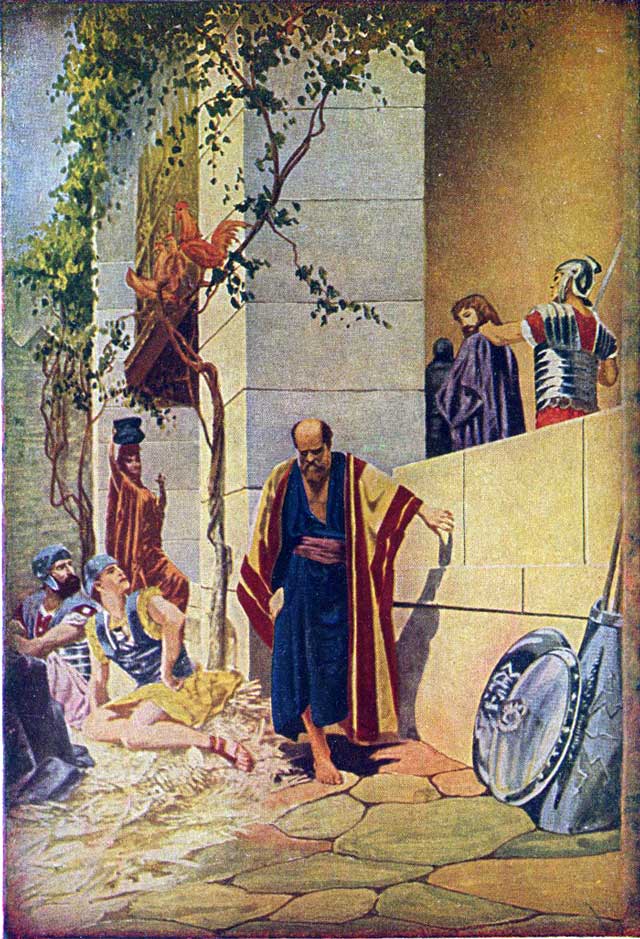
PETER DENIES CHRIST—And Peter remembered the word of Jesus, which said unto him, ‘Before the cock crow, thou shalt deny me thrice.—(Matt. 26:75.)

But as they came forward to seize Jesus, Peter drew his sword, and struck at one of the men in front, and cut off his right ear. The man was a servant of the high-priest, and his name was Malchus. Jesus said to Peter:

“Put up the sword into its sheath; the cup which my Father has given me, shall I not drink it? Do you not know that I could call upon my Father, and he would send to me armies upon armies of angels?”

Then he spoke to the crowd, “Let me do this.” And he touched the place where the ear had been cut off, and it came on again and was well. Jesus said to the rulers and leaders of the armed men:

“Do you come out against me with swords and clubs as though I were a robber? I was with you every day in the Temple, and you did not lift your hands against me. But the words in the scriptures must come to pass; and this is your hour.”

When the disciples of Jesus saw that he would not allow them to fight for him, they did not know what to do. In their sudden alarm they all ran away, and left their Master alone with his enemies. These men laid their hands on Jesus, and bound him, and led him away to the house of the high-priest. There were at that time two men called high-priests by the Jews. One was Annas, who had been high-priest until his office had been taken from him by the Romans, and given to Caiphas, his son-in-law. But Annas still had great power among the people; and they brought Jesus, all bound as he was, first to Annas.

Simon Peter, and John, the disciple whom Jesus loved, had followed after the crowd of those who carried Jesus away; and they came to the door of the high-priest’s house. John knew the high-priest and went in; but Peter at first stayed outside, until John went out and brought him in. He came in, but did not dare to go into the room where Jesus stood before the high-priest Annas. In the court-yard of the house, they had made a fire of charcoal, and Peter stood among those who were warming themselves at the fire.

Annas in the inner room asked Jesus about his disciples and his teaching. Jesus answered him:

“What I have taught has been open in the synagogues and in the Temple. Why do you ask me? Ask those that heard me; they know what I said.”

Then one of the officers struck Jesus on the mouth, saying to him:

“Is this the way that you answer the high-priest?”

Jesus answered the officer calmly and quietly:

“If I have said anything evil, tell what the evil is; but if I have spoken the truth, why do you strike me?”

While Annas and his men were thus showing their hate toward Jesus, who stood bound and alone among his enemies, Peter was still in the court-yard warming himself at the fire. A woman, who was a serving-maid in the house, looked at Peter sharply, and finally said to him:

“You were one of those men with this Jesus of Nazareth!”

Peter was afraid to tell the truth, and he answered her:

“Woman, I do not know the man; and I do not know what you are talking about.”

And to get away from her, he went out into the porch of the house. There another woman-servant saw him and said: “This man was one of those with Jesus!”

And Peter swore with an oath that he did not know Jesus at all. Soon a man came by, who was of kin to Malchus, whose ear Peter had cut off. He looked at Peter, and heard him speak, and said:

“You are surely one of this man’s disciples; for your speech shows that you came from Galilee.”

Then Peter began again to curse and to swear, declaring that he did not know the man.

Just at that moment the loud, shrill crowing of a cock startled Peter; and at the same time he saw Jesus, who was being dragged through the hall from Annas to the council-room of Caiphas, the other high-priest. And the Lord turned as he was passing and looked at Peter.

Then there flashed into Peter’s mind what Jesus had said on the evening before!

“Before the cock crows to-morrow morning, you will three times deny that you have ever known me.”

Then Peter went out of the high-priest’s house into the street; and he wept bitterly because he had denied his Lord.
THE STORY OF THE STRANGER AT THE WELL

THE STORY OF THE STRANGER AT THE WELL

While Jesus was teaching in Jerusalem and in the country places near it, John the Baptist was still preaching and baptizing. But already the people were leaving John and going to hear Jesus. Some of the followers of John the Baptist were not pleased as they saw that fewer people came to their master, and that the crowds were seeking Jesus. But John said to them: “I told you that I am not the Christ, but that I am sent before him. Jesus is the Christ, the king. He must grow greater, while I must grow less; and I am glad that it is so.”

Soon after this, Herod Antipas, the king of the province or land of Galilee, put John in prison. Herod had taken for his wife a woman named Herodias, who had left her husband to live with Herod, which was very wicked. John sent word to Herod, that it was not right for him to have this woman as his wife. These words of John made Herodias very angry. She hated John, and tried to kill him. Herod himself did not hate John so greatly, for he knew that John had spoken the truth. But he was weak, and yielded to his wife Herodias. To please her, he sent John the Baptist to a lonely prison among the mountains east of the Dead Sea; for the land in that region, as well as Galilee, was under Herod’s rule. There in prison Herod hoped to keep John safe from the hate of his wife Herodias.

Soon after John the Baptist was thrown into prison, Jesus left the country near Jerusalem with his disciples, and went toward Galilee, the province in the north. Between Judea in the south and Galilee in the north, lay the land of Samaria, where the Samaritans lived, who hated the Jews. They worshipped the Lord as the Jews worshipped him, but they had their own Temple and their own priests. And they had their own Bible, which was only the five books of Moses; for they would not read the other books of the old Testament. The Jews and the Samaritans would scarcely ever speak to each other, so great was the hate between them.

When Jews went from Galilee to Jerusalem, or from Jerusalem to Galilee, they would not pass through Samaria, but went down the mountains to the river Jordan, and walked beside the river, in order to go around Samaria. But Jesus, when he would go from Jerusalem to Galilee, walked over the mountains straight through Samaria. One morning while he was on his journey, he stopped to rest beside an old well at the foot of Mount Gerizim, not far from the city of Shechem, but nearer to a little village that was called Sychar. This well had been dug by Jacob, the great father or ancestor of the Israelites, many hundreds of years before. It was an old well then in the days of Jesus; and it is much older now; for the same well may be seen in that place still. Even now travelers may have a drink from Jacob’s well.

It was early in the morning, about sunrise, when Jesus was sitting by Jacob’s well. He was very tired, for he had walked a long journey; he was hungry, and his disciples had gone to the village near at hand to buy food. He was thirsty, too; and as he looked into the well he could see the water a hundred feet below, but he had no rope with which to let down a cup or a jar to draw up some water to drink.

Just at this moment a Samaritan woman came to the well, with her water-jar upon her head, and her rope in her hand. Jesus looked at her, and in one glance read her soul, and saw all her life.

He knew that Jews did not often speak to Samaritans, but he said to her:

“Please to give me a drink?”

The woman saw from his looks and his dress that he was a Jew, and she said to him:

“How is it that you, who are a Jew, ask drink of me, a Samaritan woman?”

Jesus answered her:

“If you knew what God’s free gift is, and if you knew who it is that says to you, ‘Give me a drink,’ you would ask him to give you living water, and he would give it to you.”

There was something in the words and the looks of Jesus which made the woman feel that he was not a common man. She said to him: “Sir, you have nothing to draw water with, and the well is deep. Where can you get that living water? Are you greater than our father Jacob, who drank from this well, and who gave it to us?”

“Whoever drinks of this water,” said Jesus, “shall thirst again, but whoever drinks of the water that I shall give him, shall never thirst; but the water that I shall give him shall be in him a well of water springing up unto everlasting life.”

“Sir,” said the woman, “give me some of this water of yours, so that I will not thirst any more, nor come all the way to this well.”

Jesus looked at the woman, and said to her, “Go home, and bring your husband, and come here.”

“I have no husband,” answered the woman.

“Yes,” said Jesus, “you have spoken the truth. You have no husband. But you have had five husbands, and the man whom you now have is not your husband.”

The woman was filled with wonder as she heard this. She saw that here was a man who knew what others could not know. She felt that God had spoken to him, and she said:

“Sir, I see that you are a prophet of God. Tell me whether our people or the Jews are right. Our fathers have worshipped on this mountain. The Jews say that Jerusalem is the place where men should go to worship. Now, which of these is the right place?”

“Woman, believe me,” said Jesus, “there is coming a time when men shall worship God in other places besides on this mountain and in Jerusalem. The time is near; it has even now come, when the true worshippers everywhere shall pray to God in spirit and in truth; for God himself is a Spirit.”

The woman said: “I know that the Anointed one is coming, the Christ. When he comes, he will teach us all things.”

Jesus said to her:

“I that speak to you now am he, the Christ!”

Just at this time the disciples of Jesus came back from the village. They wondered to see Jesus talking with this Samaritan woman, but they said nothing.

The woman had come to draw water, but in her interest in this wonderful stranger, she forgot her errand. Leaving her water-jar, she ran back to her village, and said to the people:

“Come, see a man who told me everything that I have done in all my life! Is not this man the Christ whom we are looking for?”

Soon the woman came back to the well with many of her people. They asked Jesus to come to their town, and to stay there and teach them. He went with them, and stayed there two days, teaching the people, who were Samaritans. And many of the people in that place believed in Jesus, and said:

“We have heard for ourselves; now we know that this is indeed the Saviour of the world.”

The Children’s Six Minutes: Yokes

YOKES

A Yoke is a help, not a hindrance. Our first thought is that a yoke is burdensome. A little study reveals to us the great usefulness of the yoke.

Have you ever seen a yoke of oxen? What heavy, slow-moving creatures they are! But they are pullers of heavy loads. These loads could not be drawn by them were they not yoked together.

Now there are different kinds of yokes, that is, there are many ways of rendering easier the carrying of heavy loads. For example, there is the Oriental way. First, there is the manner in which one man will carry a heavy load. He takes a pole, on each end of the pole hangs a rope. Then he divides his load, fastening half of his load to either rope. He gets beneath the pole, which is shaped to fit his shoulder, lifts, and off he trots as easily and jauntily as can be. Sometimes the load is too heavy for one man. He then summons a companion. They get a longer, heavier pole, with a much stouter rope.This time they do not divide the load, rather they keep it together. They fasten the rope securely about it, and then tie it about the pole. The men stoop, one at each end of the heavy pole. They stand up straight, the load is lifted from the ground, only a few inches perhaps, but enough to clear the ground, then, singing and laughing, keeping perfect time each with the other, they swing down the street. It is incredible the heavy loads they carry. I could not believe my eyes when I looked upon some of them.

Jesus perfectly understood the helpfulness and value of the yoke. He made it most beautiful in that he told his followers that he would help them, that he would carry his part of the burden, that he would share with them the other side of the yoke.

MEMORY VERSE, Matthew 11: 29-30

“Take my yoke upon you, and learn of me; for I am meek and lowly in heart: and ye shall find rest unto your souls. For my yoke is easy and my burden is light.”

MEMORY HYMN

“My times are in thy hand.”

1 My times are in Your hand;
my God, I wish them there!
My life, my friends, my soul, I leave
entirely to Your care.

2 My times are in Your hand
whatever they may be,
pleasing or painful, dark or bright,
as You know best for me.

3 My times are in Your hand;
why should I doubt or fear?
My Father’s hand will never cause
His child a needless tear.

4 My times are in Your hand:
Jesus, the Crucified;
those hands my cruel sins had pierced
are now my guard and guide.

5 My times are in Your hand;
such faith You give to me
that after death, at Your right hand
I shall for ever be.

Source: The Irish Presbyterian Hymnbook #516

THE STORY OF THE WATER THAT WAS TURNED INTO WINE

THE STORY OF THE WATER THAT WAS TURNED INTO WINE

A few days after Jesus met his followers or disciples at the river Jordan, he came with these men to a town in Galilee called Cana, to be present at a wedding. In those lands a feast was always held at a wedding, and often the friends of those who were married stayed several days, eating and drinking together.

The mother of Jesus was at this wedding as a friend of the family; for Nazareth, where she lived, was quite near to Cana. Before the wedding feast was over, all the wine had been used, and there was no more for the guests to drink. The mother of Jesus knew that her son had power to do whatever he chose; and she said to him; “They have no wine.”

Jesus said to her: “O woman, what have I to do with thee? My hour is not yet come.”

But his mother knew that Jesus would in some way help the people in their need, and she said to the servants who were waiting at the table:

“Whatever he tells you to do, be sure to do it.”

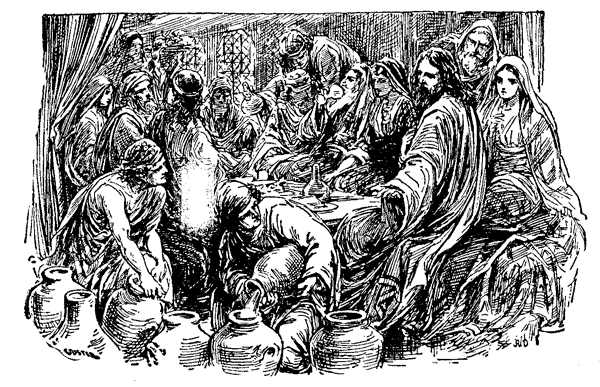
In the dining hall were standing six large stone jars, each about as large as a barrel, holding twenty-five gallons. These jars held water for washing, as the Jews washed their hands before every meal, and washed their feet as often as they came from walking in the street, since they wore no shoes, but only sandals. Jesus said to the servants:

“Fill the jars with water.”

“Fill the jars with water”

The servants obeyed Jesus, and filled the jars up to the brim. Then Jesus spoke to them again, and said:

“Now draw out some of the water, and take it to the ruler of the feast.”

They drew out water from the jars, and saw that it had been turned into wine. The ruler did not know from what place the wine had come; but he said to the young man who had just been married, the bridegroom:

“At a feast everybody gives his best wine at the beginning, and afterward, when his guests have drunk freely, he brings on wine that is not so good; but you have kept the good wine until now.”

This was the first time that Jesus used the power that God had given him, to do what no other man could do. Such works as these were called “miracles”; and Jesus did them as signs of his power as the Son of God. When the disciples saw this miracle, they believed in Jesus more fully than before.

After this Jesus went with his mother and his younger brothers to a place called Capernaum, on the shore of the Sea of Galilee. But they stayed there only a few days, for the feast of the Passover was near, and Jesus went up to Jerusalem to attend it. You remember that the feast of the Passover was held every year, to keep in mind how God had led the people of Israel out of Egypt long before.

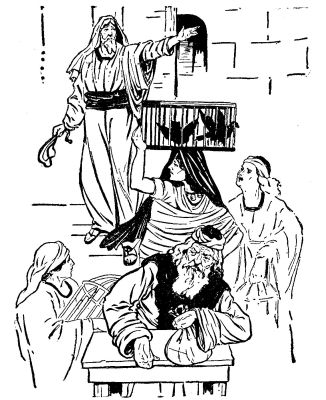
When Jesus came to Jerusalem, he found in the courts of the Temple men who were selling oxen and sheep and doves for the sacrifices, and other men sitting at tables changing the money of Jews who came from other lands into the money of Judea. All this made the courts around the Temple seem like a market, and not a place for the worship of God.

“Take these things away”

Jesus picked up some cord and made from it a little whip. With it he began to drive out of the Temple all the buyers and sellers. He was but one, and they were many; but such power was in his look, that they ran before him. He drove the men and the sheep and the oxen; he overturned the tables and threw on the floor the money, and to those who were selling the doves he said: “Take these things away; make not my Father’s house a house for selling and buying!”

The acts of Jesus were not pleasing to the rulers of the Jews, for many of them were making money by this selling of sacrifices and changing of money. Some of the rulers came to Jesus and said to him: “What right have you to come here and do such things as these? What sign can you show that God has given to you power to rule in this place?”

Jesus said to them: “I will give you a sign. Destroy this house of God, and in three days I will raise it up.”

Then said the Jews, “It has taken forty-six years to build this Temple, and it is not finished yet. Will you raise it up in three days?”

But Jesus did not mean that Temple on Mount Moriah. He was speaking of himself, for in him God was dwelling as in a temple, and he meant that when they should put him to death, he would rise again in three days. Afterward, when Jesus had died and risen again, his followers, the disciples, thought of what he had said, and understood these words.

THE STORY OF THE CHILD IN THE TEMPLE

THE STORY OF THE CHILD IN THE TEMPLE

Jesus was brought to Nazareth when he was a little child not more than three years old; there he grew up as a boy and a young man, and there he lived until he was thirty years of age. We should like to know many things about his boyhood, but the Bible tells us very little. As Joseph was a working man, it is likely that he lived in a house with only one room, with no floor except the earth, no window except a hole in the wall, no pictures upon the walls, and neither bedstead, nor chair, nor looking-glass. They sat upon the floor or upon cushions; they slept upon rolls of matting, and their meals were taken from a low table not much larger than a stool.

Jesus may have learned to read at the village school, which was generally held in the house used for worship, called the “synagogue.” The lessons were from rolls on which were written parts of the Old Testament; but Jesus never had a Bible of his own. From a child he went with Joseph to the worship in the synagogue twice every week. There they sat on the floor and heard the Old Testament read and explained, while Mary and the younger sisters of Jesus listened from a gallery behind a lattice-screen. The Jewish boys of that time were taught to know almost the whole of the Old Testament by heart.

It was the custom of the Jews from all parts of the land to go up to Jerusalem to worship at least once every year, at the feast of the Passover, which was held in the spring. Some families also stayed to the feast of Pentecost, which was fifty days after Passover; and some went again in the fall to the feast of Tabernacles, when for a week all the families slept out of doors, under roofs made of green twigs and bushes.

When Jesus was a boy twelve years old, he was taken up to the feast of the Passover, and there for the first time he saw the holy city Jerusalem, and the Temple of the Lord on Mount Moriah. Young as he was, his soul was stirred, as he walked among the courts of the Temple and saw the altar with its smoking sacrifice, the priests in their white robes, and the Levites with their silver trumpets. Though a boy, Jesus began to feel that he was the Son of God, and that this was his Father’s house.

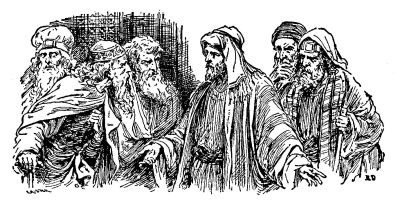
Sitting in a company of the doctors of the law

His heart was so filled with the worship of the Temple, with the words of the scribes or teachers whom he heard in the courts, and with his own thoughts, that when it was time to go home to Nazareth, he stayed behind, held fast by his love for the house of the Lord. The company of people who were traveling together was large, and at first he was not missed. But when night came and the boy Jesus could not be found, his mother was alarmed. The next day Joseph and Mary left their company and hastened back to Jerusalem. They did not at first think to go to the Temple. They sought him among their friends and kindred who were living in the city, but could not find him.

On the third day, they went up to the Temple with heavy hearts, still looking for their boy. And there they found him sitting in a company of the doctors of the law, listening to their words and asking them questions. Everybody who stood near was surprised to find how deep was the knowledge of this boy in the word of the Lord.

His mother spoke to him a little sharply, for she felt that her son had not been thoughtful of his duty. She said: “Child, why have you treated us in this way? Do you not know that your father and I have been looking for you with troubled hearts?”

“Why did you seek for me,” said Jesus. “Did you not know that I must be in my Father’s house?”

They did not understand these words; but Mary thought often about them afterward; for she felt her son was no common child, and that his words had a deep meaning. Though Jesus was wise beyond his years, he obeyed Joseph and his mother in all things. He went with them to Nazareth, and lived contented with the plain life of their country home.

As the years went on, Jesus grew from a boy to a young man. He grew, too, in knowledge, and in wisdom, and in the favor of God. He won the love of all who knew him, for there was something in his nature that drew all hearts, both young and old.

Jesus learned the trade of a carpenter with Joseph; and when Joseph died, while Jesus was still a young man, Jesus worked as a carpenter and helped his mother take care of the family. And so in the carpenter shop, and the quiet life of a country village, and the worship of the synagogue, the years passed until Jesus was thirty years of age.

THE STORY OF JESUS, THE BABE OF BETHLEHEM

THE STORY OF JESUS, THE BABE OF BETHLEHEM

Soon after the time when John the Baptist was born, Joseph the carpenter of Nazareth had a dream. In his dream he saw an angel from the Lord standing beside him. The angel said to him:

“Joseph, sprung from the line of king David, I have come to tell you, that Mary, the young woman whom you are to marry, will have a son, sent by the Lord God. You shall call his name Jesus, which means ‘salvation,’ because he shall save his people from their sins.”

God’s people had had several kings. Some of them had been selfish and cruel, but Jesus was to be a new kind of king, one who would save, not destroy men.

Soon after Joseph and Mary were married in Nazareth, a command went forth from the emperor Augustus Cæsar through all the lands of the Roman empire, for all the people to go to the cities and towns from which their families had come, and there to have their names written down upon a list, for the emperor wished a list to be made of all the people under his rule. As both Joseph and Mary had come from the family of David the king, they went together from Nazareth to Bethlehem, there to have their names written upon the list. For you remember that Bethlehem in Judea, six miles south of Jerusalem, was the place where David was born, and where his father’s family had lived for many years.

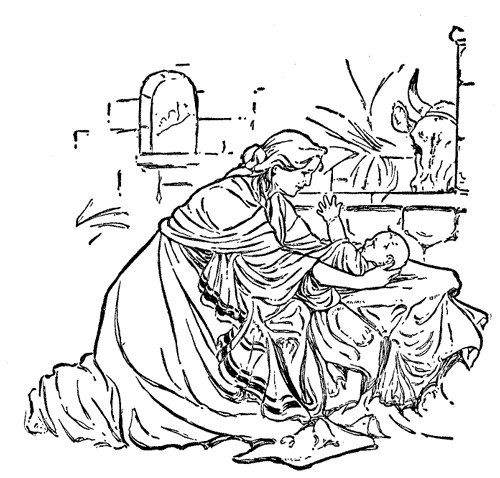
It was a long journey from Nazareth to Bethlehem; down the mountains to the river Jordan, then following the Jordan almost to its end, and then climbing the mountains of Judah to the town of Bethlehem. When Joseph and Mary came to Bethlehem they found the city full of people who, like themselves, had come to have their names enrolled or written upon the list. The inn or hotel was full, and there was no room for them; for no one but themselves knew that this young woman was soon to be the mother of the Lord of all the earth. The best that they could do was to go to a stable where the cattle were kept. There the little baby was born, and was laid in a manger, where the cattle were fed.

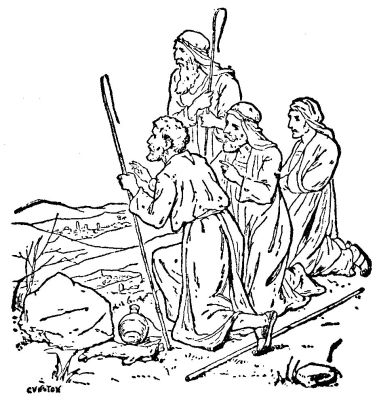
On that night, some shepherds were tending their sheep in a field near Bethlehem. Suddenly, a great light shone upon them, and they saw an angel of the Lord standing before them. They were filled with fear, as they saw how glorious the angel was. But the angel said to them:

“Be not afraid; for behold I bring you news of great joy, which shall be to all the people; for there is born to you this day in Bethlehem, the city of David, a Saviour who is Christ the Lord, the anointed king. You may see him there; and you may know him by this sign: He is a new-born baby, lying in a manger, at the inn.”

They were filled with fear

And then they saw that the air around and the sky above them were filled with angels, praising God and singing:

“Glory to God in the highest. And on earth peace among men in whom God is well pleased.”

While they looked with wonder, and listened, the angels went out of sight as suddenly as they had come. Then the shepherds said one to another:

“Let us go at once to Bethlehem, and see this wonderful thing that has come to pass, and which the Lord has made known to us.”

The baby in the manger

Then as quickly as they could go to Bethlehem, they went, and found Joseph, the carpenter of Nazareth, and his young wife Mary, and the little baby lying in the manger. They told Mary and Joseph, and others also, how they had seen the angels, and what they had heard about this baby. All who heard their story wondered at it; Mary, the mother of the child, said nothing. She thought over all these things, and silently kept them in her heart. After their visit, the shepherds went back to their flocks, praising God for the good news that he had sent to them.

When the little one was eight days old, they gave him a name; and the name given was “Jesus,” a word which means “salvation,” as the angel had told both Mary and Joseph that he should be named. So the very name of this child told what he should do for men; for he was to bring salvation to the world.

THE STORY OF THE SERMON ON THE MOUNT

THE STORY OF THE SERMON ON THE MOUNT

Among the Jews there was one class of men hated and despised by the people more than any other. That was “the publicans.” These were the men who took from the people the tax which the Roman rulers had laid upon the land. Many of these publicans were selfish, grasping, and cruel. They robbed the people, taking more than was right. Some of them were honest men, dealing fairly, and taking no more for the tax than was needful; but because so many were wicked, all the publicans were hated alike; and they were called “sinners” by the people.

One day, when Jesus was going out of Capernaum, to the seaside, followed by a great crowd of people, he passed a publican, or tax-gatherer, who was seated at his table taking money from the people who came to pay their taxes. This man was named Matthew, or Levi; for many Jews had two names. Jesus could look into the hearts of men, and he saw that Matthew was one who might help him as one of his disciples. He looked upon Matthew, and said:

“Follow me!”

At once, the publican rose up from his table, and left it to go with Jesus. All the people wondered, as they saw one of the hated publicans among the disciples, with Peter, and John, and the rest. But Jesus believed that there is good in all kinds of people. Most of the men who followed him were poor fishermen. None of them, so far as we know, was rich. And when he called Matthew he saw a man with a true and loving heart, whose rising up to follow Jesus just as soon as he was called showed what a brave and faithful friend he would be. The first of the four books about Jesus bears Matthew’s name.

A little while after Jesus called him, Matthew made a great feast for Jesus at his house; and to the feast he invited many publicans, and others whom the Jews called sinners. The Pharisees saw Jesus sitting among these people, and they said with scorn to his disciples:

“Why does your Master sit at the table with publicans and sinners?”

Jesus heard of what these men had said, and he said:

“Those that are well do not need a doctor to cure them, but those that are sick do need one. I go to these people because they know that they are sinners and need to be saved. I came not to call those who think themselves to be good, but those who wish to be made better.”

One evening Jesus went alone to a mountain not far from Capernaum. A crowd of people and his disciples followed him; but Jesus left them all, and went up to the top of the mountain, where he could be alone. There he stayed all night, praying to God, his Father and our Father. In the morning, out of all his followers, he chose twelve men who should walk with him and listen to his words, so that they might be able to teach others in turn. Some of these men he had called before; but now he called them again, and others with them. They were called “The Twelve,” or “the disciples”; and after Jesus went to heaven, they were called “The Apostles,” a word which means “those who were sent out,” because Jesus sent them out to preach the gospel to the world.

“I came not to call those who think themselves to be good”

The names of the twelve disciples, or apostles, were these: Simon Peter and his brother Andrew; James and John, the two sons of Zebedee; Philip of Bethsaida, and Nathanael, who was also called Bartholomew, a name which means “the son of Tholmai”; Thomas, who was also called Didymus, a name which means “a twin,” and Matthew the publican, or tax-gatherer; another James, the son of Alpheus, who was called “James the Less,” to keep his name apart from the first James, the brother of John; and Lebbeus, who was also called Thaddeus. Lebbeus was also called Judas, but he was a different man from another Judas, whose name is always given last. The eleventh name was another Simon, who was called “the Cananean” or “Simon Zelotes”; and the last name was Judas Iscariot, who was afterward the traitor. We know very little about most of these men, but some of them in later days did a great work. Simon Peter was a leader among them, but most of them were common sort of men of whom the best we know is that they loved Jesus and followed him to the end. Some died for him, and some served him in distant and dangerous places.

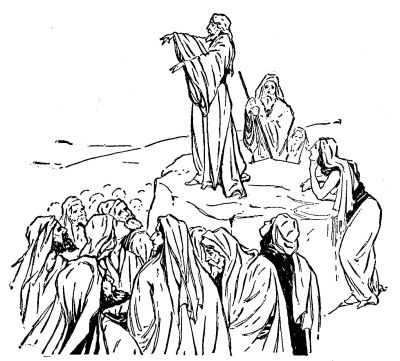
Then, on the mountain, he preached

Before all the people who had come to hear him, Jesus called these twelve men to stand by his side. Then, on the mountain, he preached to these disciples and to the great company of people. The disciples stood beside him, and the great crowd of people stood in front, while Jesus spoke. What he said on that day is called “The Sermon on the Mount.” Matthew wrote it down, and you can read it in his gospel, in the fifth, sixth, and seventh chapters. Jesus began with these words to his disciples:

“Blessed are the poor in spirit: for theirs is the kingdom of heaven.

“Blessed are they that mourn: for they shall be comforted.

“Blessed are the meek: for they shall inherit the earth.

“Blessed are they which do hunger and thirst after righteousness: for they shall be filled.

“Blessed are the merciful: for they shall obtain mercy.

“Blessed are the pure in heart: for they shall see God.

“Blessed are the peacemakers: for they shall be called the children of God.

“Blessed are they which are persecuted for righteousness’ sake: for theirs is the kingdom of heaven.

“Blessed are ye when men shall revile you, and persecute you, and shall say all manner of evil against you falsely, for my sake.

“Rejoice, and be exceedingly glad: for great is your reward in heaven: for so persecuted they the prophets which were before you.

“Ye are the salt of the earth: but if the salt have lost his savor, wherewith shall it be salted? it is thenceforth good for nothing, but to be cast out, and to be trodden under foot of men.

“Ye are the light of the world. A city that is set on an hill cannot be hid. Neither do men light a candle, and put it under a bushel, but on a candlestick; and it giveth light unto all that are in the house. Let your light so shine before men, that they may see your good works, and glorify your Father which is in heaven.”

It was in this Sermon on the Mount that Jesus told the people how they should pray, and he gave them the prayer which we all know as the Lord’s Prayer.

And this was the end of the Sermon:

“Therefore, whosoever heareth these sayings of mine, and doeth them, I will liken him unto a wise man, which built his house upon a rock:

“And the rain descended, and the floods came, and the winds blew, and beat upon that house; and it fell not; for it was founded upon a rock.

“And every one that heareth these sayings of mine, and doeth them not, shall be likened unto a foolish man, which built his house upon the sand:

“And the rain descended, and the floods came, and the winds blew, and beat upon that house; and it fell: and great was the fall of it.”

Desde la Caída del Hombre hasta el Diluvio

The Picture shows Cain and Abel with their sacrifices, Seth calling out to God, and the world with water.

Desde la Caída del Hombre hasta el Diluvio

Adán y Eva fuera del Jardín
  • En su nuevo estado de conciencia del bien y del mal, Adán y Eva comenzaron su vida fuera del Jardín del Edén. La existencia era muy diferente de antes. Anteriormente, en la paz del jardín, el primer hombre y la primera mujer habían sido encargados de cultivar y cuidar un verdadero paraíso. Ahora Adán se ganaba la vida con el sudor de su frente, luchando interminablemente contra las malas hierbas y los espinos.
  • Eva descubrió la verdad de la Palabra de Dios. Él había dicho: “Multiplicaré en gran manera tu dolor y tus conceptiones; con dolor darás a luz hijos” (Génesis 3:16). El primer hijo que Eva trajo al mundo fue un hijo llamado Caín. Ella dijo: “He adquirido un hombre del SEÑOR” (Génesis 4:1). Luego Eva dio a luz a otro hijo, Abel. La redacción aquí sugiere que los dos niños pueden haber sido gemelos. En otros lugares de la Biblia también se dice que el hombre conoció a su mujer y ella concibió. Aquí dice: “y de nuevo dio a luz a su hermano”.
La diferencia entre los dos hermanos
  • Como suele suceder con los hermanos en la misma familia, estos dos eran bastante diferentes. Abel era pastor de ovejas, pero Caín era agricultor. Según Génesis 4:3-7, también había diferencias espirituales entre estos dos hombres.
Culto Enseñado
Adán y Eva obviamente habían enseñado a sus hijos sobre la existencia de Dios y sobre la necesidad de adorarlo y ofrecerle sacrificios. Con el paso del tiempo, Caín trajo del fruto de la tierra una ofrenda al Señor. Abel también trajo una ofrenda de los primogénitos de su rebaño.
 
Sacrificio Aceptado y Rechazado
  • El Señor aceptó la ofrenda de Abel pero no la de Caín. Esto perturbó a Caín, y se enojó.
  • El Señor dijo a Caín: ¿Por qué estás enojado? ¿Y por qué ha caído tu semblante? Si haces lo correcto, ¿no serás aceptado? Y si no haces lo correcto, el pecado está a la puerta. Y a ti será su deseo, y tú dominarás sobre él. Génesis 4:6-7.
  • En Su misericordia y voluntad de perdonar el error de Caín, el Señor le hizo un llamado. Le dijo a Caín que su ofrenda podría ser aceptada así como la de Abel si él también hiciera lo correcto. La única cosa que podría evitar que Caín hiciera lo correcto sería el pecado.
Sacrificio de Sangre, un Requisito
  • ¿Qué había de malo en la ofrenda de Caín? La ofrenda de Caín no incluía un sacrificio de sangre. Él había traído una ofrenda de los frutos de la tierra. Desde el principio, el plan de Dios requería un sacrificio de sangre.
  • En el jardín, Dios había sacrificado animales para proporcionar pieles que cubrieran la desnudez de Adán y Eva. (Ver Génesis 3:21.) En otras palabras, para que los pecados fueran cubiertos, se tenía que derramar sangre.
    • Jesucristo es el Cordero que fue sacrificado desde la fundación del mundo (Apocalipsis 13:8).
    • La razón por la que Dios eligió un sacrificio de sangre es que la paga del pecado es muerte (Romanos 6:23).
    • Sin el derramamiento de sangre, los pecados no pueden ser remitidos (Hebreos 9:22).
  • Adán debió haber instruido a sus hijos o Abel no habría sabido qué traer. Sabemos que Caín llevó un sacrificio inadecuado.
  • Desde el principio de las Escrituras vemos que la sinceridad por sí sola no pone a una persona en una posición correcta ante Dios. Lo único que Dios honrará es la fe obediente, no es suficiente hacer lo que pensamos que es correcto o lo mejor que sabemos. Debemos hacer lo que Dios manda.
    • Abel obedeció a Dios por fe. Hebreos 11:4 dice: “Por la fe Abel ofreció a Dios un sacrificio más excelente que Caín, por el cual alcanzó testimonio de que era justo, dando Dios testimonio de sus ofrendas: y por ella, estando muerto, aún habla!”
El Castigo de la Desobediencia
  • Lamentablemente, Caín no aceptó la oferta de Dios de intentarlo de nuevo, sino que asesinó a su hermano, Abel.
    • El Señor, que ve y sabe todas las cosas, preguntó: “¿Dónde está Abel tu hermano?”
    • Caín mintió: “No lo sé; ¿soy yo el guardián de mi hermano?”
    • Entonces Dios pronunció la pena por el pecado de Caín: “¿Qué has hecho? La voz de la sangre de tu hermano clama a mí desde la tierra. Y ahora estás maldito de la tierra, que ha abierto su boca para recibir la sangre de tu hermano de tu mano; cuando labres la tierra, no te dará más su fuerza; serás un fugitivo y un vagabundo en la tierra!”
      • Los científicos han descubierto que el ADN, que se encuentra en la sangre, emite una vibración. Esto podría ser lo que se refiere como “la voz de la sangre de tu hermano clama a mí desde la tierra”.
    • Caín respondió: “Mi castigo es mayor de lo que puedo soportar. He aquí, me has echado hoy de la faz de la tierra; y de tu presencia me esconderé; y seré un fugitivo y un vagabundo en la tierra; y sucederá que todo aquel que me encuentre me matará” (Génesis 4:13-14).
    • El Señor respondió: Por tanto, cualquiera que mate a Caín, se tomará venganza sobre él siete veces” (Génesis 4:15). Entonces el Señor puso una marca sobre Caín para evitar que cualquiera que lo encontrara lo matara.
      • Dios aún estaba mostrando misericordia a Caín al ponerle una marca para prevenir que alguien lo matara.
    • Como resultado de sus pecados de asesinato y de negarse a obedecer a Dios, Caín dejó la presencia del Señor y fue a vivir en la solitaria tierra de Nod, al este del Edén.
Hombres que caminaron con Dios
  • Seth
    • Adán y Eva tuvieron más hijos, pero no fue hasta que dio a luz a un hijo a quien llamaron Seth que Eva dijo: ‘Porque Dios me ha dado otro descendiente en lugar de Abel, a quien mató Caín’ (Génesis 4:25).
    • Fue en los días de Seth, quien evidentemente era un hombre piadoso con el deseo de servir a Dios como lo había hecho Abel, que la gente comenzó a invocar el nombre del Señor (Génesis 4:26).
  • Enoc
    • Uno de los hombres más interesantes que vivieron en el Libro del Génesis fue Enoc. Amaba a Dios y le fue obediente. La Biblia dice: “Y caminó Enoc con Dios; y no apareció más, porque le tomó Dios” (Génesis 5:24).
    • Hebreos 11:5 ofrece más información sobre este evento inusual: “Por la fe Enoc fue traspuesto para no ver muerte; y no fue hallado, porque Dios le trasplantó; pues antes de su traslación tuvo testimonio de haber agradado a Dios.”
  • Noé
    • En los días del bisnieto de Enoc, Noé, Dios vio que la maldad del hombre era grande en la tierra y que toda la imaginación de los pensamientos de sus corazones era solo maldad continuamente. Eran tan perversos e inicuos que a Dios le dolió haberlos creado.
      • Él dijo: “Destruiré al hombre que he creado de la faz de la tierra; tanto al hombre como a la bestia, y a lo que se arrastra, y a las aves del cielo; porque me arrepiento de haberlos hecho” (Génesis 6:7).
    • Sin embargo, había un hombre que encontró gracia a los ojos del Señor: Noé. Mientras otros pensaban continuamente en cosas malas y practicaban toda clase de maldad, Noé creía en Dios y le obedecía.
      • Hebreos 11:7 lo expresa de esta manera: “Por la fe, Noé, advertido por Dios acerca de cosas que aún no se veían, con temor preparó un arca para la salvación de su casa; por la cual condenó al mundo y fue hecho heredero de la justicia que es por la fe.”
¿Qué tenían en común Abel, Seth, Enoc y Noé? Fe obediente. Creyeron en Dios y le obedecieron. Desde el principio, la fe ha sido el requisito de Dios. Como señala Hebreos 11:6, “Sin fe es imposible agradarle; porque es necesario que el que se acerca a Dios crea que le hay, y que es galardonador de los que le buscan diligentemente.”
 

Do We Love God Like He Loves Us?

What kind of love does God have? He has a Father’s love for us. He gave his life for us that is what kind of love he has for us. We should love him because he first loved us. He loved us so much. Do we love him the way he loves us?

You look around and see. God gave us the world to live in and what a bright and beautiful world it is. He made it all for us because he loves us. God made the bird that flies so high, the flower that the bees buzz around. Do we take care of the world and love it the way God loves it and us? You look and see.

That is what a father’s love is like. He loves them who are fatherless the same way he does all of us. He loved us first, so we should love him back. He made all of us, but not the same. He loves each of us in the same way that a father loves.

1 John 4:19

We love him, because he first loved us.

THE STORY OF THE CAVE OF ADULLAM

THE STORY OF THE CAVE OF ADULLAM

Now Saul had a son, Jonathan, near David’s own age. He and David became fast friends and loved one another as brothers. Saul the king became very jealous of David because the people praised him after his fight with Goliath. He even threatened to take David’s life. He tried to catch him in his own house, but David’s wife let him down from a window by a rope and he escaped. He met his friend Jonathan, who told him that he should flee. They renewed their promises of friendship, which they kept ever afterward.

From his meeting with Jonathan, David went forth to be a wanderer, having no home as long as Saul lived. He found a great cave, called the cave of Adullam, and hid in it. Soon people heard where he was, and from all parts of the land, especially from his own tribe of Judah, men who were not satisfied with the rule of King Saul gathered around David.

Saul soon heard that David, with a band of men, was hiding among the mountains of Judah, and that among those who aided him were certain priests.

This enraged King Saul, and he ordered his guards to kill all the priests. The guards would not obey him, for they felt that it was a wicked thing to lay hands upon the priests of the Lord.

But he found one man whose name was Doeg, an Edomite, who was willing to obey the king. And Doeg, the Edomite, killed eighty-five men who wore the priestly garments.

All through the land went the news of Saul’s dreadful deed, and everywhere the people began to turn from Saul, and to look toward David as the only hope of the nation.

When Saul died he was followed by David, the shepherd boy, now grown to manhood and greatly loved by the people. He had many battles to fight with the Philistines and was nearly always victorious. He was a warrior king; but he was more than a warrior. He played on his harp and composed many beautiful hymns and songs, which are collected in the book of Psalms. He was a good king and tried to obey God’s command. He had a long reign and his people were happy and prosperous. He had many sons and daughters and beautiful palaces for them to live in.