Not only shall they be received, but they shall be brought near. They will not have to be fetched, but they will be caused to come to those for whom they are procured, and will yet be brought by Him who has procured them.
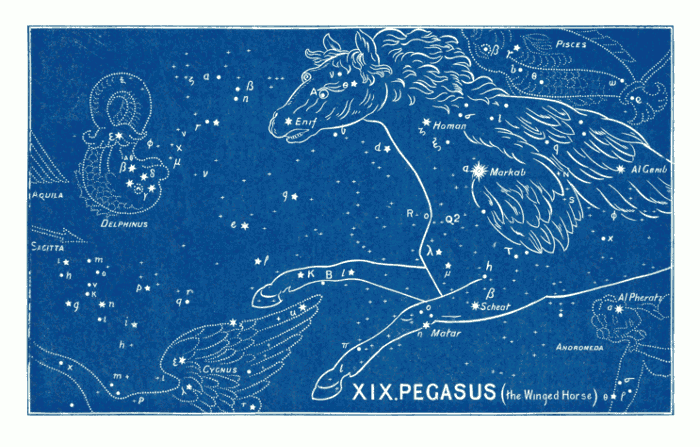
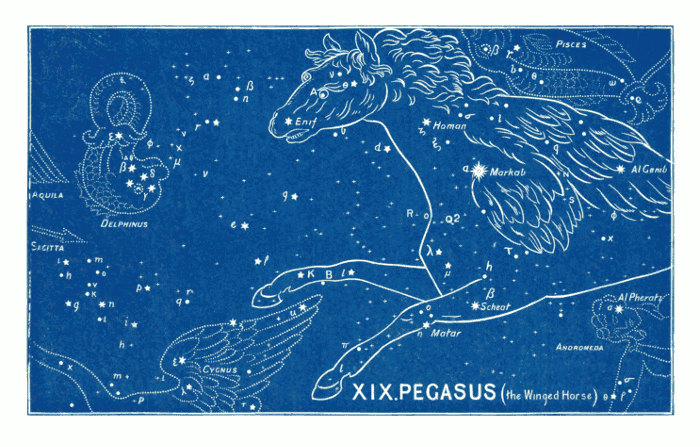
Plate 19: PEGASUS (the Winged Horse)
In the Denderah Zodiac there are two characters immediately below the horse, Pe and ka. Peka or Pega, is in Hebrew the chief, and Sus is horse. So that the very word (Pegasus) has come down to us and has been preserved through all the languages.
The names of the stars in this constellation declare to us its meaning. There are 89 altogether; one of the 1st magnitude, two of the 2nd, three of the 3rd, nine of the 4th, etc. And, as astronomers testify, “they render Pegasus peculiarly remarkable.”
The brightest, α (on the neck of the horse at the junction of the wing), comes down to us with the ancient Hebrew name of Markab, which means returning from afar. The star β (in the near shoulder) is called Scheat, i.e., who goeth and returneth. The star γ (at the tip of the wing) bears an Arabic name—Al Genib, who carries. The star ε (in the nostril) is called Enif (Arabic), the water. The star η (in the near leg) is called Matar (Arabic), who causes to overflow.
These names show us that we have to do with no mere horse. A winged horse is unknown to nature. It must therefore be used as a figure; and it can be a figure only of a person, even of Him who is “the Branch,” as the star Enif shows, who said, “If I go away, I will come again,” as the star Scheat testifies.
He who procured these blessings for the redeemed by His Atonement, is quickly coming to bring them; and is soon returning to pour them forth upon a groaning creation. This is the lesson of Pegasus.
Jesús pasó la noche orando antes de ser crucificado. Aquí hay tres de las cosas por las que oró antes de ser traicionado.
La oración del sumo sacerdote
Se encuentra en Juan 17:12
Después de haber dicho estas cosas, Jesús alzó los ojos al cielo [en oración] y dijo: «Padre, la hora ha llegado. Glorifica a tu Hijo, para que tu Hijo te glorifique a ti. Así como le has dado poder y autoridad sobre toda la humanidad, [ahora glorifícalo] para que dé vida eterna a todos los que le has dado [para que sean suyos, permanentemente y para siempre]. Y esta es la vida eterna: que te conozcan a ti, el único Dios verdadero [supremo y soberano], y [de la misma manera conozcan a] Jesús [como el] Cristo a quien tú has enviado. Yo te he glorificado [aquí abajo] en la tierra al completar la obra que me diste para hacer. Ahora, Padre, glorifícame junto contigo, con la gloria y la majestad que tenía contigo antes de que existiera el mundo.
He manifestado tu nombre [y revelado tu verdadero ser, tu esencia] a las personas que me has dado del mundo; eran tuyas y me las diste, y han guardado y obedecido tu palabra. Ahora [por fin] saben [con plena seguridad] que todo lo que me has dado proviene de ti [es real y verdaderamente tuyo]. Porque las palabras que me diste, se las he dado a ellos; y las recibieron y aceptaron y comprendieron verdaderamente [con plena seguridad] que yo vengo de ti [de tu presencia], y creyeron [sin ninguna duda] que tú me enviaste. Oro por ellos; no oro por el mundo, sino por los que me has dado, porque te pertenecen; y todo lo mío es tuyo, y [todo lo] tuyo es mío; y yo soy glorificado en ellos. Ya no estoy en el mundo; pero ellos todavía están en el mundo, y yo voy a ti. Padre Santo, guárdalos en tu nombre, el nombre que me has dado, para que sean uno, así como nosotros somos uno. Mientras estaba con ellos, los protegía en tu nombre, el nombre que me has dado; los cuidaba y los protegía, y ninguno de ellos se perdió, excepto el hijo de perdición, para que se cumpliera la Escritura.
Los discípulos en el mundo
Se encuentra en Juan 17:13-21
Pero ahora vengo a ti; y digo estas cosas mientras estoy en el mundo para que experimenten mi gozo en plenitud, completo y perfecto en ellos, llenando sus corazones de mi alegría. Les he dado tu palabra (el mensaje que me diste); y el mundo los ha odiado porque no son del mundo ni pertenecen al mundo, así como yo no soy del mundo ni pertenezco a él. No te pido que los saques del mundo, sino que los guardes y los protejas del maligno. No son del mundo, así como yo no soy del mundo. Santifícalos en la verdad; tu palabra es verdad. Así como tú me enviaste al mundo, yo también los he enviado a ellos (los creyentes) al mundo. Por causa de ellos me santifico (para hacer tu voluntad), para que también ellos sean santificados (apartados, dedicados, hechos santos) en tu verdad.
No ruego solo por estos (no es solo por ellos que hago esta petición), sino también por todos los que creerán en mí a través de su mensaje, para que todos sean uno; como tú, Padre, estás en mí y yo en ti, que también ellos sean uno en nosotros, para que el mundo crea (sin ninguna duda) que tú me enviaste.
Su gloria futura
Juan 17:22-26
Les he dado la gloria y el honor que tú me has dado, para que sean uno, así como nosotros somos uno; yo en ellos y tú en mí, para que sean perfeccionados y completados en la unidad, para que el mundo sepa sin duda alguna que tú me enviaste y que los has amado, así como me has amado a mí. Padre, deseo que también aquellos que me has dado estén conmigo donde yo estoy, para que vean mi gloria que me has dado, porque me amaste antes de la fundación del mundo.
Oh Padre justo y recto, aunque el mundo no te ha conocido ni te ha reconocido jamás, yo siempre te he conocido; y estos creyentes saben sin duda alguna que tú me enviaste; y les he dado a conocer tu nombre, y lo seguiré dando a conocer, para que el amor con que me has amado esté en ellos, y yo esté en ellos.
Their Blessings Ensured, or the Living Waters of Blessing Poured Forth for the Redeemed.
The Atonement being made, the blessings have been procured, and now they can be bestowed and poured forth upon the Redeemed. This is the truth, whether we think of Abel’s lamb, of patriarchal sacrifices, the offerings under the Law, or of that great Sacrifice of which they all testified. They all with one voice tell us that atonement made is the only foundation of blessing.
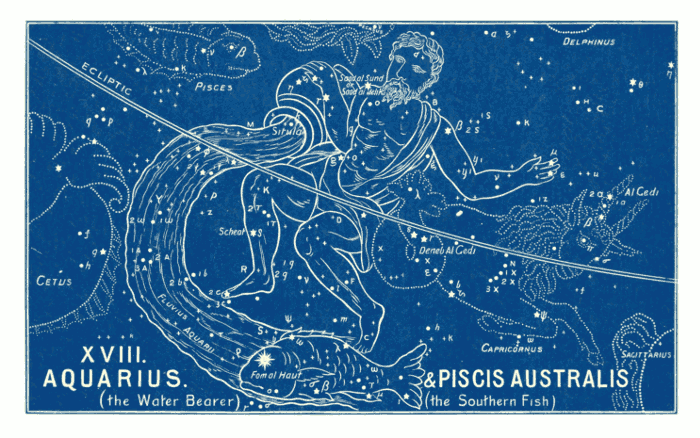
This was pictured and foreshown in the heavens from the beginning, by a man pouring forth water from an urn which seems to have an inexhaustible supply, and which flows forth downwards into the mouth of a fish, which receives it and drinks it all up.
In the ancient Zodiac of Denderah it is the same idea, though the man holds two urns, and the fish below seems to have come out of the urn. The [pg 085]man is called Hupei Tirion, which means the place of him coming down or poured forth.
In some eastern Zodiacs the Urn alone appears.
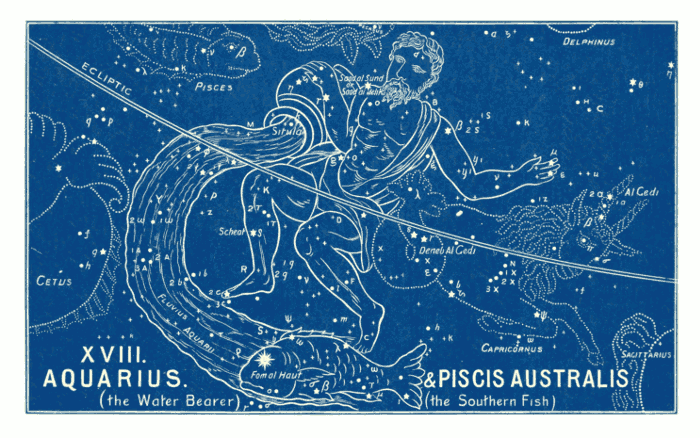
Plate 18: AQUARIUS (the Water Bearer) & PISCIS AUSTRALIS (the Southern Fish)
This agrees with its other names—Hebrew, Deli, the water-urn, or bucket (as in Num. xxiv. 7); the Arabic Delu is the same.
There are 108 stars in this Sign, four of which are of the 3rd magnitude. Their names, as far as they have come down to us, are significant.
The star α (in the right shoulder) is called Sa’ad al Melik, which means the record of the pouring forth.
The star β (in the other shoulder) is called Saad al Sund, who goeth and returneth, or the pourer out.
The bright star δ (in the lower part of the right leg) is well-known to-day by its Hebrew name Scheat, which means who goeth and returneth.
The bright star in the urn has an Egyptian name—Mon or Meon, which means simply an urn.
Aquarius is the modern Latin name by which the sign is known. It has the same meaning, the pourer forth of water.
Can we doubt what is the interpretation of this sign? The Greeks, not knowing Him of whom it testified, were, like the woman of Samaria, destitute of that living water which He alone can give. They therefore invented some story about Deucalion, the son of Prometheus; and another, saying he is Ganymede, Jove’s cup-bearer! But, as an astronomer says, “We must account otherwise for the origin of this name; for it is not possible to reconcile the [pg 086]symbols of the eleventh49 sign with Grecian mythology.” No! we must go further back than that, and not cramp our vision, and distort the Scriptures, by confining our thoughts to “the Church.” The Church is nowhere seen in these Signs, as she is nowhere revealed in the Old Testament. This we shall enlarge on when we come to the sign Pisces. Meanwhile we must read the witness of the stars as if there had been no Church!
Christ is first. Yea, He is all in all. The Scriptures testify of Him; and the very stars in this Sign tell of His going away and His coming again. These prophetic signs have to do with Him, with the Atonement He wrought, with the conflict He endured, with the blessings He secured, with the victory He shall win, and the triumph He shall have. For it is written:
“He shall pour the water out of His buckets,
And His seed shall be in many waters,
And His king shall be higher than Agag,
And His kingdom shall be exalted.”
(Num. xxiv. 7.)
It tells of that glorious day when
“A King shall reign in righteousness;
And princes shall rule in judgment;
And a MAN shall be as an hiding place
from the wind,
And a covert from the tempest;
As RIVERS of WATER in a dry place.”
(Isa. xxxii. 1, 2)
It speaks of that glorious time when Israel shall be restored, and their “eyes shall see the King in His beauty”; when the peace of Zion shall be no more disturbed, “but there the glorious Lord will be unto us a place of broad rivers and streams” (Isa. xxxiii. 17, 20, 21). Then
“The wilderness and the solitary place shall be glad for them;
And the desert shall rejoice, and blossom as the rose,
For in the wilderness shall waters break out,
And streams in the desert.”
(Isa. xxxv. 1, 6.)
“I will open rivers in high places,
And fountains in the midst of the valleys;
I will make the wilderness a pool of water,
And the dry land springs of water.”
(Isa. xli. 18.)
“Fear not, O Jacob, My servant;
And thou, Jesurun, whom I have chosen,
For I will POUR WATER upon him that is thirsty,
And floods upon the dry ground;
I will pour My Spirit upon thy seed,
And My blessing upon thy offspring.
Thus saith the Lord the King of Israel,
And his Redeemer the Lord of hosts.”
(Isa. xliv. 2, 3, 6.)
This is the meaning of the Sign. The MAN Christ Jesus, who was humbled in death will yet be seen to be the pourer forth of every blessing. Physically pouring forth literal waters, removing the curse, and turning this world into a paradise:
“Making her wilderness like Eden,
And her desert like the garden of the Lord.”
(Isa. li. 3.)
And morally pouring forth His Spirit in such abundance as to fill the whole earth with peace, and blessing, and glory, “as the waters cover the sea.”
Upon Israel restored He will pour out His blessing. They will be sprinkled with clean water, and possess a new heart and a new spirit (Ezek. xxxvi. 24-28; Joel ii. 28-32).
Such are some of the Scriptures which tell of this glorious Water-pourer. We need not rob Christ of His glory, or Israel of her blessing, in order to see in all this Pentecost or the Church. These are quite independent of the great line of prophetic truth. They are parenthetical, and distinct, and true, quite apart from the glorious prophecies of Israel’s scattering and gathering. The physical marvels referred to in the texts above can never be satisfied or exhausted by any spiritual fulfilment. We may make an application of them as far as is consistent with the teaching of the epistles; but the interpretation of them belongs to the Person of Christ, and the nation of Israel. That interpretation is pictured for us in the Sign, and in its three constellations.
1. PISCIS AUSTRALIS (The Southern Fish).
The Blessings Bestowed.
This first constellation is one of high antiquity, and its brilliant star of the first magnitude was a subject of great study by the Egyptians and Ethiopians. It is named in Arabic Fom al Haut, the mouth of the fish. There are 22 other stars.
The constellation is inseparable from Aquarius, in connection with which we have shown it in Plate XVIII (above). In the Denderah Zodiac it is called Aar, a stream.
It sets forth the simple truth that the blessings procured by the MAN—the coming Seed of the woman, will be surely bestowed and received by those for whom they are intended. There will be no failure in their communication, or in their reception. What has been purchased shall be secured and possessed.
Poco después del nacimiento de Juan el Bautista, José, el carpintero de Nazaret, tuvo un sueño. En su sueño vio a un ángel del Señor de pie junto a él. El ángel le dijo:
“José, descendiente del rey David, he venido a decirte que María, la joven con la que te vas a casar, tendrá un hijo, enviado por el Señor Dios. Le pondrás por nombre Jesús, que significa ‘salvación’, porque él salvará a su pueblo de sus pecados.”
El pueblo de Dios había tenido varios reyes. Algunos de ellos habían sido egoístas y crueles, pero Jesús sería un rey diferente, uno que salvaría, no que destruiría a los hombres.
Poco después de que José y María se casaran en Nazaret, el emperador Augusto César emitió un edicto en todo el Imperio Romano, ordenando a todos los habitantes que se dirigieran a las ciudades y pueblos de donde provenían sus familias para que sus nombres fueran registrados en un censo, ya que el emperador deseaba tener una lista de todas las personas bajo su dominio. Como tanto José como María descendían de la familia del rey David, viajaron juntos de Nazaret a Belén para que sus nombres fueran inscritos en el censo. Como recordarán, Belén de Judea, a diez kilómetros al sur de Jerusalén, era el lugar de nacimiento de David y donde su familia había vivido durante muchos años.
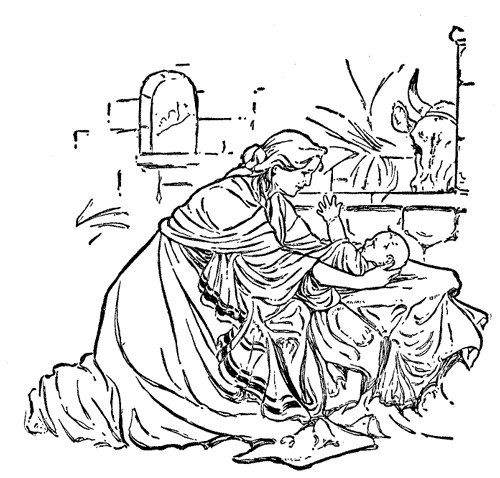
Fue un largo viaje de Nazaret a Belén; descendieron las montañas hasta el río Jordán, lo siguieron casi hasta su desembocadura y luego subieron las montañas de Judea hasta el pueblo de Belén. Cuando José y María llegaron a Belén, encontraron la ciudad llena de gente que, como ellos, había acudido para que sus nombres fueran registrados. La posada estaba llena y no había lugar para ellos; pues nadie, excepto ellos, sabía que esta joven pronto sería la madre del Señor de toda la tierra. Lo único que pudieron hacer fue ir a un establo donde se guardaba el ganado. Allí nació el pequeño, y lo acostaron en un pesebre, donde se alimentaba a los animales.
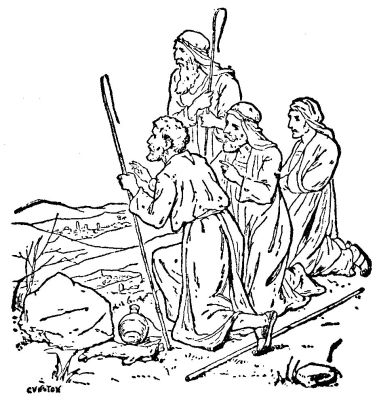
Aquella noche, unos pastores cuidaban sus ovejas en un campo cerca de Belén. De repente, una gran luz los envolvió y vieron a un ángel del Señor de pie ante ellos. Se llenaron de miedo al ver la gloria del ángel. Pero el ángel les dijo:
«No temáis, porque os traigo buenas nuevas de gran alegría, que serán para todo el pueblo: hoy os ha nacido en Belén, la ciudad de David, un Salvador, que es Cristo el Señor, el rey ungido. Podréis encontrarlo allí; y lo reconoceréis por esta señal: es un bebé recién nacido, acostado en un pesebre, en el mesón».
Y entonces vieron que el aire a su alrededor y el cielo sobre ellos estaban llenos de ángeles, que alababan a Dios y cantaban:
«Gloria a Dios en las alturas, y en la tierra paz a los hombres de buena voluntad».
Mientras miraban con asombro y escuchaban, los ángeles desaparecieron tan repentinamente como habían aparecido. Entonces los pastores se dijeron unos a otros:
«Vayamos enseguida a Belén y veamos este acontecimiento maravilloso que ha sucedido y que el Señor nos ha dado a conocer».
Entonces, tan rápido como pudieron, fueron a Belén y encontraron a José, el carpintero de Nazaret, a su joven esposa María y al pequeño bebé acostado en el pesebre. Les contaron a María y a José, y también a otros, cómo habían visto a los ángeles y lo que habían oído acerca de este niño. Todos los que escucharon su historia se maravillaron; María, la madre del niño, no dijo nada. Reflexionó sobre todas estas cosas y las guardó en silencio en su corazón. Después de su visita, los pastores regresaron a sus rebaños, alabando a Dios por las buenas nuevas que les había enviado.
Cuando el pequeño cumplió ocho días, le pusieron nombre; y el nombre que le dieron fue “Jesús”, una palabra que significa “salvación”, como el ángel les había dicho a María y a José que se llamaría. Así, el mismo nombre de este niño anunciaba lo que haría por la humanidad; pues él traería la salvación al mundo.
Traducido del “Libro maravilloso de historias bíblicas”
Esta cronología abarca desde el nacimiento de Juan el Bautista hasta la Ascensión de Jesús. Incluye otros acontecimientos históricos que tuvieron lugar durante el mismo período. Contiene algunos recursos de fuentes no religiosas con enlaces a otros sitios web. Sin embargo, esos sitios web están en inglés.
Todas las fechas son aproximadas.
6 a. C. Nacimiento de Juan el Bautista
Lucas 1
Juan 1:6
6 a. C. Augusto impone impuestos al Imperio Romano
8 d. C. El futuro emperador Claudio es nombrado augur, su único cargo oficial bajo el mandato de Augusto.
8 d. C. Jesús niño en el Templo
Lucas 2:41
9 d. C. Nacimiento del emperador Vespasiano en la ciudad de Reate.
9 d. C. Batalla del Bosque de Teutoburgo entre P. Quintilio y los germanos, que termina en una derrota total (incluida la destrucción de 3 legiones) para Roma.
9 d. C. Augusto finaliza la construcción del Ara Pacis (Altar de la Paz) en Roma.
14 d. C. Muerte del emperador Augusto en la ciudad de Nola, Italia. Ascenso de Tiberio.
14-16 d. C. Germánico César emprende campañas contra las tribus germánicas.
14 d. C. L. Elio Sejano es nombrado prefecto pretoriano.
14 d. C. Muerte del historiador romano Tito Livio en la ciudad de Patavium, Italia.
14 d. C. Se completa la construcción del acueducto Pont du Gard, cerca de la actual Nimes, en la Galia.
15 d. C. El emperador Tiberio transfiere las elecciones de las asambleas populares al Senado.
15 d. C. Nacimiento del emperador Vitelio.
17 d. C. Muerte del escritor romano Ovidio, quien falleció en Tomis, Mesia, durante su exilio, aparentemente por haber infringido el código moral de Augusto.
19 d. C. Muerte de Germánico, posiblemente, aunque no necesariamente, por orden directa de Tiberio.
22 d. C. Se completa la construcción de la Castra Praetoria (cuartel de la Guardia Pretoriana) por Sejano, y los pretorianos se convierten definitivamente en una fuerza política.
23 d. C. Nacimiento del historiador romano Plinio el Viejo en la ciudad de Novum Comum, en Italia.
This timeline goes from the Birth of John the Baptist to the Ascension of Jesus. It includes other historic events that were happening during this same time frame. There are some secular resources that links to other websites.
14 AD Death of the Roman historian Livy, in the city of Patavium, Italy.
14 AD The aqueduct, the Pont du Gard, is completed near modern Nimes in Gaul.
15 AD Emperor Tiberius transfers the elections from the popular assemblies to the Senate.
15 AD Birth of the Emperor Vitellius.
17 AD Death of the Roman writer Ovid, who died in Tomis, Moesia while exile, apparantly because of offenses to Augustus’ moral code.
19 AD Death of Germanicus, possibly but not necessarily by the direct order of Tiberius.
22 AD Construction of the Castra Praetoria (Praetorian barracks) by Sejanus is completed and the Praetorians are forever changed into a political force.
23 AD Birth of the Roman historian Pliny the Elder, in the town of Novum Comum, in Italy.
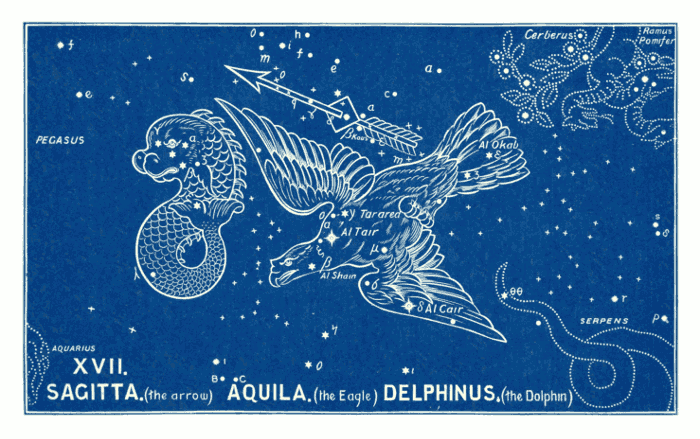
Here we have an additional picture of the effect of this arrow, in the pierced, wounded, and falling Eagle, gasping in its dying struggle. And that pierced, wounded, and dying Saviour whom it represents, after saying, in Ps. xxxviii. 2, “Thine arrows stick fast in Me,” added, in verse 10:
“My heart panteth, My strength faileth Me,
As for the light of Mine eyes it is gone from Me.”
(See also Zech. xiii. 6.)
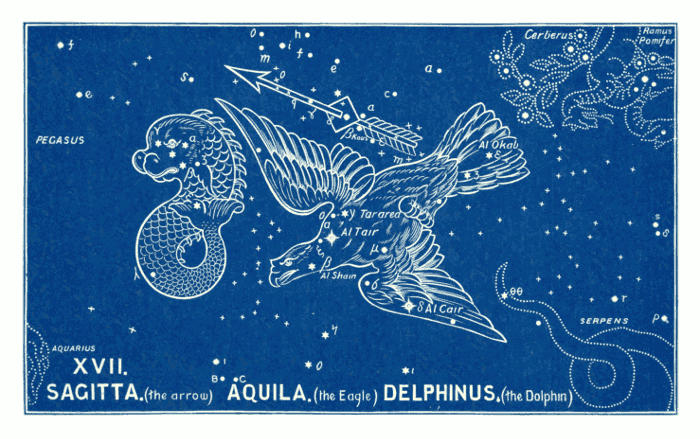
The names of the stars, all of them, bear out this representation. The constellation contains 74 stars. The brightest of them, α (in the Eagle’s neck), is a notable star of the 1st magnitude, called Al Tair (Arabic), the wounding. The star β (in the throat) is called Al Shain (Arabic), the bright, from a Hebrew root meaning scarlet coloured, as in Josh. ii. 18. The star γ (in the back) is called Tarared, wounded, or torn. δ (in the lower wing) is named Alcair, which means the piercing, and ε (in the tail), Al Okal, has the significant meaning wounded in the heel.
How can the united testimony of these names be explained except by acknowledging a Divine origin? even that of Him who afterwards foretold of the bruising of the Virgin’s Son in the written Word; yea, of Him “who telleth the number of the stars and giveth them all their names.”
3. DELPHINUS (The Dolphin).
The Dead One Rising again.
This is a bright cluster of 18 stars, five of which are of the 3rd magnitude. It is easily distinguished by the four brightest, which are in the head.
It is always figured as a fish full of life, and always with the head upwards, just as the eagle is always with the head downwards. The great peculiar characteristic of the dolphin is its rising up, leaping, and springing out of the sea.
When we compare this with the dying goat and falling eagle, what conclusion can we come to but that we have here the filling in of the picture, and the completion of the whole truth set forth in Capricornus?
Jesus “died and rose again.” Apart from His resurrection His death is without result. In His conflict with the enemy it is only His coming again in glory which is shown forth. But here, in connection with His people, with the multitudes of His redeemed, Resurrection is the great and important truth. He is “the first-fruits of them that slept”; then He, too, is here represented as a fish. He who went down into the waters of death for His people; He who could say “All thy waves and thy billows are gone over me” (Ps. xlii. 7), He it is who rises up again from the dead, having died on account of the sins of His redeemed, and risen again on account of their justification (Rom. iv. 25).
This is the picture here. In the Persian planisphere there seems to be a fish and a stream of water. The Egyptian has a vessel pouring out water.
The ancient names connected with this constellation are Dalaph (Hebrew), pouring out of water; [pg 083]Dalaph (Arabic), coming quickly;Scalooin (Arabic), swift (as the flow of water); Rotaneb or Rotaneu (Syriac and Chaldee), swiftly running.
Thus, in this first chapter of the Second Book we see the great truth of Revelation set forth; and we learn how the great Blessings of Redemption were procured. This truth cannot be more eloquently or powerfully presented than in the language of Dr. Seiss:—
“This strange goat-fish, dying in its head, but living in its afterpart—falling as an eagle pierced and wounded by the arrow of death, but springing up from the dark waves with the matchless vigour and beauty of the dolphin—sinking under sin’s condemnation, but rising again as sin’s conqueror—developing new life out of death, and heralding a new springtime out of December’s long drear nights—was framed by no blind chance of man. The story which it tells is the old, old story on which hangs the only availing hope that ever came, or ever can come, to Adam’s race. To what it signifies we are for ever shut up as the only saving faith. In that dying Seed of the woman we must see our sin-bearer and the atonement for our guilt, or die ourselves unpardoned and unsanctified. Through His death and bloodshedding we must find our life, or the true life, which alone is life, we never can have.”
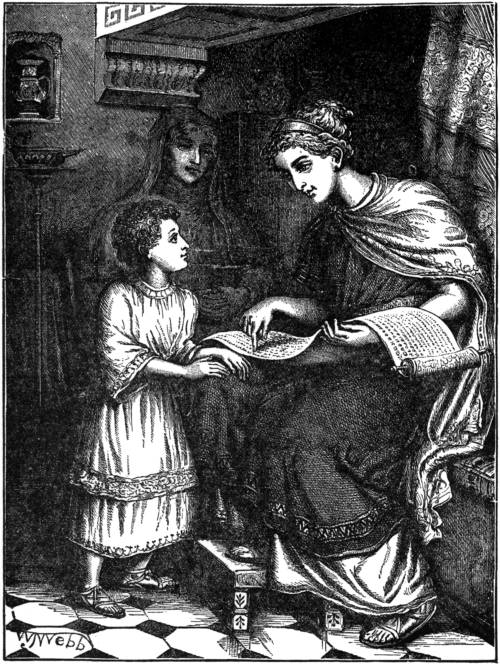
Timothy was a youthful and earnest disciple of Jesus Christ, whom Paul loved dearly. Paul had found him during one of his missionary journeys, and, discovering how highly he was esteemed as a Christian, had selected him as his assistant. Afterward Timothy became Paul’s companion in travel, and the first bishop of Ephesus. While Timothy was at Ephesus, Paul wrote two letters to him. They are contained in the Bible, and are called the Epistles to Timothy. In them Paul says many kind and wise things, giving Timothy directions how to act in his high Christian office. But Paul also speaks of Timothy’s early days, and of his mother and grandmother. These were both good women, who loved God, and diligently studied the Holy Scriptures. The mother’s name was Eunice. She was a Jewess. The grandmother’s name was Lois. Both loved the little boy Timothy, or Timotheus as he was called, and they sought to instil into his young mind and heart the love of God and the knowledge of His holy Word. In our picture we see Eunice teaching her son. She has not a bound Bible, but a manuscript, wound round small rollers. From this she reads to Timothy; while Lois, the aged grandmother, sits by.
Paul warned Timothy not to forget the teaching of his good mother and grandmother; and especially to value his knowledge of the Scriptures. Because, said Paul, “they are able to make thee wise unto salvation.” Many young folks have good mothers and grandmothers, who love to teach them about Jesus. Are they receiving this teaching as Timothy did, and being made wise unto salvation?
El nacimiento de Jesucristo fue anunciado por dos acontecimientos extraordinarios: la llegada de los Reyes Magos de Oriente y la aparición de ángeles a unos pastores en Belén.
Los sabios probablemente eran astrónomos; y al observar las estrellas, habían visto una que los impulsó a dejar su país y emprender un largo viaje a Jerusalén. Lo más probable es que viajaran en camellos, y su viaje fue arduo. Finalmente, llegaron a Jerusalén, donde preguntaron: “¿Dónde está el que ha nacido Rey de los judíos? Porque hemos visto su estrella en el Oriente y hemos venido a adorarlo”. La noticia de estas preguntas llegó al rey Herodes, y al oírlas, se turbó mucho. Era un rey malvado y temía que si había nacido otro rey, este creciera y le arrebatara la corona. Herodes también era cruel y traicionero, y aunque fingía actuar correctamente, a menudo cometía muchas maldades. Y ahora pretendía destruir al niño rey, que algún día podría quitarle el cetro.
Así pues, primero mandó llamar a los sabios de los judíos, a los sumos sacerdotes y a los escribas, y les preguntó dónde debía nacer el Cristo; y cuando le respondieron que en Belén, llamó en secreto a los Reyes Magos y les preguntó en qué momento había aparecido la estrella. Tras obtener la información que necesitaba, despidió a los Reyes Magos, diciéndoles que fueran a Belén “y buscaran diligentemente al niño; y cuando lo hayáis encontrado”, dijo Herodes, “avisadme, para que yo también vaya a adorarlo”.
LOS SABIOS ANTE EL REY
Así que los sabios partieron del rey Herodes y de Jerusalén, y continuaron su viaje hacia Belén; y la estrella que habían visto en Oriente iba delante de ellos, hasta que se detuvo sobre el lugar donde se encontraba el niño. Y al ver la estrella, se llenaron de inmensa alegría, pues supieron que habían encontrado a aquel a quien habían venido a buscar desde tan lejos.
Pero los sabios no le informaron a Herodes dónde se encontraba Jesús; y Herodes se enfureció tanto que poco después envió a sus soldados y mató a todos los niños menores de dos años que se encontraban en Belén y sus alrededores. Pensó que de esa manera mataría a Jesús, pero Dios se lo impidió.
Traducido del libro: Historias de madres del Nuevo Testamento
It is not the Arrow of Sagittarius, for that has not left his bow. That arrow is for the enemies of God. This is for the Son of God. It was of this that He spoke when He said, in Ps. xxxviii. 2:
“Thine arrows stick fast in me,
And Thy hand presseth me sore.”
He was “stricken, smitten of God, and afflicted, He was wounded for our transgressions” (Isa. liii. 4, 5). He was “pierced,” when He could say with Job, “The arrows of the Almighty are within me” (vi. 4).
Plate 17: SAGITTA (the Arrow), AQUILA (the Eagle), DELPHINUS (the Dolphin)
Here the arrow is pictured to us in mid-heaven, alone, as having been shot forth by an invisible hand. It is seen in its flight through the heavens. It is the arrow of God, showing that Redemption is all of God. It was “the will of God” which Jesus came to do. Not a mere work of mercy for miserable sinners, but a work ordained in eternity past, for the glory of God in eternity future.
This is the record of the Word, and this is what is pictured for us here. The work which the arrow accomplishes is seen in the dying Goat, and in the falling Eagle.
There are many other stars in the heavens in a straighter line, which would better serve for an arrow. Why are these stars chosen? Why is the arrow placed here? What explanation can be given, except that the Revelation in the stars and in the Book are both from the inspiration of the same Spirit?
There are about 18 stars, of which four are of the 4th magnitude. Only γ and δ are in the same line, while the shaft passes between α and β.

 articlesforchristians