A place to grow your relationship with God

Posts tagged ‘Jesus’

Explicación del capítulo 24 de Mateo

Mateo 24 es de gran importancia al estudiar los tiempos del fin. Después de que Jesús predijera la caída de Jerusalén, sus discípulos le preguntaron en privado sobre lo que había dicho.

  • Mateo 24:1-3
    • Y Jesús salió del templo y se marchó. Sus discípulos se acercaron a él para mostrarle los edificios del templo.
    • Y Jesús les dijo: ¿Veis todo esto? En verdad os digo que no quedará aquí piedra sobre piedra que no sea derribada.
    • Mientras estaba sentado en el monte de los Olivos, los discípulos se acercaron a él en privado y le preguntaron: Dinos, ¿cuándo sucederán estas cosas? ¿Y cuál será la señal de tu venida y del fin del mundo?

Aquí tienes la respuesta de Jesús desglosada para que puedas entenderla mejor.

Ten cuidado con el engaño.

  • Mateo 24:4-5
    • Jesús les respondió: «Tengan cuidado de que nadie los engañe.
    • Porque muchos vendrán en mi nombre, diciendo: “Yo soy el Cristo”, y engañarán a muchos.
  • Mateo 24:7
    • Y se levantarán muchos falsos profetas y engañarán a muchos.»

Las guerras, las hambrunas, las plagas y los terremotos se volverán algo común.

  • Mateo 24:6-7
    • Oiréis hablar de guerras y rumores de guerras; no os turbéis, porque es necesario que todo esto suceda, pero aún no es el fin.
    • Porque se levantará nación contra nación, y reino contra reino; y habrá hambres, pestes y terremotos en diferentes lugares.

Este es solo el principio del fin (de las penas).

  • Mateo 24:8
    • Todo esto es el principio de los dolores.

La persecución será terrible.

  • Mateo 24:9-10
    • Entonces os entregarán para que seáis afligidos y os matarán; y seréis odiados por todas las naciones por causa de mi nombre.
    • En aquel tiempo, muchos se escandalizarán, se traicionarán unos a otros y se odiarán mutuamente.
  • Mateo 24:12-13
    • Y debido a que la maldad abundará, el amor de muchos se enfriará.
    • Pero el que persevere hasta el fin, ese será salvo.
  • Recuerda que la persecución llegó a ser muy grave.
    • Hechos 8:1-4
      • Y Saulo consentía en su muerte. En aquel tiempo se desató una gran persecución contra la iglesia de Jerusalén, y todos se dispersaron por las regiones de Judea y Samaria, excepto los apóstoles.
      • Unos hombres piadosos sepultaron a Esteban y lloraron amargamente por él.
      • En cuanto a Saulo, asolaba la iglesia, entrando en las casas y arrastrando a hombres y mujeres para encarcelarlos.
      • Por lo tanto, los que se habían dispersado iban por todas partes predicando la palabra.

El Evangelio será predicado en todas partes antes del fin.

  • Mateo 24:14
    • Y este evangelio del reino será predicado en todo el mundo para testimonio a todas las naciones; y entonces vendrá el fin.

Recuerden que la pregunta constaba de dos partes.

  • La primera pregunta es: “¿Cuándo sucederán estas cosas?”
    • Esta pregunta se refiere a cuándo sería destruido el templo.
  • La segunda pregunta es: “¿Cuál será la señal de tu venida y del fin del mundo?”
    • Esta pregunta trata sobre el fin del mundo.

Estos versículos tratan sobre la destrucción del templo.

  • Mateo 24:15-20
    • Cuando veáis, pues, la abominación de la desolación, de la que habló el profeta Daniel, erigida en el lugar santo (el que lea, entienda),
    • entonces los que estén en Judea huyan a las montañas;
    • el que esté en la azotea no baje a sacar nada de su casa;
    • ni el que esté en el campo regrese a buscar sus ropas.
    • ¡Ay de las que estén encinta y de las que amamanten en aquellos días!
    • Orad para que vuestra huida no sea en invierno ni en sábado.
  • La ciudad fue conquistada. Quienes comprendieron estos versículos recibieron la advertencia de marcharse antes de que fuera demasiado tarde.
  • Creo que se construirá un tercer templo. Ese templo será el cumplimiento final de la abominación de la desolación, de la que habló el profeta Daniel.

Esta parte (creo) se refiere al fin del mundo, a la Gran Tribulación.

  • Mateo 24:21-22
    • Porque entonces habrá una gran tribulación, como no la ha habido desde el principio del mundo hasta ahora, ni la habrá jamás.
    • Y si no se acortaran aquellos días, nadie se salvaría; pero por causa de los elegidos, aquellos días serán acortados.

Sin embargo, se nos advierte de posibles engaños.

  • Mateo 24:23-28
    • Entonces, si alguien os dice: «Mirad, aquí está el Cristo», o «allí», no le creáis.
    • Porque se levantarán falsos Cristos y falsos profetas, y harán grandes señales y prodigios, de tal manera que, si fuera posible, engañarían incluso a los escogidos.
    • Mirad, os lo he dicho de antemano.
    • Así que, si os dicen: «Mirad, está en el desierto», no salgáis; si os dicen: «Mirad, está en los aposentos secretos», no lo creáis.
    • Porque como el relámpago que sale del oriente y brilla hasta el occidente, así será la venida del Hijo del Hombre.
    • Porque dondequiera que esté el cadáver, allí se juntarán los buitres.

Habrá señales en el cielo.

  • Mateo 24:29-31
    • Inmediatamente después de la tribulación de aquellos días, el sol se oscurecerá, la luna no dará su luz, las estrellas caerán del cielo y los poderes de los cielos serán conmovidos.
    • Entonces aparecerá en el cielo la señal del Hijo del Hombre, y todas las tribus de la tierra lamentarán, y verán al Hijo del Hombre viniendo en las nubes del cielo con poder y gran gloria.
    • Y enviará a sus ángeles con gran sonido de trompeta, y reunirán a sus escogidos de los cuatro puntos cardinales, de un extremo del cielo al otro.

A continuación, Jesús les da instrucciones para que aprendan la parábola de la higuera.

  • Mateo 24:32
    • Aprended esta parábola de la higuera: Cuando sus ramas están tiernas y brotan las hojas, sabéis que el verano está cerca.
    • Así también vosotros, cuando veáis todas estas cosas, sabed que está cerca, a las puertas.

Esta generación significa que esta época o período de tiempo terminará cuando todo se haya cumplido.

  • Mateo 24:34-35
    • De cierto os digo que esta generación no pasará hasta que todo esto se cumpla.
    • El cielo y la tierra pasarán, pero mis palabras no pasarán.

La venida de Jesús

La llegada de Jesús se compara con la época de Noé.

  • Mateo 24:37-39
    • Pero como fueron los días de Noé, así será también la venida del Hijo del Hombre.
    • Porque como en los días antes del diluvio, comían y bebían, se casaban y daban en casamiento, hasta el día en que Noé entró en el arca,
    • y no se dieron cuenta hasta que vino el diluvio y se los llevó a todos; así será también la venida del Hijo del Hombre.
  • Para obtener más información sobre este tema, lea el artículo “El Juicio de la Humanidad: Lecciones de los Días de Noé“.

Entonces Jesús explicó que algunos serían llevados y otros se quedarían.

  • Mateo 24:40-42
    • Entonces, de dos que estén en el campo, uno será llevado y el otro dejado.
    • De dos mujeres que estén moliendo en el molino, una será llevada y la otra dejada.

Estar siempre listo

  • Mateo 24:42-44
    • Por lo tanto, velad, porque no sabéis a qué hora vendrá vuestro Señor.
    • Pero sabed esto: si el dueño de la casa hubiera sabido a qué hora vendría el ladrón, habría estado alerta y no habría permitido que forzaran la entrada a su casa.
    • Por eso, estad también vosotros preparados, porque a la hora que menos penséis, vendrá el Hijo del Hombre.

Jesús explica que nosotros somos los siervos. Aquellos que sean fieles y sabios serán recompensados.

  • Mateo 24:45-51
    • ¿Quién es, pues, el siervo fiel y prudente, a quien su señor ha puesto a cargo de su casa para que les dé el alimento a su debido tiempo?
    • Bienaventurado aquel siervo a quien su señor, cuando venga, lo encuentre haciendo así.
    • De cierto os digo que lo pondrá a cargo de todos sus bienes.
    • Pero si aquel siervo malo dice en su corazón: «Mi señor tarda en venir»,
    • y comienza a golpear a sus compañeros y a comer y beber con los borrachos,
    • el señor de aquel siervo vendrá en un día que no espera y a una hora que no sabe,
    • y lo castigará severamente y le asignará su parte con los hipócritas; allí será el lloro y el crujir de dientes.

Bible Books

Bible books are great for Bible Study. Here are many books that are great to use with children and one that offers interesting insight for adults.

For Children

The Wonder Book of Bible Stories: “The Wonder Book of Bible Stories” by Logan Marshall shares simplified biblical narratives for children, conveying essential moral lessons through engaging tales from the Bible.
MOTHER STORIES From the Old Testament: This book contains engaging stories from the Old Testament including tales of creation, heroes, and important lessons.
THE CHILDREN’S SIX MINUTES by Bruce S. Wright: The Children’s Six Minutes by Bruce S. Wright features a collection of themes exploring growth, kindness, faith, and life’s lessons through various engaging stories and reflections.

Mother Stories from the New Testament: “Mother Stories from the New Testament” shares engaging narratives for children, emphasizing faith, kindness, and moral lessons from Jesus’ life.

For Adults

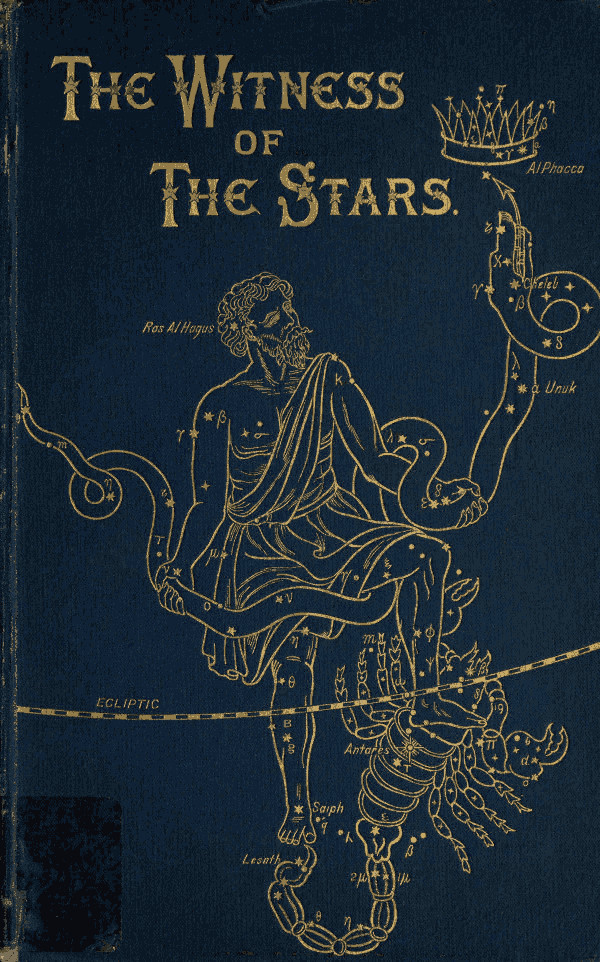
The Witness of the Stars by Rev. Bullinger

Othniel: A Biblical Hero’s Journey

There were some nations that God did not have Joshua drive out from the promise land. Those nations were left as a test for Israel.

  • Judges 3:1-5
    •  Now these are the nations which the Lord left [in order] to test Israel by them (that is, all [the people of Israel] who had not [previously] experienced any of the wars in Canaan; 
    • only in order that the generations of the sons of Israel might be taught war, at least those who had not experienced it previously)
    • The remaining nations are:
      • the five lords (governors) of the Philistines,
      • all the Canaanites,
      • the Sidonians,
      • and the Hivites who lived on Mount Lebanon from Mount Baal-hermon to the entrance of Hamath. 
    • They were [allowed to remain] for the testing of Israel, to determine whether Israel would listen to and obey the commandments of the Lord, which He had commanded their fathers (ancestors) through Moses.

Israel was commanded not to intermarry.

  • Deuteronomy 7:3-4
    • You shall not intermarry with them; you shall not give your daughter to his son, nor shall you take his daughter for your son; 
    • for they will turn your sons away from following Me to serve other gods; then the anger of the Lord will be kindled and burn against you and He will quickly destroy you. 

Israel disobeyed.

  • Judges 3:5-6
    • And the Israelites lived among the Canaanites, Hittites, Amorites, Perizzites, Hivites, and Jebusites; 
    • and they took their daughters for themselves as wives and gave their own daughters to their sons, and served their [pagan] gods.

God allowed Cushan-rishathaim the king of Mesopotamia to put them into bondage.

  • Cushan-rishathaim is often interpreted to mean “Cushan of double wickedness” or “Cushan of double iniquity,” reflecting his oppressive rule over Israel.
  • Cushan-rishathaim is described as the king of Aram Naharaim, which is often identified with the region of Mesopotamia, specifically the area between the Tigris and Euphrates rivers.
  • Aram Naharaim is better known as the Kingdom of Mitanni. This Kingdom came on the scene around 1600 BC

After 8 years of bondage the Children of Israel cried out to God.

  • Judges 3:9
    • But when the Israelites cried out to the Lord [for help], the Lord raised up a man to rescue the people of Israel, Othniel the son of Kenaz, Caleb’s younger brother. 

Othniel

  • Othniel means “lion of God.”
  • He was Caleb’s younger brother.
    • Caleb was one of the two honest 12 spies.
      • Numbers 13:6 from the tribe of Judah, Caleb the son of Jephunneh
  • We 1st learn about Othniel in Joshua 15:13-17
    •  Now to Caleb the son of Jephunneh Joshua gave a portion among the sons of Judah, as the Lord commanded him, namely, Kiriath-arba, Arba being the father of Anak (that is, Hebron)
    • So Caleb drove out from there the three sons of Anak: Sheshai and Ahiman and Talmai, the children of Anak. 
    • Then he went up from there against the people of Debir; Debir was formerly named Kiriath-sepher. 
    • Caleb said, “I will give Achsah my daughter as wife to the man who attacks Kiriath-sepher and captures it.” 
    • And Othniel the son of Kenaz, Caleb’s brother, captured it; so he gave him Achsah his daughter as a wife.

The spirit of God came upon Othniel.

  • Judges 3:10-11
    • The Spirit of the Lord came upon him, and he judged Israel. He went out to war, and the Lord gave Cushan-rishathaim king of Mesopotamia into his hand, and he prevailed over Cushan-rishathaim. 
    •  And the land was at rest [from oppression for] forty years. Then Othniel the son of Kenaz died.

This battle corresponds to the downfall of Aram Naharaim in the 14th century BC.

Witness of the Stars: Ara (The Altar)

ARA (The Altar)

Consuming Fire Prepared for His Enemies.

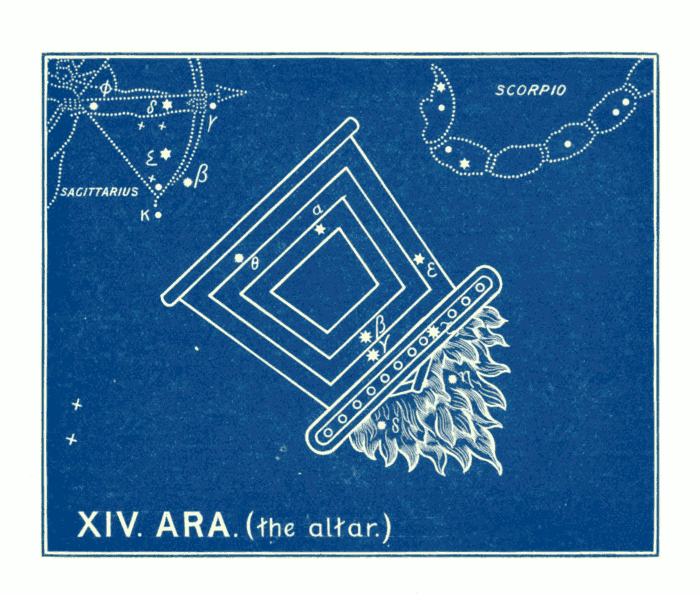
Here we have an altar or burning pyre, placed significantly and ominously upside down! with its fires burning and pointing downwards towards the lower regions, called Tartarus, or the abyss, or “outer-darkness.”

Plate 14: ARA (the Altar)

It is an asterism with nine stars, of which three are of the 3rd magnitude, four of the 4th, etc. It is south of the Scorpion’s tail, and when these constellations were first formed it was visible only on the very lowest horizon of the south, pointing to the completion of all judgment in the lake of fire.

In the Zodiac of Denderah we have a different picture, giving us another aspect of the same judgment. It is a man enthroned, with a flail in his hand. His name is Bau, the same name as Hercules has, and means He cometh. It is from the Hebrew בּוֹא (Bōh), to come, as in Isa. lxiii. 1:

“Who is this that cometh from Edom,

With dyed garments from Bozrah.”

This is a coming in judgment, as is clear from reason given in verse 4:

“For the day of vengeance is in Mine heart,

And the year of My redeemed is come.

And I looked, and there was none to help;

And I wondered that there was none to uphold;

Therefore Mine own arm brought salvation,

And My fury, it upheld Me.”

(Isa. lxiii. 4, 5.)

The completion of judgment, therefore, is what is pictured both by the burning pyre and the Coming One enthroned, with his threshing instrument.

In Arabic it is called Al Mugamra, which means the completing, or finishing. The Greeks used the word Ara sometimes in the sense of praying, but more frequently in the sense of imprecation or cursing.

This is the curse pronounced against the great enemy. This is the burning fire, pointing to the completion of that curse, when he shall be cast into that everlasting fire “prepared for the devil and his angels.” This is the allusion to it written in the midst of the very Scripture from which we have already quoted, Ps. xxi., where we read in verse 9 (which we then omitted): —

“Thou shalt make them as a fiery oven in the time of Thine anger:

The Lord shall swallow them up in His wrath;

And the fire shall devour them.”

This brings us to the final scene, closing up this first great book of the Heavens.

Melchizedek and Christ: Unraveling the Theological Mystery

Who was Melchizedek (sometimes spelled Melchisedec). Paul refers to him in Hebrews chapter 7

  • Hebrews 7:1-3
    • For this Melchisedec, king of Salem, priest of the most high God, who met Abraham returning from the slaughter of the kings, and blessed him;
    • To whom also Abraham gave a tenth part of all; first being by interpretation King of righteousness, and after that also King of Salem, which is, King of peace;
    • Without father, without mother, without descent, having neither beginning of days, nor end of life; but made like unto the Son of God; abideth a priest continually.

The writer of Hebrews noted that Melchizedek had no recorded genealogy in the priesthood, possibly because records weren’t kept in Abraham’s time. Moses later wrote about this meeting (see Gen. 14) when he composed the Torah in the wilderness, centuries after Abraham’s encounter with Melchizedek.

The writer of Hebrews and his audience understood that the Jewish priesthood began during Moses’ time in the wilderness, following the revelation of the Ten Commandments and the building of the tabernacle. Aaron was the first high priest, succeeded by his sons, and from then on, the names of all high priests serving in the tabernacle and later in the temple were carefully recorded and preserved. Hebrews 7 refers to Psalm 110:4.

  • “You are a priest forever, after the order of Melchizedek.”

When the writer of Hebrews said Melchizedek was without father, mother, or genealogy,

  • it meant there was no written record of his origins, unlike the documented lineage of the sons of Levi from Aaron, who served in the tabernacle.

Hebrews compares the ministries of Christ and Melchizedek.

  • Melchizedek appeared without a recorded past and was both king and priest,
  • Christ also belonged to that same priestly order, having no earthly father and not coming from the tribe of Levi, from which the sons of Aaron descended.
    • All priests came from the tribe of Levi, but Christ was from the tribe of Judah.
    • Being from Judah connected Him to the lineage of David and gave Him the rights of royalty, yet it also meant He was not from the priestly line.
  • The writer of Hebrews emphasized this uniqueness:
    • Christ was the High Priest from the tribe of Judah.
      • Christ is both a priest and a King.
    • Melchizedek was a king-priest.

Now here is a simple yet complicated theological question:

If Melchizedek was a pre-incarnation of Jesus Christ, then how could he be after the order of what he already was?

  • This would make him an order of himself.
  • Secondly, this would imply that Christ lived in the flesh more than 1,800 years before He became flesh, meaning that He became flesh twice.
    • This would justify the heretical teaching of reincarnation that is part of the Hindu religion.

I believe there is a simple yet very interesting possibility as to who this mysterious first king and priest of Jerusalem was. The story begins with Noah.

Remember that Noah had 3 sons.
The three sons of Noah Shem, Ham, and Japheth would eventually settle in different parts of the world and begin repopulating the earth. The book of Genesis lists the names of the descendants of Noah’s sons, and researchers identify the early nations with the parts of the earth.

  • Ham’s descendants settled in the area of northern Africa.
  • Japheth’s descendants settled in Russia and northern Europe
  • Shem’s descendants chose Arabia, Palestine, and Syria.

Of the three sons of Noah, there is one through whom the lineage of the Messiah came – the lineage of Shem. Noah gave a powerful prophecy to Shem in Genesis 9:26:

  • “And he said, Blessed be the Lord God of Shem; and Canaan shall be his servant.”

Noah continues this prophecy in Genesis 9:27:

  • “God shall enlarge Japheth, and he shall dwell in the tents of Shem; and Canaan shall be his servant.”

This prophecy is very revealing.

  • Noah mentions Canaan, the fourth son of Ham, twice.
    • Canaan became the father of the Canaanites, who are mentioned throughout the Old Testament.
      • The many tribes living in Israel during the time of Joshua and the judges were descendants of Canaan.
    • Since Canaan would serve Shem, it seems that Shem or his descendants would rule over Canaan.
      • Noah also refers to the tents of Shem, meaning the children of Shem dwelling near Canaan.
      • It’s possible that Shem himself settled in the land of Canaan, known today as Israel.
    • The Hebrew people descended from Shem’s lineage through his great-grandson Eber (see Gen. 10:21-24).
      • Terah, Abraham’s father, was also from Shem’s line, making him part of the She tribal identity. Abraham’s descendants were called Hebrews, from the word “Ibriy,” meaning “an Eberite,” referring to their descent from Eber in Shem’s lineage.

The Shem Connection
For centuries, Jewish sages have believed that the Melchizedek mentioned in Scripture was actually Shem, the righteous son of Noah who settled in Canaan, particularly in a place called Salem, later known as Jerusalem.

  • Genesis 14:18 And Melchizedek king of Salem brought forth bread and wine: and he was the priest of the most high God.

This view is reflected in the book of Jasher, which says that Shem and Eber lived in Jerusalem and ran a special teaching academy there. According to Jasher, several patriarchs sent their sons to this academy for spiritual instruction.

  • Jasher XVI, 11 “And Anonizedek, king of Jerusalem, who was Shem, went out with his men to meet Abram and his people with bread and wine, and they remained together in the valley of Melech”.

The book also says Shem and Eber were present at Sarah’s burial:

  • Jasher XXIV, 14-15 “And Abraham buried Sarah with pomp… And at the bier was Shem, his son Eber…”.

After Sarah’s death, it adds:

  • Jasher XXIV, 17 “When the days of mourning had passed, Abraham sent his son Isaac to the house of Shem and Eber to learn the ways of the Lord and His instructions, and he remained there three years”.

The first argument that arises when we teach that Melchizedek was actually Shem, to whom the lineage of the Hebrews came and the Messiah was promised, is this:

  • Wouldn’t Shem have already died before the time of Abraham and Isaac?

The answer is no.

  • Shem was about one hundred years old when the flood came and covered the earth (compare Gen. 5:32 and Gen. 7:6).
    • Two years after the flood, Shem’s son Arphaxad was born (see Gen. 11:10).
    • Shem was 102 years old at that time.
  • Eber, his great-grandson, was born when Shem was about 173 years old.
  • If we move forward to the time of Abraham and Isaac:
    • Shem died when he was six hundred years of age (see Gen. 11:10-11).
    • According to the chronology of scholars:
      • Abraham lived to the year 2121 BC
      • Shem lived until 2156 BC.

Therefore, Shem was still living in the time of Abraham and into the time of Isaac.

At the time of Shem, Jerusalem (called Salem) was separated into two divisions: the lower slope and the upper slope.

  • The lower slope
    • The lower slope included the eastern slope of the area known as the Temple Mount.
      • The east was called Salem (or in Hebrew Shalem)
  • The upper city (or western area) included the Temple Mount and part of the area where the future altar of the temple would sit.
    • The west was called Yirah (a name given by Abraham in Gen. 22:14).
  • The two names joined together to form the name Jerusalem.

The early city became large enough to be governed by Shem, who was given the title Melchizedek. Under Melchizedek, both slopes of the city were joined together.

When Abraham met Melchizedek, this king-priest was controlling the lower section of the city identified in Scripture as the “king’s dale” (see Gen. 14:17). Today this area is called the Kidron Valley, which runs below the Eastern Gate toward the village of Silwan.
Seeing that Shem would rule over Canaan and that the Hebrews were identified with Shem’s great-grandson Eber (don’t forget that Shem was still living in the time of Abraham and that from his lineage came the Messiah), Melchizedek could have been Shem.

The book of Hebrews emphasizes that Melchizedek was both a king and a priest; he is a picture of the ministry of Christ.

  • Jesus is presently the High Priest of the profession of our faith.
    • Hebrews 8:1 Now of the things which we have spoken this is the sum: We have such an high priest, who is set on the right hand of the throne of the Majesty in the heavens;
    • Hebrews 9:11 But Christ being come an high priest of good things to come, by a greater and more perfect tabernacle, not made with hands, that is to say, not of this building;
  • He will return to earth in the future to be proclaimed the King of kings.
    • Psalms 110:4 The Lord hath sworn, and will not repent, Thou art a priest for ever after the order of Melchizedek.
    • Hebrews 7:1-3
      • For this Melchisedec, king of Salem, priest of the most high God, who met Abraham returning from the slaughter of the kings, and blessed him;
      • To whom also Abraham gave a tenth part of all; first being by interpretation King of righteousness, and after that also King of Salem, which is, King of peace;
      • Without father, without mother, without descent, having neither beginning of days, nor end of life; but made like unto the Son of God; abideth a priest continually.

The writer of Hebrews compares Christ to Melchizedek but never says He was Melchizedek.
Since Melchizedek was a king-priest and Jesus is after the order of Melchizedek (king-priest), then all believers are a part of the same priesthood.

  • We are presently priests unto God offering sacrifices of praise and financial gifts to Christ who receives them in heaven.
    • Hebrews 7:8 And here men that die receive tithes; but there he receiveth them, of whom it is witnessed that he liveth.
  • In the future, we will rule and reign with Christ on earth as kings:
    • Revelation 1:6 “And hath made us kings and priests unto God and his Father; to him be
      glory and dominion for ever and ever. Amen.”
  • As priests we have spiritual authority to approach God in heaven. As kings we will be given spiritual dominion on the earth during the thousand-year reign of Christ. This is why it is important to understand that Christ is after the order of Melchizedek.

Understanding Apologetics: A Defense of Christian Faith

Apologetics is the study and practice of giving answers for the reasonableness and truth of the Christian faith.

  • Apologetics comes from the Greek apologia
    • means “to give a defense.”
      • it refers to a verbal defense or a reasoned statement or argument.
  • Apologetics is the branch of theology which deals with giving a defense of the Christian faith.

In 1 Peter 3:15, Christians are commanded to give an apologia to anyone who asks the reason for our hope.

  • 1 Peter 3:15 But sanctify the Lord God in your hearts: and be ready always to give an answer to every man that asketh you a reason of the hope that is in you with meekness and fear:

In a world where God’s Word often faces criticism both inside and outside the church, we should be ready to share the hope we have. Christianity is grounded in real history—actual people and events that truly happened. While we can counter arguments and explain the reasons for our faith, if we don’t point others to the life-changing gospel of Jesus Christ, we haven’t really defended the faith. Scripture reminds us to do this with meekness and fear, meaning we’re not here just to win arguments. Too often, Christian apologists can come across as loud, unkind, or prideful. We should proclaim the truth boldly, yet with self-control and the mindset of a messenger delivering the King’s message. We also act with reverent fear, knowing it’s only by God’s grace that we’ve been made ambassadors for Him, and that without the Holy Spirit’s work, our efforts alone can’t bring anyone to salvation. Above all, we must be careful not to misrepresent God by misusing the truth He’s entrusted to us.

These days, many Christians lack the discipline and discernment to defend their faith against “the fiery darts of the wicked one” (Ephesians 6:16). Over time, the church has become less effective at reaching those who are lost. While there are several reasons for this, a major one is that many believers have trouble explaining or defending their beliefs. As a result, Christianity is often viewed as a “blind faith,” and its followers are seen as uninformed or easily influenced.

Christianity isn’t a “blind faith” but is rooted in the God and His perfect, revealed Word. Hebrews 11:1 describes faith as “the substance of things hoped for, the evidence of things not seen.” So how can faith involve “evidence”? Because it’s anchored in real history—genuine people and events. While evidence can’t definitively prove the Bible’s truth, it can demonstrate that it supports Scripture. Viewed through the lens of God’s Word instead of human opinion, the evidence fits seamlessly with the Bible.

Throughout the New Testament the Early Leaders of the Church practiced apologetics. The authors of Scripture accurately recorded historical events, including the miracles of our Lord Jesus Christ and His Crucifixion and Resurrection.

  • Peter:
    • Wrote about the early followers of Christ:
      • 2 Peter 1:16 “For we did not follow cunningly devised fables when we made known to you the power and coming of our Lord Jesus Christ, but were eyewitnesses of His majesty”.
      • The Apostle Peter also instructed his readers to
        • “sanctify the Lord God in your hearts, and always be ready to give a defense to everyone who asks you a reason for the hope that is in you, with meekness and fear” (1 Peter 3:15).
  • Jude
    • Informed his readers about the importance of earnestly contending “for the faith which was once for all delivered to the saints” (Jude 3).
  • Paul
    • Practiced apologetics as he regularly went first to a town’s synagogue and “reasoned with them from the Scriptures, explaining and demonstrating that the Christ had to suffer and rise from the dead” (Acts 17:2, 18:4, emphasis added).
    • Paul reasoning with the religious leaders of the day does not sound like the actions of a man who had a blind faith.
    • Knew his faith was defensible.
      • He had encountered Christ on the road to Damascus (Acts 9:1–8)
      • He told the Corinthians that over 500 people had witnessed the resurrected Savior at the same time (1 Corinthians 15:6).

For information on where in history the various event wrote about in the Bible took place, please visit Key Events in Ancient History: A Comprehensive Timeline.

For more information read: The Importance of Knowing Your Christian Faith

Los siete tiempos señalados por Dios

Dios tiene un plan. «A este, entregado conforme al plan determinado y la presciencia de Dios, vosotros lo prendisteis, y por manos de inicuos lo crucificasteis y matasteis» (Hechos 2:23).

Él ha revelado el plan. «Dios, que en tiempos pasados ​​habló a nuestros antepasados ​​por medio de los profetas en diversas ocasiones y de diversas maneras, en estos últimos días nos ha hablado por medio de su Hijo, a quien constituyó heredero de todo, y por medio de quien también creó el universo» (Hebreos 1:1-2).

Ahora está completando el plan. «Y oí una gran voz del cielo que decía: “He aquí el tabernáculo de Dios está con los hombres, y él morará con ellos; y ellos serán su pueblo, y Dios mismo estará con ellos y será su Dios. Y Dios enjugará toda lágrima de los ojos de ellos; y ya no habrá muerte, ni habrá más llanto, ni clamor, ni dolor; porque las primeras cosas pasaron”. Y el que estaba sentado en el trono dijo: “He aquí, yo hago nuevas todas las cosas”. Y me dijo: “Escribe; porque estas palabras son fieles y verdaderas”. Y me dijo: “Hecho está. Yo soy el Alfa y la Omega, el principio y el fin. Al que tenga sed, yo le daré gratuitamente de la fuente del agua de la vida. El que venza heredará todas las cosas, y yo seré su Dios, y él será mi hijo”» (Apocalipsis 21:3-7).

Dios dio su plan general a los israelitas en forma de sus siete fiestas solemnes. «Habla a los hijos de Israel y diles: Estas son las fiestas solemnes del Señor, las cuales proclamaréis como santas convocaciones: estas son mis fiestas» (Levítico 23:2). Estas siete fiestas señalan acontecimientos que ya han sucedido y otros que (en el momento en que se dieron las fiestas) aún estaban por suceder.


Para obtener más información sobre las fiestas de Dios.

Otros días importantes

  •  

  •  


The Pharisee and the Tax Gatherer

THE PHARISEE AND THE TAX-GATHERER

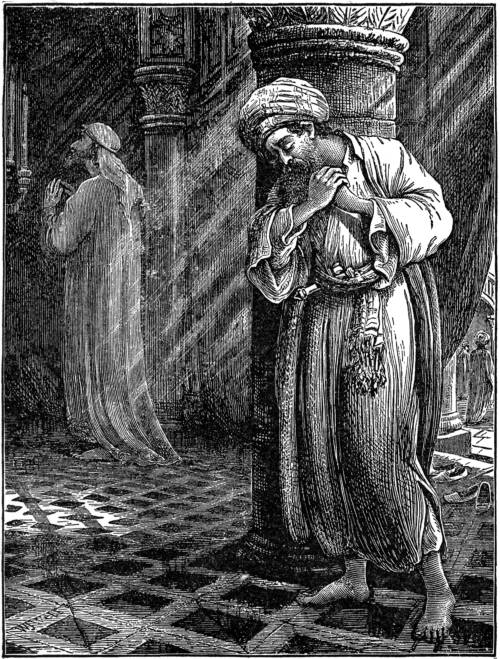
The tax-gatherers in those days were called Publicans. They were reputed to be very unjust, exacting from people more than the law required them to pay, and other wickedness was charged against them. Of course, there were good men among them; St. Matthew was a tax-gatherer before Jesus called him to follow Him. The Pharisees studied the Scriptures and explained them to the people, but they did not follow the teachings of Scripture. They were proud, and pretended they were more religious than other men, but it was only pretense. Jesus compared them to whited sepulchres, and said they were hypocrites, who led the people astray.

A Pharisee and a Publican went up into the Temple to pray. The Pharisee stood in a part of the Temple where all could see him, and prayed thus: “O God, I thank Thee that I am not like other men, who are unjust, and who take more than belongs to them. I thank Thee that I am not like this Publican. I fast twice a week; I give to the priests and Levites a tenth part of all I possess.” But the Publican, who knew that he was wicked, and felt sorry for it, stood afar off in a quiet part of the Temple where none would see him. He bowed his head and beat upon his breast, saying, “God be merciful to me a sinner.”

Jesus said that this Publican went to his home more forgiven than the Pharisee, for every one that is proud and thinks much of himself shall be put down, and he that humbleth himself and is sorry for his sins, shall be exalted. “Blessed are the meek, for they shall inherit the earth,” says Jesus.

The Importance of Keeping Vows in the Bible

THE LAW OF MAKING A VOW

Moses establishes the lawn of making a vow. The Bible clearly states that a vow is a very serious thing and is not be taken lightly.

  • Ecclesiastes 5:4-6  
    • When thou vowest a vow unto God, defer not to pay it; for he hath no pleasure in fools: pay that which thou hast vowed.
    • Better is it that thou shouldest not vow, than that thou shouldest vow and not pay.

In the Bible, a vow is a promise made to God. The first mention of a vow is about Jacob, who dreamed of a ladder reaching from heaven to earth, with angels going up and down on it. He took this as a sign of God’s favor on the place where he slept and named it “Bethel,” meaning “House of God.” Jacob also vowed that if the Lord blessed him, he would return a tenth (tithe) back to God (Genesis 28:10-22).

The Vow: Neder or Issar?

There are two types of Hebrew vows. One is called a neder and the other issar.

  • The neder vow is when a man vows a vow unto God.
    • We would say that tithing is a neder vow
  • The issar vow is when a man swears an oath to bind his soul with a bond
    • marriage between a man and a woman is an issar vow

Nazarite Vow
One of the strongest vows in the Bible was the Nazarite vow. A Nazarite vow could be a voluntary vow
commanded vow. For example, two men in the Bible were to be Nazarites from their mother’s womb-Samson and Samuel (see Judg. 13-1-7; 1 Sam. 1:11). According to Numbers 6, a Nazarite vow consisted of three parts:

  1. A Nazarite was never to drink wine or strong drink.
    • Numbers 6:3 He shall separate himself from wine and strong drink, and shall drink no vinegar of wine, or vinegar of strong drink, neither shall he drink any liquor of grapes, nor eat moist grapes, or dried. All the days of his separation shall he eat nothing that is made of the vine tree, from the kernels even to the husk.
  2. A Nazarite was never to use a razor to shave his hair.
    • Numbers 6:5 All the days of the vow of his separation there shall no razor come upon his head: until the days be fulfilled, in the which he separateth himself unto the Lord, he shall be holy, and shall let the locks of the hair of his head grow.
  3. A Nazarite was never to touch a dead body, human or animal.
    • Numbers 6:6 All the days that he separateth himself unto the Lord he shall come at no dead body.

Samson is a prime example of someone who broke a Nazarite vow.

  • He attended a seven-day feast (believed to be a wedding feast) where no doubt people were drinking wine. Yet he arose and accomplished a great feat through the anointing of the Spirit (see Judg. 14-10-20).
  • He had touched the carcass of a lion (see Judg. 14.8-9) and the jawbone of a donkey (see Judg. 15:15-17).
    • Touching a dead body was forbidden in the vow, yet the Spirit of God touched him again.
  • Finally, he rested in Delilah’s lap and under pressure revealed the final aspect of his vow to God (never to shave his hair).
    • Delilah subsequently cut his hair, breaking the third part of the vow (see Judg. 16:1-19)
    • When Samson awoke, he assumed the Lord would continue to anoint him; however, the Spirit departed from him (see Judg. 16:20
      • God had extended His mercy through two acts of vow breaking, but when the third and final commandment of the vow was broken, God was no longer obligated to anoint Samson.

Foolish Vows

  • The most foolish vow in the Old Testament
    • The vow took place when a judge named Jephthah vowed that if God would help him defeat the descendants of Ammon in battle, the first thing to come out of his house following the conflict would become a burnt offering unto the Lord.
      • Judges 11:30-31
        • And Jephthah vowed a vow unto the Lord, and said, If thou shalt without fail deliver the children of Ammon into mine hands,
        • Then it shall be, that whatsoever cometh forth of the doors of my house to meet me, when I return in peace from the children of Ammon, shall surely be the Lord’s, and I will offer it up for a burnt offering.
    • After a great victory, Jephthah returned home and his only child, a daughter, met him. She was dancing with a tambourine because of her father’s victory.
    • Then the judge remembered his foolish vow. Jephthah knew the power of the vow.
      • He said, “I have opened my mouth unto the Lord, and I cannot go back” (Judg. 11:35).
    • The reason this vow was so serious is that he made a neder vow to God.
  • The most foolish vow in the New Testament
    • This vow took place when a renegade band of forty men with a hateful agenda bound themselves with an oath” that they would not eat or drink until they killed the apostle Paul (Acts 23:21
    • The conspiracy was exposed, and Paul was secretly escorted out of the city (see Acts 23:20-35).
      • Did these forty men eventually starve to death? Probably not. When they realized that Paul was in safe hands, away from their reach, they went back to eating and drinking. Their death vow was made in the heat of the moment.
      • This vow is an issar vow made to men, which is not bound by the Holy Spirit, can be repented of.

All Vows are serious and should never be treated lightly.
Many people make vows to God in times of trouble.

  • For examples:
    • when a child is ill or in an accident, parents may tell God, “let my child live and I will serve you and and attend church.
    • Others my have a companion dying and will cry out, “heal my companion. I can’t live without this person. If you do, I will follow you!”
    • Some end up in prison and will say, “Get me out and I will minister to others.”
    • A businessman about to go bankrupt may promise God, “if you will save and prosper my business, I will tithe and support your work.
  • Sometimes the child recovers, the loved one is healed, the prisoner is released, and the business is saved, but within a few months, the people forget the vow that they had made to the Lord.
  • People do not realize that the Holy Spirit takes the promises they make very seriously.
    • Your promises are not mere words but are equal to a sacrifice laid on the altar for transgression under the Old Covenant.

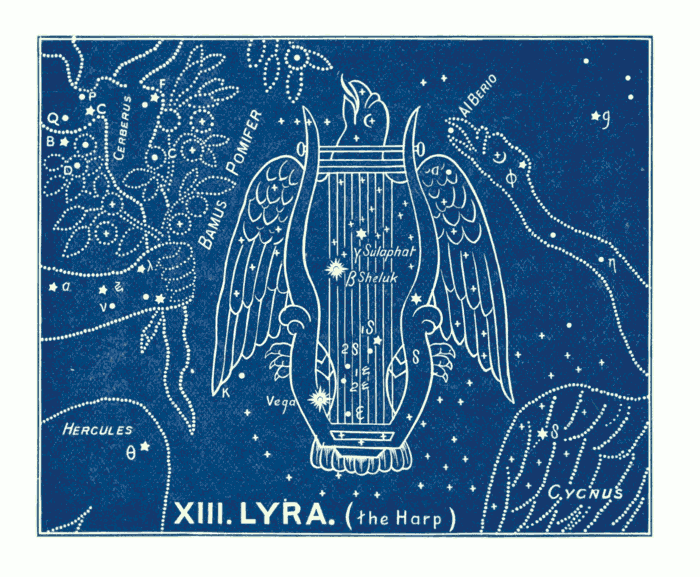
Witness of the Stars: Lyra (the Harp)

1. LYRA (The Harp)

Praise prepared for the Conqueror.

“Praise waiteth for thee, O God, in Zion” (Ps. lxv. 1). And when the waiting time is over, and the Redeemer comes forth, then the praise shall be given. “We give Thee thanks, O Lord God, the Almighty, which art, and which wast, because thou hast taken to Thee Thy great power, and didst reign” (Rev. xi. 17, r.v.). “Let us be glad and rejoice and give honour unto Him” (Rev. xix. 7). The Twenty-first Psalm should be read here, as it tells of the bursting forth of praise on the going forth of this all-gracious Conqueror.

“The King shall rejoice in Thy strength, O Lord;

And in Thy salvation how greatly shall He rejoice!…

Thine hand shall find out all Thine enemies;

Thy right hand shall find out all that hate thee….

Their fruit shalt Thou destroy from the earth;

And their seed from among the children of men.

For they intended evil against Thee;

They imagined a mischievous device which they are not able to perform,

Therefore shalt thou make them turn their back (Heb. Margin, set them as a butt),

When Thou shalt make ready Thine arrows upon Thy strings

[And shoot them] against the face of them.

Be thou exalted, Lord, in thine own strength;

SO WILL WE SING AND PRAISE THY POWER.”

(Ps. xxi. 1, 8, 10-13.)

Beautifully, then, does the harp come in here, following upon the going forth of this victorious Horseman. This Song of the Lamb follows as naturally as does the Song of Moses in Ex. xv. 1: “I will sing unto the Lord, for He hath triumphed gloriously.”

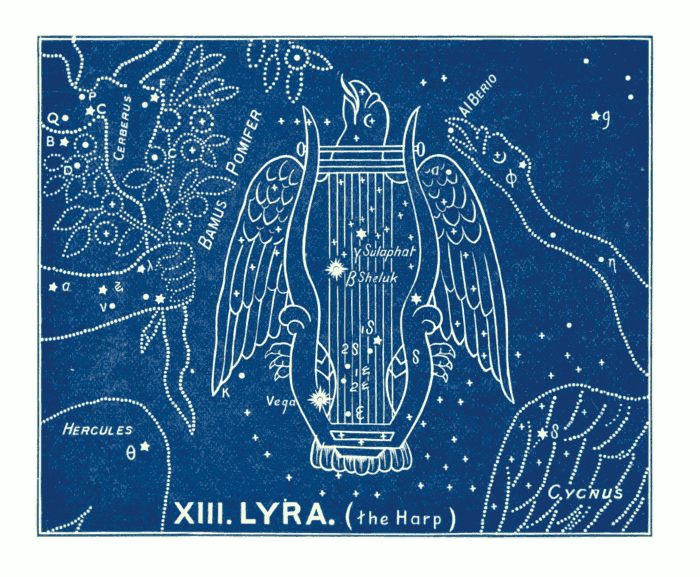
Plate 13: LYRA (the Harp)

Its brightest star, α, is one of the most glorious in the heavens, and by it this constellation may be easily known. It shines with a splendid white lustre. It is called Vega, which means He shall be exalted. Its root occurs in the opening of the Song of Moses, quoted above. Is not this wonderfully expressive?

Its other stars, β and γ, are also conspicuous stars, of the 2nd and 4th magnitude. β is called Shelyuk, which means an eagle (as does the Arabic, Al Nesr); γ is called Sulaphatspringing up, or ascending, as praise.

In the Zodiac of Denderah, this constellation is figured as a hawk or an eagle (the enemy of the serpent) in triumph. Its name is Fent-kar, which means the serpent ruled.

There may be some confusion between the Hebrew נֶשֶׁר, Nesheran eagle, and עָשׂוֹר, Gnasora harp; but there can be no doubt about the grand central truth, that praise shall ascend up “as an eagle toward heaven,” when “every creature which is in heaven, and on the earth, and such as are in the sea, and all that is in them,” shall send up their universal song of praise: “Blessing, and honour, and glory, and power, be unto Him that sitteth upon the throne and unto the Lamb for ever and ever. Amen” (Rev. v. 13, 14).

And for what is all this wondrous anthem of Praise? Listen once again. “Alleluia: Salvation, and glory, and honour, and power, unto the Lord our God; for TRUE AND RIGHTEOUS ARE HIS JUDGMENTS…. And again they said Alleluia” (Rev. xix. 1-3).

With “that blessed hope” before us,

Let no harp remain unstrung,

Let the coming advent chorus

Onward roll from tongue to tongue, Hallelujah,

“Come, Lord Jesus,” quickly come.