Lesson 4: A fat hen
Letter Sounds:
- f
- b
- x
- u
Words:
- hen
- fat
- rat
- box
- big
- run
- from
- can
Lesson:
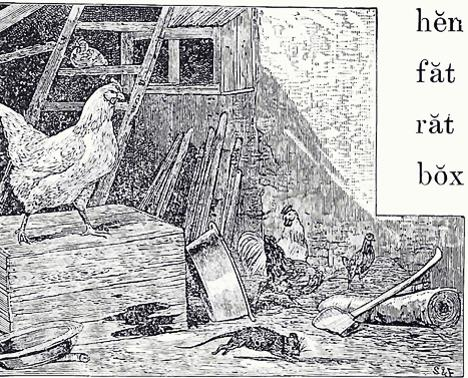
A fat hen. A big rat.
The fat hen is on the box.
The rat ran from the box.
Can the hen run?
Letter Sounds:
Words:
Lesson:
A fat hen. A big rat.
The fat hen is on the box.
The rat ran from the box.
Can the hen run?
Letter Sounds:
Words:

Lesson:
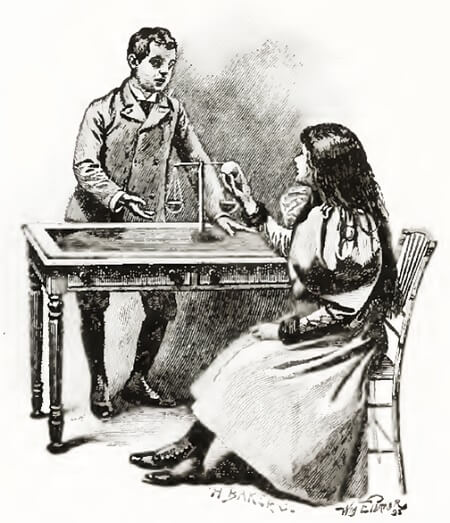
The man. A pen.
The man has a pen.
Is the pen in his hand?
It is in his hand.
“McGuffey’s First Eclectic Reader, Revised Edition” by William Holmes McGuffey is an educational textbook written in the late 19th century. This book serves as a foundational reading primer designed primarily for young children who are just beginning to learn how to read. It combines phonics and sight word instruction with moral lessons and simple narratives to help children develop literacy skills. The book consists of a series of lessons that introduce vocabulary through short passages accompanied by illustrations. Each lesson focuses on different aspects of language, from phonics to vocabulary building, and often includes questions to encourage comprehension and discussion. Throughout the text, there are moral themes such as kindness and respect, illustrated through various characters and scenarios, helping to instill values alongside reading proficiency. As students’ progress, the lessons become incrementally more complex, reinforcing their learning experience and preparing them for more advanced reading materials.

1. The fishhawk, or osprey, is not so large as the eagle; but he has, like the eagle, a hooked bill and sharp claws.
2. His color is a dark brown, with black and white spots, and his length is from twenty to twenty-two inches. His breast is mostly white. His tail and wings are long.
3. The fishhawk is often found sitting upon a tree over a pond, or lake, or river. He is also found by the seaside.
4. He watches the fish as they swim in the water beneath him; then he darts down suddenly and catches one of them.
5. When he catches a fish in his sharp, rough claws, he carries it off to eat, and, as he flies away with it for his dinner, an eagle sometimes meets him.
6. The eagle flies at him fiercely with his sharp bill and claws, and compels the hawk to drop the fish.
7. Then the eagle catches the fish as it falls, before it reaches the ground, and carries it off.
8. The poor fishhawk, with a loud cry, timidly flies away. He must go again to the water and catch another fish for his dinner.
9. Thus you see, that the eagle is a robber. He robs fishhawks, whose only mode of getting a living is by catching fish.
Words:
Words:


 articlesforchristians