A place to grow your relationship with God

Posts tagged ‘math’

Subtract Numbers from Up to 10

STEP 1

  • Children separate a larger group of up to 10 objects into two smaller groups.
  • Repeatedly separate a group of objects into smaller groups per the table below. For example, 1 pencil from 3 pencils leaves 2 pencils, 4 coins from 5 coins leaves 1 coin, and 9 cars from 10 cars leaves 1 car, etc.
  • When children are ready, have them separate the object groups themselves.
  • Children must perfectly master the operations listed in the table before proceeding to the next phase of the lesson.

STEP 2

  • Children separate groups of objects they can’t see, but can imagine (bears, mountains, trees).
  • Using the table above as a guide, ask children to call out the answer to questions such as, ‘How many are one shoe from three shoes?’ and ‘How many are nine frogs from ten frogs?’
  • Give numerous exercises on each number, with constant reviews, until children can recite each operation in the table with great accuracy and rapidity.

STEP 3

  • In this phase, do not mention objects. Children subtract numbers directly.
  • Using the table above as a guide, ask children to call out the answer to questions such as, ‘How many are one from two?’ and ‘How many are five from six?’
  • Give numerous exercises on each number, with constant reviews, until children can perform each operation with great accuracy and rapidity.

STEP 4

  • Direct children to practice writing and reciting the subtraction problems listed in the table above. For example, they would write and then recite:
  • 1 from 10 leaves 9
  • 10 minus 1 is 9
  • 10 – 1 = 9
  • Repeat for each combination in the table until the children master the tasks.

STEP 5

Have children copy, solve, and recite the following table:

  • 9 + 1 or 1 + 9 = ; therefore 10 – 1 = ; 10 – 9 =
  • 8 + 2 or 2 + 8 = ; therefore 10 – 2 = ; 10 – 8 =
  • 7 + 3 or 3 + 7 = ; therefore 10 – 3 = ; 10 – 7 =
  • 6 + 4 or 4 + 6 = ; therefore 10 – 4 = ; 10 – 6 =
  • 5 + 5 = ; therefore 10 – 5 = ;

STEP 6

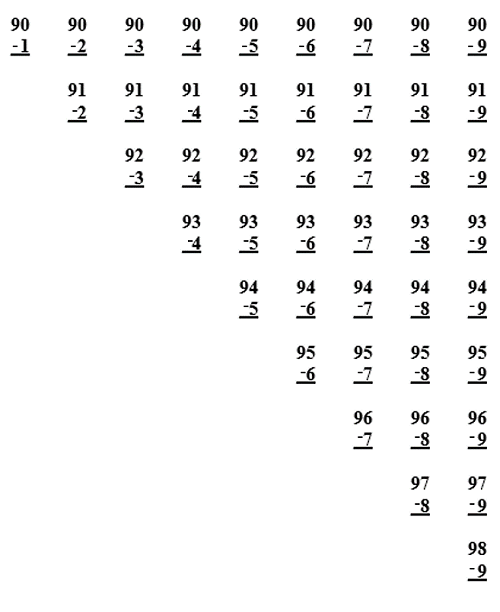
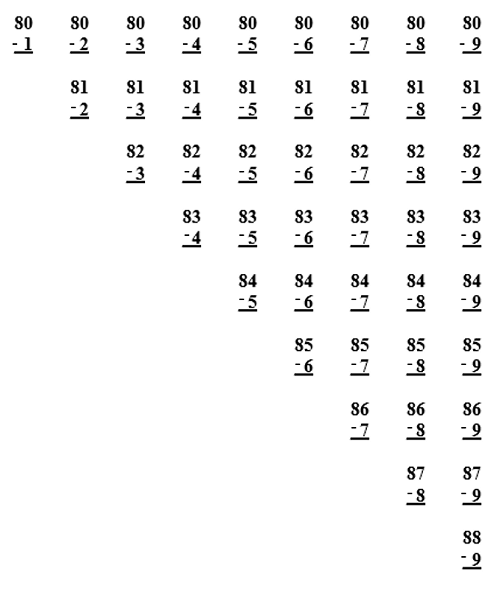
  • Assess mastery by reading aloud the word problems below and having the children mentally compute and recite the solutions. If children have difficulties, repeat the prior phases and then reassess.

Subtraction

Note — These exercises are intended for use with counters of some kind, – marbles, pebbles, kernels of corn, beans, or paper clips. The objects can be arranged in distinct groups, to represent each number indicated.

STEP 1

  • Show the picture and read the associated problems below aloud.
  • Direct children to mentally compute and recite the solutions.

STEP 2

  • If children have difficulties, practice the subtraction problems with physical objects such as coins, beans, or toys.
  • Once children master the problems with physical objects, have children retry the mental computation.

Skip Counting by 10s to and from 100

Note — These exercises are intended for use with counters of some kind, – marbles, pebbles, kernels of corn, beans, or paper clips. The objects can be arranged in distinct groups, to represent each number indicated.

STEP 1

  • Give children a set of objects such as coins, beans, or toys.
  • Have children practice skip counting up by 10s to 100 using the physical objects.

STEP 2

  • Have children practices skip counting up by 10s to 100 by reciting numbers without using the objects.

STEP 3

  • Give children a set of objects such as coins, beans, or toys.
  • Have children practice skip counting down by 10s from 100 using the physical objects.

STEP 4

  • Have children practices skip counting down by 10s from 100 by reciting numbers without using the objects.

 Skip Counting by 5s to and from 50

Note — These exercises are intended for use with counters of some kind, – marbles, pebbles, kernels of corn, beans, or paper clips. The objects can be arranged in distinct groups, to represent each number indicated.

STEP 1

  • Give children a set of objects such as coins, beans, or toys.
  • Have children practice skip counting up by 5s to 50 using the physical objects.

STEP 2

  • Have children practices skip counting up by 5s to 50 by reciting numbers without using the objects.

STEP 3

  • Give children a set of objects such as coins, beans, or toys.
  • Have children practice skip counting down by 5s from 50 using the physical objects.

STEP 4

  • Have children practices skip counting down by 5s from 50 by reciting numbers without using the objects.

Skip Counting by 4s to and from 40

Note — These exercises are intended for use with counters of some kind, – marbles, pebbles, kernels of corn, beans, or paper clips. The objects can be arranged in distinct groups, to represent each number indicated.

STEP 1

  • Give children a set of objects such as coins, beans, or toys.
  • Have children practice skip counting up by 4s to 40 using the physical objects.

STEP 2

  • Have children practices skip counting up by 4s to 40 by reciting numbers without using the objects.

STEP 3

  • Give children a set of objects such as coins, beans, or toys.
  • Have children practice skip counting down by 4s from 40 using the physical objects.

STEP 4

  • Have children practices skip counting down by 4s from 40 by reciting numbers without using the objects.

Adding Columns of Numbers

Teach children to add columns of numbers.

  • Direct children to mentally add the columns below, speaking aloud the results only of each operation.
  • Have children add columns from bottom to top for additional practice.
  • Exercise : Add the columns aloud from top to bottom and bottom to top. For example, for the first problem top to bottom, students say ‘2, 3.’

STEP 2

  • Exercise : Add the columns aloud from top to bottom and bottom to top. For example, for the first problem top to bottom, students say ‘9, 10.’
  • Direct children to mentally add the columns below, speaking aloud the results only of each operation.
  • Have children add columns from bottom to top for additional practice.
  • Exercise : Add the columns aloud from top to bottom and bottom to top. For example, for the first problem top to bottom, students say ‘2, 3.’
  • Exercise : Add the columns aloud from top to bottom and bottom to top. For example, for the first problem top to bottom, students say ‘9, 10.’
  • Exercise : Add the columns aloud from top to bottom and bottom to top. For example, for the first problem top to bottom, students say ‘4, 6.’

Math: Add Numbers Up to 18 Where One Operand is an 8

Note — These exercises are intended for use with counters of some kind, – marbles, pebbles, kernels of corn, beans, or paper clips. The objects can be arranged in distinct groups, to represent each number indicated. This page may be printed out or the student can write the problems in a notebook.

  • 1 + 8 =
  • 8 + 1 =
  • 2 + 8 =
  • 8 + 2 =
  • 3 + 8 =
  • 8 + 3 =
  • 8 + 4 =
  • 4 + 8 =
  • 5 + 8 =
  • 8 + 5 =
  • 6 + 8 =
  • 8 + 6 =
  • 7 + 8 =
  • 8 + 7 =
  • 8 + 8 =
  • 9 + 8 =
  • 8 + 9 =
  • 10 + 8 =
  • 8 + 10 =

Review – Add and Subtract Numbers Up to 10

Review – Add and Subtract Numbers Up to 10

Note — These exercises are intended for use with counters of some kind, – marbles, pebbles, kernels of corn, beans, or paper clips. The objects can be arranged in distinct groups, to represent each number indicated. This page may be printed out or the student can write the problems in a notebook.

  • 10 + 0 =
  • 9 + 1 =
  • 8 + 2 =
  • 7 + 3 =
  • 6 + 4 =
  • 5 + 5 =
  • 4 + 6 =
  • 3 + 7 =
  • 2 + 8 =
  • 1 + 9 =
  • 0 + 10 =
  • 10 – 0 =
  • 10 – 1 =
  • 10 – 2 =
  • 10 – 3 =
  • 10 – 4 =
  • 10 – 5 =
  • 10 – 6 =
  • 10 – 7 =
  • 10 – 8 =
  • 10 – 9 =
  • 10 – 10 =

Review – Add and Subtract Numbers Up to 8

Note — These exercises are intended for use with counters of some kind, – marbles, pebbles, kernels of corn, beans, or paper clips. The objects can be arranged in distinct groups, to represent each number indicated. This page may be printed out or the student can write the problems in a notebook.

Adding

  • 1 + 0 =
  • 1 + 1 =
  • 1 + 2 =
  • 1 + 3 =
  • 1 + 4 =
  • 1 + 5 =
  • 1 + 6 =
  • 1 + 7 =
  • 2 + 0 =
  • 2 + 1 =
  • 2 + 2 =
  • 2 + 3 =
  • 2 + 4 =
  • 2 + 5 =
  • 2 + 6 =
  • 3 + 0 =
  • 3 + 1 =
  • 3 + 2 =
  • 3 + 3 =
  • 3 + 4 =
  • 3 + 5 =
  • 4 + 0 =
  • 4 + 1 =
  • 4 + 2 =
  • 4 + 3 =
  • 4 + 4 =
  • 5 + 0 =
  • 5 + 1 =
  • 5 + 2 =
  • 5 + 3 =
  • 6 + 0 =
  • 6 + 1 =
  • 6 + 2 =
  • 7 + 0 =
  • 7 + 1 =
  • 8 + 0 =

Subtracting

  • 8 – 0 =
  • 8 – 1 =
  • 8 – 2 =
  • 8 – 3 =
  • 8 – 4 =
  • 8 – 5 =
  • 8 – 6 =
  • 8 – 7 =
  • 8 – 8 =
  • 7 – 0 =
  • 7 – 1 =
  • 7 – 2 =
  • 7 – 3 =
  • 7 – 4 =
  • 7 – 5 =
  • 7 – 6 =
  • 7 – 7 =
  • 6 – 0 =
  • 6 – 1 =
  • 6 – 2 =
  • 6 – 3 =
  • 6 – 4 =
  • 6 – 5 =
  • 6 – 6 =
  • 5 – 0 =
  • 5 – 1 =
  • 5 – 2 =
  • 5 – 3 =
  • 5 – 4 =
  • 5 – 5 =
  • 4 – 0 =
  • 4 – 1 =
  • 4 – 2 =
  • 4 – 3 =
  • 4 – 4 =
  • 3 – 0 =
  • 3 – 1 =
  • 3 – 2 =
  • 3 – 3 =
  • 2 – 0 =
  • 2 – 1 =
  • 2 – 2 =
  • 1 – 0 =
  • 1 – 1 =

1st grade math lesson 1 Review adding and subtracting up to 5

Note — These exercises are intended for use with counters of some kind, – marbles, pebbles, kernels of corn, beans, or paper clips. The objects can be arranged in distinct groups, to represent each number indicated. This page may be printed out or the student can write the problems in a notebook.

Adding

  • 1 + 1 =
  • 1 + 2 =
  • 1 + 3 =
  • 1 + 4 =
  • 2 + 1 =
  • 2 + 2 =
  • 3 + 1 =
  • 3 + 2 =
  • 4 + 1 =
  • 5 + 0 =

Subtraction:

  • 5 – 0 =
  • 5 – 1 =
  • 5 – 2 =
  • 5 – 3 =
  • 5 – 4 =
  • 5 – 5 =
  • 4 – 0 =
  • 4 – 1 =
  • 4 – 2 =
  • 4 – 3 =
  • 4 – 4 =
  • 3 – 0 =
  • 3 – 1 =
  • 3 – 2 =
  • 3 – 3 =
  • 2 – 0 =
  • 2 – 1 =
  • 2 – 2 =