A place to grow your relationship with God

Posts tagged ‘McGuffey’s Third Eclectic Reader’

McGuffey’s Third Eclectic Reader Lesson 69: No Crown for Me

Lesson:

  1. ‘Will you come with us, Susan?’ cried several little girls to a schoolmate. ‘We are going to the woods; do come, too.’
  2. ‘I should like to go with you very much,’ replied Susan, with a sigh; ‘but I cannot finish the task grandmother set me to do.’
  3. ‘How tiresome it must be to stay at home to work on a holiday!’ said one of the girls, with a toss of her head. ‘Susan’s grandmother is too strict.’
  4. Susan heard this remark, and, as she bent her head over her task, she wiped away a tear, and thought of the pleasant afternoon the girls would spend gathering wild flowers in the woods.
  5. Soon she said to herself, ‘What harm can there be in moving the mark grandmother put in the stocking? The woods must be very beautiful to-day, and how I should like to be in them!’
  6. ‘Grandmother,’ said she, a few minutes afterwards, ‘I am ready, now.’ ‘What, so soon, Susan?’ Her grandmother took the work, and looked at it very closely.
  7. ‘True, Susan,’ said she, laying great stress on each word; ‘true, I count twenty turns from the mark; and, as you have never deceived me, you may go and amuse yourself as you like the rest of the day.’
  8. Susan’s cheeks were scarlet, and she did not say, ‘Thank you.’ As she left the cottage, she walked slowly away, not singing as usual.
  9. ‘Why, here is Susan!’ the girls cried, when she joined their company; ‘but what is the matter? Why have you left your dear, old grandmother?’ they tauntingly added.
  10. ‘There is nothing the matter.’ As Susan repeated these words, she felt that she was trying to deceive herself. She had acted a lie. At the same time, she remembered her grandmother’s words, ‘You have never deceived me.’
  11. ‘Yes, I have deceived her,’ said she to herself. ‘If she knew all, she would never trust me again.’
  12. When the little party had reached an open space in the woods, her companions ran about enjoying themselves; but Susan sat on the grass, wishing she were at home confessing her fault.
  13. After a while Rose cried out, ‘Let us make a crown of violets, and put it on the head of the best girl here.’
  14. ‘It will be easy enough to make the crown, but not so easy to decide who is to wear it,’ said Julia.
  15. ‘Why, Susan is to wear it, of course,’ said Rose: ‘is she not said to be the best girl in school and the most obedient at home?’
  16. ‘Yes, yes; the crown shall be for Susan,’ cried the other girls, and they began to make the crown. It was soon finished.
  17. ‘Now, Susan,’ said Rose, ‘put it on in a very dignified way, for you are to be our queen.’
  18. As these words were spoken, the crown was placed on her head. In a moment she snatched it off, and threw it on the ground, saying, ‘No crown for me; I do not deserve it.’
  19. The girls looked at her with surprise. ‘I have deceived my grandmother,’ said she, while tears flowed down her cheeks. ‘I altered the mark she put in the stocking, that I might join you in the woods.’
  20. ‘Do you call that wicked?’ asked one of the girls. ‘I am quite sure it is; and I have been miserable all the time I have been here.’
  21. Susan now ran home, and as soon as she got there she said, with a beating heart, ‘O grandmother! I deserve to be punished, for I altered the mark you put in the stocking. Do forgive me; I am very sorry and unhappy.’
  22. ‘Susan,’ said her grandmother, ‘I knew it all the time; but I let you go out, hoping that your own conscience would tell you of your sin. I am so glad that you have confessed your fault and your sorrow.’
  23. ‘When shall I be your own little girl again?’ ‘Now,’ was the quick reply, and Susan’s grandmother kissed her forehead.

DEFINITIONS

  1. Tiresome: Tedious, wearisome.
  2. Stress: Force, emphasis.
  3. Company: A number of persons together.
  4. Tauntingly: In a disagreeable, reproachful manner.
  5. Confessing: Telling of, acknowledging.
  6. Fault: Wrongdoing, sin.
  7. Dignified: Respectful, stately.
  8. Altered: Changed.
  9. Miserable: Wretched, very unhappy.
  10. Forehead: The front part of the head above the eyes.

McGuffey’s Third Eclectic Reader Lesson 68: The Violet

Lesson:

  1. Down in a green and shady bed,

A modest violet grew;

Its stalk was bent, it hung its head,

As if to hide from view

  1. And yet it was a lovely flower,

Its colors bright and fair;

It might have graced a rosy bower

Instead of hiding there.

  1. Yet there it was content to bloom,

In modest tints arrayed,

And there it spread its sweet perfume,

Within the silent shade.

  1. Then let me to the valley go,

This pretty flower to see;

That I may also learn to grow

In sweet humility.

Jane Taylor.

McGuffey’s Third Eclectic Reader Lesson 67: Susie and Rover

Lesson:

  1. ‘Mamma,’ said Susie Dean, one summer’s morning, ‘may I go to the woods, and pick berries?’
  2. ‘Yes,’ replied Mrs. Dean, ‘but you must take Rover with you.’
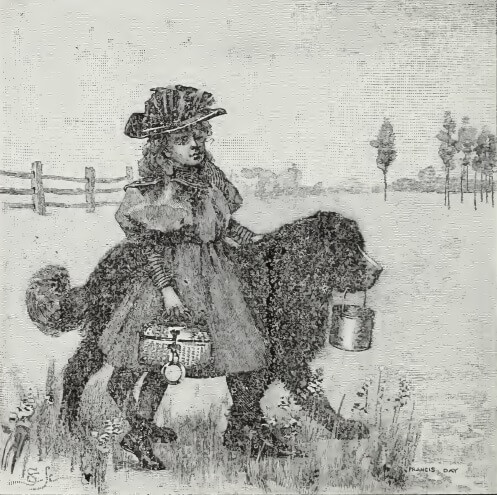
  3. Susie brought her little basket, and her mother put up a nice lunch for her. She tied down the cover, and fastened a tin cup to it.
  4. The little girl called Rover—a great Newfoundland dog—and gave him a tin pail to carry. ‘If I bring it home full, mamma,’ she said, ‘won’t you make some berry cakes for tea?’
  5. Away she tripped, singing as she went down the lane and across the pasture. When she got to the woods, she put her dinner basket down beside a tree, and began to pick berries.
  6. Rover ran about, chasing a squirrel or a rabbit now and then, but never straying far from Susie.
  7. The tin pail was not a very small one. By the time it was two thirds full, Susie began to feel hungry, and thought she would eat her lunch.
  8. Rover came and took his place at her side as soon as she began to eat. Did she not give him some of the lunch? No, she was in a selfish mood, and did no such thing.
  9. ‘There, Rover, run away! there’s a good dog,’ she said; but Rover staid near her, watching her steadily with his clear brown eyes.
  10. The meat he wanted so much, was soon eaten up; and all he got of the nice dinner, was a small crust of gingerbread that Susie threw away.
  11. After dinner, Susie played a while by the brook. She threw sticks into the water, and Rover swam in and brought them back. Then she began to pick berries again.
  12. She did not enjoy the afternoon as she did the morning. The sunshine was as bright, the berries were as sweet and plentiful, and she was neither tired nor hungry.
  13. But good, faithful Rover was hungry, and she had not given him even one piece of meat. She tried to forget how selfish she had been; but she could not do so, and quite early she started for home.
  14. When she was nearly out of the woods, a rustling in the underbrush attracted her attention. ‘I wonder if that is a bird or a squirrel,’ said she to herself. ‘If I can catch it, how glad I shall be!’
  15. She tried to make her way quietly through the underbrush; but what was her terror when she saw it large snake coiled up before her, prepared for a spring!
  16. She was so much frightened that she could not move; but brave Rover saw the snake, and, springing forward, seized it by the neck and killed it.
  17. When the faithful dog came and rubbed his head against her hand, Susie put her arms ’round his neck, and burst into tears. ‘O Rover,’ she cried, ‘you dear, good dog! How sorry I am that I was so selfish!’
  18. Rover understood the tone of her voice, if he did not understand her words, and capered about in great glee, barking all the time. You may be sure that he had a plentiful supper that evening.
  19. Susie never forgot the lesson of that day. She soon learned to be on her guard against a selfish spirit, and became a happier and more lovable little girl.

Mrs. M. O. Johnson—Adapted.

DEFINITIONS

  1. Selfish: Thinking and caring only for one’s self.
  2. Mood: State of mind.
  3. Steadily: Constantly.
  4. Plentiful: Abundant.
  5. Neither: Not the one or the other.
  6. Underbrush: Shrubs or small bushes in a forest.
  7. Attracted: Drew.
  8. Terror: Fright, fight.
  9. Capered: Frisked.

McGuffey’s Third Eclectic Reader Lesson 66: The Little Loaf

Lesson:

  1. Once when there was a famine, a rich baker sent for twenty of the poorest children in the town, and said to them, ‘In this basket there is a loaf for each of you. Take it, and come back to me every day at this hour till God sends us better times.’
  2. The hungry children gathered eagerly about the basket, and quarreled for the bread, because each wished to have the largest loaf. At last they went away without even thanking the good gentleman.
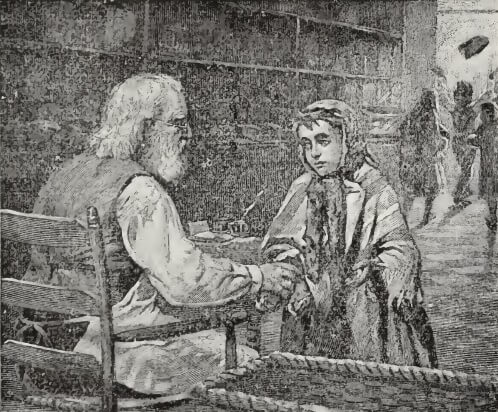
  3. But Gretchen, a poorly-dressed little girl, did not quarrel or struggle with the rest, but remained standing modestly in the distance. When the ill-behaved girls had left, she took the smallest loaf, which alone was left in the basket, kissed the gentleman’s hand, and went home.
  4. The next day the children were as ill-behaved as before, and poor, timid Gretchen received a loaf scarcely half the size of the one she got the first day. When she came home, and her mother cut the loaf open, many new, shining pieces of silver fell out of it.
  5. Her mother was very much alarmed, and said, ‘Take the money back to the good gentleman at once, for it must have got into the dough by accident. Be quick, Gretchen! be quick!’
  6. But when the little girl gave the rich man her mother’s message, he said, ‘No, no, my child, it was no mistake. I had the silver pieces put into the smallest loaf to reward you. Always be as contented, peaceable, and grateful as you now are. Go home now, and tell your mother that the money is your own.’

DEFINITIONS

  1. Famine: A general scarcity of food.
  2. Loaf: A molded mass of regular shape (as of bread or cake).
  3. Gretchen: A girl’s name – the shortened for or pet name for Marguerite.
  4. Remained: Stayed.
  5. Distance: Place which is far off.
  6. Ill-behaved: Rude, having bad manners.
  7. Accident: Mistake.
  8. Message: Word sent, communication.
  9. Peaceable: Quiet, gentle.

McGuffey’s Third Eclectic Reader Lesson 65: Mary Dow

Lesson:

  1. ‘Come in, little stranger,’ I said,

As she tapped at my half open door;

While the blanket, pinned over her head,

Just reached to the basket she bore.

  1. A look full of innocence fell

From her modest and pretty blue eye,

As she said, ‘I have matches to sell,

And hope you are willing to buy.

  1. ‘A penny a bunch is the price,

I think you’ll not find it too much;

They are tied up so even and nice,

And ready to light with a touch.’

  1. I asked, ‘What’s your name, little girl?’

”Tis Mary,’ said she, ‘Mary Dow;’

And carelessly tossed off a curl,

That played on her delicate brow.

  1. ‘My father was lost on the deep;

The ship never got to the shore;

And mother is sad, and will weep,

To hear the wind blow and sea roar.

  1. ‘She sits there at home, without food,

Beside our poor, sick Willy’s bed;

She paid all her money for wood,

And so I sell matches for bread.

  1. ‘I’d go to the yard and get chips,

But then it would make me too sad

To see the men building the ships,

And think they had made one so bad.

  1. ‘But God, I am sure, who can take

Such fatherly care of a bird,

Will never forget nor forsake

The children who trust in his word.

  1. ‘And now, if I only can sell

The matches I brought out today,

I think I shall do very well,

And we shall rejoice at the pay.’

  1. ‘Fly home, little bird,’ then I thought,

‘Fly home, full of joy, to your nest;’

For I took all the matches she brought,

And Mary may tell you the rest.

DEFINITIONS

  1. Blanket: A square of loosely woven woolen cloth.
  2. Matches: Small splits of wood, one end of which has been dipped in a preparation which will take fire by rubbing.
  3. Penny: Coin worth one cent.
  4. Delicate: Soft and fair.
  5. Forsake: Leave, reject.

McGuffey’s Third Eclectic Reader Lesson 64: Mary’s Dime

Lesson:

  1. There! I have drawn the chairs into the right corners, and dusted the room nicely. How cold papa and mamma will be when they return from their long ride! It is not time to toast the bread yet, and I am tired of reading.
  2. What shall I do? Somehow, I can’t help thinking about the pale face of that little beggar girl all the time. I can see the glad light filling her eyes, just as plain as I did when I laid the dime in her little dirty hand.
  3. How much I had thought of that dime, too! Grandpa gave it to me a whole month ago, and I had kept it ever since in my red box upstairs; but those sugar apples looked so beautiful, and were so cheap—only a dime apiece—that I made up my mind to have one.
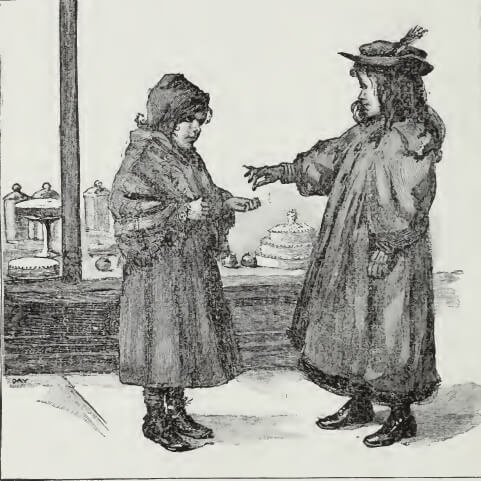
  4. I can see her—the beggar girl, I mean—as she stood there in front of the store, in her old hood and faded dress, looking at the candies laid all in a row. I wonder what made me say, ‘Little girl, what do you want?’
  5. How she stared at me, just as if nobody had spoken kindly to her before. I guess she thought I was sorry for her, for she said, so earnestly and sorrowfully, ‘I was thinking how good one of those gingerbread rolls would taste. I haven’t had anything to eat today.’
  6. Now, I thought to myself, ‘Mary Williams, you have had a good breakfast and a good dinner this day, and this poor girl has not had a mouthful. You can give her your dime; she needs it a great deal more than you do.’
  7. I could not resist that little girl’s sorrowful, hungry look—so I dropped the dime right into her hand, and, without waiting for her to speak, walked straight away. I’m so glad I gave her the dime, if I did have to go without the apple lying there in the window, and looking just like a real one.

DEFINITIONS

  1. Toast: To scorch until brown by the heat of a fire.
  2. Cheap: Low in price.
  3. Apiece: Each.
  4. Hood: A soft covering for the head.
  5. Faded: Having lost freshness of color.
  6. Stared: Looked earnestly.
  7. Sorrowfully: Full of sadness.
  8. Gingerbread: A kind of sweet cake flavored with ginger.

McGuffey’s Third Eclectic Reader Lesson 63: We are Seven

Lesson:

  1. I met a little cottage girl:

She was eight years old, she said;

Her hair was thick with many a curl,

That clustered round her head.

  1. She had a rustic, woodland air,

And she was wildly clad:

Her eyes were fair, and very fair;—

Her beauty made me glad.

  1. ‘Sisters and brothers, little maid,

How many may you be?’

‘How many? Seven in all,’ she said,

And, wondering, looked at me.

  1. ‘And where are they? I pray you tell.’

She answered, ‘Seven are we;

And two of us at Conway dwell,

And two are gone to sea.

  1. ‘Two of us in the churchyard lie,

My sister and my brother;

And, in the churchyard cottage, I

Dwell near them with my mother,’

  1. ‘You say that two at Conway dwell,

And two are gone to sea,

Yet ye are seven! I pray you tell,

Sweet maid, how this may be.’

  1. Then did the little maid reply,

‘Seven boys and girls are we;

Two of us in the churchyard lie,

Beneath the churchyard tree.’

  1. ‘You run about, my little maid,

Your limbs, they are alive;

If two are in the churchyard laid,

Then ye are only five.’

  1. ‘Their graves are green, they may be seen,’

The little maid replied,

‘Twelve steps or more from mother’s door,

And they are side by side.

  1. ‘My stockings there I often knit,

My kerchief there I hem;

And there upon the ground I sit,

And sing a song to them.

  1. ‘And often after sunset, sir,

When it is light and fair,

I take my little porringer,

And eat my supper there.

  1. ‘The first that died was sister Jane;

In bed she moaning lay,

Till God released her from her pain;

And then she went away.

  1. ‘So in the churchyard she was laid;

And, when the grass was dry,

Together round her grave we played,

My brother John and I.

  1. ‘And when the ground was white with snow,

And I could run and slide,

My brother John was forced to go,

And he lies by her side.’

  1. ‘How many are you, then?’ said I,

‘If they two are in heaven?’

Quick was the little maid’s reply,

‘O master! we are seven.’

  1. ‘But they are dead; those two are dead!

Their spirits are in heaven!’

‘T was throwing words away: for still

The little maid would have her will,

And said, ‘Nay, we are seven.’

William Wordsworth.

DEFINITIONS

  1. Clustered: Hung in bunches.
  2. Rustic: Country-like.
  3. Kerchief: Handkerchief.
  4. Porringer: A small dish for soup or porridge.
  5. Released: Freed, relieved.

McGuffey’s Third Eclectic Reader Lesson 62: The Insolent Boy

Lesson:

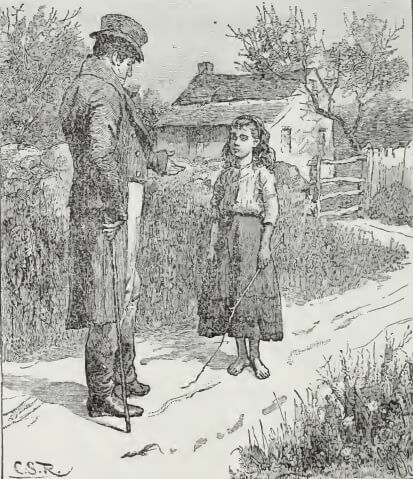
  1. James Selton was one of the most insolent boys in the village where he lived. He would rarely pass people in the street without being guilty of some sort of abuse.
  2. If a person were well-dressed, he would cry out, ‘Dandy!’ If a person’s clothes were dirty or torn, he would throw stones at him, and annoy him in every way.
  3. One afternoon, just as the school was dismissed, a stranger passed through the village. His dress was plain and somewhat old, but neat and clean. He carried a cane in his hand, on the end of which was a bundle, and he wore a broad-brimmed hat.
  4. No sooner did James see the stranger, then he winked to his playmates, and said, ‘Now for some fun!’ He then silently went toward the stranger from behind, and, knocking off his hat, ran away.
  5. The man turned and saw him, but James was out of hearing before he could speak. The stranger put on his hat, and went on his way. Again did James approach; but this time, the man caught him by the arm, and held him fast.
  6. However, he contented himself with looking James a moment in the face, and then pushed him from him. No sooner did the naughty boy find himself free again, then he began to pelt the stranger with dirt and stones.
  7. But he was much frightened when the ‘rowdy,’ as he foolishly called the man, was struck on the head by a brick, and badly hurt. All the boys now ran away, and James skulked across the fields to his home.
  8. As he drew near the house, his sister Caroline came out to meet him, holding up a beautiful gold chain and some new books for him to see.
  9. She told James, as fast as she could talk, that their uncle, who had been away several years, had come home, and was now in the house; that he had brought beautiful presents for the whole family; that he had left his carriage at the tavern, a mile or two off, and walked on foot, so as to surprise his brother, their father.
  10. She said, that while he was coming through the village, some wicked boys threw stones at him, and hit him just over the eye, and that mother had bound up the wound. ‘But what makes you look so pale?’ asked Caroline, changing her tone.
  11. The guilty boy told her that nothing was the matter with him; and running into the house, he went upstairs into his chamber. Soon after, he heard his father calling him to come down. Trembling from head to foot, he obeyed. When he reached the parlor door, he stood, fearing to enter.
  12. His mother said, ‘James, why do you not come in? You are not usually so bashful. See this beautiful watch, which your uncle has brought for you.’
  13. What a sense of shame did James now feel! Little Caroline seized his arm, and pulled him into the room. But he hung down his head, and covered his face with his hands.
  14. His uncle went up to him, and kindly taking away his hands, said, ‘James, will you not bid me welcome?’ But quickly starting back, he cried, ‘Brother, this is not your son. It is the boy who so shamefully insulted me in the street!’
  15. With surprise and grief did the good father and mother learn this. His uncle was ready to forgive him, and forget the injury. But his father would never permit James to have the gold watch, nor the beautiful books, which his uncle had brought for him.
  16. The rest of the children were loaded with presents. James was obliged to content himself with seeing them happy. He never forgot this lesson so long as he lived. It cured him entirely of his low and insolent manners.

DEFINITIONS

  1. Insolent: Rude, insulting.
  2. Rarely: Hardly ever.
  3. Abuse: Ill usage.
  4. Dandy: A fop.
  5. Dismissed: Let out.
  6. Naughty: Bad, wicked.
  7. Rowdy: A low fellow, who engages in fights.
  8. Skulked: Went in a sneaking manner.
  9. Uncle: The brother of one’s father or mother.
  10. Tavern: A small hotel.
  11. Shamefully: Disgracefully.
  12. Insulted: Treated with abuse.
  13. Injury: Harm done.
  14. Entirely: Altogether.

McGuffey’s Third Eclectic Reader Lesson 61: Little Gustava

Lesson:

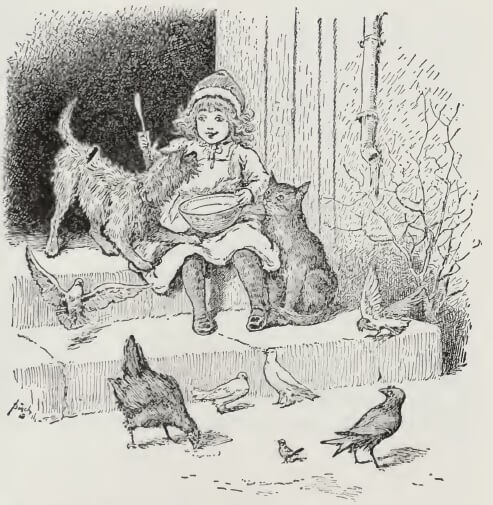
  1. Little Gustava sits in the sun,

Safe in the porch, and the little drops run

From the icicles under the eaves so fast,

For the bright spring sun shines warm at last,

And glad is little Gustava.

  1. She wears a quaint little scarlet cap,

And a little green bowl she holds in her lap,

Filled with bread and milk to the brim,

And a wreath of marigolds round the rim:

‘Ha! ha!’ laughs little Gustava.

  1. Up comes her little gray, coaxing cat,

With her little pink nose, and she mews, ‘What’s that?’

Gustava feeds her,—she begs for more,

And a little brown hen walks in at the door:

‘Good day!’ cries little Gustava.

  1. She scatters crumbs for the little brown hen,

There comes a rush and a flutter, and then

Down fly her little white doves so sweet,

With their snowy wings and their crimson feet:

‘Welcome!’ cries little Gustava.

  1. So dainty and eager they pick up the crumbs.

But who is this through the doorway comes?

Little Scotch terrier, little dog Rags,

Looks in her face, and his funny tail wags:

‘Ha! ha!’ laughs little Gustava.

  1. ‘You want some breakfast, too?’ and down

She sets her bowl on the brick floor brown,

And little dog Rags drinks up her milk,

While she strokes his shaggy locks, like silk:

‘Dear Rags!’ says little Gustava.

  1. Waiting without stood sparrow and crow,

Cooling their feet in the melting snow.

‘Won’t you come in, good folk?’ she cried,

But they were too bashful, and staid outside,

Though ‘Pray come in!’ cried Gustava.

  1. So the last she threw them, and knelt on the mat,

With doves, and biddy, and dog, and cat.

And her mother came to the open house door:

‘Dear little daughter, I bring you some m’

My merry little Gustava.’

  1. Kitty and terrier, biddy and doves,

All things harmless Gustava loves,

The shy, kind creatures it is joy to feed,

And, oh! her breakfast is sweet indeed

To happy little Gustava!

Celia Thaxter.

DEFINITIONS

  1. Gustava: A girl’s name.
  2. Icicles: Water frozen in long, needle-like shapes.
  3. Eaves: The lower edges of a roof.
  4. Quaint: Odd.
  5. Marigold: A yellow flower.
  6. Knelt: Bent on her knees.
  7. Biddy: Chicken.

McGuffey’s Third Eclectic Reader Lesson 60: The Contented Boy

Lesson:

Mr. Lenox was one morning riding by himself. He got off from his horse to look at something on the roadside. The horse broke away from him, and ran off. Mr. Lenox ran after him, but soon found that he could not catch him.

A little boy at work in a field near the road, heard the horse. As soon as he saw him running from his master, the boy ran very quickly to the middle of the road, and, catching the horse by the bridle, stopped him till Mr. Lenox came up.

Mr. Lenox. Thank you, my good boy, you have caught my horse very nicely. What shall I give you for your trouble?

Boy. I want nothing, sir.

Mr. L. You want nothing? So much the better for you. Few men can say as much. But what were you doing in the field?

B. I was rooting up weeds, and tending the sheep that were feeding on turnips.

Mr. L. Do you like to work?

B. Yes, sir, very well, this fine weather.

Mr. L. But would you not rather play?

B. This is not hard work. It is almost as good as play.

Mr. L. Who set you to work?

B. My father, sir.

Mr. L. What is your name?

B. Peter Hurdle, sir.

Mr. L. How old are you?

B. Eight years old, next June.

Mr. L. How long have you been here?

B. Ever since six o’clock this morning.

Mr. L. Are you not hungry?

B. Yes, sir, but I shall go to dinner soon.

Mr. L. If you had a dime now, what would you do with it?

B. I don’t know, sir. I never had so much.

Mr. L. Have you no playthings?

B. Playthings? What are they?

Mr. L. Such things as ninepins, marbles, tops, and wooden horses.

B. No, sir. Tom and I play at football in winter, and I have a jumping rope. I had a hoop, but it is broken.

Mr. L. Do you want nothing else?

B. I have hardly time to play with what I have. I have to drive the cows, and to run on errands, and to ride the horses to the fields, and that is as good as play.

Mr. L. You could get apples and cakes, if you had money, you know.

B. I can have apples at home. As for cake, I do not want that. My mother makes me a pie now and then, which is as good.

Mr. L. Would you not like a knife to cut sticks?

B. I have one. Here it is. Brother Tom gave it to me.

Mr. L. Your shoes are full of holes. Don’t you want a new pair?

B. I have a better pair for Sundays.

Mr. L. But these let in water.

B. I do not mind that, sir.

Mr. L. Your hat is all torn, too.

B. I have a better one at home.

Mr. L. What do you do when it rains?

B. If it rains very hard when I am in the field, I get under a tree for shelter.

Mr. L. What do you do, if you are hungry before it is time to go home?

B. I sometimes eat a raw turnip.

Mr. L. But if there is none?

B. Then I do as well as I can without. I work on, and never think of it.

Mr. L. Why, my little fellow, I am glad to see that you are so contented. Were you ever at school?

B. No, sir. But father means to send me next winter.

Mr. L. You will want books then.

B. Yes, sir; each boy has a Spelling Book, a Reader, and a Testament.

Mr. L. Then I will give them to you. Tell your father so, and that it is because you are an obliging, contented little boy.

B. I will, sir. Thank you.

Mr. L. Goodbye, Peter.

B. Good morning, sir.

Dr. John Aiken

DEFINITIONS

Rooting: Pulling up by the roots.

Tending: Watching, attending.

Turnip: A vegetable.

Weather: State of the atmosphere.

Errands: Messages.

Raw: Not cooked.

Testament: The last twenty-seven books of the Bible.