A place to grow your relationship with God

Posts tagged ‘McGuffey’s Third Eclectic Reader’

McGuffey’s Third Eclectic Reader Lesson 38: A Summer Day

Words:

  • tints
  • sheaves
  • fireflies
  • chimney
  • tinkle
  • lawns
  • whirl
  • buttercup
  • lowing
  • lance

Lesson:

  1. This is the way the morning dawns:

Rosy tints on flowers and trees,

Winds that wake the birds and bees,

Dewdrops on the fields and lawns—

This is the way the morning dawns.

  1. This is the way the sun comes up:

Gold on brook and glossy leaves,

Mist that melts above the sheaves,

Vine, and rose, and buttercup—

This is the way the sun comes up.

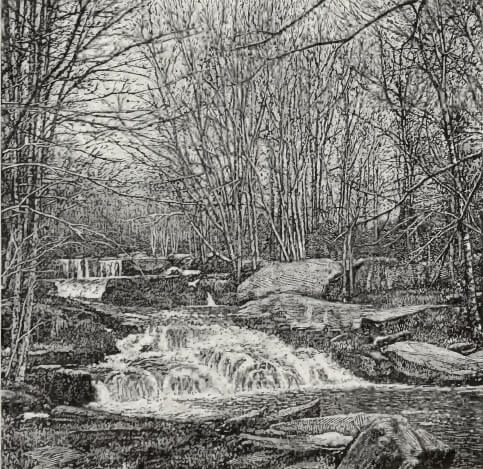
  1. This is the way the river flows:

Here a whirl, and there a dance;

Slowly now, then, like a lance,

Swiftly to the sea it goes—

This is the way the river flows.

  1. This is the way the rain comes down:

Tinkle, tinkle, drop by drop,

Over roof and chimney top;

Boughs that bend, and skies that frown—

This is the way the rain comes down.

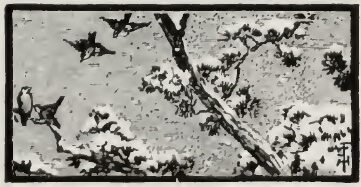
  1. This is the way the birdie sings:

‘Baby birdies in the nest,

You I surely love the best;

Over you I fold my wings’—

This is the way the birdie sings.

  1. This is the way the daylight dies:

Cows are lowing in the lane,

Fireflies wink on hill and plain;

Yellow, red, and purple skies—

This is the way the daylight dies.

George Cooper.

McGuffey’s Third Eclectic Reader Lesson 35: Prayers

Words:

  • hallow
  • amen
  • temptation
  • gracious
  • kingdom
  • forgive
  • transgressions
  • supplied
  • portion
  • bounty
  • weakness
  • helpless
  • deign
  • solemn
  • compassion
  • plumage
  • revere
  • secure
  • forever
  • pardons

Lesson:

The Lord’s Prayer

  1. Our Father in heaven,

We hallow thy name;

May thy kingdom holy

On earth be the same;

Oh, give to us daily

Our portion of bread;

It is from thy bounty,

That all must be fed.

  1. Forgive our transgressions.

And teach us to know

The humble compassion

That pardons each foe;

Keep us from temptation,

From weakness and sin,

And thine be the glory

Forever! Amen!

An Evening Prayer

  1. Before I close my eyes in sleep,

Lord, hear my evening prayer,

And deign a helpless child to keep,

With they protecting care.

  1. Though young in years, I have been taught

Thy name to love and fear;

Of thee to think with solemn thought,

Thy goodness to revere.

  1. That goodness gives each simple flower

Its scent and beauty, too;

And feeds it in night’s darkest hour

With heaven’s refreshing dew.

  1. The little birds that sing all day

In many a leafy wood,

By thee are clothed in plumage gay,

By thee supplied with food.

  1. And when at night they cease to sing,

By thee protected still,

Their young ones sleep beneath their wing,

Secure from every ill.

  1. Thus may’st thou guard with gracious arm

The bed whereon I lie,

And keep a child from every harm

By thine own watchful eye.

McGuffey’s Third Eclectic Reader Lesson 34: George’s Feast

Words:

  • faint
  • collect
  • refresh
  • lining
  • happiness
  • feast
  • scarlet
  • offered
  • lifting
  • strawberries

Lesson:

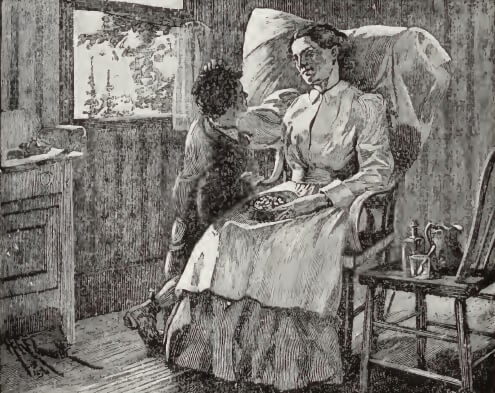
  1. George’s mother was very poor. Instead of having bright, blazing fires in winter, she had nothing to burn but dry sticks, which George picked up from under the trees and hedges.
  2. One fine day in July, she sent George to the woods, which were about two miles from the village in which she lived. He was to stay there all day, to get as much wood as he could collect.
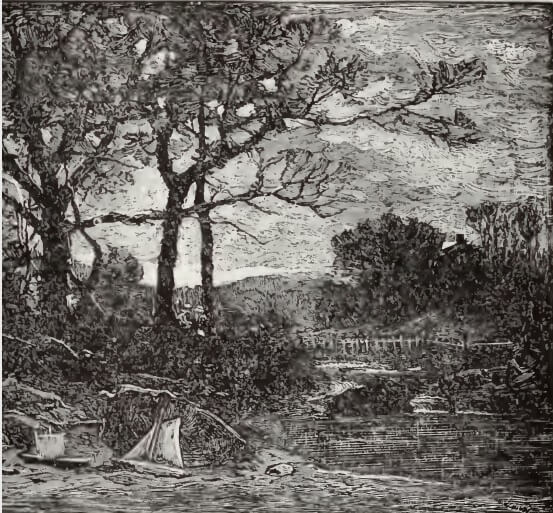
  3. It was a bright, sunny day, and George worked very hard; so that by the time the sun was high, he was hot, and wished for a cool place where he might rest and eat his dinner.
  4. While he hunted about the bank he saw among the moss some fine, wild strawberries, which were a bright scarlet with ripeness.
  5. ‘How good these will be with my bread and butter!’ thought George; and lining his little cap with leaves, he set to work eagerly to gather all he could find, and then seated himself by the brook.
  6. It was a pleasant place, and George felt happy and contented. He thought how much his mother would like to see him there, and to be there herself, instead of in her dark, close room in the village.
  7. George thought of all this, and just as he was lifting the first strawberry to his mouth, he said to himself, ‘How much mother would like these;’ and he stopped, and put the strawberry back again.
  8. ‘Shall I save them for her?’ said he, thinking how much they would refresh her, yet still looking at them with a longing eye.
  9. ‘I will eat half, and take the other half to her,’ said he at last; and he divided them into two heaps. But each heap looked so small, that he put them together again.
  10. ‘I will only taste one,’ thought he; but, as he again lifted it to his mouth, he saw that he had taken the finest, and he put it back. ‘I will keep them all for her,’ said he, and he covered them up nicely, till he should go home.
  11. When the sun was beginning to sink, George set out for home. How happy he felt, then, that he had all his strawberries for his sick mother. The nearer he came to his home, the less he wished to taste them.
  12. Just as he had thrown down his wood, he heard his mother’s faint voice calling him from the next room. ‘Is that you, George? I am glad you have come, for I am thirsty, and am longing for some tea.’
  13. George ran in to her, and joyfully offered his wild strawberries. ‘And you saved them for your sick mother, did you?’ said she, laying her hand fondly on his head, while the tears stood in her eyes. ‘God will bless you for all this, my child.’
  14. Could the eating of the strawberries have given George half the happiness he felt at this moment?

McGuffey’s Third Eclectic Reader Lesson 27: The New Year

Words:

  • Edward
  • receive
  • wretched
  • thousand
  • gratitude
  • repeat
  • language
  • shivering
  • German
  • understood

Lesson:

  1. One pleasant New-year morning, Edward rose, and washed and dressed himself in haste. He wanted to be first to wish a happy New Year.
  2. He looked in every room, and shouted the words of welcome. He ran into the street, to repeat them to those he might meet.
  3. When he came back, his father gave him two bright, new silver dollars.
  4. His face lighted up as he took them. He had wished for a long time to buy some pretty books that he had seen at the bookstore.
  5. He left the house with a light heart, intending to buy the books.
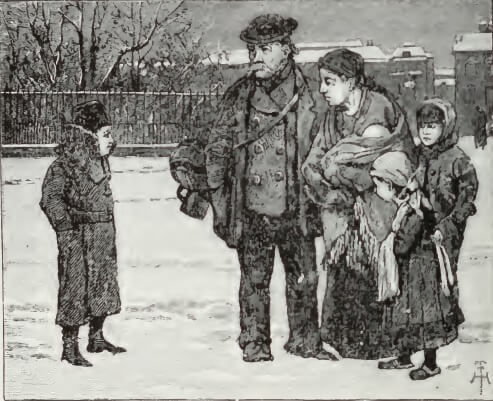
  6. As he ran down the street, he saw a poor German family, the father, mother, and three children shivering with cold.
  7. ‘I wish you a happy New Year,’ said Edward, as he was gayly passing on. The man shook his head.
  8. ‘You do not belong to this country,’ said Edward. The man again shook his head, for he could not understand or speak our language.
  9. But he pointed to his mouth, and to the children, as if to say, ‘These little ones have had nothing to eat for a long time.’
  10. Edward quickly understood that these poor people were in distress. He took out his dollars, and gave one to the man, and the other to his wife.
  11. How their eyes sparkled with gratitude! They said something in their language, which doubtless meant, ‘We thank you a thousand times, and will remember you in our prayers.’
  12. When Edward came home, his father asked what books he had bought. He hung his head a moment, but quickly looked up.
  13. ‘I have bought no books,’ said he, ‘I gave my money to some poor people, who seemed to be very hungry and wretched.
  14. ‘I think I can wait for my books till next New Year. Oh, if you had seen how glad they were to receive the money!’
  15. ‘My dear boy;’ said his father, ‘here is a whole bundle of books. I give them to you, more as a reward for your goodness of heart than as a New-year gift.
  16. ‘I saw you give the money to the poor German family. It was no small sum for a little boy to give cheerfully.
  17. ‘Be thus ever ready to help the poor, and wretched, and distressed; and every year of your life will be to you a happy New Year.’

McGuffey’s Third Eclectic Reader Lesson 26: Three Little Mice

Words:

  • exactly
  • folding
  • cheese
  • chamber
  • rattling
  • protruded
  • forepaws
  • gazed
  • doubt
  • released
  • perplexed
  • lattice
  • queer (this simply means strange)
  • cozy
  • staircase

Lesson:

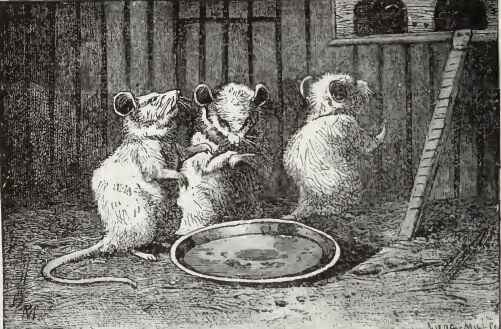
  1. I will tell you the story of three little mice,

If you will keep still and listen to me,

Who live in a cage that is cozy and nice,

And are just as cunning as cunning can be.

They look very wise, with their pretty red eyes,

That seem just exactly like little round beads;

They are white as the snow, and stand up in a row

Whenever we do not attend to their needs;—

  1. Stand up in a row in a comical way,—

Now folding their forepaws as if saying, ‘please;’

Now rattling the lattice, as much as to say,

‘We shall not stay here without more bread and cheese,’

They are not at all shy, as you’ll find, if you try

To make them run up in their chamber to bed;

If they don’t want to go, why, they won’t go—ah! no,

Though you tap with your finger each queer little head.

  1. One day as I stood by the side of the cage,

Through the bars there protruded a funny, round tail;

Just for mischief I caught it, and soon; in a rage,

Its owner set up a most pitiful wail.

He looked in dismay,—there was something to pay,—

But what was the matter he could not make out;

What was holding him so, when he wanted to go

To see what his brothers upstairs were about?

  1. But soon from the chamber the others rushed down,

Impatient to learn what the trouble might be;

I have not a doubt that each brow wore a frown,

Only frowns on their brows are not easy to see.

For a moment they gazed, perplexed and amazed;

Then began both together to—gnaw off the tail!

So, quick I released him,—do you think that it pleased him?

And up the small staircase they fled like a gale.

McGuffey’s Third Eclectic Reader Lesson 25: Things to Remember

Words:

  • avoid
  • prevent
  • forgive
  • rise
  • guide
  • during
  • pouting
  • protection
  • slam
  • manner
  • peevish
  • howling
  • satisfied
  • trust
  • angry

Lesson:

  1. When you rise in the morning, remember who kept you from danger during the night. Remember who watched over you while you slept, and whose sun shines around you, and gives you the sweet light of day.
  2. Let God have the thanks of your heart, for his kindness and his care; and pray for his protection during the wakeful hours of day.
  3. Remember that God made all creatures to be happy, and will do nothing that may prevent their being so, without good reason for it.
  4. When you are at the table, do not eat in a greedy manner. Eat quietly, and do not reach forth your hand for the food, but ask someone to help you.
  5. Do not become peevish and pout, because you do not get a part of everything. Be satisfied with what is given you.
  6. Avoid a pouting face, angry looks, and angry words. Do not slam the doors. Go quietly up and down stairs; and never make a loud noise about the house.
  7. Be kind and gentle in your manners; not like the howling winter storm, but like the bright summer morning.
  8. Do always as your parents bid you. Obey them with a ready mind, and with a pleasant face.
  9. Never do anything that you would be afraid or ashamed that your parents should know. Remember, if no one else sees you, God does, from whom you cannot hide even your most secret thought.
  10. At night, before you go to sleep, think whether you have done anything that was wrong during the day, and pray to God to forgive you. If anyone has done you wrong, forgive him in your heart.
  11. If you have not learned something useful, or been in some way useful, during the past day, think that it is a day lost, and be very sorry for it.
  12. Trust in the Lord, and He will guide you in the way of good men. The path of the just is as the shining light that shineth more and more unto the perfect day.
  13. We must do all the good we can to all men, for this is well pleasing in the sight of God. He delights to see his children walk in love, and do good one to another.

McGuffey’s Third Eclectic Reader Lesson 24: Beautiful Hands

Words:

  • opinion
  • piano
  • coarse
  • bathe
  • sweep

Lesson:

  1. ‘O Miss Roberts! what coarse-looking hands Mary Jessup has!’ said Daisy Marvin, as she walked home from school with her teacher.
  2. ‘In my opinion, Daisy, Mary’s hands are the prettiest in the class.’
  3. ‘Why, Miss Roberts, they are as red and hard as they can be. How they would look if she were to try to play on a piano!’ exclaimed Daisy.
  4. Miss Roberts took Daisy’s hands in hers, and said, ‘Your hands are very soft and white, Daisy—just the hands to look beautiful on a piano; yet they lack one beauty that Mary’s hands have. Shall I tell you what the difference is?’
  5. ‘Yes, please, Miss Roberts.’
  6. ‘Well, Daisy, Mary’s hands are always busy. They wash dishes; they make fires; they hang out clothes, and help to wash them, too; they sweep, and dust, and sew; they are always trying to help her poor, hard-working mother.
  7. ‘Besides, they wash and dress the children; they mend their toys and dress their dolls; yet, they find time to bathe the head of the little girl who is so sick in the next house to theirs.
  8. ‘They are full of good deeds to every living thing. I have seen them patting the tired horse and the lame dog in the street. They are always ready to help those who need help.’
  9. ‘I shall never think Mary’s hands are ugly any more, Miss Roberts.’
  10. ‘I am glad to hear you say that, Daisy; and I must tell you that they are beautiful because they do their work gladly and cheerfully.’
  11. ‘O Miss Roberts! I feel so ashamed of myself, and so sorry,’ said Daisy, looking into her teacher’s face with tearful eyes.
  12. ‘Then, my dear, show your sorrow by deeds of kindness. The good alone are really beautiful.’

McGuffey’s Third Eclectic Reader by William Holmes McGuffey     

McGuffey’s Third Eclectic Reader by William Holmes McGuffey   

 “McGuffey’s Third Eclectic Reader” by William Holmes McGuffey is a graded textbook published in the 1836–1837 edition. Part of a revolutionary series that shaped American education, this reader taught vocabulary and comprehension at a level equivalent to modern fifth or sixth grade. Using stories, poems, and essays, it gradually introduced new words while emphasizing spelling, pronunciation, and moral instruction. 

McGuffey’s Third Eclectic Reader Lesson 23: Sunset

Words:

  • sinking
  • streamlet
  • sweetness
  • cowslip

Lesson:

  1. Now the sun is sinking

In the golden west;

Birds and bees and children

All have gone to rest;

And the merry streamlet,

As it runs along,

With a voice of sweetness

Sings its evening song.

  1. Cowslip, daisy, violet,

In their little beds,

All among the grasses

Hide their heavy heads;

There they’ll all, sweet darlings,

Lie in the happy dreams.

Till the rosy morning

Wakes them with its beams.

McGuffey’s Third Eclectic Reader Lesson 22: The Wind and the Sun. A Fable

Words:

  • decide
  • buckled
  • mountain
  • shelter
  • party
  • dispute
  • succeed
  • forcibly
  • mantle
  • oven

Lesson:

  1. A dispute once arose between the Wind and the Sun, as to which was the stronger.
  2. To decide the matter, they agreed to try their power on a traveler. That party which should first strip him of his cloak, was to win the day.
  3. The Wind began. He blew a cutting blast, which tore up the mountain oaks by their roots, and made the whole forest look like a wreck.
  4. But the traveler, though at first he could scarcely keep his cloak on his back, ran under a hill for shelter, and buckled his mantle about him more closely.
  5. The Wind having thus tried his utmost power in vain, the Sun began.
  6. Bursting through a thick cloud, he darted his sultry beams so forcibly upon the traveler’s head, that the poor fellow was almost melted.
  7. ‘This,’ said he, ‘is past all bearing. It is so hot, that one might as well be in an oven.’
  8. So he quickly threw off his cloak, and went into the shade of a tree to cool himself.
  9. This fable teaches us, that gentle means will often succeed where forcible ones will fail.