A place to grow your relationship with God

Posts tagged ‘McGuffey’s Third Eclectic Reader’

McGuffey’s Third Eclectic Reader Lesson 21: Hummingbirds

Words:

  • West Indies
  • adorn
  • approach
  • motion
  • attached
  • sugar plum
  • cotton
  • instinct
  • object
  • defending
  • necessary
  • rapid
  • brilliant
  • fibers
  • severely

Lesson:

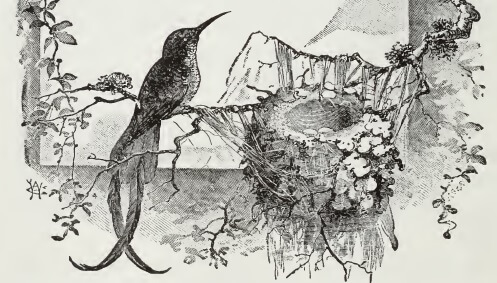
  1. The most beautiful hummingbirds are found in the West Indies and South America. The crest of the tiny head of one of these shines like a sparkling crown of colored light.
  2. The shades of color that adorn its breast, are equally brilliant. As the bird flits from one object to another, it looks more like a bright flash of sunlight than it does like a living being.
  3. But, you ask, why are they called hummingbirds? It is because they make a soft, humming noise by the rapid motion of their wings—a motion so rapid, that as they fly you can only see that they have wings.
  4. One day when walking in the woods, I found the nest of one of the smallest hummingbirds. It was about half the size of a very small hen’s egg, and was attached to a twig no thicker than a steel knitting needle.
  5. It seemed to have been made of cotton fibers, and was covered with the softest bits of leaf and bark. It had two eggs in it, quite white, and each about as large as a small sugarplum.
  6. When you approach the spot where one of these birds has built its nest, it is necessary to be careful. The mother bird will dart at you and try to peck your eyes. Its sharp beak may hurt your eyes most severely, and even destroy the sight.
  7. The poor little thing knows no other way of defending its young, and instinct teaches it that you might carry off its nest if you could find it.
McGuffey’s Third Eclectic Reader Lesson 20: A Moment Too Late

Words:

  • downy
  • firmly
  • staid
  • petals
  • crime

Lesson:

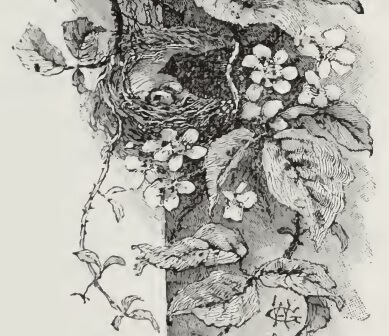
  1. A moment too late, my beautiful bird,

A moment too late are you now;

The wind has your soft, downy nest disturbed—

The nest that you hung on the bough.

  1. A moment too late; that string in your bill,

Would have fastened it firmly and strong;

But see, there it goes, rolling over the hill!

Oh, you staid a moment too long.

  1. A moment, one moment too late, busy bee;

The honey has dropped from the flower:

No use to creep under the petals and see;

It stood ready to drop for an hour.

  1. A moment too late; had you sped on your wing,

The honey would not have been gone;

Now you see what a very, a very sad thing

‘Tis to stay a moment too long.

  1. Little girl, never be a moment too late,

It will soon end in trouble or crime;

Better be an hour early, and stand and wait,

Than a moment behind the time.

  1. If the bird and the bee, little boy, were too late,

Remember, as you play along

On your way to school, with pencil and slate,

Never stay a moment too long.

McGuffey’s Third Eclectic Reader Lesson 19: The Birds Set Free

Words:

  • wires
  • trade
  • bargain
  • sadness
  • prisoners
  • war
  • French
  • apiece
  • number
  • resolved

Lesson:

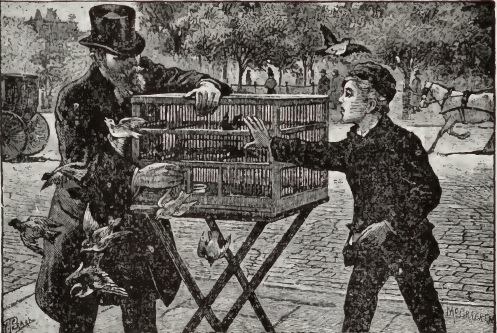
  1. A man was walking one day through a large city. On a street corner he saw a boy with a number of small birds for sale, in a cage.
  2. He looked with sadness upon the little prisoners flying about the cage, peeping through the wires, beating them with their wings, and trying to get out.
  3. He stood for some time looking at the birds. At last he said to the boy, ‘How much do you ask for your birds?’
  4. ‘Fifty cents apiece, sir,’ said the boy. ‘I do not mean how much apiece,’ said the man, ‘but how much for all of them? I want to buy them all.’
  5. The boy began to count, and found they came to five dollars. ‘There is your money,’ said the man. The boy took it, well pleased with his morning’s trade.
  6. No sooner was the bargain settled than the man opened the cage door, and let all the birds fly away.
  7. The boy, in great surprise, cried, ‘What did you do that for, sir? You have lost all your birds.’
  8. ‘I will tell you why I did it,’ said the man. ‘I was shut up three years in a French prison, as a prisoner of war, and I am resolved never to see anything in prison which I can make free.’

McGuffey’s Third Eclectic Reader Lesson 18: The Widow and the Merchant

Words:

  • died
  • woman
  • convinced
  • amazed
  • wrote
  • pity
  • mistake
  • rewarded
  • grateful
  • check
  • distress
  • hesitation
  • husband
  • musician
  • widow
  • assistance

Lesson:

  1. A merchant, who was very fond of music, was asked by a poor widow to give her some assistance. Her husband, who was a musician, had died, and left her very poor indeed.
  2. The merchant saw that the widow and her daughter, who was with her, were in great distress. He looked with pity into their pale faces, and was convinced by their conduct that their sad story was true.
  3. ‘How much do you want, my good woman?’ said the merchant.
  4. ‘Five dollars will save us,’ said the poor widow, with some hesitation.
  5. The merchant sat down at his desk, took a piece of paper, wrote a few lines on it, and gave it to the widow with the words, ‘Take it to the bank you see on the other side of the street.’
  6. The grateful widow and her daughter, without stopping to read the note, hastened to the bank. The banker at once counted out fifty dollars instead of five, and passed them to the widow.
  7. She was amazed when she saw so much money. ‘Sir, there is a mistake here,’ she said. ‘You have given me fifty dollars, and I asked for only five.’
  8. The banker looked at the note once more, and said, ‘The check calls for fifty dollars.’
  9. ‘It is a mistake—indeed it is,’ said the widow.
  10. The banker then asked her to wait a few minutes, while he went to see the merchant who gave her the note.
  11. ‘Yes.’ said the merchant, when he had heard the banker’s story, ‘I did make a mistake. I wrote fifty instead of five hundred. Give the poor widow five hundred dollars, for such honesty is poorly rewarded with even that sum.’

McGuffey’s Third Eclectic Reader Lesson 17: What the Minutes Say

Lesson:

  1. We are but minutes—little things!

Each one furnished with sixty wings,

With which we fly on our unseen track,

And not a minute ever comes back.

  1. We are but minutes; use us well,

For how we are used we must one day tell.

Who uses minutes, has hours to use;

Who loses minutes, whole years must lose.

McGuffey’s Third Eclectic Reader Lesson 16: Bird Friends

Words:

  • wife
  • greet
  • beard
  • worms
  • prayers
  • faith
  • grove
  • crusts
  • church
  • furnished

Lesson:

  1. I once knew a man who was rich in his love for birds, and in their love for him. He lived in the midst of a grove full of all kinds of trees. He had no wife or children in his home.
  2. He was an old man with gray beard, blue and kind eyes, and a voice that the birds loved; and this was the way he made them his friends.
  3. While he was at work with a rake on his nice walks in the grove, the birds came close to him to pick up the worms in the fresh earth he dug up. At first, they kept a rod or two from him, but they soon found he was a kind man, and would not hurt them, but liked to have them near him.
  4. They knew this by his kind eyes and voice, which tell what is in the heart. So, day by day their faith in his love grew in them.
  5. They came close to the rake. They would hop on top of it to be first at the worm. They would turn up their eyes into his when he spoke to them, as if they said, ‘He is a kind man; he loves us; we need not fear him.’
  6. All the birds of the grove were soon his fast friends. They were on the watch for him, and would fly down from the green tree tops to greet him with their chirp.
  7. When he had no work on the walks to do with his rake or his hoe, he took crusts of bread with him, and dropped the crumbs on the ground. Down they would dart on his head and feet to catch them as they fell from his hand.
  8. He showed me how they loved him. He put a crust of bread in his mouth, with one end of it out of his lips. Down they came like bees at a flower, and flew off with it crumb by crumb.
  9. When they thought he slept too long in the morning, they would fly in and sit on the bedpost, and call him up with their chirp.
  10. They went with him to church, and while he said his prayers and sang his hymns in it, they sat in the trees, and sang their praises to the same good God who cares for them as he does for us.
  11. Thus, the love and trust of birds were a joy to him all his life long; and such love and trust no boy or girl can fail to win with the same kind heart, voice, and eye that he had.

Adapted from Elihu Burritt.

McGuffey’s Third Eclectic Reader Lesson 15: Harry and Annie

Words:

  • least
  • thaw
  • sliding
  • plunged
  • naturedly
  • bade
  • scatter
  • pretend
  • exploring
  • disobedient

Lesson:

  1. Harry and Annie lived a mile from town, but they went there to school every day. It was a pleasant walk down the lane, and through the meadow by the pond.
  2. I hardly know whether they liked it better in summer or in winter. They used to pretend that they were travelers exploring a new country, and would scatter leaves on the road that they might find their way back again.
  3. When the ice was thick and firm, they went across the pond. But their mother did not like to have them do this unless someone was with them.
  4. ‘Don’t go across the pond today, children,’ she said, as she kissed them and bade them good-by one morning; ‘it is beginning to thaw.’
  5. ‘All right, mother,’ said Harry, not very good- naturedly, for he was very fond of running and sliding on the ice. When they came to the pond, the ice looked hard and safe.
  6. ‘There,’ said he to his sister, ‘I knew it hadn’t thawed any. Mother is always afraid we shall be drowned. Come along, we will have a good time sliding. The school bell will not ring for an hour at least.’
  7. ‘But you promised mother,’ said Annie.
  8. ‘No, I didn’t. I only said ‘All right,’ and it is all right.’
  9. ‘I didn’t say anything; so I can do as I like,’ said Annie.
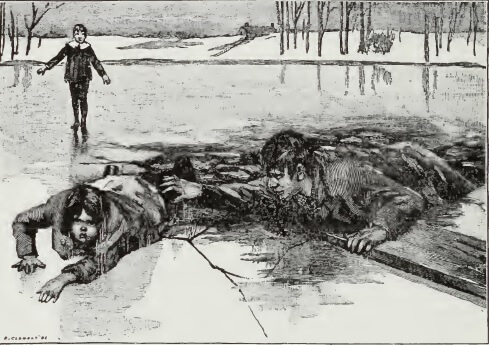
  10. So they stepped on the ice, and started to go across the pond. They had not gone far before the ice gave way, and they fell into the water.
  11. A man who was at work near the shore, heard the screams of the children, and plunged into the water to save them. Harry managed to get to the shore without any help, but poor Annie was nearly drowned before the man could reach her.
  12. Harry went home almost frozen, and told his mother how disobedient he had been. He remembered the lesson learned that day as long as he lived.

McGuffey’s Third Eclectic Reader Lesson 14: The Little Bird’s Song

Words:

  • melody
  • unnoticed
  • modest
  • content
  • Gracie

Lesson:

  1. A little bird, with feathers brown,

Sat singing on a tree;

The song was very soft and low,

But sweet as it could be.

  1. The people who were passing by,

Looked up to see the bird

That made the sweetest melody

That ever they had heard.

  1. But all the bright eyes looked in vain;

Birdie was very small,

And with his modest, dark-brown coat,

He made no show at all.

  1. ‘Why, father,’ little Gracie said

‘Where can the birdie be?

If I could sing a song like that,

I’d sit where folks could see.’

  1. ‘I hope my little girl will learn

A lesson from the bird,

And try to do what good she can,

Not to be seen or heard.

  1. ‘This birdie is content to sit

Unnoticed on the way,

And sweetly sing his Maker’s praise

From dawn to close of day.

  1. ‘So live, my child, all through your life,

That, be it short or long,

Though others may forget your looks,

They’ll not forget your song.’

McGuffey’s Third Eclectic Reader Lesson 13: The Wolf

Words:

  • wolf
  • grieved
  • sleeve
  • neighbors
  • earnest
  • axes
  • clubs
  • order
  • single
  • destroy

Lesson:

  1. A boy was once taking care of some sheep, not far from a forest. Nearby was a village, and he was told to call for help if there was any danger.
  2. One day, in order to have some fun, he cried out, with all his might, ‘The wolf is coming! the wolf is coming!’
  3. The men came running with clubs and axes to destroy the wolf. As they saw nothing they went home again, and left John laughing in his sleeve.
  4. As he had had so much fun this time, John cried out again, the next day, ‘The wolf! the wolf!’
  5. The men came again, but not so many as the first time. Again they saw no trace of the wolf; so they shook their heads, and went back.
  6. On the third day, the wolf came in earnest. John cried in dismay, ‘Help! help! the wolf! the wolf!’ But not a single man came to help him.
  7. The wolf broke into the flock, and killed a great many sheep. Among them was a beautiful lamb, which belonged to John.
  8. Then he felt very sorry that he had deceived his friends and neighbors, and grieved over the loss of his pet lamb.

The truth itself is not believed,

From one who often has deceived.

McGuffey’s Third Eclectic Reader Lesson 12: A Walk in the Garden

Words:

  • shook
  • gravel
  • invited
  • assure
  • continued
  • plants
  • borders
  • enjoyed
  • meddle
  • admiring

Lesson:

  1. Frank was one day walking with his mother, when they came to a pretty garden. Frank looked in, and saw that it had clean gravel walks, and beds of beautiful flowers all in bloom.
  2. He called to his mother, and said, ‘Mother, come and look at this pretty garden. I wish I might open the gate, and walk in.’
  3. The gardener, being near, heard what Frank said, and kindly invited him and his mother to come into the garden.
  4. Frank’s mother thanked the man. Turning to her son, she said, ‘Frank, if I take you to walk in this garden, you must take care not to meddle with anything in it.’
  5. Frank walked along the neat gravel paths, and looked at everything, but touched nothing that he saw.
  6. He did not tread on any of the borders, and was careful that his clothes should not brush the tops of the flowers, lest he might break them.
  7. The gardener was much pleased with Frank, because he was so careful not to do mischief. He showed him the seeds, and told him the name of many of the flowers and plants.
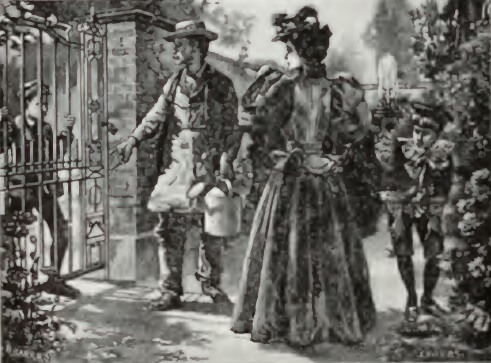
  8. While Frank was admiring the beauty of a flower, a boy came to the gate, and finding it locked, he shook it hard. But it would not open. Then he said, ‘Let me in; let me in; will you not let me in this garden?’
  9. ‘No, indeed,’ said the gardener, ‘I will not let you in, I assure you; for when I let you in yesterday, you meddled with my flowers, and pulled some of my rare fruit. I do not choose to let a boy into my garden who meddles with the plants.’
  10. The boy looked ashamed, and when he found that the gardener would not let him in, he went slowly away.
  11. Frank saw and felt how much happier a boy may be by not meddling with what does not belong to him.
  12. He and his mother then continued their walk in the garden, and enjoyed the day very much. Before they left, the gardener gave each of them some pretty flowers.