A place to grow your relationship with God

Posts tagged ‘Old Testament’

Jeremiah: The Weeping Prophet and His Message

Jeremiah


Jeremiah 1:5 “Before I formed you in the womb I knew you, Before you were born I sanctified you I ordained you a prophet to the nations.”

  • Author
    • Jeremiah the son of Hilkiah
    • Jeremiah was told not to marry or have children
      • Jeremiah 16:1-2 “The word of the LORD also came to me, saying. You shall not take a wife, nor shall you have sons or daughters in this place.”
    • Called the “Weeping Prophet
  • Date
    • 626-586 B.C.
    • Jeremiah’s ministry started during the reign of Josiah, King of Judah. He delivered prophecies throughout the reigns of Josiah, Jehoahaz, Jehoiakim, Jehoiachin, and Zedekiah, continuing his work even after the fall of Jerusalem.
  • Theme
    • Failure to repent will lead to destruction
      • Jeremiah 2:19 Your own wickedness will correct you, and your backslidings will rebuke you. Know therefore and see that it is an evil and bitter thing that you have forsaken the LORD your God, and the fear of Me is not in you,” Says the Lord GOD of hosts.
      • John 12:48 He who rejects Me, and does not receive My words, has that which judges him the word that I have spoken will judge him in the last day.
      • The book of Jeremiah has more words in it then any other book. It has at total word count of approximately 788,280.
  • Purpose
    • The book of Jeremiah is filled with warning, guidance, and hope. It warns of the coming destruction due to Judah’s refusal to repent, offers instructions to the Jewish people taken into Babylonian exile, and shares a hopeful message about the restoration of Jerusalem and the arrival of the Messiah.
  • Content
    • The call of Jeremiah: Jeremiah 1:1-19
      • Jeremiah 1:5-10 “Before I formed you in the womb I knew you, before you were born, I sanctified your I ordained you a prophet to the nations.” Then said I: “Ah, Lord GOD! Behold, I cannot speak, for I am a youth.” But the LORD said to me: “Do not say, ‘I am a youth,” For you shall go to all to whom I send you, and whatever I command you, you shall speak. Do not be afraid of their faces, For I am with you to deliver you,” says the LORD. Then the LORD put forth His hand and touched my mouth, and the LORD said to me “Behold, I have put My words in your mouth. See, I have this day set you over the nations and over the kingdoms, To root out and to pull down, To destroy and to throw down, To build and to plant.”
    • The condition of Judah: Jeremiah 2:1-6:30
      • Jeremiah 2:2-5 “Go and cry in the hearing of Jerusalem, saying. Thus says the LORD: I remember you, the kindness of your youth, The love of your betrothal When you went after Me in the wilderness, In a land not sown Israel was holiness to the LORD, The firstfruits of His increase. All that devour him will offend; Disaster will come upon them,” says the LORD. “Hear the word of the LORD, O house of Jacob and all the families of the house of Israel “Thus says the LORD: “What injustice have your fathers found in Me That they have gone far from Me, Have followed idols, And have become idolaters?
    • The temple, law, and covenant: Jeremiah 7:1-12:17
      • Jeremiah 7:2-3 Stand in the gate of the Lord’s house, and proclaim there this word, and say, Hear the word of the Lord, all ye of Judah, that enter in at these gates to worship the Lord. Thus saith the Lord of hosts, the God of Israel, Amend your ways and your doings, and I will cause you to dwell in this place.
      • Jeremiah 7:28 But thou shalt say unto them, This is a nation that obeyeth not the voice of the Lord their God, nor receiveth correction: truth is perished, and is cut off from their mouth.
    • Jeremiah 11:6-8 Then the Lord said unto me, Proclaim all these words in the cities of Judah, and in the streets of Jerusalem, saying, Hear ye the words of this covenant, and do them. For I earnestly protested unto your fathers in the day that I brought them up out of the land of Egypt, even unto this day, rising early and protesting, saying, Obey my voice. Yet they obeyed not, nor inclined their ear, but walked every one in the imagination of their evil heart: therefore I will bring upon them all the words of this covenant, which I commanded them to do: but they did them not.
      • imagination” or “Dictates” is how it is written in the New King James Version.
        • This word comes from שְׁרִירוּת shᵉrîyrûwth, sher-ee-rooth’; from H8324 in the sense of twisted, i.e. firm; obstinacy:—imagination, lust.
          • it means stubbornness, hardness, firmness
        • This word is found ten times in the Bible. Eight of the ten are in the book of Jeremiah referring to Israel’s refusal to respond to God’s warnings.
    • The certainty of captivity: Jeremiah 13:1-18:23
      • Jeremiah 13:19 The cities of the South shall be shut up, And no one shall open them, Judah shall be carried away captive, all of it; It shall be wholly carried away captive.
    • The confrontation of leaders: Jeremiah 19:1-28:17
      • Jeremiah 25:11-12  And this whole land shall be a desolation, and an astonishment; and these nations shall serve the king of Babylon seventy years. And it shall come to pass, when seventy years are accomplished, that I will punish the king of Babylon, and that nation, saith the Lord, for their iniquity, and the land of the Chaldeans, and will make it perpetual desolations.
    • The promise of restoration: Jeremiah 29:1-33-26
      • Jeremiah 29:10.11(NKJV) For thus says the LORD: After seventy years are completed at Babylon, I will visit you and perform My good word toward you, and cause you to return to this place “For I know the thoughts that I think toward you, says the LORD, thoughts of peace and not of evil, to give you a future and a hope.
    • The kingdom falls: Jeremiah 34:1-29:18
      • Jeremiah 39:1-2 In the ninth year of Zedekiah king of Judah, in the tenth month, Nebuchadnezzar king of Babylon and all his army came against Jerusalem, and besieged it. In the eleventh year of Zedekiah, in the fourth month, on the ninth day of the month, the city was penetrated
    • The trip to Egypt: Jeremiah 40:1-45:5
      • Jeremiah 42:10-17 If ye will still abide in this land, then will I build you, and not pull you down, and I will plant you, and not pluck you up: for I repent me of the evil that I have done unto you. Be not afraid of the king of Babylon, of whom ye are afraid; be not afraid of him, saith the Lord: for I am with you to save you, and to deliver you from his hand. And I will shew mercies unto you, that he may have mercy upon you, and cause you to return to your own land. But if ye say, We will not dwell in this land, neither obey the voice of the Lord your God, Saying, No; but we will go into the land of Egypt, where we shall see no war, nor hear the sound of the trumpet, nor have hunger of bread; and there will we dwell: And now therefore hear the word of the Lord, ye remnant of Judah; Thus saith the Lord of hosts, the God of Israel; If ye wholly set your faces to enter into Egypt, and go to sojourn there; Then it shall come to pass, that the sword, which ye feared, shall overtake you there in the land of Egypt, and the famine, whereof ye were afraid, shall follow close after you there in Egypt; and there ye shall die. So shall it be with all the men that set their faces to go into Egypt to sojourn there; they shall die by the sword, by the famine, and by the pestilence: and none of them shall remain or escape from the evil that I will bring upon them.
    • The word to foreign nations: Jeremiah 46:1-51:64
      • Judgment on
        • Egypt
        • Philistia
        • Moab
        • Ammon
        • Damascus
        • Babylon
    • The fall of Jerusalem reviewed: Jeremiah 52:1-34
      • Jeremiah 52:4-5  And it came to pass in the ninth year of his reign, in the tenth month, in the tenth day of the month, that Nebuchadrezzar king of Babylon came, he and all his army, against Jerusalem, and pitched against it, and built forts against it round about. So the city was besieged unto the eleventh year of king Zedekiah.
  • Christ in the Book of Jeremiah
    • The lifestyle of Jeremiah was similar to that of Jesus. Jeremiah is considered a type of Christ in the Old Testament.
      • Jeremiah was accused on political treason, so was Christ
      • Jeremiah was tried, persecuted, and imprisoned for the words he spoke
      • Jeremiah and Jesus both foretold the destruction of the temple in Jerusalem and their own people rejected them
      • Jeremiah wept with compassion over the people of Israel
        •  Luke 19:41-44 As He (Jesus) approached Jerusalem, He saw the city and wept over it [and the spiritual ignorance of its people], 42 saying, “If [only] you had known on this day [of salvation], even you, the things which make for peace [and on which peace depends]! But now they have been hidden from your eyes. 43 For a time [of siege] is coming when your enemies will put up a barricade [with pointed stakes] against you, and surround you [with armies] and hem you in on every side, 44 and they will level you to the ground, you [Jerusalem] and your children within you. They will not leave in you one stone on another, all because you did not [come progressively to] recognize [from observation and personal experience] the time of your visitation [when God was gracious toward you and offered you salvation].”
      • Jeremiah was mistreated yet chose to forgive

Understanding Isaiah: Judgment and Restoration Messages

Isaiah


Isaiah 53:5 But He was wounded for our transgressions, He was bruised for our iniquities; The chastisement for our peace was upon Him, And by His stripes we are healed.

  • Author
    • Isaiah 1:1 The vision of Isaiah the son of Amoz, which he saw concerning Judah and Jerusalem in the days of Uzziah, Jotham, Ahaz, and Hezekiah, kings of Judah.
    • Isaiah “Yahweh Is Salvation”
    • Isaiah was martyred during the reign of Manasseh. Most believed he was cut into.
  • Date
    • 700-690 B.C.
    • Isaiah prophesied during the reigns of Uzziah, Jotham, Ahaz, and Hezekiah, kings of Judah.
  • Theme
    • God’s Salvation
  • Purpose
    • To declare God’s displeasure with Judah, Israel, and surrounding nations due to their disobedience
      • Isaiah 1:2-4 Hear, O heavens, and give ear, O earth! For the LORD has spoken: “I have nourished and brought up children, And they have rebelled against Me; The ox knows its owner And the donkey its master’s crib; But Israel does not know, My people do not consider. Alas, sinful nation, A people laden with iniquity, A brood of evildoers, Children who are corrupters! They have forsaken the LORD, They have provoked to anger The Holy One of Israel, They have turned away backward.
    • A warning to God’s people and a call to repentance
      • Isaiah 1:19 If you are willing and obedient, You shall eat the good of the land;
    • A message of hope for the faithful remnant
      • Isaiah 37:31 And the remnant who have escaped of the house of Judah Shall again take root downward, And bear fruit upward.
        • Remnant is the people who would come back from Babylon.
  • Content
    • 2 Parts:
      • Chapters 1-39
        • God’s Judgment
      • Chapters 40-66
        • God’s Salvation and Restoration
    • Judgment and hope of restoration Isaiah 1:1-6:13
      • Isaiah 2:6 For You have forsaken Your people, the house of Jacob, Because they are filled with eastern ways; They are soothsayers like the Philistines, And they are pleased with the children of foreigners.
      • Isaiah 6:11-13 Then said I, Lord, how long? And he answered, Until the cities be wasted without inhabitant, and the houses without man, and the land be utterly desolate, And the Lord have removed men far away, and there be a great forsaking in the midst of the land. But yet in it shall be a tenth, and it shall return, and shall be eaten: as a teil tree, and as an oak, whose substance is in them, when they cast their leaves: so the holy seed shall be the substance thereof.
        • the tenth is the remnant and the one that didn’t leave.
        • they are few and heavily persecuted.
    • Trust in Assyria or God Isaiah 7:1-12:6
      • 2 Kings 16:7-8 So Ahaz sent messengers to Tiglath-Pileser king of Assyria, saying, “I am your servant and your son. Come up and save me from the hand of the king of Syria and from the hand of the king of Israel, who rise up against me. And Ahaz took the silver and gold that was found in the house of the LORD, and in the treasuries of the king’s house, and sent it as a present to the king of Assyria.
    • Prophecies about nations Isaiah 13:1-23:18
      • Prophecy concerning
        • Babylon
        • Assyria
        • Philistia
        • Moab
        • Syria
        • Israel
        • Ethiopia
        • Egypt
        • Edom
        • Arabia
        • Jerusalem
        • Tyre
    • Israel’s judgment and deliverance Isaiah 24:1-27:13
      • Isaiah 24:5-6 The earth is also defiled under its inhabitants, Because they have transgressed the laws, Changed the ordinance, Broken the everlasting covenant. Therefore the curse has devoured the earth, And those who dwell in it are desolate. Therefore the inhabitants of the earth are burned, And few men are left.
      • Isaiah 27:2-6 In that day sing to her, A vineyard of red wine! the LORD, keep it, I water it every moment; Lest any hurt it, I keep it night and day. Fury is not in Me. Who would set briers and thorns against Me in battle? I would go through them, I would burn them together. Or let him take hold of My strength That he may make peace with Me; And he shall make peace with Me. Those who come He shall cause to take root in Jacob; Israel shall blossom and bud, A fill the face of the world with fruit.
    • Warnings, judgment, and future glory Isaiah 28:1-35:10
      • Isaiah 31:1-5 Woe to those who go down to Egypt for help, And rely on horses, Who trust in chariots because they are many, And in horsemen because they are very strong. But who do Yet He also is wise and will bring disaster, And will not call back His words, But will arise not look to the Holy One of Israel, Nor seek the LORD! against the house of evildoers, And against the help of those who work iniquity. Now the Egyptians are men, and not God; And their horses are flesh, and not spirit When the LORD stretches out His hand, Both he who helps will fall, And he who is helped will fall down; They all will perish together. For thus the LORD has spoken to me: “As a lion roars, And a young lion over his prey (When a multitude of shepherds is summoned against him. He will not be afraid of their voice Nor be disturbed by their noise), So the LORD of hosts will come down To fight Like birds flying about, So will the LORD of hosts defend Jerusalem. Defending, He will also deliver it; Passing over, He will preserve it. for Mount Zion and for its hill.
    • King Hezekiah and Assyria Isaiah 36:1-39:8
      • Isaiah 38:5-6 Go and tell Hezekiah, ‘Thus says the LORD, the God of David your father: “I have heard your prayer, I have seen your tears; surely I will add to your days fifteen years. I will deliver you and this city from the hand of the king of Assyria, and I will defend this city.”
    • Promises of deliverance Isaiah 40:1-56:8
      • Isaiah 40:1-5 “Comfort, yes, comfort My people!” Says your God. Speak comfort to Jerusalem, and cry out to her, That her warfare is ended, That her iniquity is pardoned; For she has received from the LORD’S hand Double for all her sins.” The voice of one crying in the wilderness: “Prepare the way of the LORD; Make straight in the desert A highway for our God. Every valley shall be exalted And every mountain and hill brought low; The crooked places shall be made straight And the rough places smooth; The glory of the LORD shall be revealed, And all flesh shall see it together, For the mouth of the LORD has spoken.”
    • The future kingdom Isaiah 56:9-66:24
      • Isaiah 60:1 (NKJV) Arise, shine; For your light has come! And the glory of the LORD is risen upon you.
      • Isaiah 60:1(AMP) Arise [from the depression and prostration in which circumstances have kept you-rise to a new life]! Shine (be radiant with the glory or the Lord), for your light has come, and the glory of the Lord has risen upon you!
      • Isaiah 61:6-7 But you shall be named the priests of the LORD, They shall call you the servants of our God. You shall eat the riches of the Gentiles, And in their glory you shall boast. Instead of your shame you shall have double honor, And instead of confusion they shall rejoice in their portion. Therefore in their land they shall possess double; Everlasting joy shall be theirs.
  • Christ in the Book of Isaiah
    • The book of Isaiah contains more prophecies about the Messiah than any other Old Testament book. Seventeen chapters contain prophetic references to Christ.
    • Christ is spoken of:
      • The Lord
      • Branch of the Lord
      • Immanuel
      • Wonderful Counselor
      • Mighty God
      • Everlasting Father
      • Prince of Peace
      • Rod of Jesse
      • Cornerstone
      • King
      • Shepherd
      • Servant of Yahweh
      • Elect One
      • The Holy One of Isreal appears 25 times
      • Lamb of God
      • Leader and Commander
      • Redeemer
      • Anointed One
    • Isaiah Chapter 53
    • Isaiah Chapter 61

Understanding Noah’s Sons and the Tower of Babel

Before the tower of Babel, there was Noah.

Noah had three sons.
Shem, who is the father of the Israelites.

Ham the father of the Philistines.
Japheth, the father of the Gentiles.

Shem had 5 Sons , Japeth had 7sons, and their brother had 4 sons.

Sons of Ham

  • Cush
  • Mizraim
  • Phut
  • Canaan

Please see Genesis 10:6


Sons of Japeth

  • Gomer
  • Magog
  • Madai
  • Javan
  • Tubal
  • Meshech
  • Tiras
    please see Genesis 10:2-5

Sons of Shem

  • Elam
  • Asshur
  • Arphaxad
  • Lud
  • Aram

Please see Genesis 10:22


Son of Cush
1.Nimrod
There are more of Cush’s sons.

Please see Genesis 10:8

In Genesis 10:32 It says that “These are the families of the sons of Noah, after their generations, in their nations: and by these were the nations divided in the earth after the flood.”

After the flood, Noah Sons had children, who built the tower of Babel. From the Mountain of Ararat where the ark landed, Noah came out. Later, they moved east into the valley of Mesopotamia and there they lived on plain in the land Shinar.


Shinar Soil was the best that was available to make bricks to build with.
So the people after Noah stated building the tower of Babel.

The people were thinking more about their own work and less about God who gives them their strength.

The tower  of  Babel
Babel: Bay – buhl

Verses
The Story is in Genesis 11:1-9
Genesis 10 :10

  1. Babel is the name given to the city that did not obey God and Scatter over the earth. But they stay in one place. The word Babel, which means Confusion because God confusion their tongues
  2. The higher they built the prouder they were of their tower. But suddenly their language was confused, and everybody had to stop building. They Scatted in all directions.”
  3. To people, the tower is a skyscraper, but for God, it is so small that he came down from heaven to catch a glimpse of the people’s effort.

The history of words

  1. Babel derives ultimately from an Akkadian word that means gateway to God.
  2. Another word is Similiar. The Hebrew word Balal that means confused
  3. They wanted to go to heaven to talk to the gods, So God had to confuse them.

How they built the tower

  1. The tower was constructed of brick because there was no stone in Southern Mesopotamia.
  2. The one built at Ur in Southern Mesopotamia in about 2100 B.C was a pyramid of three terraces. Consisting of a temple
  3. Today in the Middle East people still make bricks in the same way they would have done to build the tower of Babel. They use wet mud that they shape in a wooden frame. Then it is pressed out and left in the sun to bake.


How did it look like?

A ziggurat dating to the Babylonian period (605-550 BC)

The tower of Babel may have looked like a type of temple called a ziggurat. They were a pyramid-shaped, and some may have been over 300 feet high. They had the steps on the outer side and a temple at the top.

Where is it?

  1. People have built Ziggurat towers from the earliest times. These towers were built by people as temples. Now days people have found ruins all over ancient Mesopotamia which is in modern-day Iraq.
  2. The traditional site of the tower of Babel was Babylon, one of the chief cities founded by Nimrod son of Cush son of Ham Son of Noah.


Why was It Built

It was built because of human pride and rebellion. It was built during the period after the flood.
The account moves from a description of the Sin to a time of punishment. God had to stop mankind
from getting more power for themselves, and going beyond the limits.

God’s confusing of the builders’ Languages and His scattering of them throughout the Earth
can be read in Genesis 11:9.

THE FINDING OF MOSES

THE FINDING OF MOSES

Pharoah, becoming alarmed at the increasing power and numbers of the Israelites in Egypt, ordered that every male child who might be born to them should be cast into the river, and drowned. But the wife of a man named Levi felt that she could not give up her babe, and for three months she hid him. When she could hide him no longer, she prepared a basket of rushes, and coated it with pitch, so that it would float upon the river and keep out the water. In this ark she placed her infant son, and hid the ark among the flags and bulrushes on the river-bank, and set the child’s sister to watch it.

Now it happened that the daughter of Pharaoh came with her maidens to bathe in the river; and when she saw the basket she sent one of her maids to fetch it. And when she looked at the child he wept, and she had compassion for him, and said, “This is one of the Hebrews’ children.” Then the child’s sister came forward and said to Pharaoh’s daughter, “Shall I call to thee a Hebrew woman that she may nurse the child for thee?” And when the princess said, “Go!” she, the maid, went and called her own mother, to whom Pharaoh’s daughter said, “Take this child and nurse him for me, and I will give thee thy wages.” And the woman took the child and nursed him. And when he had grown, his mother took him to the princess, who adopted him as her son, and called his name Moses, which means drawn out, because she took him from the water. Afterwards he grew to be a great man: he was learned in all the wisdom of the Egyptians; and we are told, “he was mighty in words and deeds.”

The Finding of Moses

Joseph and His Brethren

JOSEPH AND HIS BRETHREN

How wonderful is the way in which God works for those who fear Him! The history of Joseph teaches us this truth.

Joseph had one younger and ten elder brothers. The name of the younger brother was Benjamin. Jacob was the father of them all; and Rachel was the mother of Joseph and Benjamin. Jacob loved Joseph more than all his other sons, and made him a coat of many colours; but his elder brothers hated him, and one day, when far away from home, proposed to kill him. They cast him into a pit instead, and afterwards sold him as a slave to some merchants who were travelling from Gilead to Egypt. When they returned to their father, they took Joseph’s coat of many colours, which they had dipped in blood, and brought it to Jacob, saying: “This have we found: know now if it be thy son’s coat or no.” Jacob knew the coat; and thought Joseph had been killed by some wild beast, and mourned for him greatly.

The merchants carried Joseph into Egypt, and sold him to one of the king’s officers, named Potiphar. But, though a slave, he was not forsaken by God. No, God was with him, and made all that he did to prosper. His master placed him over all his house, but his mistress wanted him to commit a great sin. When he refused, she accused him unjustly to his master, and Potiphar had him cast into prison.

God was with Joseph in the prison, and gave him such favour with the keeper that he set him over all the other prisoners. Among them were two; one who had been the king’s butler, and the other his baker. Both had dreams which troubled them much, but Joseph was enabled by God to interpret their dreams for them. By-and-by Pharaoh, the king, dreamed a dream. He was standing on the banks of a river, and saw seven fat cows come up out of the water and feed in a meadow; afterwards seven very lean cows came up and devoured the fat ones. Then Pharaoh awoke; but he dreamed again, and saw that seven very poor ears of corn devoured seven that were full and good. In the morning he was greatly troubled. What could the dreams mean? He called for the magicians and the wise men, but they could not tell. At last it was told him how Joseph had interpreted the dreams in the prison; so he sent for Joseph, who came from the prison, and stood before the king.

Pharaoh said, “I have dreamed a dream, and there is none that can interpret it; and I have heard say of thee, that thou canst understand a dream to interpret it.” Joseph answered, “It is not in me: God shall give Pharaoh an answer of peace.” Then Joseph told Pharaoh that the dreams had been sent by God, to show him that after seven years of great plenty had passed there would come seven years of famine. He also advised Pharaoh to lay up corn in cities during the years of plenty, so that the people might be fed during the years of famine. Pharaoh saw what great wisdom God had given Joseph, and made him ruler over all the land of Egypt. The corn was stored up; and after the years of plenty the famine came.

JOSEPH BEFORE THE PHAROAH

During all this time Jacob and his sons had been dwelling in Canaan; where, through the famine, they were now in want of food. So Jacob sent his sons to Egypt to buy corn. The Bible tells us, in the book of Genesis, how they came to Egypt, and all that befell them there; and how at last Joseph, the ruler of the mighty kingdom, made himself known to them as the brother they had cruelly sold for a slave. But he forgave them, and sent to fetch his father Jacob, saying that all were to come into Egypt, where he would provide for them.

Jacob could not at first believe the good news his sons brought; but when he saw the waggons which Joseph had sent to carry him and the little ones, he said, “It is enough; Joseph my son is yet alive; I will go and see him before I die.” So he journeyed to Egypt, with his sons, and all that he had; and as he drew near Joseph went to meet him. When Joseph met his father, he fell on his neck, and wept there. And Jacob said, “Now let me die, since I have seen thy face, because thou art yet alive.” He was so full of joy that it seemed to him there was nothing else worth living for. Afterwards Joseph presented his father to Pharaoh; and Jacob blessed Pharaoh; who allowed him and his family to dwell in the land of Goshen.

JACOB PRESENTED TO PHARAOH

The Story of Rebekah

THE STORY OF REBEKAH

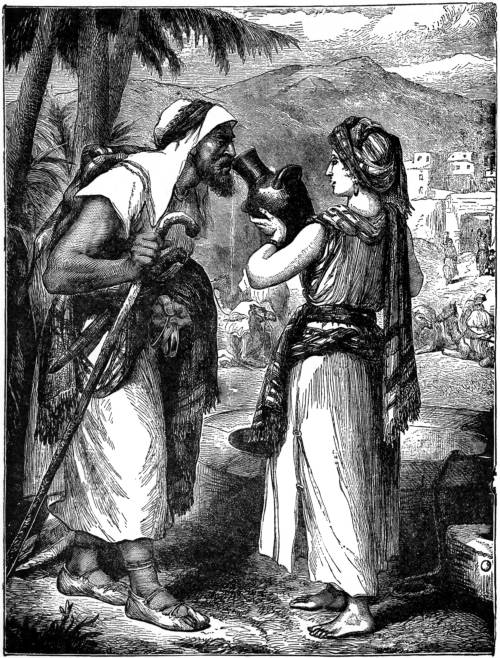
When Abraham had grown old, he desired that his son, Isaac, should take a wife. But he did not wish him to choose one from among the women of Canaan, for they worshipped idols. So he called his oldest servant, and commanded him to make a journey to Abraham’s own country, and there to choose a wife for Isaac. Then the man took ten camels, together with food and other goods for the journey, and set out for the city of Nahor. When he came to the walls of the city he spied a well, and, as it was evening, the young women were coming out to draw water. Then he asked God to help him to choose a wife for Isaac, saying, “Let it come to pass, that the damsel to whom I shall say, ‘Let down thy pitcher, I pray thee, that I may drink,’ and who shall reply, ‘Drink, and I will give thy camels drink also;’ let her be the one Thou hast chosen for Thy servant Isaac.”

REBEKAH GIVING DRINK TO ABRAHAM’S SERVANT

Before he had done speaking, there came out a beautiful young woman, whose name was Rebekah. She was the grand-daughter of Nahor, Abraham’s brother. She carried a pitcher upon her shoulder, and went down to the well and filled it. Then Abraham’s servant ran to her and asked her for a drink from her pitcher. She said, “Drink, my lord,” and held the pitcher for him, and afterwards drew water for his camels also. Then he took a golden jewel and a pair of gold bracelets, and put them upon her, and asked whose daughter she was, and if her father could lodge him and his company. When she told him who she was, he was glad, and worshipped God, for he was sure then that he had been led to the house of Abraham’s brother.

Then Rebekah called out her friends, and they took the man in to lodge him for the night, and set food before him. But he would not eat until he had told them his errand, and how he believed God had chosen Rebekah for Isaac’s wife. He then asked the parents to say whether they would give their daughter or not, but they said: “It has been ordered by God; we cannot give or refuse her. Rebekah is before you. Take her and go. Let her be Isaac’s wife, as the Lord hath spoken.”

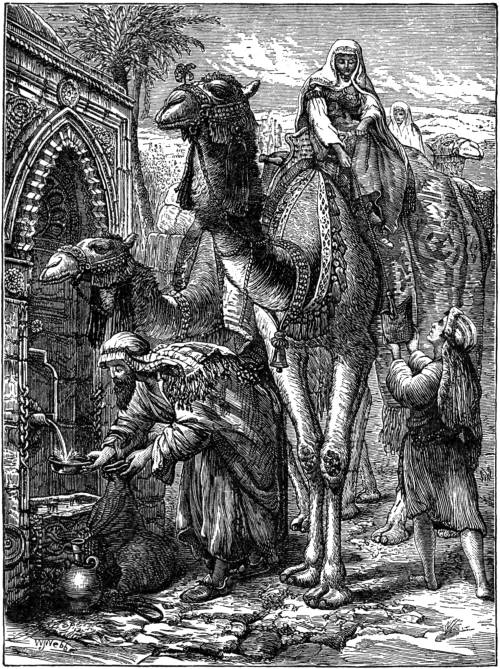
When the man heard these words, he again praised God, and then he brought out rich clothing, and jewels of gold and silver, and gave them to Rebekah. He also gave presents to her mother and brother. When they asked Rebekah if she would go with the man, she said “Yes,” and took leave of her friends, who blessed her. Then, with her nurse and her maids, she rode upon the camels, and followed the man, for she believed that so God had ordered it.

Isaac dwelt by the well Lahai-roi, and one evening he walked into the fields to meditate. As he lifted up his eyes he saw the company of camels coming towards him. At the same time, Rebekah lifted up her eyes and saw Isaac. When the man told her it was his master Isaac, she alighted from the camel, and covered her face with a veil, according to the custom of the East. When the man told Isaac all he had done, Isaac was pleased, and welcomed Rebekah, and gave her the tent that had been his mother’s. And she became his wife.

REBEKAH JOURNEYING TO ISAAC

The Meaning Behind Ecclesiastes: Wisdom for Life

Ecclesiastes means Preacher or Teacher


Ecclesiastes 12:13(NKJV) Let us hear the conclusion of the whole matter: Fear God and keep His commandments, For this is man’s all.

  • Author: Solomon in his later years
  • Date: Approximately 931 B.C.
  • Themes:
    • The pursuit of truth and the true meaning of life.
    • An understanding that everything under the sun is meaningless apart from God
  • Purpose
    • The title of this book in the Hebrew Old Testament is Teacher or Preacher.
    • The Greek word for this book means speaker or one called out.
    • Solomon wrote this book after a lifetime of seeking things of this world to bring meaning and satisfaction of life. He writes this to spare future generations the bitterness of learning through their own experience that life is meaningless without God.
  • Content
    • Life without meaning: Ecclesiastes 1:1-11
      • Ecclesiastes 1:2-4: “Vanity of vanities,” says the Preacher, “Vanity of vanities, all is vanity.” What profit has a man from all his labor in which he toils under the sun? “One generation passes away, and another generation comes; but the earth abides forever.
    • The limits of Man’s wisdom: Ecclesiastes 1:12-2:25
      • Ecclesiastes 2:16 For there is no more remembrance of the wise than of the fool forever, Since all that now is will be forgotten in the days to come And how does a wise man die? As the fool!
    • A time for everything: Ecclesiastes 3:1-22
      • Ecclesiastes 3:1-8 To everything there is a season, A time for every purpose under heaven: time to be born, And a time to die, A time to plant, And a time to pluck what is planted, A time to kill, And a time to heal, A time to break down, And a time to build up, A time to weep, And a time to laugh, A time to mourn, And a time to dance, time to cast away stones, And a time to gather stones; A time to embrace, And a time to refrain from embracing; A time to gain, And a time to lose, A time to keep, And a time to throw away. A time to tear, And a time to sew, A time to keep silence, And a time to speak, A time to love, And a time to hate; A time of war, And a time of peace.
    • Disappointments and contentment: Ecclesiastes 4:1-5:20
      • Ecclesiastes 4:9-12 Two are better than one, Because they have a good reward for their labor. Or if they fall, one will lift up his companion. But woe to him who is alone when he falls, For he has no one to help him up. Again, if two lie down together, they will keep warm; But how can one be warm alone? Though one may be overpowered by another, two can withstand him. And a threefold cord is not quickly broken.
    • Satisfaction in this life is limited: Ecclesiastes 6:1-8:17
      • Ecclesiastes 7:29 Truly, this only I have found: That God made man upright, But they have sought out many schemes.”
    • Life balanced with wisdom: Ecclesiastes 9:1-10:20
      • Ecclesiastes 9:10 Whatever your hand finds to do, do it with your might, for there is no work or device or knowledge or wisdom in the grave where you are going
    • True wisdom in fearing the Lord: Ecclesiastes 11:1-12:14
      • Ecclesiastes 12:13 Let us hear the conclusion of the whole matter: Fear God and keep His commandments. For this is man’s all
  • Christ in the book of Ecclesiastes
    • The principles of life as paralleled in Matthew 6:25-34
    • Matthew 6:33 But seek first the kingdom of God and His righteousness, and all these things shall be added to you.

Lot’s Flight from Sodom

LOT’S FLIGHT FROM SODOM

In Palestine, the land in which Jesus dwelt when He was upon earth, there is an inland sea, called the Dead Sea. Its waters are very salt, and no trees grow upon its shores. Many long years before the birth of Jesus Christ, two cities stood upon the plain which the waters of the Dead Sea now cover. These cities were named Sodom and Gomorrah. Their inhabitants were very wicked, so God destroyed their cities by raining brimstone and fire upon them.

Before God destroyed these cities, He sent two angels to Lot, Abraham’s nephew, who dwelt in Sodom, commanding him to flee from it, taking his family with him. The angels hastened him, saying, “Arise, take thy wife, and thy two daughters, which are here; lest thou be consumed in the iniquity of the city.” Then the angels took all four by the hand and led them out, and said to Lot, “Escape for thy life; look not behind thee, neither stay thou in all the plain; escape to the mountain, lest thou be consumed.”

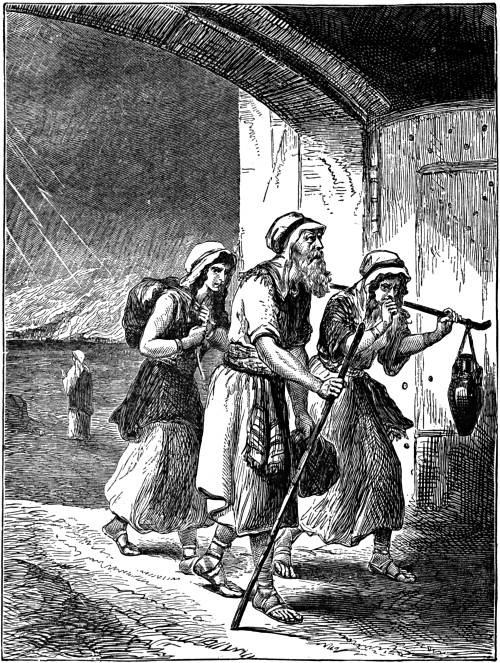
Lot pleaded that he might take refuge in a little city, named Zoar, not very far distant; and having obtained the angels’ permission to do so, he took his wife and daughters, and hastened away. In our picture we see him and his daughters entering Zoar, and Sodom burning in the distance—but what is that strange figure standing on the plain? Alas! that is Lot’s wife; the angel had commanded them that none were to look back, but she did so, and was turned into a pillar of salt.

Lot did wrong in dwelling in such a wicked city as Sodom, and lost all his property when he escaped for his life.

LOT ENTERING ZOAR.

Abraham and Isaac

ABRAHAM AND ISAAC

Abraham feared God and obeyed His commandments; and God promised to bless Abraham very greatly. He gave him riches in cattle, and silver, and gold; and said that the land of Canaan should belong to him and his descendants. God also gave him a son in his old age, whom he loved, very dearly and named Isaac. But God intended to try Abraham, to see if he loved Him above all else.

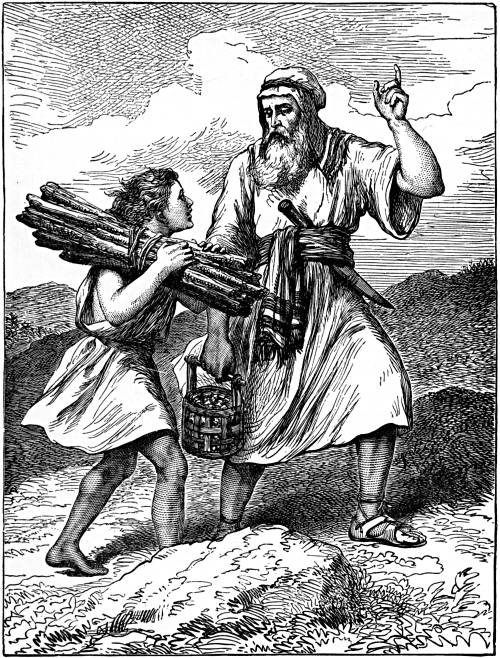
One day God told Abraham to take his son Isaac, and to journey into the land of Moriah; there to build an altar and offer Isaac as a sacrifice upon it. It was a strange command, but Abraham knew that God would not bid him do what was wrong, and believed that even if he slew his son, God was able to raise him to life again. So he rose early in the morning, saddled his ass, took two of his young men, and wood for the fire; and then, accompanied by Isaac, started on his journey. On the third day they came near the place God had pointed out, and Abraham left the young men with the ass, while he and his son journeyed up the mountain alone. As they went along, Isaac—who carried the wood, while his father carried the knife and the fire, said: “My father.” And Abraham replied, “Here am I, my son.” Then Isaac said: “Behold the fire and the wood: but where is the lamb for a burnt offering?” Abraham answered: “My son, God will provide Himself a lamb for a burnt offering.”

The altar was built, Isaac was bound and laid upon it, and Abraham’s arm was uplifted to strike the blow that was to take his son’s life away. Then God called to Abraham, “Lay not thine hand upon the lad, neither do thou anything unto him; for now I know that thou fearest God, seeing that thou hast not withheld thy son, thine only son from Me.” Abraham looked up, and behind him saw a ram which was caught in a thicket by its horns; this he took and offered as a sacrifice to God.

So God tried Abraham; and also Himself provided the lamb for the burnt offering, as Abraham had said.

ABRAHAM AND ISAAC

MOTHER STORIES From the Old Testament

MOTHER STORIES

FROM THE OLD TESTAMENT

A Book of the Best Stories from the Old Testament That Mothers Can Tell Their Children