A place to grow your relationship with God

Posts tagged ‘Old Testament’

The Tower of Babel

THE TOWER OF BABEL

Babel means confusion. Was it not a strange name to give a tower? How did it get this?

After Noah left the ark, God made a promise to him that He would no more destroy the earth by a flood, and blessed him and his sons. In course of time many little children were born, baby boys and girls, who grew up to be fathers and mothers having children also. In this manner a great many people dwelt again on the earth. For more than one hundred years they all spoke the same language, and as, in course of time, they journeyed onward, they came to a large plain in the land of Shinar, near to where Babylon was afterwards built. Here they said they would remain and build a great city, with a high tower ascending to heaven.

Now God, when he blessed Noah, had said to him, “Be fruitful, and multiply, and replenish the earth;” meaning that the people were to scatter abroad, so that the world might become inhabited again. But these men wanted to keep together, and found one great empire, the centre of which should be the great city with the lofty tower. So they made bricks and burnt them, and took a kind of pitch for mortar, and began to build. Some learned men say they took three years in getting the materials, and were twenty-two years building the tower. It was very great and high, but it was never finished. The people did wickedly in building it, and God, who saw all they were doing, confounded their language, so that one could not understand another. Thus they left off building the tower, and that is why it is called Babel. Then God scattered them abroad to re-people the earth.
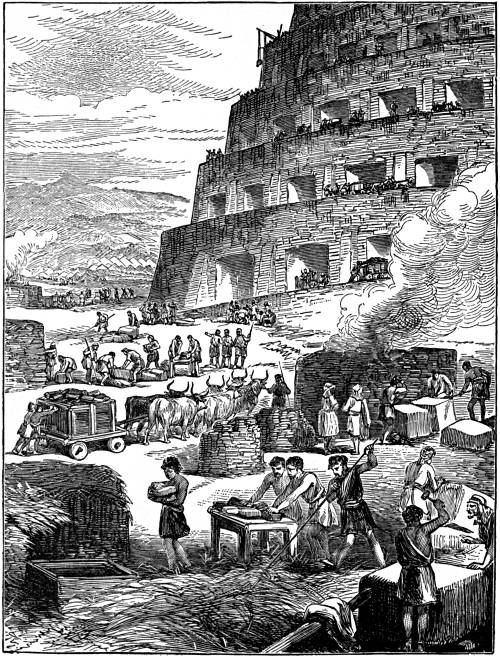
BUILDING THE TOWER OF BABEL

The Flood

THE FLOOD

About fifteen hundred years had passed since Cain slew Abel, during which time man had become more and more wicked. At length God saw “that the wickedness of man was great in the earth, and that every imagination of the thoughts of his heart was only evil continually.” Then God said, “I will destroy man whom I have created from the face of the earth.”

But one man was righteous and served God. His name was Noah. God told him that the world would be drowned by a flood because of the wickedness of the people, and commanded him to build a great ark to float upon the waters. In this ark God promised to preserve alive Noah and his family; and also two of each of every living thing on the earth—animals, birds, and creeping things. All the rest were to die.

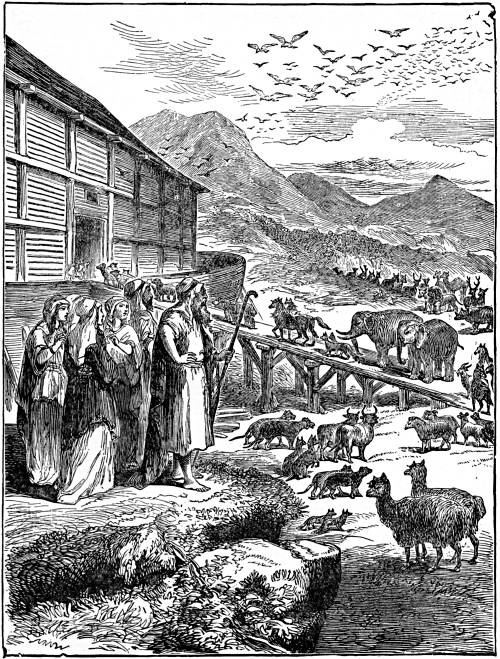
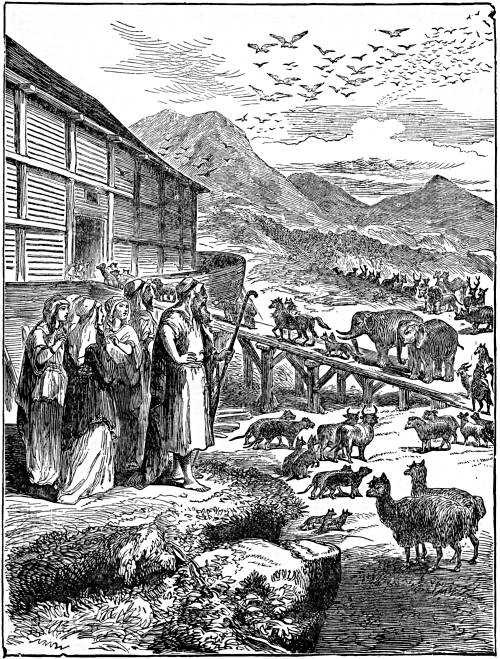
Noah built the ark as God commanded. It took him a great many years, during which time the people were warned to forsake their sins and turn to God, but they did not do so. At last the ark was finished, and Noah, with his wife, and his sons with their wives, and the animals, birds, and creeping things, as God had commanded, all entered into it. What a long procession it must have been! Then God shut them in, and they dwelt in safety while the rain came down, and the waters rose up and covered the earth. All were drowned except those in the ark.

A year afterwards, when the waters were dried up, Noah, and all that had been with him, left the ark. Then Noah built an altar, and offered sacrifices to God, in thankfulness for God’s goodness to him and his family.

ENTERING THE ARK

Cain and Abel

CAIN AND ABEL

What a sad story the Bible tells us in the fourth chapter of Genesis! Cain and Abel were brothers, the sons of Adam and Eve. How they should have loved each other! Yet we find that Cain killed Abel. Why did he do this?

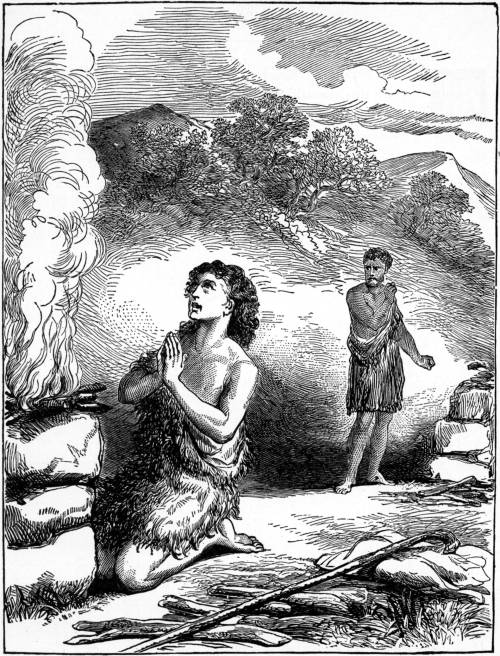
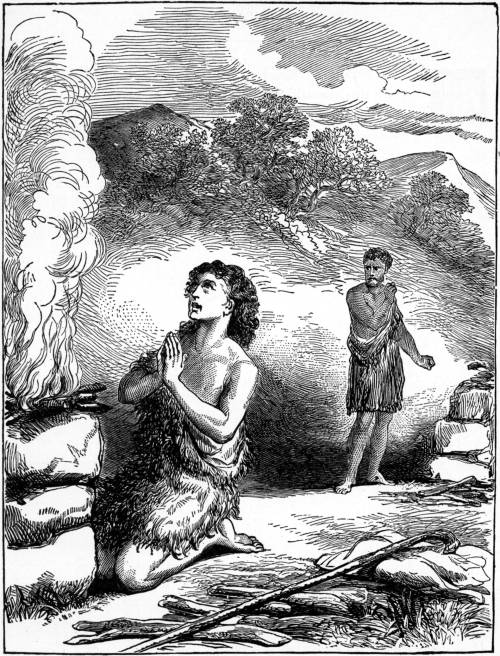
Cain was a husbandman, who tilled the ground; Abel was a shepherd, who kept sheep. One day each offered a sacrifice to God. Cain brought fruit, and Abel brought a lamb. God accepted Abel’s offering, but not Cain’s. Why? Well, I am not quite sure, but I think it was because Abel offered his sacrifice according as God had commanded, and had faith in a promised Saviour; but Cain simply acknowledged God’s goodness in giving him the fruits of the earth. God had probably told them, too, that when they came to worship Him, they were to bring a lamb or a kid as a sacrifice for their sins; this Abel had done, but Cain had not. Cain was angry because God had accepted Abel’s offering and not his; and he hated his brother Abel.

God knew the evil thought Cain had towards his brother, and asked him, “Why art thou wroth?” and said, “If thou doest well, shalt thou not be accepted?” But Cain did still more wickedly. When out in the field he killed his brother. Was it not a cruel deed? They were alone when this murder was committed, yet one eye saw it all. God saw it, and said to Cain: “Where is Abel, thy brother?” We cannot sin without God knowing it! Cain told God a lie. He answered, “I know not.” But he did know. God was angry with Cain for his sin, and sent him as a fugitive and vagabond to wander on the earth.

ABEL’S SACRIFICE.

Adam and Eve

ADAM AND EVE

In the beginning God made the heaven and the earth He also made the sun, moon, and stars; trees, flowers, and all vegetable life; and all animals, birds, fishes, and insects. Then God made man. The name of the first man was Adam, and the first woman was Eve. Both were placed in a beautiful garden called the Garden of Eden, where they might have been happy continually had they not sinned. But God forbade them to eat of the fruit of the tree of the knowledge of good and evil. Satan tempted Eve to take the fruit of this tree. She ate, and gave to Adam, and he ate also. Thus they sinned, and sin came into the world.

Then God called to Adam and said, “Where art thou?” Before this, Adam and Eve had been happy when God was near, now they were afraid. Why? Because they knew they had done wrong. So sin makes us afraid of God.

God rebuked them for the evil they had done; and then drove them out of the Garden of Eden, placing an angel to keep watch over the gate so that they could not return.

MOTHER STORIES From the Old Testament

(This post is being modified)
November 30, -0001, 12:00 am 0 boosts 0 favorites

Exploring the Book of Esther: Themes and Historical Context

Esther: The last of the Books of History


Esther 4:14
For if you remain completely silent at this time, relief and deliverance will arise for the Jews from another place, but you and your father’s house will perish. Yet who knows whether you have come to the kingdom for such a time as this?”


Author:

  • The author is unknown but was written by a Jew familiar with Persian customs.
  • Possibly written by Mordecai or Ezra.


Date:

  • Shortly after 465 B.C.
  • At this time a number of Jews were still in Babylon under Persian rule.
  • They had been freed to return to Jerusalem for over fifty years.


Theme:

  • God’s favor toward His people as they face opposition


Purpose:

  • Although the name of God is not mentioned in the book of Esther, this book demonstrates God’s sovereignty and loving care for His people.
  • No matter what the plan of the enemy is God’s plan is greater and always ensures His people victory.


Content:

  • Esther made Queen: Esther 1:1-2:23
    • Esther 2:4 Then let the young woman who pleases the king be queen instead of Vashti. This thing pleased the king, and he did so.
      • Esther 2:17 Now the king was attracted to Esther more than to any of the other women, and she won his favor and approval more than any of the other virgins. So he set a royal crown on her head and made her queen instead of Vashti.
  • Haman’s Plot to Destroy the Jews: Esther 3:1-5:14
    • Esther 3:2 Then the royal officials at the king’s gate asked Mordecai, “Why do you disobey the king’s command?”
    • Esther 3:5-6 When Haman saw that Mordecai would not kneel down or pay him honor, he was enraged.  Yet having learned who Mordecai’s people were, he scorned the idea of killing only Mordecai. Instead Haman looked for a way to destroy all Mordecai’s people, the Jews, throughout the whole kingdom of Xerxes.
    • Esther 3:8-10 Then Haman said to King Xerxes, “There is a certain people dispersed among the peoples in all the provinces of your kingdom who keep themselves separate. Their customs are different from those of all other people, and they do not obey the king’s laws; it is not in the king’s best interest to tolerate them. If it pleases the king, let a decree be issued to destroy them, and I will give ten thousand talents of silver to the king’s administrators for the royal treasury.” So the king took his signet ring from his finger and gave it to Haman son of Hammedatha, the Agagite, the enemy of the Jews.
    • Esther 5:14 His wife Zeresh and all his friends said to him, “Have a pole set up, reaching to a height of fifty cubits, and ask the king in the morning to have Mordecai impaled on it. Then go with the king to the banquet and enjoy yourself.” This suggestion delighted Haman, and he had the pole set up.
  • Victory for the Jews: Esther 6:1-10:3
    • Esther 6:13 “Haman” …told Zeresh his wife and all his friends everything that had happened to him. His advisers and his wife Zeresh said to him, “Since Mordecai, before whom your downfall has started, is of Jewish origin, you cannot stand against him—you will surely come to ruin!” 
    • Esther 7:3-6 Then Queen Esther answered, “If I have found favor with you, Your Majesty, and if it pleases you, grant me my life—this is my petition. And spare my people—this is my request. For I and my people have been sold to be destroyed, killed and annihilated. If we had merely been sold as male and female slaves, I would have kept quiet, because no such distress would justify disturbing the king.” King Xerxes asked Queen Esther, “Who is he? Where is he—the man who has dared to do such a thing?” Esther said, “An adversary and enemy! This vile Haman!” Then Haman was terrified before the king and queen. 
    • Esther 7:10 So they hanged Haman on the gallows that he had prepared for Mordecal. Then the king’s wrath subsided.
    • Esther 9:1 Now in the twelfth month, that is, the month of Adar, on the thirteenth day, the time came for the king’s command and his decree to be executed. On the day that the enemies of the Jews had hoped to overpower them, the opposite occurred, in that the Jews themselves overpowered those who hated them.
    • Esther 9:20-22 And Mordecal wrote these things and sent letters to all the Jews, near and far, who were in all the provinces of King Ahasuerus, to establish among them that they should celebrate yearly the fourteenth and fifteenth days of the month of Adar, as the days on which the Jews had rest from their enemies, as the month which was turned from sorrow to joy for them, and from mourning to a holiday; that they should make them days of feasting and joy, of sending presents to one another and gifts to the poor.
    • Esther 10:3 For Mordecal the Jew as second to King Ahasuerus, and was great among the Jews and well received by the multitude of his brethren, seeking the good of his people and speaking peace to all his countrymen.

Christ in the Book of Esther

  • Esther as a type of Christ
    • Willing to risk her life for the lives of her people
    • Interceding for the Jewish people
  • Esther as a type of the Church
    • Esther 2:17 The king loved Esther more than all the other women, and she obtained favor in his sight more than all the virgins; so he set the royal crown upon her made her queen instead of Vashti.
    • Ephesians 5:22 Husbands, love your wives, just as Christ loved the church and gave himself up for her.

Ezra’s Journey: Rebuilding the Temple in Jerusalem


Ezra 1:5
Then the heads of the fathers’ houses of Judah and Benjamin, and the priests and the Levites, with all whose spirits God had moved, arose to go up and build the house of the LORD which is in Jerusalem.

  • Author
    • Ezra (the Lord has helped) the priest who led the second of three groups
      returning from Babylon to Jerusalem
    • It is also believed that Ezra wrote 1 & 2 Chronicles, Nehemiah, (Psalm 119)
  • Date
    • 538-457 B.C.
  • Theme
    • Exiles returning to Jerusalem and the rebuilding of the temple
      • Jeremiah 29:10 For thus says the LORD: After seventy years are completed at Babylon, I will visit you and perform My good word toward you, and cause you to return to this place.
      • Jeremiah 29:11 (NKJV) For I know the thoughts that I think toward you, says the LORD, thoughts of peace and not of evil, to give you a future and a hope.
      • Jeremiah 29:11 (NIV) For I know the plans I have for you,” declares the LORD, “plans to prosper you and not to harm you, plans to give you hope and a future.
  • Purpose
    • The book of Ezra describes the efforts of the exiles returning to Jerusalem to rebuild the temple. Jeshua is the high priest and Zerubbabel is the governor. Ezra returned to teach the law to the people in Jerusalem.
      • Ezra 7:10(NKJV) For Ezra had prepared his heart to seek the Law of the LORD, and to do it, and to teach statutes and ordinances in Israel.
    • The book of Ezra shows God’s faithfulness to His word. Ezra like the book of Daniel is partly written in Aramaic
  • Content
    • The first exiles return to the land of Judah (Ezra 1:1-2:70)
      • Ezra 1:5(NKJV) Then the heads of the fathers’ houses of Judah and Benjamin, and the priests and the Levites, with all whose spirits God had moved, arose to go up and build the house of the LORD which is in Jerusalem.
      • Ezra 2:1(NKJV) Now these are the people of the province who came back from the captivity, of those who had been carried away, whom Nebuchadnezzar the king of Babylon had carried away to Babylon, and who returned to Jerusalem and Judah, everyone to his own city.
      • 3 primary groups of those returning to Jerusalem
        • 1 group around 538 B.C. under the leadership of Zerubbabel
        • 2nd group around 458 B.C. under the leadership of Ezra
        • 3rd group around 445 B.C. under the leadership of Nehemiah
      • The return to Jerusalem was on a volunteer basis. Many Jews chose to remain in Babylon.
    • The rebuilding of the temple (Ezra 3:1-6:22)
      • Ezra 3:1(NKJV) And when the seventh month had come, and the children of Israel were in the cities, the people gathered together as one man to Jerusalem.
      • Ezra 3:2(NKJV) Then Jeshua the son of Jozadak and his brethren the priests, and Zerubbabel the son of Shealtiel and his brethren, arose and built the altar of the God of Israel, to offer burnt offerings on it, as it is written in the Law of Moses the man of God.
      • Ezra 3:6(NKJV) From the first day of the seventh month they began to offer burnt offerings to the LORD, although the foundation of the temple of the LORD had not been laid.
      • In 539 B.C. the begin rebuilding the temple. They were delayed for eighteen years by opposition from the north. In 521 B.C. after receiving a decree from Darius king of Persia they completed and dedicated the temple in 515 B.C.
        • Ezra 6:14-16(NKJV) So the elders of the Jews built, and they prospered through the prophesying of Haggai the prophet and Zechariah the son of Iddo. And they built and finished it, according to the commandment of the God of Israel, and according to the command of Cyrus, Darius, and Artaxerxes king of Persia. Now the temple was finished on the third day of the month of Adar, which was in the sixth year of the reign of King Darius. Then the children of Israel, the priests and the Levites and the rest of the descendants of the captivity, celebrated the dedication of this house of God with joy.
    • Ezra’s ministry (Ezra 7:1-10:44)
      • Ezra 7:6-10(NKJV) this Ezra came up from Babylon; and he was a skilled scribe in the Law of Moses, which the LORD God of Israel had given. The king granted him all his request, according to the hand of the LORD his God upon him. Some of the children of Israel, the priests, the Levites, the singers, the gatekeepers, and the Nethinim came up to Jerusalem in the seventh year of King Artaxerxes. And Ezra came to Jerusalem in the fifth month, which was in the seventh year of the king. On the first day of the first month he began his journey from Babylon, and on the first day of the fifth month he came to Jerusalem, according to the good hand of his God upon him. For Ezra had prepared his heart to seek the Law of the LORD, and to do it, and to teach statutes and ordinances in Israel.
      • Ezra 9:8 (NKJV) And now for a little while grace has been shown from the LORD our God, to leave us a remnant to escape, and to give us a peg in His holy place, that our God may enlighten our eyes and give us a measure of revival in our bondage.
    • Ezra 9:9(NKJV) For we were slaves. Yet our God did not forsake us in our bondage; but He extended mercy to us in the sight of the kings of Persia, to revive us, to repair the house of our God, to rebuild its ruins, and to give us a wall in Judah and Jerusalem.
  • Christ in the Book of Ezra
    • Ezra the scribe as a type of Christ being the Word
    • Ezra the priest as type of Christ the great High Priest
    • Christ being the fulfillment of God’s Promise seed

Lessons from the Kings of Judah found in 2 Chronicles: Obedience and Forgiveness

  • Author
    • Ezra – according to some Jewish traditions or possible a contemporary of Ezra
  • Date
    • 971-538 BC
      • Chapters 1-9
        • a 40-year period from 971 BC to 931 BC
        • This is Solomon’s Reign
      • Chapters 10-35
        • a 393-year period from 931 BC -538 BC
        • 20 different kings
      • Chapters 35-36
        • The fall of Judah
        • Coves captivity and return
          • political
        • Destruction and the temple (586 BC)
          • Religious
  • Theme
    • “Divine Editorial” on Spiritual Characteristics of the Davidic Dynasty
    • Temple: spiritual significance past to future
    • God’s ongoing offer of forgiveness
  • Purpose
    • obedience brings blessings
    • disobedience means the blessing are withdrawn
    • Key verses
      • 2 Chronicles 7:14 If my people, which are called by my name, shall humble themselves, and pray, and seek my face, and turn from their wicked ways; then will I hear from heaven, and will forgive their sin, and will heal their land.
      • 2 Chronicles 16:9 For the eyes of the Lord run to and fro throughout the whole earth, to shew himself strong in the behalf of them whose heart is perfect toward him. Herein thou hast done foolishly: therefore from henceforth thou shalt have wars.
    • Key Chapter
  • Content
    • Solomon’s Reign
      • Chapters 1-9
      • The kingdom splits into after King Solomon’s death
    • Judah’s Kings
      • Chapters 10-36
      • 8 good kings
      • part of the house of David
      • the messianic line is preserved
    • Temple Restorers
      • Asa
        • 2 Chronicles 14:2-4: And Asa did that which was good and right in the eyes of the Lord his God: For he took away the altars of the strange gods, and the high places, and brake down the images, and cut down the groves: And commanded Judah to seek the Lord God of their fathers, and to do the law and the commandment.
      • Jehoshaphat 
        • 2 Chronicles 17:1-9: And Jehoshaphat his son reigned in his stead, and strengthened himself against Israel. And he placed forces in all the fenced cities of Judah, and set garrisons in the land of Judah, and in the cities of Ephraim, which Asa his father had taken. And the Lord was with Jehoshaphat, because he walked in the first ways of his father David, and sought not unto Baalim; But sought to the Lord God of his father, and walked in his commandments, and not after the doings of Israel. Therefore the Lord stablished the kingdom in his hand; and all Judah brought to Jehoshaphat presents; and he had riches and honour in abundance. And his heart was lifted up in the ways of the Lord: moreover he took away the high places and groves out of Judah. Also in the third year of his reign he sent to his princes, even to Benhail, and to Obadiah, and to Zechariah, and to Nethaneel, and to Michaiah, to teach in the cities of Judah. And with them he sent Levites, even Shemaiah, and Nethaniah, and Zebadiah, and Asahel, and Shemiramoth, and Jehonathan, and Adonijah, and Tobijah, and Tobadonijah, Levites; and with them Elishama and Jehoram, priests. And they taught in Judah, and had the book of the law of the Lord with them, and went about throughout all the cities of Judah, and taught the people.
      • Joash
        • 2 Chronicles 24:1-4: Joash was seven years old when he began to reign, and he reigned forty years in Jerusalem. His mother’s name also was Zibiah of Beersheba. And Joash did that which was right in the sight of the Lord all the days of Jehoiada the priest. And Jehoiada took for him two wives; and he begat sons and daughters. And it came to pass after this, that Joash was minded to repair the house of the Lord.
      • Hezekiah
      • Josiah
  • Christ in book of Chronicles
    • Temple
      • Matthew 12:6: But I say unto you, That in this place is one greater than the temple.
      • John 2: 19:  Jesus answered and said unto them, Destroy this temple, and in three days I will raise it up.
      • Revelations 21:22: And I saw no temple therein: for the Lord God Almighty and the Lamb are the temple of it.

The Davidic Covenant: Significance in 1st Chronicles and Beyond

  • Author
    • Ezra – according to some Jewish traditions or possible a contemporary of Ezra
  • Date
    • covers the same time period of Jewish History as 1st and 2nd Samuel and 1st and 2nd Kings
  • Theme
    • written to the remnants that returned from Babylonian Captivity to encourage and remind them that they are the covenant people of God.
    • Written to remind the people of their Spiritual heritage and identity
    • It retraces the whole of Israel’s history up to the return of the remnant.
  • Purpose
    • Davidic Covenant
      • David’s eternal throne which points to the Messiah (Jesus)
  • Content
    • Royal line of David
      • Chapters 1-9
    • Reign of David
      • Chapters 10-29
    • Key chapter: chapter 17
    • Key verse: 17:11-14
      • And it shall come to pass, when thy days be expired that thou must go to be with thy fathers, that I will raise up thy seed after thee, which shall be of thy sons; and I will establish his kingdom. He shall build me an house, and I will stablish his throne for ever. I will be his father, and he shall be my son: and I will not take my mercy away from him, as I took it from him that was before thee: But I will settle him in mine house and in my kingdom for ever: and his throne shall be established for evermore.
  • Emphasis is on:
    • God’s grace and forgiveness
    • to encourage the remnant
    • temple preparation and worship
    • priestly perspective – Levites
  • Christ in book of Chronicles
    • David’s throne would be eternal leading to the Messiah
    • Judah’s genealogy is the preamble to Christ’s genealogy found in Matthew chapter 1 and Luke chapter 3

The Importance of 1st and 2nd Chronicles in Biblical History

Intro:

  • 1st and 2nd Chronicles
    • originally one book in the Hebrew Bible.
    • The title of the book is Words of the Days
      • Accounts or events
    • equivalent meaning today
      • The Events of the Times
  • 3rd Century
    • Became a divided book with the Greek translation (Septuagint)
    • Title: Of Things Omitted
      • refers to things omitted in Samuel and Kings
    • Some copies titled it Concerning the Kings of Judah
  • 385-405 AD
    • Translated to Latin (Latin Vulgate)
      • The Latin Vulgate is a late-fourth-century Latin translation of the Bible, produced primarily under the labor and scholarship of Jerome (circa 347–420 AD). Its name comes from the Latin word “vulgata,” meaning “common version,” reflecting its purpose to provide a uniform, accessible text for believers throughout the Roman Empire. Over time, the Vulgate became a foundational text, shaping Christian theology, liturgy, and scholarship across centuries.
    • Jerome intitles is “Chronicles”
      • meaning the Chronicles of the whole of Sacred History
      • 1st and 2nd Chronicles cover the same period of History as 1st and 2nd Samuel and 1st and 2nd Kings

Why have another account?

  • A different prospective
1st and 2nd Samuel and 1st and 2nd KingsChronicles
Prophetic PerspectivePriestly Perspective
Political HistoryReligious History
Wars ProminentTemple Prominent
Record of Both NationsRecord of Judah
Continuing History of NationContinuity of David
Man’s FailureGod’s Faithfulness
  • A different People
    • written to the remnant that returned from exile
      • Judah had been exiled to Babylon for 70 years
      • Temple destroyed in 586 BC
  • 1st Chronicles
    • Chapters 1-9: David’s genealogy from Adam to David
    • Chapters 10-29: 33 years of David’s rule over the United Kingdom of Israel (the whole 12 tribes)
  • 2nd Chronicles
    • Chapters 1-9: covers 40 years from 971 BC to 931 BC
    • Chapters 10-36: covers 393 years from 931-538 BC
  • Political Captivity
    • Babylon takes over as the ruling power
  • Religious Captivity
    • the temple is destroyed
  • Genealogy
    • Chronicles was last in the order Hebrew Bible
    • 1st Chronicles chapters 1-9 is the preamble to the genealogy of Christ in Matthew chapter 1 and Luke chapter 3

2 Kings: Lessons from the Divided Kingdom of Israel

The picture shows a map of the divided kingdom of Israel.

2 Kings

2 Kings 21:10-12(NKJV)
And the LORD Spoke by His servants the prophets, saying, Because Manasseh king of Judah has done these abominations (he has acted more wickedly than all the Amorites who were before him. and has also made Judah sin with his idols), therefore thus says the LORD God of Israel: ‘Behold, I am bringing such calamity upon Jerusalem and Judah. that whoever hears of it, both his ears will tingle.
 
Author
  • The author of 1st and 2nd Kings is unknown but the writing if these two books are attributed to Jeremiah
  • Jeremiah is also called the weeping prophet.
 
Date
  • 560-538 B.C.
Theme
  • Lessons from the ruin of Israel and Judah
  • Disobedience and Rebellion bring Captivity and Bondage
Purpose
  • The apostasy of the divided kingdom brings captivity and bondage.
  • Judgment on the kingdom of Israel came through Assyria
  • Judgment on the kingdom of Judah through Babylon.
  • The kingdoms experience short periods of revival under the rule of godly kings.
Content
  • Elijah and Elisha: 2 Kings 1:1-8:15
    • 2 Kings 2:9(NKJV) And so it was, when they had crossed over, that Eljah said to Elisha, “Ask! What may I do for you, before I am taken away from you?” Elisha said, “Please let a double portion of your spirit be upon me.”
  • Kings of Israel and Judah: 2 Kings 8:16-17:6
The picture shows a chart of the Kings of Israel and Judah
  • Israel Captive to Assyria: 2 Kings 17:7-41
    • 2 Kings 17:6-9(NKJV) In the ninth year of Hoshea, the king of Assyria took Samaria and carried Israel away to Assyria, and placed them in Halah and by the Habor, the River of Gozan, and in the cities of the Medes. For so it was that the children of Israel had sinned against the Lord their God, who had brought them up out of the land of Egypt, from under the hand of Pharaoh king of Egypt; and they had feared other gods, 8 and had walked in the statutes of the nations whom the Lord had cast out from before the children of Israel, and of the kings of Israel, which they had made. 9 Also the children of Israel secretly did against the Lord their God things that were not right, and they built for themselves [a]high places in all their cities, from watchtower to fortified city.
  • Judah Survives Assyrian Rule: 2 Kings 18:1-23:37
    • 2 Kings 18:1-7(NKJV) Now it came to pass in the third year of Hoshea the son of Elah, king of Israel, that Hezekiah the son of Ahaz, king of Judah, began to reign. 2 He was twenty-five years old when he became king, and he reigned twenty-nine years in Jerusalem. His mother’s name was Abi the daughter of Zechariah. And he did what was right in the sight of the Lord, according to all that his father David had done. He removed the [b]high places and broke the sacred pillars, cut down the [c]wooden image and broke in pieces the bronze serpent that Moses had made; for until those days the children of Israel burned incense to it, and called it Nehushtan.  He trusted in the Lord God of Israel, so that after him was none like him among all the kings of Judah, nor who were before him. 6 For he held fast to the Lord; he did not depart from following Him, but kept His commandments, which the Lord had commanded Moses.  The Lord was with him; he prospered wherever he went. And he rebelled against the king of Assyria and did not serve him.
  • Judah Captive to Babylon: 2 Kings 24:1-25:30
    • 2 Kings 24:8-12(NKJV) Jehoiachin was eighteen years old when he became king, and he reigned in Jerusalem three months. His mother’s name was Nehushta the daughter of Elnathan of Jerusalem. And he did evil in the sight of the Lord, according to all that his father had done. At that time the servants of Nebuchadnezzar king of Babylon came up against Jerusalem, and the city was besieged.  And Nebuchadnezzar king of Babylon came against the city, as his servants were besieging it. Then Jehoiachin king of Judah, his mother, his servants, his princes, and his officers went out to the king of Babylon; and the king of Babylon, in the eighth year of his reign, took him prisoner.
Christ In 2nd Kings
  • Elijah the forerunner for Christ
  • Elisha as a type of Christ
John 14:12(NKJV)
Most assuredly, I say to you, he who believes in Me, the works that I do he will do also; and greater works than these he will do, because I go to My Father.