Trees are plants. Trees often have a central wood trunk supporting branches and leaves
Facts about trees:
Trees are some of the oldest living things on Earth.
God made plants on day third day. This was before animals and after the creation of light and the atmosphere. (Click here to read more about the week of Creation)
All sorts of living things thrive in trees, including insects, lichens, birds, and squirrels.
Trees are a Perennial plant (that means it is a plant that persists for several years, usually with new herbaceous growth from a part that survives from growing season to growing season)
There are several parts that make up a tree.
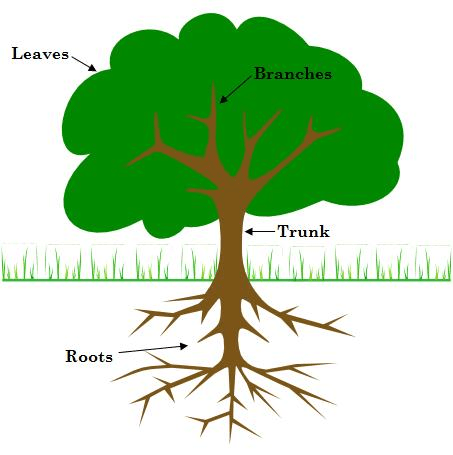
The main parts of a tree include roots, trunk, branches and leaves.
The roots of a tree are underground. They help support the tree and feed it nutrients, like water.
The trunk of the tree starts at the ground and rises upward. The trunk transport nutrients from the roots to the rest of the tree. It also helps the branches and leaves overtop other plants and get as much sunlight as possible.
The branches extend out from the trunk in all directions. Leaves and stems grow from the branches covering as much area as possible that contains sunlight.
The leaves are used to create energy from sunlight, a process known as photosynthesis.
How trees reproduce (make a new tree).
Trees reproduce by pollination, which can occur through insects, wind, or animals.
Trees produce seeds that can grow into a separate adult tree if the conditions are right.
Trees have various ways to spread their seeds. Wind carries winged and plumed seeds, while animals help disperse seeds found in edible fruits. Some seeds rely on gravity, simply dropping to the ground.
Trees are useful in many ways.
Trees generate oxygen, a vital resource for the survival of humans and animals. Take a moment to breathe deeply and be thankful for the oxygen produced by trees.
Trees are the primary source of lumber used by humans to build things, like a home or wooden boat. Trees are also used to create decorative art and furniture, like a table or statue.
The wood for trees can also be used as fuel for a fire, both for warmth and cooking.
Trees are also the source of food, like fruit and nuts. The sap from some trees is used to create syrups.
Trees don’t belong to any official taxonomic group. The term “tree” is simply used to describe various plant species that share certain physical traits.
Several popular species of trees include the red maple tree, the oak tree, the magnolia tree, the sugar maple tree, the sweetgum tree, the cherry blossom tree, the palm tree, the sequoia tree, the dogwood tree and the pine tree.
Wasps aren’t just one kind; there are over 30,000 species around the world. Each has its own unique behaviors and important roles in nature.
Insects like wasps can be grouped into two main types: social and solitary. Social wasps create nests and live together in colonies, while solitary wasps prefer to live alone and don’t build shared nests.
Many wasp species prey on other insects, helping to manage pest populations. This natural form of pest control is crucial for maintaining healthy gardens and supporting agriculture.
Wasps play a vital role in keeping insect populations in check, which helps agriculture and cuts down on the use of chemical pesticides.
Although not as effective as bees, some wasps also help pollinate plants. As they collect nectar from flowers, they unintentionally carry pollen between them.
Wasp nests come in a variety of designs depending on the species, with some building complex, multi-chambered structures that dangle from trees, while others prefer to dig their nests underground.
These nests can accommodate thousands of wasps and are commonly constructed in sheltered areas, such as beneath eaves or within dense vegetation.
Every year, certain groups of animals migrate from one location to another. Some travel thousands of miles in the spring and return the same distance in the fall. These incredible journeys are known as migrations.
Why do animals migrate?
Animals migrate as the weather and seasons change, seeking warmer climates, better food sources, or a safe place to give birth to their offspring.
How do animals know when and where to migrate?
Changes in weather, daylight length, or food availability can signal to animals that it’s time to move. How they know which direction to go remains a mystery. Some scientists believe animals are born with this knowledge, learning it “genetically” from their parents. This innate behavior is also known as instinct.
How do they find their way?
Animals don’t rely on the internet, GPS, or maps to find their way, yet they travel thousands of miles across land and sea each year. They’ve developed unique ways to navigate the Earth. Some use the Sun and stars to determine direction, while others rely on wind patterns or landmarks like mountains, rivers, and lakes. Some even possess a special sense that helps them detect the Earth’s magnetic field to guide their journey. It’s incredible what animals are capable of!
Migrations on the land
Caribou live in the snowy tundra of the far north. In North America, they migrate each spring to the northern coast to give birth to their calves in the summer. When fall comes, they head back south below the Arctic Circle. Some caribou herds travel up to 3,500 miles, covering as much as 35 miles a day.
Zebras and wildebeest – Every year, zebra and wildebeest herds in the African savannah embark on a massive clockwise migration. They’re always on the move, following the rainy seasons to find areas where food is abundant.
Emperor penguins, who are excellent swimmers, walk across 125 miles of ice each year to the place where they birth their chicks.
Migrations in the air
Arctic terns -Arctic terns hold the record for the longest migration of any animal on Earth. Every six months, they journey from the Arctic to Antarctica and back again, covering an astonishing roundtrip distance of nearly 50,000 miles. Thankfully, these strong and speedy birds can complete the trip in just about 40 days.
The average arctic tern will travel the equivalent of going around the Earth 60 times in their lifetime.
Canadian geese – Every year, Canadian geese migrate south to escape the freezing winters that ice over lakes and ponds. In the summer, they head back north to breed and nest. Their iconic V-shaped flight formation helps them conserve energy, enabling them to travel up to 600 miles in a single day.
European White Storks – Migrating flocks of European white storks can stretch for lengths of up to 125 miles.
Insects such as butterflies migrate.
For example, monarch butterflies migrate in groups. No single butterfly makes the whole journey. The butterflies go through multiple generations to reach their destination.
Migrations in the water
Gray whales – Gray whales migrate between the chilly northern waters of the Bering Sea during summer and the warm waters of Baja California in winter. They give birth to their calves in the winter before heading back north in early spring. Their migration spans an impressive 5,000 to 6,000 miles.
Salmon – Salmon have a fascinating one-time round-trip migration in their lifetime. They hatch from eggs in fresh water, grow, and eventually swim downstream to spend most of their lives in the ocean. When it’s time to spawn, they return to their birthplace to lay eggs, after which they die. Some salmon travel hundreds of miles upriver, with Chinook salmon covering 900 miles and climbing nearly 7,000 feet in altitude to complete their journey home.
Sea Turtles – Sea turtles migrate back to the same beach where they were born to lay their eggs.
Fun Facts about Animal Migrations
Many animals get ready for migration by building up energy reserves and strengthening specific muscles to ensure they’re fit enough for the journey.
Birds save energy and are able to travel great distances by riding the air currents.
Male and female walruses migrate in separate herds.
Birds migrate when they fly south in fall and north in the spring.
Fish migrate through the water to feed or spawn (lay eggs to make baby fish).
Other animals such as mammals, amphibians, reptiles, and crustaceans also migrate.
It’s a widespread misunderstanding that pumpkins are vegetables, and there’s actually a good explanation for it.
In many cuisines worldwide, pumpkins are treated as vegetables and included in savory dishes since they aren’t as overly sweet as other fruits.
Since they grow from flowers and contain seeds, they are classified as fruits botanically, regardless of what culinary experts might claim.
Pumpkins grow from tiny fruits attached to flowers which grow off long vines.
Pumpkin plants have really long vines
Not all pumpkins are orange!
Have you ever seen a pumpkin in a color other than orange, like green or blue? And if you have, have you ever wondered why they aren’t more common?
The color of a pumpkin is determined by its genetic makeup. Through natural or artificial cross-breeding and hybridization, pumpkins can come in a variety of colors, including red, white, orange, yellow, or bluish-grey, often with mottled or speckled stripes.
It’s not easy to come across these exotic colors in most markets since they’re rare and highly sought after. If you do spot them, make sure to get your parents’ permission before buying, as they can be quite pricey.
Almost all parts of a pumpkin are edible
People eat pumpkin shells, seeds, flesh, and flowers. Pumpkin pie, pumpkin soup, and pumpkin muffins are popular items made from pumpkin.
Pumpkins are native to North America
Recent studies suggest that pumpkins first originated in North America, particularly in northeastern Mexico and the southern United States, with the oldest pumpkin seeds discovered in Mexico.
Many people carve pumpkins into Jack-O-Lanterns for Halloween.
Carving pumpkins on Halloween was an old Irish tradition.
Have you ever thought of jack-o-lanterns being made from anything other than pumpkins? Hard to imagine, right? Surprisingly, carving pumpkins is a fairly recent tradition. According to an old Irish folk tale, Stingy Jack was a cunning man who tried to trick the Devil for his own benefit. After his death, he was denied entry to both heaven and hell, leaving him to wander the earth and haunt people. To keep Jack away, the Irish began carving demonic faces into turnips. When they immigrated to America, they switched to pumpkins, which were native, larger, and easier to carve.
Some people compete to grow ‘Giant Pumpkins.’ The largest Giants can weigh more than 2000 pounds, close to what a small car weighs.
Other people build machines to throw pumpkins in pumpkin chunking contests. The team with the machine that throws the pumpkin farthest wins.


 articlesforchristians