This is a fictional story about a Missionary family who lives in a Submarine. Parts 1 and 2 are finished. I will be writing a few more parts as time goes on.
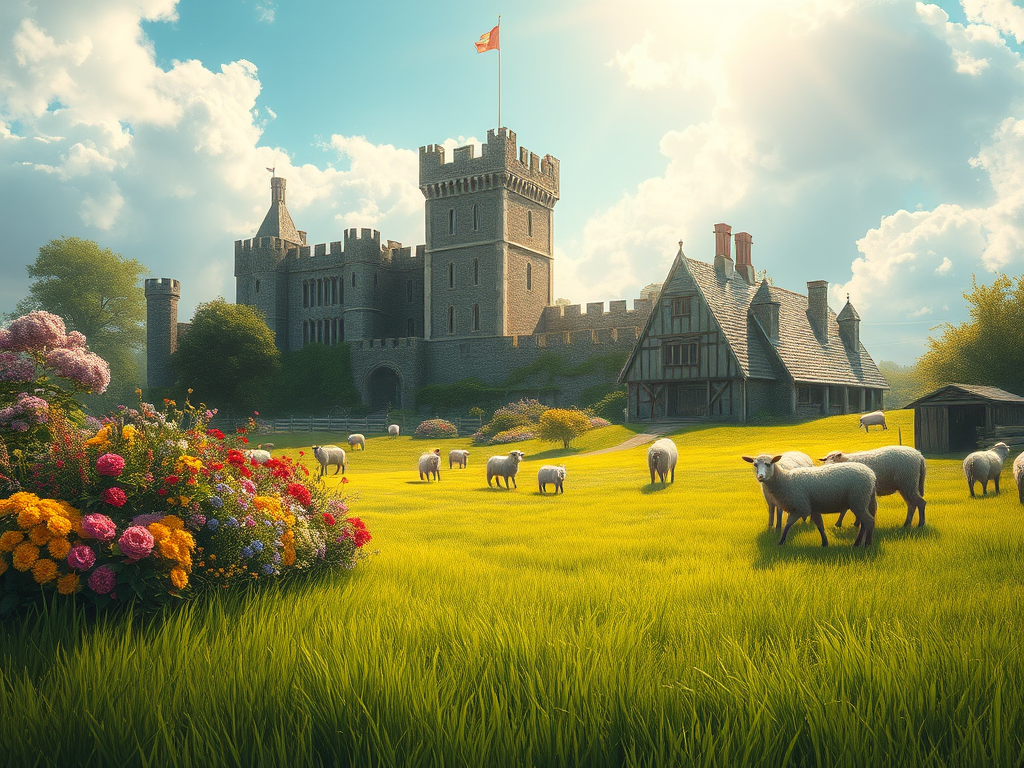
After the storm at sea, we were all glad to be on dry land. After one day of rest, we went to visit our grandparents. Our Grandparents live in an old castle. The castle has 3 floors plus the attic. When we got to the castle. Our Grandparents. Welcome us with hugs, kisses, and lunch. Then we talk a little bit about what happen last time we were together.
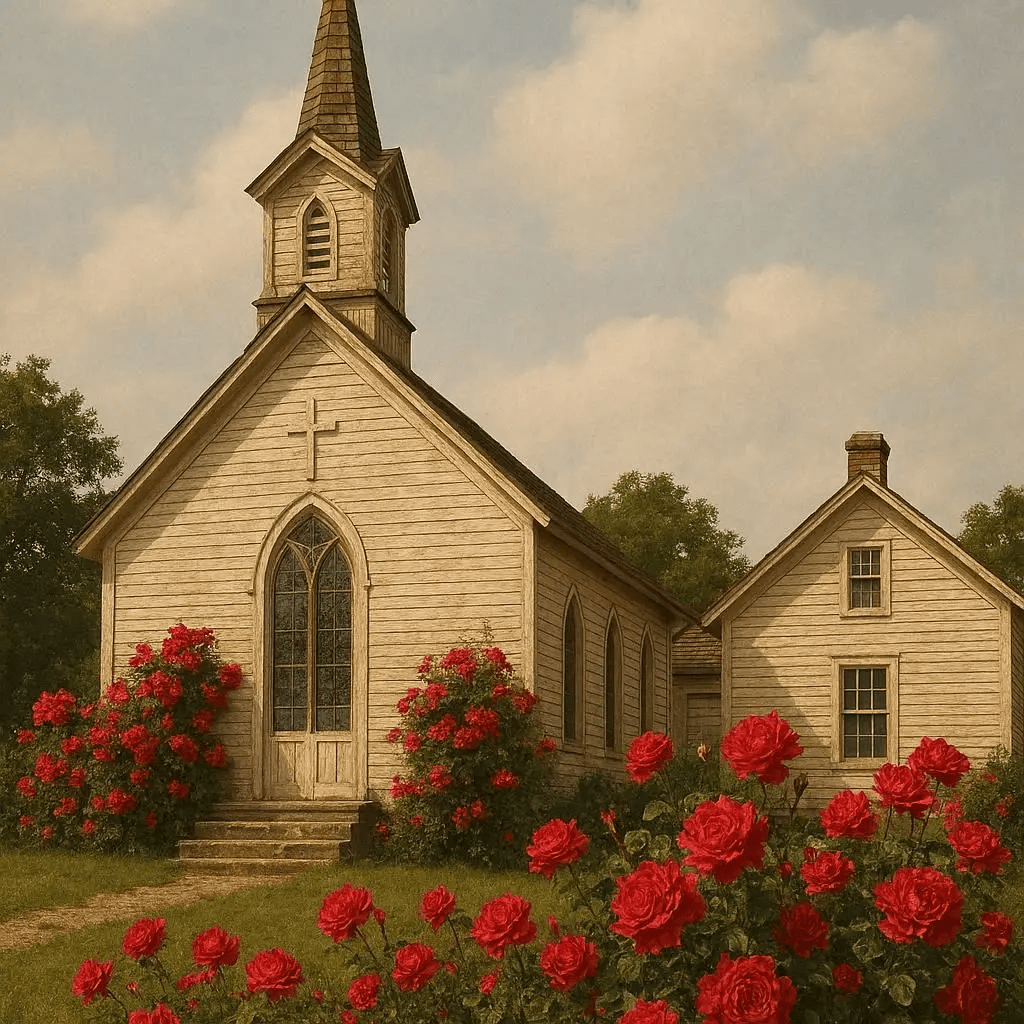
Then we had to go meet Pastor David Campbell. So, we said our goodbyes and jumped into the rental car. Pastor David, and his family were aways so nice to us. When we got to the church, we saw Pastor David and Mrs. Campbell. Pastor David had two kids of his own one was around Joy’s age and her name is Fiona. The other was around Mark’s age, and his name is Patrick. Well, that is how many kids he had last time we were here. When we all got out of the car, we saw that Pastor David was holding a baby! “Pastor David has a baby!” Danny said loudly as he ran around in the grass. “Yes,” Little Danny, “I do.” “What is the baby’s name our mother asks?” “His name is Jack,” said Mrs. Campbell. Now that we have said our hellos, I think I know two people who want to see their friends. Danny, Joy, Mark, and I knew who Mrs. Campbell was talking about, Fiona and Patrick. They are in the back waiting on you guys. So, we ran to the house near the church where the Campbell’s live to play with Fiona and Patrick and their 2 dogs. While the grownups went inside the church to talk about next Sunday. After a while of playing, Mother and Father said it is time to go back to the castle to eat Dinner.
When we got there, grandma had made a shepherd’s pie. Grandma’s shepherd’s pie is so always so good. So, we ate our dinner. Our grandparents insisted on putting us up for the night. They put us children in the old children’s room. Maybe it was just Mark and me, but we couldn’t sleep. We kept hearing something. “Rebecca” yes Mark, “I hear something do you?” “Yes, Mark I do it is at the door.” Mark and I walked to the door to open it. When we opened the door, we saw our grandparents’ dog Honey. “Look Rebecca it’s only Honey.” “Okay now we should go to sleep Mark tomorrow is Saturday than its Sunday.” So, we went back to sleep.
When we woke up in the morning, we woke to the singing of birds, and the sun coming through the window. Honey was at the foot of the bed. “Good morning, Rebecca,” said Joy. “We are waiting on you so we can go down together.” “Okay let me get my clothes on.” So, I hurried to put my clothes and shoes on. After that Danny, Joy, Mark and I walk downstairs to the kitchen. “Go on and sat down kids eat up then you may explore the castle grounds.” “Okay grandma.” “Where mom and dad?” “They went to the stores for food for the sub. They will be back in an hour. Now eat up.” “Okay grandma.” So, we hurried and ate so that we could go exploring.
The castle has so much to explore. A few visits ago, Joy found a secret room where Mark found an old tea set. Another time, Danny and I found an old picture of our great, great, great okay let just said really great Aunt Mary and Uncle Eric Brennan. So, we don’t know what we will find next. But sometimes we don’t find anything. Like today but that’s okay.
After mom and dad got back the day went by so quickly, but it was fun too. Soon, it was dinner then it was bedtime. When we woke up the next morning it was Sunday. So, after breakfast, we got ready for church. When we got there, Dad went with Pastor David, and we went with Mrs. Campbell.
When everyone got there, Pastor David introduced us to everyone. Then our dad started to preach and just guess what he preached about. He preached that we all need to keep our faith in God so even if the water gets too high, keep your faith. Everyone loves the story dad told them.
After the service as we were walking to the car, we ask the Campbells to please join us for lunch at the castle. They said yes. So, we all were walking to the car when we heard a meow Joy and Fiona look around then Joy saw it 4 little kittens and their mother in a basket near the church. “Dad, Dad come look!” Dad went over where Joy was. Can we keep them please?” When Danny, Mark and I saw them we start begging, too. “No!” our dad said firmly. When Dad said that we move to let our mom to see them. Then we remind mom that she wants a cat or two. Our dad looked for help from Paster David. He said sorry we have too many pets with 2 dogs. “Mother, Father ” our dad said to our grandma and grandpa, “Help”. Paster David asked, “What are you guy going to call your new pets?” Thank a lot for helping to remind us of names. Look at this. It’s a note. It says to whoever finds this please take care of the kittens and their mother. Their names are Little Peep, Sunrise, Rose, Molly and Mary Ann. Little Peep is the black one with blue eyes [boy]. Sunrise is the yellow one with green [boy]. Rose the one that one just like her mother [girl]. Molly the one that look like just like her mother but with a white chest [girl] and their mother Mary Anne with Green eyes.
Lift to Right side. Little Peep, Sunrise, Molly, Rose, and Mary Ann
Mom, can we keep them? Absolutely yes!” What?” Our father said. Come a long children let’s put the basket in the car and go. After we got to the castle we ate lunch. Then baby Jake sat down to play with Honey and us children went the children’s room with the kittens, and their mother. Fiona and I would keep them, but you heard what our dad said. Thanks Patrick. “Rebecca” “Yes, Fiona do you think you dad will let you keep the kittens?” “I hope so”. Why don’t you children ask him yourself? Dad? “Your mom talked me into it.” “Thank dad” “You guys are welcome.” After that it was time for Fiona and Patrick to go home. That night at dinner Grandma made cupcakes that looked like kittens. Grandpa made some cat toys out of some rope for the kittens. Soon, it was bedtime. So, we made the kittens and their mother to lie down in the baskets.
Before we left Dublin to go to Iceland [Reykjavík] Fiona and Patrick ran up to us. We are so happy you guys are still here. We know you have a cat tower, food and treats, but here are some toys. Thank you so much Fiona and Patrick. See you when come back to visit. Rebecca, Mark, Joy, Danny, it’s time to go. “Goodbye.” “Goodbye Fiona and Patrick.” And that’s the story of how our family grew.
Once upon a time there were four little Rabbits, and their names were-Flopsy, Mopsy, Cotton-tail, and Peter. They lived with their Mother in a sand-bank, underneath the root of a very big fir tree. “Now, my dears,” said old Mrs. Rabbit one morning, “you may go into the fields or down the lane, but don’t go into Mr. McGregor’s garden: your Father had an accident there; he was put in a pie by Mrs. McGregor. Now run along, and don’t get into mischief. I am going out.” Then old Mrs. Rabbit took a basket and her umbrella, and went through the wood to the baker’s. She bought a loaf of brown bread and five currant buns. Flopsy, Mopsy, and Cotton-tail, who were good little bunnies, went down the lane to gather blackberries; But Peter, who was very naughty, ran straight away to Mr. McGregor’s garden, and squeezed under the gate! First he ate some lettuces and some French beans; and then he ate some radishes; And then, feeling rather sick, he went to look for some parsley. But round the end of a cucumber frame, whom should he meet but Mr. McGregor! Mr. McGregor was on his hands and knees planting out young cabbages, but he jumped up and ran after Peter, waving a rake and calling out, “Stop thief.” Peter was most dreadfully frightened; he rushed all over the garden, for he had forgotten the way back to the gate. He lost one of his shoes among the cabbages, and the other shoe amongst the potatoes. After losing them, he ran on four legs and went faster, so that I think he might have got away altogether if he had not unfortunately run into a gooseberry net, and got caught by the large buttons on his jacket. It was a blue jacket with brass buttons, quite new. Peter gave himself up for lost, and shed big tears; but his sobs were overheard by some friendly sparrows, who flew to him in great excitement, and implored him to exert himself. Mr. McGregor came up with a sieve, which he intended to pop upon the top of Peter; but Peter wriggled out just in time, leaving his jacket behind him. And rushed into the toolshed, and jumped into a can. It would have been a beautiful thing to hide in, if it had not had so much water in it. Mr. McGregor was quite sure that Peter was somewhere in the toolshed, perhaps hidden underneath a flowerpot. He began to turn them over carefully, looking under each. Presently Peter sneezed- “Kertyschoo!” Mr. McGregor was after him in no time, and tried to put his foot upon Peter, who jumped out of a window, upsetting three plants. The window was too small for Mr. McGregor, and he was tired of running after Peter. He went back to his work. Peter sat down to rest; he was out of breath and trembling with fright, and he had not the least idea which way to go. Also he was very damp with sitting in that can. After a time he began to wander about, going lippity-lippity-not very fast, and looking all around. He found a door in a wall; but it was locked, and there was no room for a fat little rabbit to squeeze underneath. An old mouse was running in and out over the stone doorstep, carrying peas and beans to her family in the wood. Peter asked her the way to the gate, but she had such a large pea in her mouth that she could not answer. She only shook her head at him. Peter began to cry. Then he tried to find his way straight across the garden, but he became more and more puzzled. Presently, he came to a pond where Mr. McGregor filled his water cans. A white cat was staring at some goldfish; she sat very, very still, but now and then the tip of her tail twitched as if it were alive. Peter thought it best to go away without speaking to her; he has heard about cats from his cousin, little Benjamin Bunny. He went back towards the toolshed, but suddenly, quite close to him, he heard the noise of a hoe- scr-r-ritch, scratch, scratch, scritch. Peter scuttered underneath the bushes. But presently, as nothing happened, he came out, and climbed upon a wheelbarrow, and peeped over. The first thing he saw was Mr. McGregor hoeing onions. His back was turned towards Peter, and beyond him was the gate! Peter got down very quietly off the wheelbarrow, and started running as fast as he could go, along a straight walk behind some black-currant bushes. Mr. McGregor caught sight of him at the corner, but Peter did not care. He slipped underneath the gate, and was safe at last in the wood outside the garden. Mr. McGregor hung up the little jacket and the shoes for a scarecrow to frighten the blackbirds. Peter never stopped running or looked behind him till he got home to the big fir tree. He was so tired that he flopped down upon the nice soft sand on the floor of the rabbit-hole, and shut his eyes. His mother was busy cooking; she wondered what he had done with his clothes. It was the second little jacket and pair of shoes that Peter had lost in a fortnight! I am sorry to say that Peter was not very well during the evening. His mother put him to bed, and made some chamomile tea; and she gave a dose of it to Peter! “One tablespoonful to be taken at bedtime.” But Flopsy, Mopsy, and Cotton-tail had bread and milk and blackberries for supper.
Some forty years ago I passed the winter in the wilderness of northern Maine. I was passionately fond of skating, and the numerous lakes and rivers, frozen by the intense cold, offered an ample field to the lover of this pastime.
Sometimes my skating excursions were made by moonlight; and it was on such an occasion that I met with an adventure which even now I cannot recall without a thrill of horror.
I had left our cabin one evening just before dusk, with the intention of skating a short distance up the Kennebec, which glided directly before the door. The night was beautifully clear with the light of the full moon and millions of stars. Light also came glinting from ice and snow-wreath and incrusted branches, as the eye followed for miles the broad gleam of the river, that like a jeweled zone swept between the mighty forests that bordered its banks.
And yet all was still. The cold seemed to have frozen tree, air, water, and every living thing. Even the ringing of my skates echoed back from the hill with a startling clearness; and the crackle of the ice, as I passed over it in my course, seemed to follow the tide of the river with lightning speed.
I had gone up the river nearly two miles, when, coming to a little stream which flows into the larger, I turned into it to explore its course. Fir and hemlock of a century’s growth met overhead, and formed an archway radiant with frost-work. All was dark within; but I was young and fearless, and I laughed and shouted with excitement and joy.
My wild hurrah rang through the silent woods, and I stood listening to the echoes until all was hushed. Suddenly a sound arose,—it seemed to come from beneath the ice. It was low and tremulous at first, but it ended in one long wild howl.
I was appalled. Never before had such a sound met my ears. Presently I heard the brushwood on shore crash as though from the tread of some animal. The blood rushed to my forehead; my energies returned, and I looked around me for some means of escape.
The moon shone through the opening at the mouth of the creek by which I had entered the forest; and, considering this the best way of escape, I darted toward it like an arrow. It was hardly a hundred yards distant, and the swallow could scarcely have excelled me in flight; yet, as I turned my eyes to the shore, I could see several dark objects dashing through the brushwood at a pace nearly double in speed to my own. By their great speed, and the short yells which they occasionally gave, I knew at once that these were the much-dreaded gray wolves.
The bushes that skirted the shore now seemed to rush past with the velocity of lightning, as I dashed on in my flight to pass the narrow opening. The outlet was nearly gained; a few seconds more, and I would be comparatively safe. But in a moment my pursuers appeared on the bank above me, which here rose to the height of ten or twelve feet. There was no time for thought; I bent my head, and dashed wildly forward. The wolves sprang, but, miscalculating my speed, they fell behind, as I glided out upon the river!
I turned toward home. The light flakes of snow spun from the iron of my skates, and I was some distance from my pursuers, when their fierce howl told me they were still in hot pursuit. I did not look back; I did not feel afraid, or sorry, or glad; one thought of home, of the bright faces awaiting my return, and of their tears if they never should see me,—and then all the energies of body and mind were exerted for escape.
I was perfectly at home on the ice. Many were the days that I had spent on my good skates, never thinking that they would one day prove my only means of safety.
Every half-minute a furious yelp from my fierce attendants made me but too certain that they were in close pursuit. Nearer and nearer they came. At last I heard their feet pattering on the ice; I even felt their very breath, and heard their snuffing scent! Every nerve and muscle in my frame was strained to the utmost.
The trees along the shore seemed to dance in an uncertain light, my brain turned with my own breathless speed, my pursuers hissed forth their breath with a sound truly horrible, when all at once an involuntary motion on my part turned me out of my course. The wolves close behind, unable to stop, and as unable to turn on smooth ice, slipped and fell, still going on far ahead. Their tongues were lolling out, their white tusks were gleaming from their bloody mouths, their dark shaggy breasts were flecked with foam; and as they passed me their eyes glared, and they howled with fury.
The thought flashed on my mind that by turning aside whenever they came too near I might avoid them; for, owing to the formation of their feet, they are unable to run on ice except in a straight line. I immediately acted upon this plan, but the wolves having regained their feet sprang directly toward me.
The race was renewed for twenty yards up the stream; they were almost close at my back, when I glided round and dashed directly past them. A fierce yell greeted this movement, and the wolves, slipping on their haunches, again slid onward, presenting a perfect picture of helplessness and disappointed rage. Thus I gained nearly a hundred yards at each turning. This was repeated two or three times, the baffled animals becoming every moment more and more excited.
At one time, by delaying my turning too long, my bloodthirsty antagonists came so near that they threw their white foam over my coat as they sprang to seize me, and their teeth clashed together like the spring of a fox-trap. Had my skates failed for one instant, had I tripped on a stick, or had my foot been caught in a fissure, the story I am now telling would never have been told.
I thought over all the chances. I knew where they would first seize me if I fell. I thought how long it would be before I died, and then of the search for my body: for oh, how fast man’s mind traces out all the dread colors of death’s picture only those who have been near the grim original can tell!
At last I came opposite the cabin, and my hounds—I knew their deep voices—roused by the noise, bayed furiously from their kennels. I heard their chains rattle—how I wished they would break them!—then I should have had protectors to match the fiercest dwellers of the forest. The wolves, taking the hint conveyed by the dogs, stopped in their mad career, and after a few moments turned and fled.
I watched them until their forms disappeared over a neighboring hill; then, taking off my skates, I wended my way to the cabin with feelings which may be better imagined than described. But even yet I never see a broad sheet of ice by moonlight without thinking of that snuffing breath, and those ferocious beasts that followed me so closely down that frozen river.
Never think that you have learned
    All there is to know.
  That's the surest way of all
    Ignorance to show.
“I’ve found Old Mr. Toad!” cried Peter Rabbit, hurrying after Jimmy Skunk.
“Where?” demanded Jimmy.
“In the water,” declared Peter. “He’s sitting right over there where the water is shallow, and he didn’t notice me at all. Let’s get Unc’ Billy, and then creep over to the edge of the Smiling Pool and watch to see if Old Mr. Toad really does try to sing.”
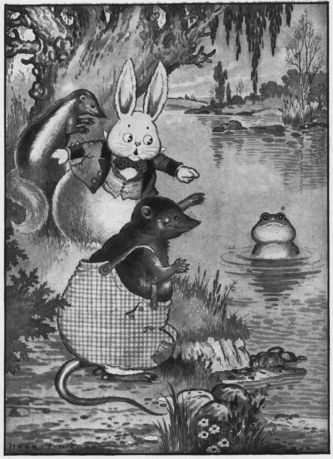
So they hunted up Unc’ Billy Possum, and the three stole very softly over to the edge of the Smiling Pool, where the bank was low and the water shallow. Sure enough, there sat Old Mr. Toad with just his head out of water. And while they were watching him, something very strange happened.
“What—what’s the matter with him?” whispered Peter, his big eyes looking as if they might pop out of his head.
“If he don’t watch out, he’ll blow up and bust!” exclaimed Jimmy.
“Listen!” whispered Unc’ Billy Possum. “Do mah ol’ ears hear right? ‘Pears to me that that song is coming right from where Brer Toad is sitting.”
It certainly did appear so, and of all the songs that glad spring day there was none sweeter. Indeed there were few as sweet. The only trouble was the song was so very short. It lasted only for two or three seconds. And when it ended, Old Mr. Toad looked quite his natural self again; just as commonplace, almost ugly, as ever. Peter looked at Jimmy Skunk, Jimmy looked at Unc’ Billy Possum, and Unc’ Billy looked at Peter. And no one had a word to say. Then all three looked back at Old Mr. Toad.
And even as they looked, his throat began to swell and swell and swell, until it was no wonder that Jimmy Skunk had thought that he was in danger of blowing up. And then, when it stopped swelling, there came again those beautiful little notes, so sweet and tremulous that Peter actually held his breath to listen. There was no doubt that Old Mr. Toad was singing just as he had said he was going to, and it was just as true that his song was one of the sweetest if not the sweetest of all the chorus from and around the Smiling Pool. It was very hard to believe, but Peter and Jimmy and Unc’ Billy both saw and heard, and that was enough. Their respect for Old Mr. Toad grew tremendously as they listened.
“How does he do it?” whispered Peter.
“With that bag under his chin, of course,” replied Jimmy Skunk. “Don’t you see it’s only when that is swelled out that he sings? It’s a regular music bag. And I didn’t know he had any such bag there at all.”
“I wish,” said Peter Rabbit, feeling of his throat, “that I had a music bag like that in my throat.”
And then he joined in the laugh of Jimmy and Unc’ Billy, but still with something of a look of wistfulness in his eyes.
Jimmy Skunk scratched his head thoughtfully as he watched Old Mr. Toad go down the Lone Little Path, hop, hop, hipperty-hop, towards the Smiling Pool. He certainly was puzzled, was Jimmy Skunk. If Old Mr. Toad had told him that he could fly, Jimmy would not have been more surprised, or found it harder to believe than that Old Mr. Toad had a beautiful voice. The truth is, Jimmy didn’t believe it. He thought that Old Mr. Toad was trying to fool him.
Presently Peter Rabbit came along. He found Jimmy Skunk sitting in a brown study. He had quite forgotten to look for fat beetles, and when he forgets to do that you may make up your mind that Jimmy is doing some hard thinking.
“Hello, old Striped-coat, what have you got on your mind this fine morning?” cried Peter Rabbit.
“Him,” said Jimmy simply, pointing down the Lone Little Path.
Peter looked. “Do you mean Old Mr. Toad!” he asked.
Jimmy nodded. “Do you see anything queer about him?” he asked in his turn.
Peter stared down the Lone Little Path. “No,” he replied, “except that he seems in a great hurry.”
“That’s just it,” Jimmy returned promptly. “Did you ever see him hurry unless he was frightened?”
Peter confessed that he never had.
“Well, he isn’t frightened now, yet just look at him go,” retorted Jimmy. “Says he has got a beautiful voice, and that he has to take part in the spring chorus at the Smiling Pool and that he is late.”
Peter looked very hard at Jimmy to see if he was fooling or telling the truth. Then he began to laugh. “Old Mr. Toad sing! The very idea!” he cried. “He can sing about as much as I can, and that is not at all.”
Jimmy grinned. “I think he’s crazy, if you ask me,” said he. “And yet he was just as earnest about it as if it were really so. I think he must have eaten something that has gone to his head. There’s Unc’ Billy Possum over there. Let’s ask him what he thinks.”
So Jimmy and Peter joined Unc’ Billy, and Jimmy told the story about Old Mr. Toad all over again. Unc’ Billy chuckled and laughed just as they had at the idea of Old Mr. Toad’s saying he had a beautiful voice. But Unc’ Billy has a shrewd little head on his shoulders. After a few minutes he stopped laughing.
“Ah done learn a right smart long time ago that Ah don’ know all there is to know about mah neighbors,” said he. “We-uns done think of Brer Toad as ugly-lookin’ fo’ so long that we-uns may have overlooked something. Ah don’ reckon Brer Toad can sing, but Ah ‘lows that perhaps he thinks he can. What do you-alls say to we-uns going down to the Smiling Pool and finding out what he really is up to?”
“The very thing!” cried Peter, kicking up his heels. You know Peter is always ready to go anywhere or do anything that will satisfy his curiosity.
Jimmy Skunk thought it over for a few minutes, and then he decided that as he hadn’t anything in particular to do, and as he might find some fat beetles on the way, he would go too. So off they started after Old Mr. Toad, Peter Rabbit in the lead as usual, Unc’ Billy Possum next, grinning as only he can grin, and in the rear Jimmy Skunk, taking his time and keeping a sharp eye out for fat beetles.
I once knew a man who was rich in his love for birds, and in their love for him. He lived in the midst of a grove full of all kinds of trees. He had no wife or children in his home.
He was an old man with gray beard, blue and kind eyes, and a voice that the birds loved; and this was the way he made them his friends.
While he was at work with a rake on his nice walks in the grove, the birds came close to him to pick up the worms in the fresh earth he dug up. At first, they kept a rod or two from him, but they soon found he was a kind man, and would not hurt them, but liked to have them near him.
They knew this by his kind eyes and voice, which tell what is in the heart. So, day by day their faith in his love grew in them.
They came close to the rake. They would hop on top of it to be first at the worm. They would turn up their eyes into his when he spoke to them, as if they said, ‘He is a kind man; he loves us; we need not fear him.’
All the birds of the grove were soon his fast friends. They were on the watch for him, and would fly down from the green tree tops to greet him with their chirp.
When he had no work on the walks to do with his rake or his hoe, he took crusts of bread with him, and dropped the crumbs on the ground. Down they would dart on his head and feet to catch them as they fell from his hand.
He showed me how they loved him. He put a crust of bread in his mouth, with one end of it out of his lips. Down they came like bees at a flower, and flew off with it crumb by crumb.
When they thought he slept too long in the morning, they would fly in and sit on the bedpost, and call him up with their chirp.
They went with him to church, and while he said his prayers and sang his hymns in it, they sat in the trees, and sang their praises to the same good God who cares for them as he does for us.
Thus, the love and trust of birds were a joy to him all his life long; and such love and trust no boy or girl can fail to win with the same kind heart, voice, and eye that he had.
At the earliest break of day, Don Quixote made ready to ride out in quest of adventures. He buckled on his armor. He took his lance and his shield in his hands. His gallant steed, Rozinante, stood saddled and bridled at the door of the inn.
He again embraced the innkeeper. “Farewell, thou greatest of my benefactors,” he cried. “May heaven bless thee for having made me a knight.”
Then, with the help of a groom, he mounted and rode forth into the world.
Right gayly did he ride. For he felt that he was now in truth a knight, and his mind was filled with lofty thoughts.
Right gayly also did Rozinante canter along the highway, and proudly did he hold his head. For did he not know that he was carrying the bravest of brave men?
They had gone but a little way when Don Quixote suddenly remembered the innkeeper’s command to provide himself with money, clean shirts, and some salve.
“The command must be obeyed,” he said. “I must go home to get those necessary things.”
So he turned his horse’s head and took the first byroad that led towards his village. And now Rozinante seemed to have new life put into his lean body. He sniffed the air and trotted so fast that his heels seemed scarcely to touch the ground.
“This is after the manner of heroes,” said Don Quixote. “Yet I still lack one thing. I need a faithful squire to ride with me and serve me. All the knights I have ever read about had squires who followed in their footsteps and looked on while they were fighting. I think, therefore, that while I am providing myself with money and shirts, I will also get me a squire.”
Presently, as they were passing through a lonely place, the knight fancied that he heard distressing cries. They seemed to come from the midst of a woody thicket near the roadside.
“I thank Heaven for this lucky moment,” he said to himself. “I shall now have an adventure. No doubt I shall rescue someone who is in peril, or I shall correct some grievous wrong.”
He put spurs to Rozinante and rode as fast as he could to the spot from which the cries seemed to issue.
At the edge of the woody thicket he saw a horse tied to a small oak tree. Not far away, a lad of about fifteen years was tied to another oak. The lad’s shoulders and back were bare, and it was he who was making the doleful outcry. For a stout country fellow was standing over him and beating him unmercifully with a horsewhip.
“Hold! hold!” cried Don Quixote, rushing up. “It is an unmanly act to strike a person who cannot strike back.”
The farmer was frightened at the sudden appearance of a knight on horseback. He dropped his whip. He stood with open mouth and trembling hands, not knowing what to expect. “Come, sir,” said Don Quixote, sternly. “Take your lance, mount your horse, and we will settle this matter by a trial of arms.”
The farmer answered him very humbly. “Sir Knight,” he said, “this boy is my servant, and his business is to watch my sheep. But he is lazy and careless, and I have lost half of my flock through his neglect.”
“What of that?” said Don Quixote. “You have no right to beat him, when you know he cannot beat you.”
“I beat him only to make a better boy of him,” answered the farmer. “He will tell you that I do it to cheat him out of his wages: but he tells lies even while I am correcting him.”
“What! what!” cried Don Quixote. “Do you give him the lie right here before my face? I have a good mind to run you through the body with my lance. Untie the boy and pay him his money. Obey me this instant, and let me not hear one word of excuse from you.”
The farmer, pale with fear, loosed the boy from the cords which bound him to the tree.
“Now, my young man,” said Don Quixote, “how much does this fellow owe you?”
“He owes me nine months’ wages at seven dollars a month,” was the answer.
“Nine times seven are sixty-three,” said the knight. “Sir, you owe this lad sixty-three dollars. If you wish to save your life pay it at once.”
The farmer was now more alarmed than before. He fell upon his knees. He lifted his hands, imploring mercy. He sobbed with fright.
“Noble sir,” he cried, “it is too much; for I have bought him three pairs of shoes at a dollar a pair; and twice when he was sick, I paid the doctor a dollar.”
“That may be,” answered Don Quixote, “but we will set those dollars against the beating you have given him without cause. Come, pay him the whole amount.”
“I would gladly do so,” said the farmer, “but I have not a penny in my pocket. If you will let the lad go home with me, I will pay him every dollar.”
“Go home with him!” cried the lad. “Not I. Why, he would beat me to death and not pay at all.”
“He won’t dare to do it,” answered Don Quixote. “I have commanded him and he must obey. His money is at his house. I give him leave to go and get it. His honor as a knight will make him pay his debt to you.”
“A knight!” said the lad. “He is no knight. He is only John Haldudo, the farmer.”
“What of that?” said Don Quixote. “Why may not the Haldudos have a knight in the family?”
“Well, he is not much of a knight. A knight would pay his debts,” said the lad.
“And he will pay you, for I have commanded him,” said Don Quixote.
Then turning to the farmer, he said, “Go, and make sure that you obey me. I will come this way again soon, and if you have failed, I will punish you. I will find you out, even though you hide yourself as close as a lizard.”
The farmer arose from his knees and was about to speak, but the knight would not listen.
“I will have no words from you,” he said. “You have naught to do but to obey. And if you would ask who it is that commands you, know that I am the valorous Don Quixote de la Mancha, the righter of wrongs and the friend of the downtrodden. So, goodbye!”
Having said this, he gave spurs to Rozinante and galloped away.
The farmer watched him until he was quite out of sight. Then he turned and called to the boy.
“Come, Andrew,” he said. “Come to me now, and I will pay thee what I owe thee. I will obey this friend of the downtrodden.”
“You will do well to obey him,” said the boy. “He is a knight, and if you fail to pay me, he will come back and make things hot for you.”
“Yes, I know,” answered the farmer. “I will pay you well and show you how much I love you.”
Then, without another word, he caught hold of the boy and again tied him to the tree. The boy yelled lustily, but Don Quixote was too far away to hear his cries. The farmer fell upon him and beat him with fists and sticks until he was almost dead. Finally he loosed him and let him go.
“Now, Andrew, go find your friend of the downtrodden,” he said. “Tell him how well I have paid you.”
Poor Andrew said nothing. He hobbled slowly away, while the farmer mounted his horse and rode grimly homeward.
In the meanwhile, Don Quixote was speeding toward his own village. He was very much pleased with himself and with his first adventure as a knight.
“O Dulcinea, most beautiful of beauties,” he cried, “well mayest thyself be happy. For thy knight has done a noble deed this day.”
And thus he rode gallantly onward, his lance clanging against his coat of mail at every motion of his steed.
One morning in midsummer, Don Quixote arose very early, long before anyone else was awake.
He put on his coat of mail and the old helmet which he had patched with pasteboard and green ribbons.
He took down the short sword that had been his great-grandfather’s, and belted it to his side. He grasped his long lance. He swung the leather shield upon his shoulder.
Then he went out very quietly by the back door, lest he should awaken his niece or the housekeeper.
He went softly to the barn and saddled his steed. Then he mounted and rode silently away through the sleeping village and the quiet fields.
He was pleased to think how easily he had managed things. He was glad that he had gotten away from the house and the village without any unpleasant scenes.
“I trust that I shall presently meet with some worthy adventure,” he said to himself.
But soon a dreadful thought came into his mind: He was not a knight, for no one had conferred that honor upon him; and the laws of chivalry would not permit him to contend in battle with anyone of noble rank until he himself was knighted.
“Whoa, Rozinante!” he said. “I must consider this matter.”
He stopped underneath a tree, and thought and thought. Must he give up his enterprise and return home?
“No, that I shall never do!” he cried. “I will ride onward, and the first worthy man that I meet shall make me knight.”
So he spoke cheeringly to Rozinante and resumed his journey. He dropped the reins loosely upon the horse’s neck, and allowed him to stroll hither and thither as he pleased.
“It is thus,” he said, “that knights ride out upon their quests. They go where fortune and their steeds may carry them.”
Thus, leisurely, he sat in the saddle, while Rozinante wandered in unfrequented paths, cropped the green herbage by the roadside, or rested himself in the shade of some friendly tree. The hours passed, but neither man nor beast took note of time or distance.
“We shall have an adventure by and by,” said Don Quixote softly to himself.
The sun was just sinking in the west when Rozinante, in quest of sweeter grass, carried his master to the summit of a gentle hill. There, in the valley below him, Don Quixote beheld a little inn nestling snugly by the roadside.
“Ha!” he cried. “Did I not say that we should have an adventure?”
He gathered up the reins; he took his long lance in his hand; he struck spurs into his loitering steed, and charged down the hill with the speed of a plow horse.
He imagined that the inn was a great castle with four towers and a deep moat and a drawbridge.
At some distance from the gate he checked his steed and waited. He expected to see a dwarf come out on the wall of the castle and sound a trumpet to give notice of the arrival of a strange knight; for it was always so in the books which he had read.
But nobody came. Don Quixote grew impatient. At length he urged Rozinante forward at a gentle pace, and was soon within hailing distance of the inn. Just then a swineherd, in a field near by, blew his horn to call his pigs together.
“Ah, ha!” cried Don Quixote. “There is the dwarf at last. He is blowing his bugle to tell them that I am coming.” And with the greatest joy in the world he rode onward to the door of the inn.
The innkeeper was both fat and jolly; and when he saw Don Quixote riding up, he went out to welcome him. He could not help laughing at the war-like appearance of his visitor — with his long lance, his battered shield, and his ancient coat of mail. But he kept as sober a face as possible and spoke very humbly.
“Sir Knight,” he said, “will you honor me by alighting from your steed? I have no bed to offer you, but you shall have every other accommodation that you may ask.”
Don Quixote still supposed that the inn was a castle; and he thought that the innkeeper must be the governor. So he answered in pompous tones:—
“Senior Castellano, anything is enough for me. I care for nothing but arms, and no bed is so sweet to me as the field of battle.”
The innkeeper was much amused. “You speak well, Sir Knight. Since your wants are so few, I can promise that you shall lack nothing. Alight, and enter!” And with that he went and held Don Quixote’s stirrup while he dismounted.
The poor old man had eaten nothing all day. His armor was very heavy. He was stiff from riding so long. He could hardly stand on his feet. But with the innkeeper’s help he was soon comfortably seated in the kitchen of the inn.
“I pray you, Senior Castellano,” he said, “take good care of my steed. There is not a finer horse in the universe.”
The innkeeper promised that the horse should lack nothing, and led him away to the stable.
When he returned to the kitchen he found Don Quixote pulling off his armor. He had relieved himself of the greater part of his coat of mail; but the helmet had been tied fast with the green ribbons, as I have told you, and it could not be taken off without cutting them.
“Never shall anyone harm those ribbons,” cried Don Quixote; and after vainly trying to untie them he was obliged to leave them as they were. It was a funny sight to see him sitting there with his head enclosed in the old patched-up helmet.
“Now, Sir Knight,” said the innkeeper, “will you not deign to partake of a little food? It is quite past our supper time, and all our guests have eaten. But perhaps you will not object to taking a little refreshment alone.”
“I will, indeed, take some with all my heart,” answered Don Quixote. “I think I shall enjoy a few mouthfuls of food more than anything else in the world.”
As ill luck would have it, it was Friday, and there was no meat in the house. There were only a few small pieces of salt fish in the pantry, and these had been picked over by the other guests.
“Will you try some of our fresh trout?” asked the landlord. “They are very small, but they are wholesome.”
“Well,” answered Don Quixote, “if there are, several of the small fry, I shall like them as well as a single large fish. But whatever you have, I pray you bring it quickly; for the heavy armor and the day’s travel have given me a good appetite.”
So a small table was set close by the door, for the sake of fresh air; and Don Quixote drew his chair up beside it.
Then the innkeeper brought some bits of the fish, ill-dressed and poorly cooked. The bread was as brown and moldy as Don Quixote’s armor; and there was nothing to drink but cold water.
It was hard for the poor man to get the food to his mouth, for his helmet was much in his way. By using both hands, however, he managed to help himself. Then you would have laughed to see him eat; for, indeed, he was very hungry.
“No true knight will complain of that which is set before him,” he said to himself.
Suddenly, however, the thought again came to him that he was not yet a knight. He stopped eating. The last poor morsel of fish was left untouched on the table before him. His appetite had left him.
“Alas! alas!” he groaned. “I cannot lawfully ride out on any adventure until I have been dubbed a knight. I must see to this business at once.”
He arose and beckoned to the innkeeper to follow him to the barn. “I have something to say to you,” he whispered.
“Your steed, Sir Knight,” said the innkeeper, “has already had his oats. I assure you he will be well taken care of.”
“It is not of the steed that I wish to speak,” answered Don Quixote; and he carefully shut the door behind them.
Then falling at the innkeeper’s feet, he cried, “Sir, I shall never rise from this place till you have promised to grant the boon which I am about to beg of you.”
The innkeeper did not know what to do. He tried to raise the poor man up, but he could not. At last he said, “I promise. Name the boon which you wish, and I will give it to you.”
“Oh, noble sir,” answered Don Quixote, “I knew you would not refuse me. The boon which I beg is this: Allow me to watch my armor in the chapel of your castle tonight, and then in the morning — oh, in the morning — “
“And what shall I do in the morning?” asked the innkeeper.
“Kind sir,” he answered, “do this: Bestow on me the honor of knighthood. For I long to ride through every corner of the earth in quest of adventures; and this I cannot do until after I have been dubbed a knight.”
The innkeeper smiled, and his eyes twinkled. For he was a right jolly fellow, and he saw that here was a chance for some merry sport.
“Certainly, certainly,” he said, right kindly. “You are well worthy to be a knight, and I honor you for choosing so noble a calling. Arise, and I will do all that you ask of me.”
“I thank you,” said Don Quixote. “Now lead me to your chapel. I will watch my armor there, as many a true and worthy knight has done in the days of yore.”
“I would gladly lead you thither,” said the innkeeper, but at the present time there is no chapel in my castle. It will do just as well, however, to watch your armor in some other convenient place. Many of the greatest knights have done this when there was no chapel to be found.”
“Noble sir, I believe you are right,” said Don Quixote. “I have read of their doing so. And since you have no chapel, I shall be content with any place.”
“Then bring your armor into the courtyard of my castle,” said the innkeeper. “Guard it bravely until morning, and at sunrise I will dub you a knight.”
“I thank you, noble sir,” said Don Quixote. “I will bring the armor at once.”
“But stop!” cried the innkeeper. “Have you any money?”
“Not a penny,” was the answer. “I have never read of any knight carrying money with him.”
“Oh, well, you are mistaken there,” said the innkeeper. “The books you have read may not say anything about it. But that is because the authors never thought it worth while to write about such common things as money and clean shirts and the like.”
“Have you any proof of that?”
“Most certainly I have. I know quite well that every knight had his purse stuffed full of money. Everyone, also, carried some clean shirts and a small box of salve for the healing of wounds.”
“It does look reasonable,” agreed Don Quixote, “but I never thought of it.”
“Then let me advise you as a father advises his son,” said the innkeeper. “As soon as you have been made a knight, ride homeward and provide yourself with these necessary articles.”
“I will obey you, most noble sir,” answered Don Quixote.
He then made haste and got his armor together. He carried it to the barnyard and laid it in a horse trough by the well.
The evening was now well gone, and it was growing dark. Don Quixote took his shield upon his left arm. He grasped his long lance in his right hand. Then he began to pace to and fro across the barnyard. He held his head high, like a soldier on duty; and the old patched helmet, falling down over his face, gave him a droll if not fearful appearance.
The full moon rose, bright and clear. The barnyard was lighted up, almost as by day. The innkeeper and his guests stood at the windows of the inn, and watched to see what would happen. Presently a mule driver came into the yard to water his mules. He saw something lying in the trough, and was stooping to take it out before drawing water from the well. But at that moment Don Quixote rushed upon him.
“Stop, rash knight!” he cried. “Touch not those arms. They are the arms of the bravest man that ever lived. Touch them not, or instant death shall be your doom.”
The mule driver was a dull fellow and very slow. He but dimly understood what was said to him, and so paid no attention to the warning. He laid hold of the coat of mail and threw it upon the ground.
“O my lady Dulcinea! Help me in this first trial of my valor!” cried Don Quixote.
At the same moment he lifted his lance with both hands and gave the mule driver a thrust which laid him flat in the dust of the barnyard.
Another such knock would have put an end to the poor fellow. But Don Quixote was too brave to think of striking a fallen foe.
He picked up the coat of mail and laid it again in the horse trough. Then he went on, walking back and forth as though nothing had happened.
The poor mule driver lay senseless by the side of the trough. The innkeeper and his friends still watched from the inn.
“He is a hard-headed fellow,” said one. “He is used to rough knocks, and will soon recover.”
In a few moments a noisy wagoner drove into the barnyard. He took his team quite close to the trough. Then he began to clear it out in order to give water to his horses.
Don Quixote, however, was ready for him. He said not a word, but lifted his lance and hurled it at the wagoner’s head. It is a wonder that the fellow’s skull was not broken.
The wagoner fell to the ground, yelling most grievously. The people in the inn were frightened, and all ran quickly to the barnyard to put an end to the rough sport.
When Don Quixote saw them coming, he braced himself on his shield and drew his sword.
“O my Dulcinea, thou queen of beauty!” he cried. “Now give strength to my arm and courage to my beating heart.”
He felt brave enough to fight all the wagoners and mule drivers in the world. But just then several of the wagoner’s friends came running into the barnyard, and each began to throw stones at Don Quixote.
The stones fell in a shower about his head, and he was forced to shelter himself under his shield. Yet he stood bravely at his post, and nothing could make him abandon his arms.
“Fling on!” he cried. “Do your worst. I dare you to come within my reach.”
He spoke with such fierceness that every man shrank back in fear. Some took refuge in the barn, but kept on throwing stones.
“Let him alone,” cried the innkeeper. “He is a harmless fellow who wishes to become a knight. He has lost his senses through too much reading. Come away and leave him in peace.”
The men stopped throwing stones. Don Quixote put down his shield and began again to pace back and forth between the horse trough and the barn. He allowed the servants to carry away the wounded wagoner and the unconscious mule driver; but he glared at them so fiercely that they were glad to be out of his reach.
The innkeeper began to think that he had carried the sport far enough. He was afraid that more and worse mischief might be done. So he spoke right gently to Don Quixote:—
“Brave sir, you have done nobly. You have guarded your armor with courage. You have shown yourself worthy of knighthood, and I will give you that honor without further delay.”
“But it is not yet daybreak,” answered Don Quixote. “I must guard my armor till the dawn appears.”
“It is not at all necessary,” said the innkeeper. “I have read of some very famous knights who stood guard only two hours; and you have watched for more than four hours although beset by many foes.”
“Time flies swiftly when one is doing his duty,” said Don Quixote. “The brave man is bravest when he curbs his anger; but if I am again attacked, I shall not be able to restrain my fury. Not a man in this castle shall be left alive unless it be to please you.”
“You shall not be attacked,” said the innkeeper. “You have guarded your armor quite long enough, and I will make you a knight at once, if you are willing.”
“Nothing can please me better,” answered Don Quixote; and he laid his lance gently down by the side of his armor. The innkeeper, thereupon, called to his guests and servants to come and see the ceremony. A book was brought to him in which he kept his accounts of hay and straw. He opened it with much dignity while Don Quixote stood with closed eyes beside his armor.
The women of the inn gathered in a circle about them. A boy held a piece of lighted candle, while the innkeeper pretended to read a chapter from the book.
The reading being finished, Don Quixote knelt down in the dust of the barnyard. The innkeeper stood over him and mumbled some words without meaning. He gave him a blow on the neck with his hand. Then he slapped him on the back with the flat of his sword.
“Arise, Sir Knight,” he said. “Thou are Don Quixote de la Mancha, the most valorous of men. Be brave, be brave, be always brave.”
Don Quixote arose, feeling that he was now in truth a knight and ready to do valorous deeds.
One of the women handed him his sword. “May your worship be a lucky knight,” she said.
Another arranged the green ribbons which held his helmet in place. “May you prosper, brave sir, wherever you go,” she said.
Don Quixote threw his arms around the innkeeper’s neck and thanked him. He could not rest until he had done some gallant deed. So he sat up all the rest of the night, polishing his armor and thinking impatiently of the morrow.
“I don’ know as I cal’lated to be the makin’ of any child,” Miranda had said as she folded Aurelia’s letter and laid it in the light-stand drawer. “I s’posed, of course, Aurelia would send us the one we asked for, but it’s just like her to palm off that wild young one on somebody else.”
“You remember we said that Rebecca or even Jenny might come, in case Hannah couldn’t,” interposed Jane.
“I know we did, but we hadn’t any notion it would turn out that way,” grumbled Miranda.
“She was a mite of a thing when we saw her three years ago,” ventured Jane; “she’s had time to improve.”
“And time to grow worse!”
“Won’t it be kind of a privilege to put her on the right track?” asked Jane timidly.
“I don’ know about the privilege part; it’ll be considerable of a chore, I guess. If her mother hain’t got her on the right track by now, she won’t take to it herself all of a sudden.”
This depressed and depressing frame of mind had lasted until the eventful day dawned on which Rebecca was to arrive.
“If she makes as much work after she comes as she has before, we might as well give up hope of ever gettin’ any rest,” sighed Miranda as she hung the dish towels on the barberry bushes at the side door.
“But we should have had to clean house, Rebecca or no Rebecca,” urged Jane; “and I can’t see why you’ve scrubbed and washed and baked as you have for that one child, nor why you’ve about bought out Watson’s stock of dry goods.”
“I know Aurelia if you don’t,” responded Miranda. “I’ve seen her house, and I’ve seen that batch o’ children, wearin’ one another’s clothes and never carin’ whether they had ’em on right sid’ out or not; I know what they’ve had to live and dress on, and so do you. That child will like as not come here with a passel o’ things borrowed from the rest o’ the family. She’ll have Hannah’s shoes and John’s undershirts and Mark’s socks most likely. I suppose she never had a thimble on her finger in her life, but she’ll know the feelin’ o’ one before she’s ben here many days. I’ve bought a piece of unbleached muslin and a piece o’ brown gingham for her to make up; that’ll keep her busy. Of course she won’t pick up anything after herself; she probably never see a duster, and she’ll be as hard to train into our ways as if she was a heathen.”
“She’ll make a dif’rence,” acknowledged Jane, “but she may turn out more biddable ‘n we think.”
“She’ll mind when she’s spoken to, biddable or not,” remarked Miranda with a shake of the last towel.
Miranda Sawyer had a heart, of course, but she had never used it for any other purpose than the pumping and circulating of blood. She was just, conscientious, economical, industrious; a regular attendant at church and Sunday-school, and a member of the State Missionary and Bible societies, but in the presence of all these chilly virtues you longed for one warm little fault, or lacking that, one likable failing, something to make you sure she was thoroughly alive. She had never had any education other than that of the neighborhood district school, for her desires and ambitions had all pointed to the management of the house, the farm, and the dairy. Jane, on the other hand, had gone to an academy, and also to a boarding-school for young ladies; so had Aurelia; and after all the years that had elapsed there was still a slight difference in language and in manner between the elder and the two younger sisters.
Jane, too, had had the inestimable advantage of a sorrow; not the natural grief at the loss of her aged father and mother, for she had been content to let them go; but something far deeper. She was engaged to marry young Tom Carter, who had nothing to marry on, it is true, but who was sure to have, some time or other. Then the war broke out. Tom enlisted at the first call. Up to that time Jane had loved him with a quiet, friendly sort of affection, and had given her country a mild emotion of the same sort. But the strife, the danger, the anxiety of the time, set new currents of feeling in motion. Life became something other than the three meals a day, the round of cooking, washing, sewing, and church going. Personal gossip vanished from the village conversation. Big things took the place of trifling ones,—sacred sorrows of wives and mothers, pangs of fathers and husbands, self-denials, sympathies, new desire to bear one another’s burdens. Men and women grew fast in those days of the nation’s trouble and danger, and Jane awoke from the vague dull dream she had hitherto called life to new hopes, new fears, new purposes. Then after a year’s anxiety, a year when one never looked in the newspaper without dread and sickness of suspense, came the telegram saying that Tom was wounded; and without so much as asking Miranda’s leave, she packed her trunk and started for the South. She was in time to hold Tom’s hand through hours of pain; to show him for once the heart of a prim New England girl when it is ablaze with love and grief; to put her arms about him so that he could have a home to die in, and that was all;—all, but it served.
It carried her through weary months of nursing—nursing of other soldiers for Tom’s dear sake; it sent her home a better woman; and though she had never left Riverboro in all the years that lay between, and had grown into the counterfeit presentment of her sister and of all other thin, spare, New England spinsters, it was something of a counterfeit, and underneath was still the faint echo of that wild heart-beat of her girlhood. Having learned the trick of beating and loving and suffering, the poor faithful heart persisted, although it lived on memories and carried on its sentimental operations mostly in secret.
“You’re soft, Jane,” said Miranda once; “you allers was soft, and you allers will be. If ‘t wa’n’t for me keeping you stiffened up, I b’lieve you’d leak out o’ the house into the dooryard.”
It was already past the appointed hour for Mr. Cobb and his coach to be lumbering down the street.
“The stage ought to be here,” said Miranda, glancing nervously at the tall clock for the twentieth time. “I guess everything ‘s done. I’ve tacked up two thick towels back of her washstand and put a mat under her slop-jar; but children are awful hard on furniture. I expect we sha’n’t know this house a year from now.”
Jane’s frame of mind was naturally depressed and timorous, having been affected by Miranda’s gloomy presages of evil to come. The only difference between the sisters in this matter was that while Miranda only wondered how they could endure Rebecca, Jane had flashes of inspiration in which she wondered how Rebecca would endure them. It was in one of these flashes that she ran up the back stairs to put a vase of apple blossoms and a red tomato-pincushion on Rebecca’s bureau.
The stage rumbled to the side door of the brick house, and Mr. Cobb handed Rebecca out like a real lady passenger. She alighted with great circumspection, put the bunch of faded flowers in her aunt Miranda’s hand, and received her salute; it could hardly be called a kiss without injuring the fair name of that commodity.
“You needn’t ‘a’ bothered to bring flowers,” remarked that gracious and tactful lady; “the garden ‘s always full of ’em here when it comes time.”
Jane then kissed Rebecca, giving a somewhat better imitation of the real thing than her sister. “Put the trunk in the entry, Jeremiah, and we’ll get it carried upstairs this afternoon,” she said.
“I’ll take it up for ye now, if ye say the word, girls.”
“No, no; don’t leave the horses; somebody’ll be comin’ past, and we can call ’em in.”
“Well, good-by, Rebecca; good-day, Mirandy ‘n’ Jane. You’ve got a lively little girl there. I guess she’ll be a first-rate company keeper.”
Miss Sawyer shuddered openly at the adjective “lively” as applied to a child; her belief being that though children might be seen, if absolutely necessary, they certainly should never be heard if she could help it. “We’re not much used to noise, Jane and me,” she remarked acidly.
Mr. Cobb saw that he had taken the wrong tack, but he was too unused to argument to explain himself readily, so he drove away, trying to think by what safer word than “lively” he might have described his interesting little passenger.
“I’ll take you up and show you your room, Rebecca,” Miss Miranda said. “Shut the mosquito nettin’ door tight behind you, so ‘s to keep the flies out; it ain’t flytime yet, but I want you to start right; take your passel along with ye and then you won’t have to come down for it; always make your head save your heels. Rub your feet on that braided rug; hang your hat and cape in the entry there as you go past.”
“It’s my best hat,” said Rebecca
“Take it upstairs then and put it in the clothes-press; but I shouldn’t ‘a’ thought you’d ‘a’ worn your best hat on the stage.”
“It’s my only hat,” explained Rebecca. “My every-day hat wasn’t good enough to bring. Fanny’s going to finish it.”
“Lay your parasol in the entry closet.”
“Do you mind if I keep it in my room, please? It always seems safer.”
“There ain’t any thieves hereabouts, and if there was, I guess they wouldn’t make for your sunshade, but come along. Remember to always go up the back way; we don’t use the front stairs on account o’ the carpet; take care o’ the turn and don’t ketch your foot; look to your right and go in. When you’ve washed your face and hands and brushed your hair you can come down, and by and by we’ll unpack your trunk and get you settled before supper. Ain’t you got your dress on hind sid’ foremost?”
Rebecca drew her chin down and looked at the row of smoked pearl buttons running up and down the middle of her flat little chest.
“Hind side foremost? Oh, I see! No, that’s all right. If you have seven children you can’t keep buttonin’ and unbuttonin’ ’em all the time—they have to do themselves. We’re always buttoned up in front at our house. Mira’s only three, but she’s buttoned up in front, too.”
Miranda said nothing as she closed the door, but her looks were at once equivalent to and more eloquent than words.
Rebecca stood perfectly still in the centre of the floor and looked about her. There was a square of oilcloth in front of each article of furniture and a drawn-in rug beside the single four poster, which was covered with a fringed white dimity counterpane.
Everything was as neat as wax, but the ceilings were much higher than Rebecca was accustomed to. It was a north room, and the window, which was long and narrow, looked out on the back buildings and the barn.
It was not the room, which was far more comfortable than Rebecca’s own at the farm, nor the lack of view, nor yet the long journey, for she was not conscious of weariness; it was not the fear of a strange place, for she loved new places and courted new sensations; it was because of some curious blending of uncomprehended emotions that Rebecca stood her sunshade in the corner, tore off her best hat, flung it on the bureau with the porcupine quills on the under side, and stripping down the dimity spread, precipitated herself into the middle of the bed and pulled the counterpane over her head.
In a moment the door opened quietly. Knocking was a refinement quite unknown in Riverboro, and if it had been heard of would never have been wasted on a child.
Miss Miranda entered, and as her eye wandered about the vacant room, it fell upon a white and tempestuous ocean of counterpane, an ocean breaking into strange movements of wave and crest and billow.
“REBECCA!”
The tone in which the word was voiced gave it all the effect of having been shouted from the housetops.
A dark ruffled head and two frightened eyes appeared above the dimity spread.
“What are you layin’ on your good bed in the daytime for, messin’ up the feathers, and dirtyin’ the pillers with your dusty boots?”
Rebecca rose guiltily. There seemed no excuse to make. Her offense was beyond explanation or apology.
“I’m sorry, aunt Mirandy—something came over me; I don’t know what.”
“Well, if it comes over you very soon again we’ll have to find out what ‘t is. Spread your bed up smooth this minute, for ‘Bijah Flagg ‘s bringin’ your trunk upstairs, and I wouldn’t let him see such a cluttered-up room for anything; he’d tell it all over town.”
When Mr. Cobb had put up his horses that night he carried a kitchen chair to the side of his wife, who was sitting on the back porch.
“I brought a little Randall girl down on the stage from Maplewood to-day, mother. She’s kin to the Sawyer girls an’ is goin’ to live with ’em,” he said, as he sat down and began to whittle. “She’s that Aurelia’s child, the one that ran away with Susan Randall’s son just before we come here to live.”
“How old a child?”
“‘Bout ten, or somewhere along there, an’ small for her age; but land! she might be a hundred to hear her talk! She kep’ me jumpin’ tryin’ to answer her! Of all the queer children I ever come across she’s the queerest. She ain’t no beauty—her face is all eyes; but if she ever grows up to them eyes an’ fills out a little she’ll make folks stare. Land, mother! I wish ‘t you could ‘a’ heard her talk.”
“I don’t see what she had to talk about, a child like that, to a stranger,” replied Mrs. Cobb.
“Stranger or no stranger, ‘t wouldn’t make no difference to her. She’d talk to a pump or a grind-stun; she’d talk to herself ruther ‘n keep still.”
“What did she talk about?”
“Blamed if I can repeat any of it. She kep’ me so surprised I didn’t have my wits about me. She had a little pink sunshade—it kind o’ looked like a doll’s amberill, ‘n’ she clung to it like a burr to a woolen stockin’. I advised her to open it up—the sun was so hot; but she said no, ‘t would fade, an’ she tucked it under her dress. ‘It’s the dearest thing in life to me,’ says she, ‘but it’s a dreadful care.’ Them ‘s the very words, an’ it’s all the words I remember. ‘It’s the dearest thing in life to me, but it’s an awful care!’ “—here Mr. Cobb laughed aloud as he tipped his chair back against the side of the house. “There was another thing, but I can’t get it right exactly. She was talkin’ ’bout the circus parade an’ the snake charmer in a gold chariot, an’ says she, ‘She was so beautiful beyond compare, Mr. Cobb, that it made you have lumps in your throat to look at her.’ She’ll be comin’ over to see you, mother, an’ you can size her up for yourself. I don’ know how she’ll git on with Mirandy Sawyer—poor little soul!”
This doubt was more or less openly expressed in Riverboro, which, however, had two opinions on the subject; one that it was a most generous thing in the Sawyer girls to take one of Aurelia’s children to educate, the other that the education would be bought at a price wholly out of proportion to its intrinsic value.
Rebecca’s first letters to her mother would seem to indicate that she cordially coincided with the latter view of the situation.

 “Now, my dears,” said old Mrs. Rabbit one morning, “you may go into the fields or down the lane, but don’t go into Mr. McGregor’s garden: your Father had an accident there; he was put in a pie by Mrs. McGregor. Now run along, and don’t get into mischief. I am going out.”
 Then old Mrs. Rabbit took a basket and her umbrella, and went through the wood to the baker’s. She bought a loaf of brown bread and five currant buns.
 Flopsy, Mopsy, and Cotton-tail, who were good little bunnies, went down the lane to gather blackberries;
 But Peter, who was very naughty, ran straight away to Mr. McGregor’s garden, and squeezed under the gate! First he ate some lettuces and some French beans; and then he ate some radishes; And then, feeling rather sick, he went to look for some parsley.
 But round the end of a cucumber frame, whom should he meet but Mr. McGregor!
 Mr. McGregor was on his hands and knees planting out young cabbages, but he jumped up and ran after Peter, waving a rake and calling out, “Stop thief.”
 Peter was most dreadfully frightened; he rushed all over the garden, for he had forgotten the way back to the gate. He lost one of his shoes among the cabbages, and the other shoe amongst the potatoes.
 After losing them, he ran on four legs and went faster, so that I think he might have got away altogether if he had not unfortunately run into a gooseberry net, and got caught by the large buttons on his jacket.
 It was a blue jacket with brass buttons, quite new. Peter gave himself up for lost, and shed big tears; but his sobs were overheard by some friendly sparrows, who flew to him in great excitement, and implored him to exert himself.
 Mr. McGregor came up with a sieve, which he intended to pop upon the top of Peter; but Peter wriggled out just in time, leaving his jacket behind him.
 And rushed into the toolshed, and jumped into a can. It would have been a beautiful thing to hide in, if it had not had so much water in it.
 Mr. McGregor was quite sure that Peter was somewhere in the toolshed, perhaps hidden underneath a flowerpot. He began to turn them over carefully, looking under each.
 Presently Peter sneezed- “Kertyschoo!” Mr. McGregor was after him in no time, and tried to put his foot upon Peter, who jumped out of a window, upsetting three plants. The window was too small for Mr. McGregor, and he was tired of running after Peter. He went back to his work.
 Peter sat down to rest; he was out of breath and trembling with fright, and he had not the least idea which way to go. Also he was very damp with sitting in that can. After a time he began to wander about, going lippity-lippity-not very fast, and looking all around. He found a door in a wall; but it was locked, and there was no room for a fat little rabbit to squeeze underneath.
 An old mouse was running in and out over the stone doorstep, carrying peas and beans to her family in the wood. Peter asked her the way to the gate, but she had such a large pea in her mouth that she could not answer. She only shook her head at him. Peter began to cry.
 Then he tried to find his way straight across the garden, but he became more and more puzzled. Presently, he came to a pond where Mr. McGregor filled his water cans. A white cat was staring at some goldfish; she sat very, very still, but now and then the tip of her tail twitched as if it were alive. Peter thought it best to go away without speaking to her; he has heard about cats from his cousin, little Benjamin Bunny.
 He went back towards the toolshed, but suddenly, quite close to him, he heard the noise of a hoe- scr-r-ritch, scratch, scratch, scritch. Peter scuttered underneath the bushes. But presently, as nothing happened, he came out, and climbed upon a wheelbarrow, and peeped over. The first thing he saw was Mr. McGregor hoeing onions. His back was turned towards Peter, and beyond him was the gate!
 Peter got down very quietly off the wheelbarrow, and started running as fast as he could go, along a straight walk behind some black-currant bushes.
 Mr. McGregor caught sight of him at the corner, but Peter did not care. He slipped underneath the gate, and was safe at last in the wood outside the garden. Mr. McGregor hung up the little jacket and the shoes for a scarecrow to frighten the blackbirds.
 Peter never stopped running or looked behind him till he got home to the big fir tree. He was so tired that he flopped down upon the nice soft sand on the floor of the rabbit-hole, and shut his eyes. His mother was busy cooking; she wondered what he had done with his clothes. It was the second little jacket and pair of shoes that Peter had lost in a fortnight!
 I am sorry to say that Peter was not very well during the evening. His mother put him to bed, and made some chamomile tea; and she gave a dose of it to Peter! “One tablespoonful to be taken at bedtime.”
 But Flopsy, Mopsy, and Cotton-tail had bread and milk and blackberries for supper.


 articlesforchristians