A place to grow your relationship with God

Posts tagged ‘Stars’

Witness of the Stars: Ara (The Altar)

ARA (The Altar)

Consuming Fire Prepared for His Enemies.

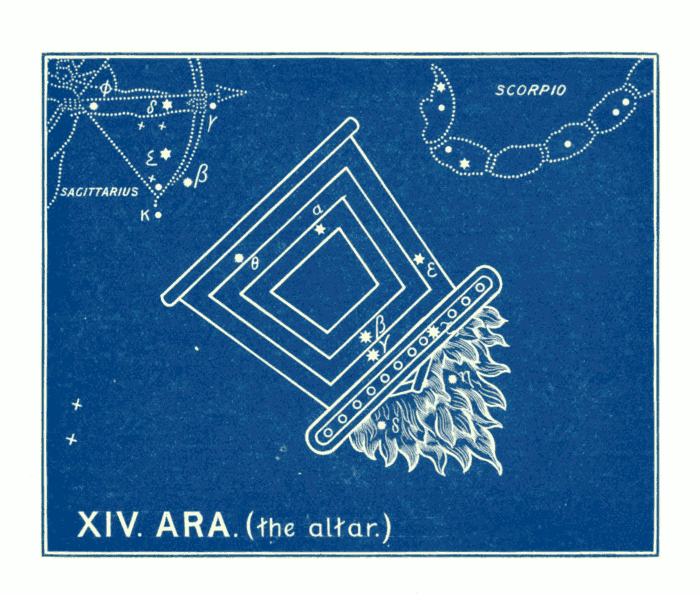
Here we have an altar or burning pyre, placed significantly and ominously upside down! with its fires burning and pointing downwards towards the lower regions, called Tartarus, or the abyss, or “outer-darkness.”

Plate 14: ARA (the Altar)

It is an asterism with nine stars, of which three are of the 3rd magnitude, four of the 4th, etc. It is south of the Scorpion’s tail, and when these constellations were first formed it was visible only on the very lowest horizon of the south, pointing to the completion of all judgment in the lake of fire.

In the Zodiac of Denderah we have a different picture, giving us another aspect of the same judgment. It is a man enthroned, with a flail in his hand. His name is Bau, the same name as Hercules has, and means He cometh. It is from the Hebrew בּוֹא (Bōh), to come, as in Isa. lxiii. 1:

“Who is this that cometh from Edom,

With dyed garments from Bozrah.”

This is a coming in judgment, as is clear from reason given in verse 4:

“For the day of vengeance is in Mine heart,

And the year of My redeemed is come.

And I looked, and there was none to help;

And I wondered that there was none to uphold;

Therefore Mine own arm brought salvation,

And My fury, it upheld Me.”

(Isa. lxiii. 4, 5.)

The completion of judgment, therefore, is what is pictured both by the burning pyre and the Coming One enthroned, with his threshing instrument.

In Arabic it is called Al Mugamra, which means the completing, or finishing. The Greeks used the word Ara sometimes in the sense of praying, but more frequently in the sense of imprecation or cursing.

This is the curse pronounced against the great enemy. This is the burning fire, pointing to the completion of that curse, when he shall be cast into that everlasting fire “prepared for the devil and his angels.” This is the allusion to it written in the midst of the very Scripture from which we have already quoted, Ps. xxi., where we read in verse 9 (which we then omitted): —

“Thou shalt make them as a fiery oven in the time of Thine anger:

The Lord shall swallow them up in His wrath;

And the fire shall devour them.”

This brings us to the final scene, closing up this first great book of the Heavens.
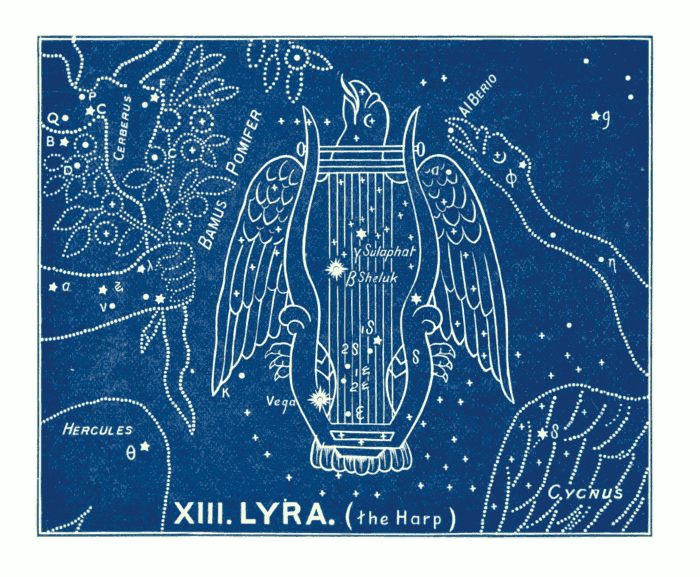
Witness of the Stars: Lyra (the Harp)

1. LYRA (The Harp)

Praise prepared for the Conqueror.

“Praise waiteth for thee, O God, in Zion” (Ps. lxv. 1). And when the waiting time is over, and the Redeemer comes forth, then the praise shall be given. “We give Thee thanks, O Lord God, the Almighty, which art, and which wast, because thou hast taken to Thee Thy great power, and didst reign” (Rev. xi. 17, r.v.). “Let us be glad and rejoice and give honour unto Him” (Rev. xix. 7). The Twenty-first Psalm should be read here, as it tells of the bursting forth of praise on the going forth of this all-gracious Conqueror.

“The King shall rejoice in Thy strength, O Lord;

And in Thy salvation how greatly shall He rejoice!…

Thine hand shall find out all Thine enemies;

Thy right hand shall find out all that hate thee….

Their fruit shalt Thou destroy from the earth;

And their seed from among the children of men.

For they intended evil against Thee;

They imagined a mischievous device which they are not able to perform,

Therefore shalt thou make them turn their back (Heb. Margin, set them as a butt),

When Thou shalt make ready Thine arrows upon Thy strings

[And shoot them] against the face of them.

Be thou exalted, Lord, in thine own strength;

SO WILL WE SING AND PRAISE THY POWER.”

(Ps. xxi. 1, 8, 10-13.)

Beautifully, then, does the harp come in here, following upon the going forth of this victorious Horseman. This Song of the Lamb follows as naturally as does the Song of Moses in Ex. xv. 1: “I will sing unto the Lord, for He hath triumphed gloriously.”

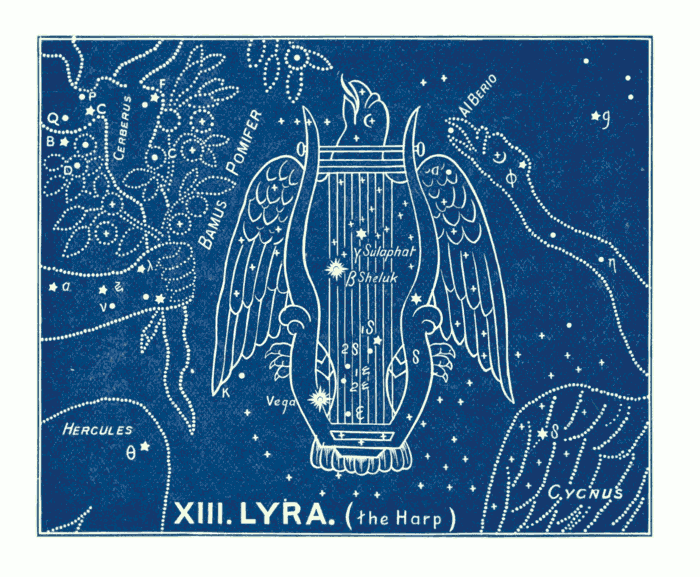
Plate 13: LYRA (the Harp)

Its brightest star, α, is one of the most glorious in the heavens, and by it this constellation may be easily known. It shines with a splendid white lustre. It is called Vega, which means He shall be exalted. Its root occurs in the opening of the Song of Moses, quoted above. Is not this wonderfully expressive?

Its other stars, β and γ, are also conspicuous stars, of the 2nd and 4th magnitude. β is called Shelyuk, which means an eagle (as does the Arabic, Al Nesr); γ is called Sulaphatspringing up, or ascending, as praise.

In the Zodiac of Denderah, this constellation is figured as a hawk or an eagle (the enemy of the serpent) in triumph. Its name is Fent-kar, which means the serpent ruled.

There may be some confusion between the Hebrew נֶשֶׁר, Nesheran eagle, and עָשׂוֹר, Gnasora harp; but there can be no doubt about the grand central truth, that praise shall ascend up “as an eagle toward heaven,” when “every creature which is in heaven, and on the earth, and such as are in the sea, and all that is in them,” shall send up their universal song of praise: “Blessing, and honour, and glory, and power, be unto Him that sitteth upon the throne and unto the Lamb for ever and ever. Amen” (Rev. v. 13, 14).

And for what is all this wondrous anthem of Praise? Listen once again. “Alleluia: Salvation, and glory, and honour, and power, unto the Lord our God; for TRUE AND RIGHTEOUS ARE HIS JUDGMENTS…. And again they said Alleluia” (Rev. xix. 1-3).

With “that blessed hope” before us,

Let no harp remain unstrung,

Let the coming advent chorus

Onward roll from tongue to tongue, Hallelujah,

“Come, Lord Jesus,” quickly come.

Witness of the Stars: SERPENS and OPHIUCHUS

The Struggle with the Enemy

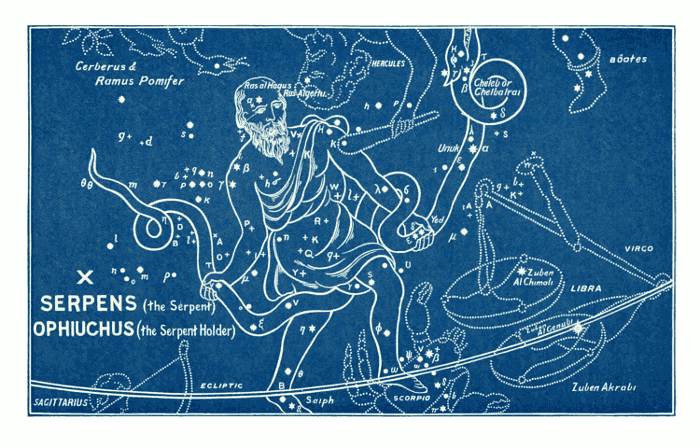
Here, Serpens, the serpent, is seen struggling vainly in the powerful grasp of the man who is named O-phi-u-chus. In Latin he is called Serpentarius. He is at one and the same moment shown to be seizing the serpent with his two hands, and treading on the very heart of the scorpion, marked by the deep red star Antares (wounding).

Just as we read the first constellation of the woman and child Coma, as expounding the first sign Virgo, so we have to read this first constellation as expounding the second sign Libra. Hence, we have here a further picture, showing the object of this conflict on the part of the scorpion.

In Scorpio we see merely the effort to wound Ophiuchus in the heel; but here we see the effort of the serpent to seize the Crown, which is situated immediately over the serpent’s head, and to which he is looking up and reaching forth.

The contest is for Dominion! It was the Devil, in the form of a serpent, that robbed the first man of his crown; but in vain he struggled to wrest it from the sure possession of the Second Man. Not only does he fail in the attempt, but is himself utterly defeated and trodden under foot.

Plate 10: SERPENS (the Serpent) and OPHIUCHUS (the Serpent Holder)

There are no less than 134 stars in these two constellations. Two are of the 2nd magnitude, fourteen of the 3rd, thirteen of the 4th, etc.

The brightest star in the Serpent, α (in the neck), is named Unuk, which means encompassing. Another Hebrew name is Alyahthe accursed. From this is Al Hay (Arabic), the reptile. The next brightest star is β (in the jaw), named, in Arabic, Cheleb, or Chelbalrai, the serpent enfolding. The Greek name, Ophiuchus, is itself from the Hebrew and Arabic name Afeichus, which means the serpent held. The brightest star in Ophiuchus, α (in the head), is called Ras al Hagus (Arabic), the head of him who holds.

Other Hebrew names of stars, not identified, are Triophastreading under footSaiph (in the foot of Ophiuchus), bruisedCarnebusthe woundingMegeroscontending. In the Zodiac of Denderah we have a throned human figure, called Api-bauthe chief who cometh. He has a hawk’s head to show that he is the enemy of the serpent, which is called Khu, and means ruled or enemy.

All these combines to set before us in detail the nature of the conflict and its final issue. That final issue is, however, exhibited by the last of the three constellations of this chapter. The Victor Himself requires a whole picture to fully set forth the glorious victory.