Understanding Biblical Warnings Against Superstitions
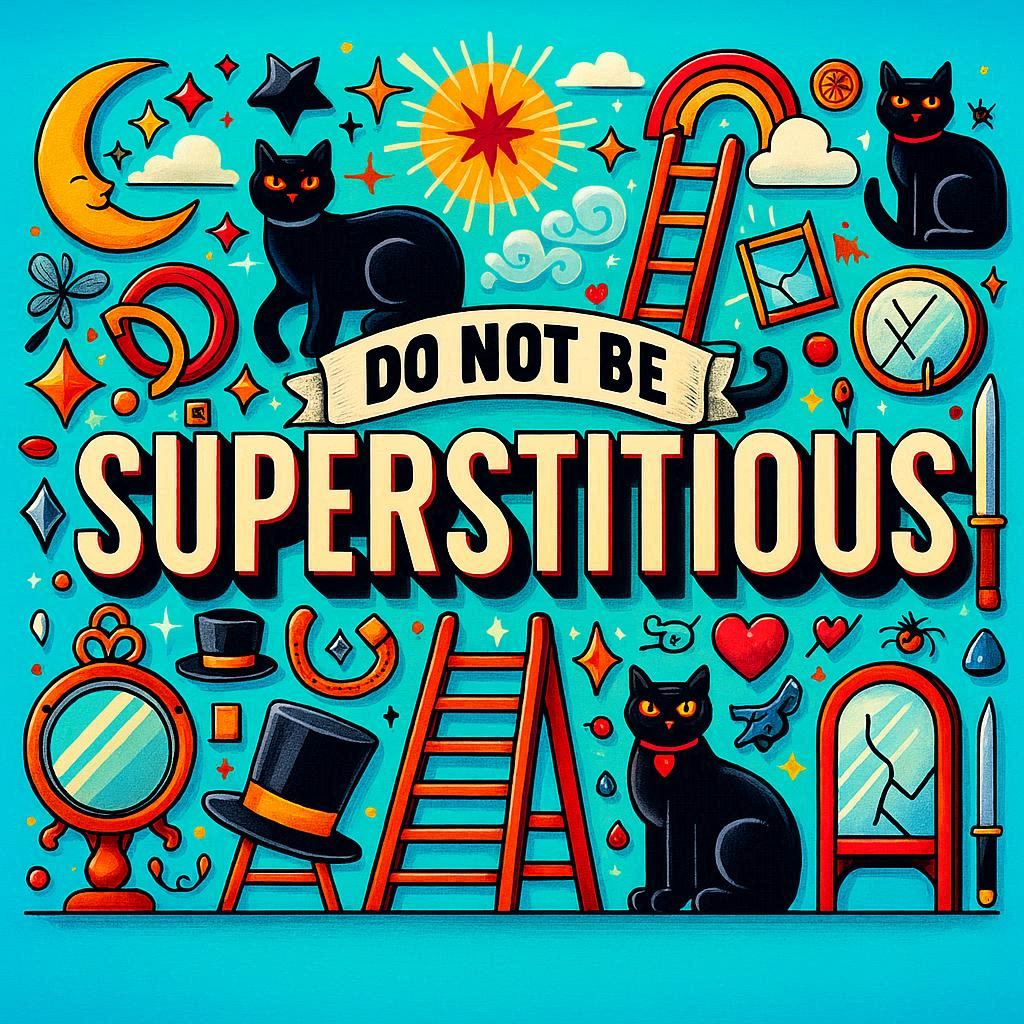
One of the commandments in the Old Testament is a command telling us not to be superstitious.
Leviticus 19:26
- KJV
- Ye shall not eat anything with the blood: neither shall ye use enchantment, nor observe times.
- Amp version
- ‘You shall not eat anything with the blood, nor practice divination [using omens or witchcraft] or soothsaying.
- Complete Jewish Bible
- “‘Do not eat anything with blood. Do not practice divination or fortune-telling.
- Christian Standard Bible
- “You are not to eat anything with blood in it. You are not to practice divination or witchcraft.
Vocabulary words:
- superstitious
- of, relating to, or swayed by superstition
- a superstitious ritual
- observe tmes
- enchantment
Here are some more verses about superstitions.
- 1 Timothy 4:7 ESV
- Have nothing to do with irreverent, silly myths. Rather train yourself for godliness;
- Deuteronomy 18:10-12 ESV
- There shall not be found among you anyone who burns his son or his daughter as an offering, anyone who practices divination or tells fortunes or interprets omens, or a sorcerer or a charmer or a medium or a necromancer or one who inquires of the dead, for whoever does these things is an abomination to the Lord. And because of these abominations the Lord your God is driving them out before you.
- Leviticus 19:31 ESV
- “Do not turn to mediums or necromancers; do not seek them out, and so make yourselves unclean by them: I am the Lord your God.
- Colossians 2:8-10 ESV
- See to it that no one takes you captive by philosophy and empty deceit, according to human tradition, according to the elemental spirits of the world, and not according to Christ. For in him the whole fullness of deity dwells bodily, and you have been filled in him, who is the head of all rule and authority.
- 1 Timothy 1:3-4 ESV
- As I urged you when I was going to Macedonia, remain at Ephesus so that you may charge certain persons not to teach any different doctrine, nor to devote themselves to myths and endless genealogies, which promote speculations rather than the stewardship from God that is by faith.
We are called to walk by faith in the knowledge of our savior Jesus Christ. We are commanded in both the Old and New Testament to avoid all things connected with superstition. Superstitious actions are connected with witchcraft and idolatry. When you put your trust in anything or ritual you are not fully trusting in God.
Common superstitions include beliefs like avoiding black cats, not walking under ladders, and throwing salt over your shoulder, often rooted in cultural traditions and historical fears.
Popular Superstitions
- Walking Under a Ladder: Considered bad luck, this superstition stems from the triangular shape formed by a ladder against a wall, which was seen as sacred in ancient cultures. Breaking this triangle was thought to invite misfortune.
- Black Cats: In many Western cultures, a black cat crossing your path is seen as a sign of bad luck, often associated with witchcraft. However, in some cultures, black cats are considered good luck.
- Breaking a Mirror: This superstition suggests that breaking a mirror brings seven years of bad luck, as mirrors were once believed to reflect not just one’s image but also one’s soul.
- Throwing Salt Over Your Shoulder: Spilling salt is thought to bring bad luck, but tossing a pinch over your left shoulder is believed to ward off evil spirits lurking there.
- Opening an Umbrella Indoors: This is considered bad luck, possibly due to the practical dangers of opening an umbrella in a confined space, which could cause accidents.
- Friday the 13th: Many people consider this day to be unlucky, stemming from various historical and cultural beliefs about the number 13 and its associations with misfortune.
- Avoiding the Number 13: Many buildings skip the 13th floor, and some people avoid the number altogether due to its negative connotations in various cultures.
- Never Stick Chopsticks Upright: In China and Japan, sticking chopsticks upright in rice is a taboo, as it resembles incense sticks used at funerals, inviting death.
- Beginner’s Luck is a “Thing”: “Beginner’s luck” is the idea that people new to a sport or game are likely to win when they try it out for the first time. It could very well be that beginners simply do better because they aren’t as stressed out about winning. Experts say that too much anxiety can hamper performance.
- Knock on Wood or “Touch Wood” To Prevent Bad Luck
- Druids and Pagan cultures believed that knocking on wood would enlist the help of tree gods.
- You have probably performed this ritual a thousand times: You just finished the sentence that you never get sick, or that your car never breaks down, then you immediately search for something that’s made of wood so you can give it a few taps with your knuckles.
- There are several theories of where this originated, but most agree that this belief started with the Druids. Their idea of divinity involved nature and the trees were their gods. Knocking on wood was considered a form of physical contact with them, which brought along good fortune. Most Pagan cultures around the ancient world also believed that trees were inhabited by spirits, so it was thought that by simply knocking on the bark of a tree, you could stir the aid of the nature spirit residing within. It’s unlikely that knocking on wood does little more than send people to the front door looking for the pizza guy.
- Crossing Your Fingers Brings Good Luck
- Ever wish or hope for something and then cross your fingers? The reason for this was that it is believed that bad luck is trapped at the point where the two fingers meet so when we cross our fingers, we stop the bad luck from escaping and allow our wishes to come true. Not very likely, but it’s still one we almost all practice.
- Ever wish or hope for something and then cross your fingers? The reason for this was that it is believed that bad luck is trapped at the point where the two fingers meet so when we cross our fingers, we stop the bad luck from escaping and allow our wishes to come true. Not very likely, but it’s still one we almost all practice.
If you are guilty of any of these, repent today. We are called to follow God not superstitions.
 articlesforchristians