Witness of the Star: ORION (The Coming Prince)
1. ORION (The Coming Prince)
Light Breaking Forth in the Redeemer.
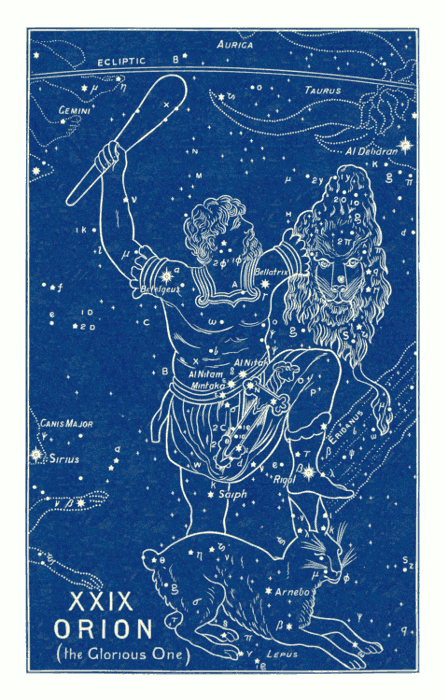
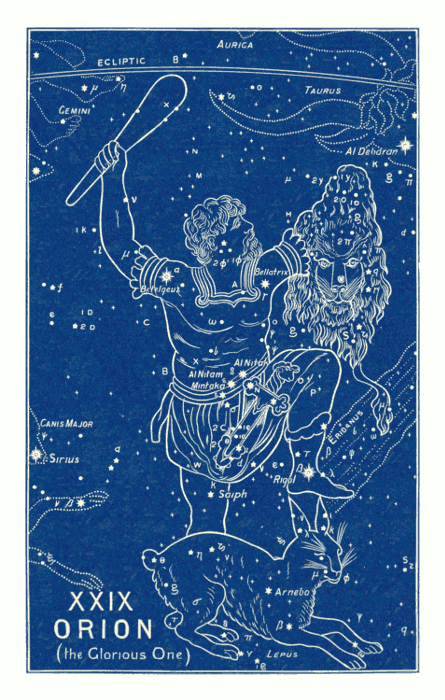
This picture is to show that the coming one is no mere animal, but a man: a mighty, triumphant, glorious prince.
He is so pictured in the ancient Denderah Zodiac, where we see a man coming forth pointing to the three bright stars (Rigel, Bellatrix, and Betelguez) as his. His name is given as Ha-ga-t, which means this is he who triumphs. The hieroglyphic characters below read Oar. Orion was anciently spelt Oarion, from the Hebrew root, which means light. So that Orion means coming forth as light. The ancient Akkadian was Ur-ana, the light of heaven.
Orion is the most brilliant of all the constellations, and when he comes to the meridian he is accompanied by several adjacent constellations of great splendour. There is then above the horizon the most glorious view of the celestial bodies that the starry firmament affords; and this magnificent view is visible to all the habitable world, because the equinoctial line (or solstitial colure) passes nearly through the middle of Orion.
Aratus thus sings of him:—
“Eastward, beyond the region of the Bull,
Stands great Orion. And who, when night is clear,
Beholds him gleaming bright, shall cast his eyes in vain
To find a Sign more glorious in all heaven.”
The constellation is mentioned by name, as being perfectly well known both by name and appearance, in the time of Job; and as being an object of familiar knowledge at that early period of the world’s history. See Job ix. 9; xxxviii. 31, and Amos v. 8 (Heb. כְּסִיל, Chesil, which means a strong one, a hero, or giant).
It contains 78 stars, two being of the 1st magnitude, four of the 2nd, four of the 3rd, sixteen of the 4th, etc.
A little way below ι (in the sword) is a very remarkable nebulous star. A common telescope will show that it is a beautiful nebula. A powerful telescope reveals it as consisting of collections of nebulous stars, these again being surrounded by faint luminous points, which still more powerful telescopes would resolve into separate stars.
Thus, beautifully is set forth the brilliancy and glory of that Light which shall break forth when the moment comes for it to be said, “Arise, shine, for thy light is come.”
The picture presents us with “the Light of the world.” His left foot is significantly placed upon the head of the enemy. He is girded with a glorious girdle, studded with three brilliant stars; and upon this girdle is hung a sharp sword. Its handle proves that this mighty Prince is come forth in a new character. He is again proved to be “the Lamb that was slain,” for the hilt of this sword is in the form of the head and body of a lamb. In his right hand he lifts on high his mighty club; while in his left he holds forth the token of his victory—the head and skin of the “roaring lion.” We ask in wonder, “Who is this?” and the names of the stars give us the answer.
The brightest, α (in the right shoulder), is named Betelgeuz, which means the coming (Mal. iii. 2) of the branch.
The next, β (in the left foot), is named Rigel, or Rigol, which means the foot that crusheth. The foot is lifted up, and placed immediately over the head of the enemy, as though in the very act of crushing it. Thus, the name of the star bespeaks the act.
The next star, γ (in the left shoulder), is called Bellatrix, which means quickly coming, or swiftly destroying.
The name of the fourth star, δ (one of the three in the belt), carries us back to the old, old story, that this glorious One was once humbled; that His heel was once bruised. Its name is Al Nitak, the wounded One. Similarly the star κ (in the right leg) is called Saiph, bruised, which is the very word used in Gen. iii. 15, thus connecting Orion with the primeval prophecy. Like Ophiuchus, he has one leg bruised; while, with the other, he is crushing the enemy under foot.
This is betokened by other stars, not identified, named Al Rai, who bruises, who breaks (as in Cepheus); and Thabit (Hebrew), treading on.
Other (Arabic) names relate to His Person: Al Giauzâ, the branch; Al Gebor, the mighty; Al Mirzam, the ruler; Al Nagjed, the prince; Niphla (Chaldee), the mighty; Nux (Hebrew), the strong.
Some names relate to His coming, as Betelgeuse and Bellatrix, as above; Heka (Chaldee), coming; and Meissa (Hebrew), coming forth.
Such is the cumulative testimony of Orion’s stars, which, day after day, and night after night, show forth this knowledge. That testimony was afterwards written in the Book. The Prince of Glory, who was once wounded for the sins of His redeemed, is about to rise up and shine forth for their deliverance. Their redemption draweth nigh; for—
“The Lord shall go forth as a mighty man,
He shall stir up jealousy like a man of war;
He shall cry, yea, roar;
He shall prevail against His enemies.
I have [He says] long time holden my peace;
I have been still, and refrained myself:
Now will I cry like a travailing woman;
I will destroy and devour at once.”
(Isa. xlii. 13, 14.)
Then it will be said to His people (and the setting of the prophecy in its beautiful introverted structure shows us the beauty and glory of the truth it reveals):
a | Arise,
b | Shine; for thy light is come,
c | And the glory of the Lord is risen upon thee.
d | For, behold, the darkness shall cover the earth,
d | And gross darkness the people;
c | But the Lord shall arise upon thee, and His gloryshall be seen upon thee.
b | And the Gentiles shall come to thy light,
a | And kings to the brightness of thy rising.
(Isa. lx. 1-3.)
This is “the glory of God” which the heavens constantly declare (Ps. xix. 1). They tell of that blessed time when the whole earth shall be filled with His glory (Num. xiv. 21; Isa. xi. 9); when “the glory of the Lord shall be revealed, and all flesh shall see it together” (Isa. xl. 5), as all see now the beauty of Orion’s glory.
But side by side with the glory which the coming Light of the world shall bring for His people, there is “that wicked,” whom the Lord “shall destroy with the brightness of His coming.” Hence, as in the concluding chapter (IV.) of the First Book (of which this Third Book is the expansion) we had in Lyra (the harp), as § 1, Praise prepared for the Conqueror; and in ARA (the burning pyre), as § 2, Consuming fire prepared for His enemies: so in the first chapter of this book, we have in ORION, as § 1, Glory prepared for the Conqueror; and in ERIDANUS, as § 2, the River of wrath prepared for His enemies.
 articlesforchristians