The Symbol of the Cross in the Old Testament
Believers agree that Christ was crucified on some form of cross, though opinions differ on the exact type used. There are generally four main beliefs about the specific kind of cross in question.
- The cross was the traditional cross with a long vertical beam and a cross beam, which we see in pictures.
- The cross was a T shape, with the cross beam placed on top of the pole.
- The cross was actually a tree with the top crossbeam placed on two branches of the tree.
- The cross was a long pole placed in the ground, and Christ’s hands and feet were nailed to it.
While the design or style of the cross matters less than the event it represents, there are five symbolic images of the cross found throughout the Old Testament and across the 1,500-year span of the law and the prophets.
Passover:
At the Passover, the blood was placed on the left and right side posts the center archway above the entrance
- Exodus 12:7 And they shall take of the blood, and strike it on the two side posts and on the upper door post of the houses, wherein they shall eat it.
These three marks of blood on the outside of the door were positioned in the same manner as the three crosses on
Golgotha-a man on the left and right, with Christ in the center.
- John 19:18 Where they crucified him, and two other with him, on either side one, and Jesus in the midst.
At the Exodus Passover, no blood was placed upon the floor at the entrance, as the family would be “trampling the blood of the lamb under their feet” when they departed. The writer of Hebrews alluded to a backslider and his severe punishment when he wrote,
- Heb. 10:29
- Of how much sorer punishment, suppose ye, shall he be thought worthy, who hath trodden under foot the Son of God, and hath counted the blood of the covenant, wherewith he was sanctified, an unholy thing, and hath done despite unto the Spirit of grace?
The three marks on the door pictured the three crosses on Golgotha.
The Camp of Israel:
The tabernacle stood at the center of the camp, with the twelve tribes divided into four groups: three to the north, three to the south, three to the east, and three to the west. From high above, the encampment of Israel would appear as a massive cross, with the tabernacle serving as the “heart” of it all.
The Brass Serpent:
Moses constructed a brass serpent and wrapped it around a pole.
- Num. 21:9
- And Moses made a serpent of brass, and put it upon a pole, and it came to pass, that if a serpent had bitten any man, when he beheld the serpent of brass, he lived.
We are uncertain about whether the pole had a cross beam at the top. However, Christ stated that as Moses lifted the serpent in the wilderness, so He too would be lifted up (on the cross) to draw men to Him.
- John 3:14
- And as Moses lifted up the serpent in the wilderness, even so must the Son of man be lifted up:
- John 12:32
- And I, if I be lifted up from the earth, will draw all men unto me.
Thus, the brass serpent becomes a type of Christ, bearing our sins on the cross.
The Furniture of the Tabernacle:
The positioning of the sacred furniture are all positioned in a certain manner inside the tabernacle curtains.
- the brass altar and laver
- the showbread table
- menorah, golden altar
- the Ark of the Covenant
When a person views the furniture from above the tent, it is positioned in the form of a cross.
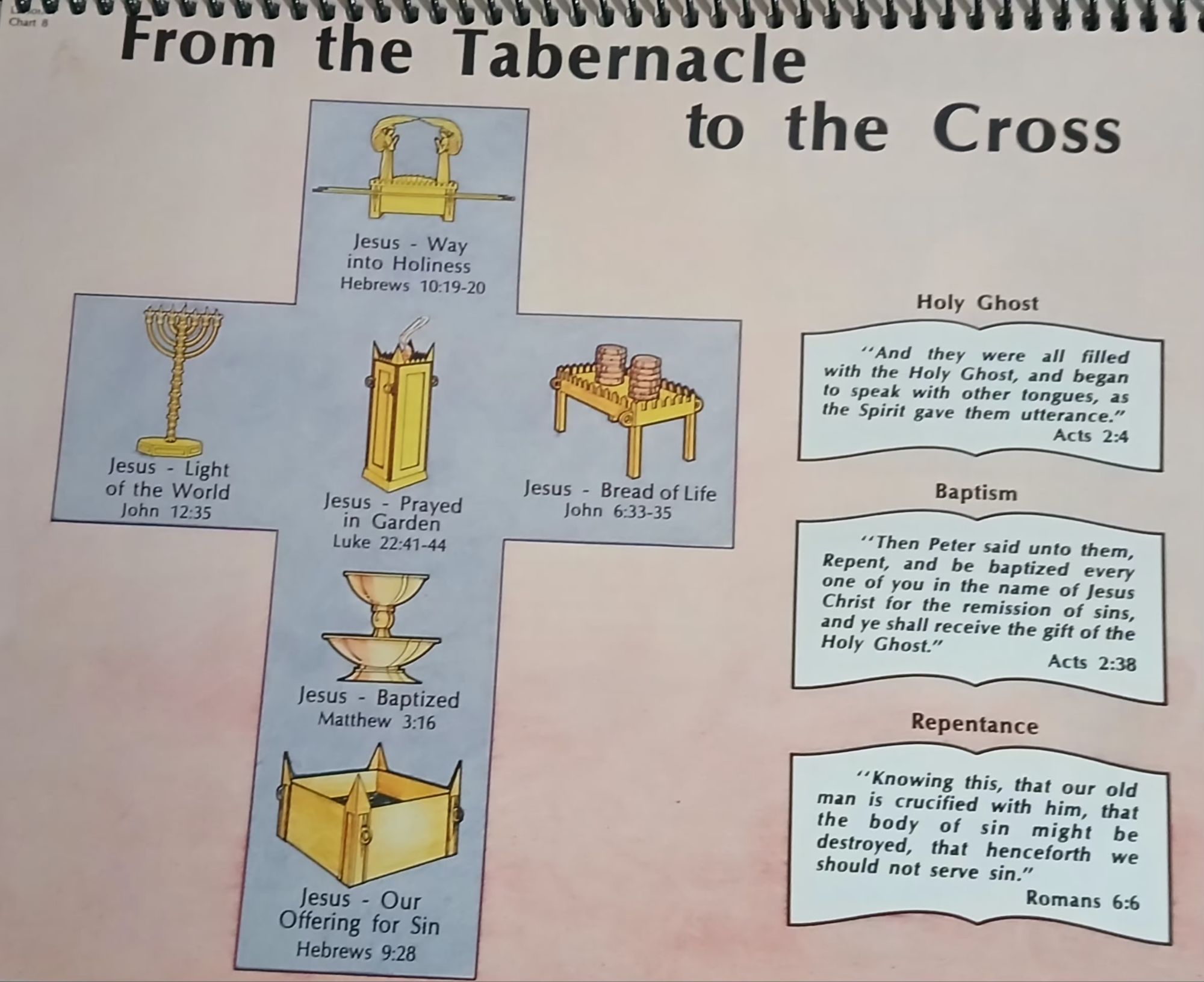
The brass laver is the “foot” of the cross, the showbread and menorah are the two hands, and the Ark
of the Covenant becomes the head, or top area of a cross imagery.
- Exodos 40:1-3
- Then the Lord spoke to Moses, saying,
- “On the first day of the first month (Abib) you shall set up the tabernacle of the Tent of Meeting [of God with you].
- You shall place the ark of the Testimony there, and you shall screen off the ark [from the Holy Place of God’s Presence] with the veil (partition curtain).
- Then the Lord spoke to Moses, saying,
The Hebrew Letter Tav:
The last letter of the Hebrew alphabet is the letter Tav. The earliest form of Hebrew was written in picture form, but over the centuries the form of the letters has changed. Today, the form is an Aramaic square script in the Torah Scrolls.
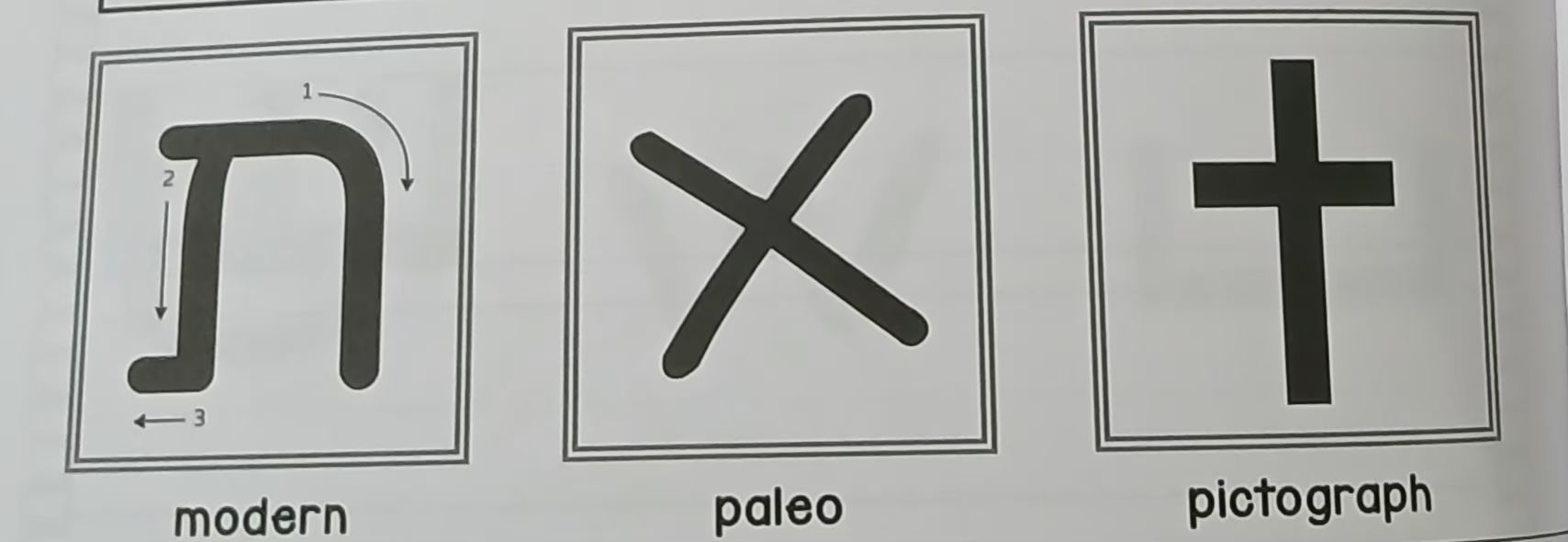
In Hebrew each letter has a meaning.
Tav means:
- mark
- sign
- covenant
The letter Tav is believed to have been the “mark” placed on the foreheads of the righteous by the angel of the Lord in Ezekiel.
This because the word mark in Ezekiel 9:4 and 9:6 is the Hebrew letter Tav. Thus, the symbol of the cross was used as a protective mark during the time of Ezekiel to separate the righteous from the unrighteous.
- Ezekiel 9:4-6
- The Lord said to him, “Go through the midst of the city, throughout all of Jerusalem, and put a mark on the foreheads of the men who sigh [in distress] and grieve over all the repulsive acts which are being committed in it.”
- But to the others I heard Him say, “Follow him [the man with the scribe’s writing case] throughout the city and strike; do not let your eyes have pity and do not spare [anyone].
- Utterly slay old men, young men, maidens, little children, and women; but do not touch or go near anyone on whom is the mark. Begin at My sanctuary.” So they began with the old men who were in front of the temple [who did not have the Lord’s mark on their foreheads].
 articlesforchristians