In the time of the Judges in Israel, a man named Elimelech was living in the town of Bethlehem, in the tribe of Judah, about six miles south of Jerusalem. His wife’s name was Naomi, and his two sons were Mahlon and Chilion. For some years the crops were poor, and food was scarce in Judah; and Elimelech with his family went to live in the land of Moab, which was on the east of the Dead Sea, as Judah was on the west.
There they stayed ten years, and in that time Elimelech died. His two sons married women of the country of Moab, one named Orpah, the other named Ruth. But the two young men also died in the land of Moab; so that Naomi and her two daughters-in-law were all left widows.
Naomi heard that God had again given good harvests and bread to the land of Judah, and she rose up to go from Moab back to her own land and her own town of Bethlehem. The two daughters-in-law loved her, and both would have gone with her, though the land of Judah was a strange land to them, for they were of the Moabite people.
Naomi said to them: “Go back, my daughters, to your own mothers’ homes. May the Lord deal kindly with you, as you have been kind to your husbands and to me. May the Lord grant that each of you may yet find another husband and a happy home.”
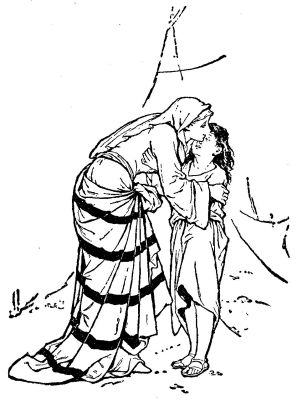
Then Naomi kissed them in farewell, and the three women all wept together. The two young widows said to her:
“You have been a good mother to us, and we will go with you, and live among your people.”
“No, no,” said Naomi. “You are young, and I am old. Go back and be happy among your own people.”
Then Orpah kissed Naomi, and went back to her people; but Ruth would not leave her. She said:
“Do not ask me to leave you, for I never will. Where you go, I will go; where you live, I will live; your people shall be my people; and your God shall be my God. Where you die, I will die, and be buried. Nothing but death itself shall part you and me.”
When Naomi saw that Ruth was firm in her purpose, she ceased trying to persuade her; so the two women went on together. They walked around the Dead Sea, and crossed the river Jordan, and climbed the mountains of Judah, and came to Bethlehem.
Naomi had been absent from Bethlehem for ten years, but her friends were all glad to see her again. They said:
“Is this Naomi, whom we knew years ago?”
Now the name Naomi means “pleasant.” And Naomi said:
“Call me not Naomi; call me Mara, for the Lord has made my life bitter. I went out full, with my husband and two sons; now I come home empty, without them. Do not call me ‘Pleasant,’ call me ‘Bitter.'”
The name “Mara,” by which Naomi wished to be called means “bitter.” But Naomi learned later that “Pleasant” was the right name after all.
There was living in Bethlehem at that time a very rich man named Boaz. He owned large fields that were abundant in their harvests; and he was related to the family of Elimelech, Naomi’s husband, who had died.
It was the custom in Israel when they reaped the grain not to gather all the stalks, but to leave some for the poor people, who followed after the reapers with their sickles, and gathered what was left. When Naomi and Ruth came to Bethlehem, it was the time of the barley harvest; and Ruth went out into the fields to glean the grain which the reapers had left. It so happened that she was gleaning in the field that belonged to Boaz, this rich man.
Boaz came out from the town to see his men reaping, and he said to them, “The Lord be with you”; and they answered him, “The Lord bless you.”
And Boaz said to his master of the reapers: “Who is this young woman that I see gleaning in the field?”
The man answered: “It is the young woman from the land of Moab, who came with Naomi. She asked leave to glean after the reapers, and has been here gathering grain since yesterday.”
Then Boaz said to Ruth: “Listen to me, my daughter. Do not go to any other field, but stay here with my young women. No one shall harm you; and when you are thirsty, go and drink at our vessels of water.”
Ruth went out into the fields to glean the grain
Then Ruth bowed to Boaz, and thanked him for his kindness, all the more kind because she was a stranger in Israel. Boaz said: “I have heard how true you have been to your mother-in-law Naomi, in leaving your own land and coming with her to this land. May the Lord, under whose wings you have come, give you a reward!”
And at noon, when they sat down to rest and to eat, Boaz gave her some of the food. And he said to the reapers:
“When you are reaping, leave some of the sheaves for her; and drop out some sheaves from the bundles, where she may gather them.”
That evening, Ruth showed Naomi how much she had gleaned, and told her of the rich man Boaz, who had been so kind to her. And Naomi said:
“This man is a near relation of ours. Stay in his fields, as long as the harvest lasts.” And so Ruth gleaned in the fields of Boaz until the harvest had been gathered.
At the end of the harvest, Boaz held a feast on the threshing-floor. And after the feast, by the advice of Naomi, Ruth went to him, and said to him:
“You are a near relation of my husband and of his father, Elimelech. Now will you not do good to us for his sake?”
And when Boaz saw Ruth, he loved her; and soon after this he took her as his wife. And Naomi and Ruth went to live in his home; so that Naomi’s life was no more bitter, but pleasant. And Boaz and Ruth had a son, whom they named Obed; and later Obed had a son named Jesse; and Jesse was the father of David, the shepherd boy who became king. So Ruth, the young woman of Moab, who chose the people and the God of Israel, became the mother of kings.
After Esau found that he had lost his birthright and his blessing, he was very angry against his brother Jacob; and he said to himself, and told others:
“My father Isaac is very old and cannot live long. As soon as he is dead, then I shall kill Jacob for having robbed me of my right.”
When Rebekah heard this, she said to Jacob, “Before it is too late, do you go away from home and get out of Esau’s sight. Perhaps when Esau sees you no longer, he will forget his anger, and then you can come home again. Go and visit my brother Laban, your uncle, in Haran, and stay with him for a little while.”
We must remember that Rebekah came from the family of Nahor, Abraham’s younger brother, who lived in Haran, a long distance to the northeast of Canaan, and that Laban was Rebekah’s brother.
So Jacob went out of Beersheba, on the border of the desert, and walked alone, carrying his staff in his hand. One evening, just about sunset, he came to a place among the mountains, more than sixty miles distant from his home. And as he had no bed to lie down upon, he took a stone and rested his head upon it for a pillow, and lay down to sleep.
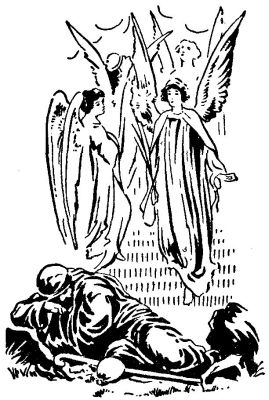
Angels were upon the stairs
And on that night Jacob had a wonderful dream. In his dream he saw stairs leading from the earth where he lay up to heaven; and angels were going up and coming down upon the stairs. And above the stairs, he saw the Lord God standing. And God said to Jacob:
“I am the Lord, the God of Abraham, and the God of Isaac your father; and I will be your God, too. The land where you are lying all alone, shall belong to you and to your children after you; and your children shall spread abroad over the lands, east and west, and north and south, like the dust of the earth; and in your family all the world shall receive a blessing. And I am with you in your journey, and I will keep you where you are going, and will bring you back to this land. I will never leave you, and I will surely keep my promise to you.”
And in the morning Jacob awakened from his sleep, and he said:
“Surely, the Lord is in this place, and I did not know it! I thought that I was all alone, but God has been with me. This place is the house of God; it is the gate of heaven!”
And Jacob took the stone on which his head had rested, and he set it up as a pillar, and poured oil on it as an offering to God. And Jacob named that place Bethel, which in the language that Jacob spoke means “The House of God.”
And Jacob made a promise to God at that time, and said:
“If God really will go with me and will keep me in the way that I go, and will give me bread to eat and will bring me to my father’s house in peace, then the Lord shall be my God: and this stone shall be the house of God, and of all that God gives me I will give back to God one-tenth as an offering.”
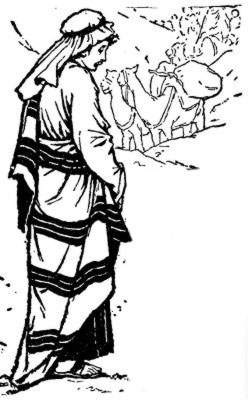
Then Jacob went onward in his long journey. He walked across the river Jordan in a shallow place, feeling his way with his staff; he climbed mountains and journeyed beside the great desert on the east, and at last came to the city of Haran. Beside the city was the well, where Abraham’s servant had met Jacob’s mother, Rebekah; and there, after Jacob had waited for a time, he saw a young woman coming with her sheep to give them water.
Then Jacob took off the flat stone that was over the mouth of the well, and drew water and gave it to the sheep. And when he found that this young woman was his own cousin Rachel, the daughter of Laban, he was so glad that he wept for joy. And at that moment he began to love Rachel, and longed to have her for his wife.
Jacob went onward in his long journey
Rachel’s father, Laban, who was Jacob’s uncle, gave a welcome to Jacob, and took him into his home.
And Jacob asked Laban if he would give his daughter, Rachel, to him as his wife; and Jacob said, “If you give me Rachel, I will work for you seven years.”
And Laban said, “It is better that you should have her, than that a stranger should marry her.”
So Jacob lived seven years in Laban’s house, caring for his sheep and oxen and camels; but his love for Rachel made the time seem short.
At last the day came for the marriage; and they brought in the bride, who, after the manner of that land, was covered with a thick veil, so that her face could not be seen. And she was married to Jacob, and when Jacob lifted up her veil he found that he had married, not Rachel, but her older sister, Leah, who was not beautiful, and whom Jacob did not love at all.
Jacob was very angry that he had been deceived,—though that was just the way in which Jacob himself had deceived his father and cheated his brother Esau. But his uncle Laban said:
“In our land we never allow the younger daughter to be married before the older daughter. Keep Leah for your wife, and work for me seven years longer, and you shall have Rachel also.”
For in those times, as we have seen, men often had two wives, or even more than two. So Jacob stayed seven years more, fourteen years in all, before he received Rachel as his wife.
While Jacob was living at Haran, eleven sons were born to him. But only one of these was the child of Rachel, whom Jacob loved. This son was Joseph, who was dearer to Jacob than any other of his children, partly because he was the youngest, and because he was the child of his beloved Rachel.
Now we are to learn of three judges who ruled Israel in turn. Their names were Ibzan, Elon, and Abdon. None of these were men of war, and in their days the land was quiet.
But the people of Israel again began to worship idols; and as a punishment God allowed them once more to pass under the power of their enemies. The seventh oppression, which now fell upon Israel, was by far the hardest, the longest and the most widely spread of any, for it was over all the tribes. It came from the Philistines, a strong and warlike people who lived on the west of Israel upon the plain beside the Great Sea. They worshipped an idol called Dagon, which was made in the form of a fish’s head on a man’s body.
These people, the Philistines, sent their armies up from the plain beside the sea to the mountains of Israel and overran all the land. They took away from the Israelites all their swords and spears, so that they could not fight; and they robbed their land of all the crops, so that the people suffered for want of food. And as before, the Israelites in their trouble, cried out to the Lord, and the Lord heard their prayer.
In the tribe-land of Dan, which was next to the country of the Philistines, there was living a man named Manoah. One day an angel came to his wife and said:
“You shall have a son, and when he grows up he will begin to save Israel from the hand of the Philistines. But your son must never drink any wine or strong drink as long as he lives. And his hair must be allowed to grow long and must never be cut, for he shall be a Nazarite under a vow to the Lord.”
When a child was given especially to God, or when a man gave himself to some work for God, he was forbidden to drink wine, and as a sign, his hair was left to grow long while the vow or promise to God was upon him. Such a person as this was called a Nazarite, a word which means “one who has a vow”; and Manoah’s child was to be a Nazarite, and under a vow, as long as he lived.
The child was born and was named Samson. He grew up to become the strongest man of whom the Bible tells. Samson was no general, like Gideon or Jephthah, to call out his people and lead them in war. He did much to set his people free; but all that he did was by his own strength.
When Samson became a young man he went down to Timnath, in the land of the Philistines. There he saw a young Philistine woman whom he loved, and wished to have as his wife. His father and mother were not pleased that he should marry among the enemies of his own people. They did not know that God would make this marriage the means of bringing harm upon the Philistines and of helping the Israelites.
As Samson was going down to Timnath to see this young woman, a hungry lion came out of the mountain, roaring against him. Samson seized the lion, and tore him in pieces as easily as another man would have killed a little kid of the goats, and then went on his way. He made his visit and came home, but said nothing to any one about the lion.
After a time Samson went again to Timnath for his marriage with the Philistine woman. On his way he stopped to look at the dead lion; and in its body he found a swarm of bees, and honey which they had made. He took some of the honey and ate it as he walked, but told no one of it.
At the wedding-feast, which lasted a whole week, there were many Philistine young men, and they amused each other with questions and riddles.
“I will give you a riddle,” said Samson. “If you answer it during the feast, I will give you thirty suits of clothing; and if you cannot answer it then you must give me the thirty suits of clothing.” “Let us hear your riddle,” they said. And this was Samson’s riddle:
“Out of the eater came forth meat, And out of the strong came forth sweetness.”
They could not find the answer, though they tried to find it all that day and the two days that followed. And at last they came to Samson’s wife and said to her:
“Coax your husband to tell you the answer. If you do not find it out, we will set your house on fire, and burn you and all your people.”
And Samson’s wife urged him to tell her the answer. She cried and pleaded with him and said:
“If you really loved me, you would not keep this a secret from me.”
At last Samson yielded, and told his wife how he had killed the lion and afterward found the honey in its body. She told her people, and just before the end of the feast they came to Samson with the answer. They said:
“What is sweeter than honey? And what is stronger than a lion?” And Samson said to them:
“If you had not plowed with my heifer, You had not found out my riddle.”
By his “heifer,”—which is a young cow,—of course Samson meant his wife. Then Samson was required to give them thirty suits of clothing. He went out among the Philistines, killed the first thirty men whom he found, took off their clothes, and gave them to the guests at the feast. But all this made Samson very angry. He left his wife and went home to his father’s house. Then the parents of his wife gave her to another man.
But after a time Samson’s anger passed away, and he went again to Timnath to see his wife. But her father said to him:
“You went away angry, and I supposed that you cared nothing for her. I gave her to another man, and now she is his wife. But here is her younger sister; you can have her for your wife, instead.”
But Samson would not take his wife’s sister. He went out very angry; determined to do harm to the Philistines, because they had cheated him. He caught all the wild foxes that he could find, until he had three hundred of them. Then he tied them together in pairs, by their tails; and between each pair of foxes he tied to their tails a piece of dry wood which he set on fire. These foxes with firebrands on their tails he turned loose among the fields of the Philistines when the grain was ripe. They ran wildly over the fields, set the grain on fire, and burned it; and with the grain the olive trees in the fields.
When the Philistines saw their harvests destroyed, they said, “Who has done this?”
And the people said, “Samson did this, because his wife was given by her father to another man.”
The Philistines looked on Samson’s father-in-law as the cause of their loss; and they came and set his home on fire, and burned the man and his daughter whom Samson had married. Then Samson came down again, and alone fought a company of Philistines, and killed them all, as a punishment for burning his wife.
After this Samson went to live in a hollow place in a split rock, called the rock of Etam. The Philistines came up in a great army, and overran the fields in the tribe-land of Judah.
“Why do you come against us?” asked the men of Judah, “what do you want from us?”
“We have come,” they said, “to bind Samson, and to deal with him as he has dealt with us.”
The men of Judah said to Samson:
“Do you not know that the Philistines are ruling over us? Why do you make them angry by killing their people? You see that we suffer through your pranks. Now we must bind you and give you to the Philistines, or they will ruin us all.”
And Samson said, “I will let you bind me, if you will promise not to kill me yourselves; but only to give me safely into the hands of the Philistines.”
They made the promise; and Samson gave himself up to them, and allowed them to tie him up fast with new ropes. The Philistines shouted for joy as they saw their enemy brought to them, led in bonds by his own people. But as soon as Samson came among them, he burst the bonds as though they had been light strings; and picked up from the ground the jawbone of an ass, and struck right and left with it as with a sword. He killed almost a thousand of the Philistines with this strange weapon. Afterward he sang a song about it, thus:
“With the jawbone of an ass, heaps upon heaps, With the jawbone of an ass, have I slain a thousand men.”
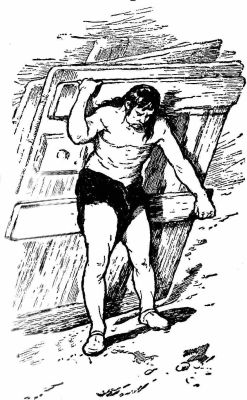
After this Samson went down to the chief city of the Philistines, which was named Gaza. It was a large city; and like all large cities, was surrounded with a high wall. When the men of Gaza found Samson in their city, they shut the gates, thinking that they could now hold him as a prisoner. But in the night Samson rose up, went to the gates, pulled their posts out of the ground, and put the gates with their posts upon his shoulder. He carried off the gates of the city and left them on the top of a hill not far from the city of Hebron.
After this Samson saw another woman among the Philistines, and he loved her. The name of this woman was Delilah. The rulers of the Philistines came to Delilah and said to her:
“Find out, if you can, what it is that makes Samson so strong, and tell us. If you help us to get control of him, so that we can have him in our power, we will give you a great sum of money.”
He carried off the gates of the city
And Delilah coaxed and pleaded with Samson to tell her what it was that made him so strong. Samson said to her:
“If they will tie me with seven green twigs from a tree, then I shall not be strong any more.”
They brought her seven green twigs, like those of a willow tree; and she bound Samson with them while he was asleep. Then she called out to him:
“Wake up, Samson, the Philistines are coming against you!”
And Samson rose up and broke the twigs as easily as if they had been charred in the fire, and went away with ease.
And Delilah tried again to find his secret. She said:
“You are only making fun of me. Now tell me truly how you can be bound.” And Samson said:
“Let them bind me with new ropes that have never been used before; and then I cannot get away.”
While Samson was asleep again, Delilah bound him with new ropes. Then she called out as before:
“Get up, Samson, for the Philistines are coming!” And when Samson rose up, the ropes broke as if they were thread. And Delilah again urged him to tell her; and he said:
“You notice that my long hair is in seven locks. Weave it together in the loom, just as if it were the threads in a piece of cloth.”
Then, while he was asleep, she wove his hair in the loom, and fastened it with a large pin to the weaving-frame. But when he awoke, he rose up, and carried away the pin and the beam of the weaving-frame; for he was as strong as before.
And Delilah, who was anxious to serve her people, said:
“Why do you tell me that you love me, as long as you deceive me and keep from me your secret?” And she pleaded with him day after day, until at last he yielded to her and told her the real secret of his strength. He said:
“I am a Nazarite, under a vow to the Lord, not to drink wine, and not to allow my hair to be cut. If I should let my hair be cut short, then the Lord would forsake me, and my strength would go from me, and I would be like other men.”
Then Delilah knew that she had found the truth at last. She sent for the rulers of the Philistines, saying:
“Come up this once, and you shall have your enemy; for he has told me all that is in his heart.”
Then while the Philistines were watching outside, Delilah let Samson go to sleep, with his head upon her knees. While he was sound asleep, they took a razor and shaved off all his hair. Then she called out as at other times.
“Rise up, Samson, the Philistines are upon you.”
He awoke, and rose up, expecting to find himself strong as before; for he did not at first know that his long hair had been cut off. But the vow to the Lord was broken, and the Lord had left him. He was now as weak as other men, and helpless in the hands of his enemies. The Philistines easily made him their prisoner; and that he might never do them more harm, they put out his eyes. Then they chained him with fetters, and sent him to prison at Gaza. And in the prison they made Samson turn a heavy millstone to grind grain, just as though he were a beast of burden.
But while Samson was in prison, his hair grew long again; and with his hair his strength came back to him; for Samson renewed his vow to the Lord.
One day, a great feast was held by the Philistines in the temple of their fish-god, Dagon. For they said:
“Our god has given Samson, our enemy, into our hand. Let us be glad together and praise Dagon.”
And the temple was thronged with people, and the roof over it was also crowded with more than three thousand men and women. They sent for Samson, to rejoice over him; and Samson was led into the court of the temple, before all the people, to amuse them. After a time, Samson said to the boy who was leading him:
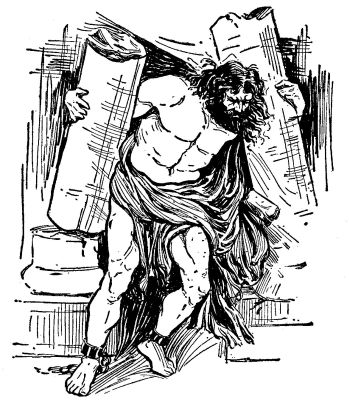
He bowed forward with all his might and pulled the pillars with him
“Take me up to the front of the temple, so that I may stand by one of the pillars, and lean against it.”
And while Samson stood between the two pillars, he prayed:
“O Lord God, remember me, I pray thee, and give me strength, only this once, O God: and help me, that I may obtain vengeance upon the Philistines for my two eyes!”
Then he placed one arm around the pillar on one side, and the other arm around the pillar on the other side; and he said: “Let me die with the Philistines.”
And he bowed forward with all his might, and pulled the pillars over with him, bringing down the roof and all upon it upon those that were under it. Samson himself was among the dead; but in his death he killed more of the Philistines than he had killed during his life.
Then in the terror which came upon the Philistines the men of Samson’s tribe came down and found his dead body, and buried it in their own land. After that it was years before the Philistines tried again to rule over the Israelites.
Samson did much to set his people free; but he might have done much more, if he had led his people, instead of trusting alone to his own strength; and if he had lived more earnestly, and not done his deeds as though he was playing pranks. There were deep faults in Samson, but at the end he sought God’s help, and found it, and God used Samson to set his people free.
Now Esau, when he grew up, did not care for his birthright or the blessing which God had promised. But Jacob, who was a wise man, wished greatly to have the birthright which would come to Esau when his father died. Once, when Esau came home, hungry and tired from hunting in the fields, he saw that Jacob had a bowl of something that he had just cooked for dinner. And Esau said:
“Give me some of that red stuff in the dish. Will you not give me some? I am hungry.”
“Sell me your birthright”
And Jacob answered, “I will give it to you, if you will first of all sell to me your birthright.”
And Esau said, “What is the use of the birthright to me now, when I am almost starving to death? You can have my birthright if you will give me something to eat.”
Then Esau made Jacob a solemn promise to give to Jacob his birthright, all for a bowl of food. It was not right for Jacob to deal so selfishly with his brother; but it was very wrong in Esau to care so little for his birthright and God’s blessing.
Some time after this, when Esau was forty years old, he married two wives. Though this would be very wicked in our times, it was not supposed to be wrong then; for even good men then had more than one wife. But Esau’s two wives were women from the people of Canaan, who worshipped idols, and not the true God. And they taught their children also to pray to idols; so that those who came from Esau, the people who were his descendants, lost all knowledge of God, and became very wicked. But this was long after that time.
Isaac and Rebekah were very sorry to have their son Esau marry women who prayed to idols and not to God; but still Isaac loved his active son Esau more than his quiet son Jacob. But Rebekah loved Jacob more than Esau.
Isaac became at last very old and feeble, and so blind that he could see scarcely anything. One day he said to Esau:
“My son, I am very old, and do not know how soon I must die. But before I die, I wish to give to you, as my older son, God’s blessing upon you, and your children, and your descendants. Go out into the fields, and with your bow and arrows shoot some animal that is good for food, and make for me a dish of cooked meat such as you know I love; and after I have eaten it I will give you the blessing.”
Now Esau ought to have told his father that the blessing did not belong to him, for he had sold it to his brother Jacob. But he did not tell his father. He went out into the fields hunting, to find the kind of meat which his father liked the most.
Now Rebekah was listening, and heard all that Isaac had said to Esau. She knew that it would be better for Jacob to have the blessing than for Esau; and she loved Jacob more than Esau. So she called to Jacob and told him what Isaac had said to Esau, and she said:
“Now, my son, do what I tell you, and you will get the blessing instead of your brother. Go to the flocks and bring to me two little kids from the goats, and I will cook them just like the meat which Esau cooks for your father. And you will bring it to your father, and he will think that you are Esau, and will give you the blessing; and it really belongs to you.”
“Now, my son, do what I tell you”
But Jacob said, “You know that Esau and I are not alike. His neck and arms are covered with hairs, while mine are smooth. My father will feel of me, and he will find that I am not Esau; and then, instead of giving me a blessing, I am afraid that he will curse me.”
But Rebekah answered her son, “Never mind; you do as I have told you, and I will take care of you. If any harm comes it will come to me; so do not be afraid, but go and bring the meat.”
Then Jacob went and brought a pair of little kids from the flocks, and from them his mother made a dish of food, so that it would be to the taste just as Isaac liked it. Then Rebekah found some of Esau’s clothes, and dressed Jacob in them; and she placed on his neck and hands some of the skins of the kids, so that his neck and his hands would feel rough and hairy to the touch.
Then Jacob came into his father’s tent, bringing the dinner, and speaking as much like Esau as he could, he said:
“Here I am, my father.”
And Isaac said, “Who are you, my son?”
And Jacob answered, “I am Esau, your oldest son; I have done as you bade me; now sit up and eat the dinner that I have made, and then give me your blessing as you promised me.”
And Isaac said, “How is it that you found it so quickly?”
Jacob answered, “Because the Lord your God showed me where to go and gave me good success.”
Isaac did not feel certain that it was his son Esau, and he said, “Come near and let me feel you, so that I may know that you are really my son Esau.”
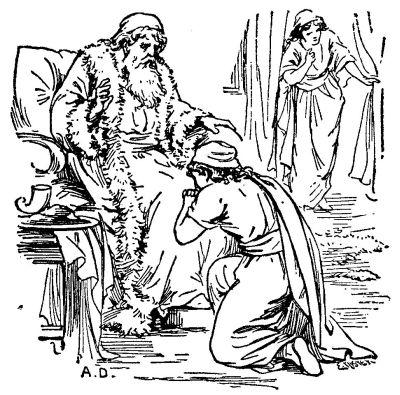
And Jacob went up close to Isaac’s bed, and Isaac felt of his face, and his neck, and his hands, and he said:
“May nations bow down to you.”
“The voice sounds like Jacob, but the hands are the hands of Esau. Are you really my son Esau?”
And Jacob told a lie to his father, and said, “I am.”
Then the old man ate the food that Jacob had brought to him; and he kissed Jacob, believing him to be Esau; and he gave him the blessing, saying to him:
“May God give you the dew of heaven, and the richness of the earth, and plenty of grain and wine. May nations bow down to you and peoples become your servants. May you be the master over your brother, and may your family and descendants that shall come from you rule over his family and his descendants. Blessed be those that bless you, and cursed be those that curse you.”
Just as soon as Jacob had received the blessing he rose up and hastened away. He had scarcely gone out, when Esau came in from hunting, with the dish of food that he had cooked. And he said:
“Let my father sit up and eat the food that I have brought, and give me the blessing.”
And Isaac said, “Why, who are you?”
Esau answered, “I am your son; your oldest son, Esau.”
And Isaac trembled, and said, “Who then is the one that came in and brought to me food? and I have eaten his food and have blessed him; yes, and he shall be blessed.”
When Esau heard this, he knew that he had been cheated; and he cried aloud, with a bitter cry, “O, my father, my brother has taken away my blessing, just as he took away my birthright! But cannot you give me another blessing, too? Have you given everything to my brother?”
And Isaac told him all that he had said to Jacob, making him the ruler over his brother.
But Esau begged for another blessing; and Isaac said:
“My son, your dwelling shall be of the riches of the earth and of the dew of heaven. You shall live by your sword and your descendants shall serve his descendants. But in time to come they shall break loose and shall shake off the yoke of your brother’s rule and shall be free.”
All this came to pass many years afterward. The people who came from Esau lived in a land called Edom, on the south of the land of Israel, where Jacob’s descendants lived. And after a time the Israelites became rulers over the Edomites; and later still, the Edomites made themselves free from the Israelites. But all this took place hundreds of years afterward.
It was better that Jacob’s descendants, those who came after him, should have the blessing, than that Esau’s people should have it; for Jacob’s people worshipped God, and Esau’s people walked in the way of the idols and became wicked.
After Abraham died, his son Isaac lived in the land of Canaan. Like his father, Isaac had his home in a tent; around him were the tents of his people, and many flocks of sheep and herds of cattle feeding wherever they could find grass to eat and water to drink.
Isaac and his wife Rebekah had two children. The older was named Esau and the younger Jacob.
Esau was a man of the woods and very fond of hunting; and he was rough and covered with hair.
Jacob was quiet and thoughtful, staying at home, dwelling in a tent, and caring for the flocks of his father.
Isaac loved Esau more than Jacob, because Esau brought to his father that which he had killed in his hunting; but Rebekah liked Jacob, because she saw that he was wise and careful in his work.
Among the people in those lands, when a man dies, his older son receives twice as much as the younger of what the father has owned. This was called his “birthright,” for it was his right as the oldest born. So Esau, as the older, had a “birthright” to more of Isaac’s possessions than Jacob. And besides this, there was the privilege of the promise of God that the family of Isaac should receive great blessings.
“The Wonder Book of Bible Stories” by Logan Marshall is a collection of biblical stories written in the early 20th century. This work aims to present key narratives from the Bible in a simplified and engaging manner tailored for children, allowing them to grasp important moral lessons and the essence of these timeless tales.
You remember that in those times of which we are telling, when men worshipped God, they built an altar of earth or of stone, and laid an offering upon it as a gift to God. The offering was generally a sheep, or a goat, or a young ox—some animal that was used for food. Such an offering was called “a sacrifice.”
But the people who worshipped idols often did what seems to us strange and very terrible. They thought that it would please their gods if they would offer as a sacrifice the most precious living things that were their own; and they would take their own little children and kill them upon their altars as offerings to the gods of wood and stone, that were no real gods, but only images.
God wished to show Abraham and all his descendants, those who should come after him, that he was not pleased with such offerings as those of living people, killed on the altars. And God took a way to teach Abraham, so that he and his children after him would never forget it. Then at the same time he wished to see how faithful and obedient Abraham would be to his commands; how fully Abraham would trust in God, or, as we would say, how great was Abraham’s faith in God.
So God gave to Abraham a command which he did not mean to have obeyed, though this he did not tell to Abraham. He said:
“Take now your son, your only son Isaac, whom you love so greatly, and go to the land of Moriah, and there on a mountain that I will show you, offer him for a burnt-offering to me.”
Though this command filled Abraham’s heart with pain, yet he would not be as surprised to receive it as a father would in our day; for such offerings were very common among all those people in the land where Abraham lived. Abraham never for one moment doubted or disobeyed God’s word. He knew that Isaac was the child whom God had promised, and that God had promised, too, that Isaac should have children, and that those coming from Isaac should be a great nation. He did not see how God could keep his promise with regard to Isaac, if Isaac should be killed as an offering; unless indeed God should raise him up from the dead afterward.
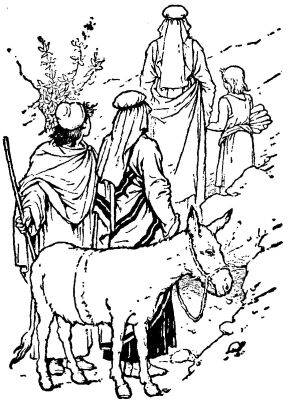
But Abraham undertook at once to obey. God’s command. He took two young men with him and an ass laden with wood for the fire; and he went toward the mountain in the north, Isaac, his son, walking by his side. For two days they walked, sleeping under the trees at night in the open country. And on the third day Abraham saw the mountain far away. And as they drew near to the mountain Abraham said to the young men:
For two days they walked
“Stay here with the ass, while I go up yonder mountain with Isaac to worship; and when we have worshipped, we will come back to you.” For Abraham believed that in some way God would bring back Isaac to life. He took the wood from the ass and placed it on Isaac, and they two walked up the mountain together. As they were walking, Isaac said:
“Father, here is the wood, but where is the lamb for the offering?”
And Abraham said, “My son, God will provide himself a Lamb for a burnt offering.”
And they came to the place on the top of the mountain. There Abraham built an altar of stones and earth heaped up; and on it he placed the wood. Then he tied the hands and the feet of Isaac, and laid him on the altar, on the wood. And Abraham lifted up his hand, holding a knife to kill his son. Another moment longer and Isaac would be slain by his own father’s hand.
“God will provide himself a lamb for a burnt offering”
But just at that moment the angel of the Lord out of heaven called to Abraham, and said:
“Abraham! Abraham!”
And Abraham answered, “Here I am, Lord.” Then the angel of the Lord said:
“Do not lay your hand upon your son. Do no harm to him. Now I know that you love God more than you love your only son, and that you are obedient to God, since you are ready to give up your son, your only son, to God.”
What a relief and a joy these words from heaven brought to the heart of Abraham! How glad he was to know that it was not God’s will for him to kill his son! Then Abraham looked around, and there in the thicket was a ram caught by his horns. And Abraham took the ram and offered him up for a burnt-offering in place of his son. So Abraham’s words came true when he said that God would provide for himself a lamb.
The place where this altar was built Abraham named Jehovah-jireh, words in the language that Abraham spoke meaning, “The Lord will provide.”
This offering, which seems so strange, did much good. It showed to Abraham, and to Isaac also, that Isaac belonged to God, for to God he had been offered; and in Isaac all those who should come from him, his descendants, had been given to God. Then it showed to Abraham and to all the people after him, that God did not wish children or men killed as offerings for worship; and while all the people around offered such sacrifices, the Israelites, who came from Abraham and from Isaac, never offered them, but offered oxen and sheep and goats instead.
These gifts, which cost so much toil, they felt must be pleasing to God, because they expressed their thankfulness to him. But they were glad to be taught that God does not desire men’s lives to be taken but loves our living gifts of love and kindness.
After the great flood the family of Noah and those who came after him grew in number, until, as the years went on, the earth began to be full of people once more. But there was one great difference between the people who had lived before the flood and those who lived after it. Before the flood, all the people stayed close together, so that very many lived in one land, and no one lived in other lands. After the flood families began to move from one place to another, seeking for themselves new homes. Some went one way, and some another, so that as the number of people grew, they covered much more of the earth than those who had lived before the flood.
Part of the people went up to the north and built a city called Nineveh, which became the ruling city of a great land called Assyria, whose people were called Assyrians.
Another company went away to the west and settled by the great river Nile, and founded the land of Egypt, with its strange temples and pyramids, its sphinx and its monuments.
Another company wandered northwest until they came to the shore of the great sea which they called the Mediterranean Sea. There they founded the cities of Sidon and Tyre, where the people were sailors, sailing to countries far away, and bringing home many things from other lands to sell to the people of Babylon, and Assyria, and Egypt, and other countries.
Among the many cities which the people built were two called Sodom and Gomorrah. The people in these cities were very wicked and were nearly all destroyed. One good man named Lot and his family escaped. There was another good man named Abraham who did not live in these cities. He tried to do God’s will and was promised a son to bring joy into his family.
After Sodom and Gomorrah were destroyed, Abraham moved his tent and his camp away from that part of the land, and went to live near a place called Gerar, in the southwest, not far from the Great Sea. And there at last, the child whom God had promised to Abraham and Sarah, his wife, was born, when Abraham, his father, was a very old man.
They named this child Isaac, as the angel had told them he should be named. And Abraham and Sarah were so happy to have a little boy, that after a time they gave a great feast and invited all the people to come and rejoice with them, and all in honor of the little Isaac.
Now Sarah had a maid named Hagar, an Egyptian woman, who ran away from her mistress, and saw an angel by a well, and afterward came back to Sarah. She, too, had a child and his name was Ishmael. So now there were two boys in Abraham’s tent, the older boy, Ishmael, the son of Hagar, and the younger boy, Isaac, the son of Abraham and Sarah.
Ishmael did not like the little Isaac, and did not treat him kindly. This made his mother Sarah very angry, and she said to her husband:
“I do not wish to have this boy Ishmael growing up with my son Isaac. Send away Hagar and her boy, for they are a trouble to me.”
And Abraham felt very sorry to have trouble come between Sarah and Hagar, and between Isaac and Ishmael; for Abraham was a kind and good man, and he was friendly to them all.
But the Lord said to Abraham, “Do not be troubled about Ishmael and his mother. Do as Sarah has asked you to do, and send them away. It is best that Isaac should be left alone in your tent, for he is to receive everything that is yours. I the Lord will take care of Ishmael, and will make a great people of his descendants, those who shall come from him.”
So the next morning Abraham sent Hagar and her boy away, expecting them to go back to the land of Egypt, from which Hagar had come. He gave them some food for the journey, and a bottle of water to drink by the way. The bottles in that country are not like ours, made of glass. They are made from the skin of a goat. One of these skin-bottles Abraham filled with water and gave to Hagar.
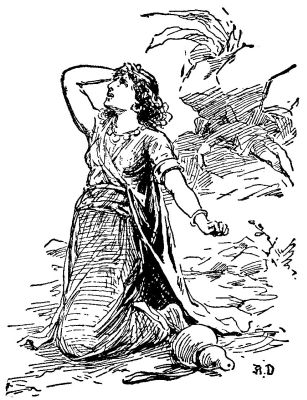
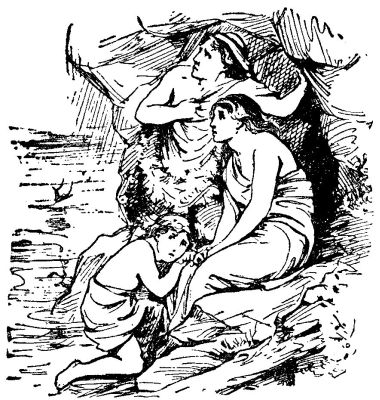
And Hagar went away from Abraham’s tent, leading her little boy. But in some way she lost the road, and wandered over the desert, not knowing where she was, until all the water in the bottle was used up; and her poor boy in the hot sun and the burning sand had nothing to drink. She thought that he would die of his terrible thirst; and she laid him down under a little bush; and then she went away, for she said to herself:
In some way she lost the road
“I cannot bear to look at my poor boy suffering and dying for want of water.”
And just at that moment, while Hagar was crying, and her boy was moaning with thirst, she heard a voice saying to her:
“Hagar, what is your trouble? Do not be afraid. God has heard your cry and the cry of your child. God will take care of you both, and will make of your boy a great nation of people.”
It was the voice of an angel from heaven; and then Hagar looked, and there, close at hand, was a spring of water in the desert. How glad Hagar was as she filled the bottle with water and took it to her suffering boy under the bush!
Learned to shoot with the bow and arrow
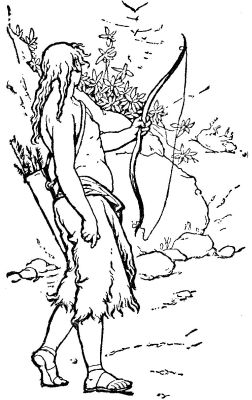
After this Hagar did not go down to Egypt. She found a place where she lived and brought up her son in the wilderness, far from other people. And Ishmael grew up in the desert and learned to shoot with the bow and arrow. He became a wild man, and his children after him grew up to be wild men also. They were the Arabians of the desert, who even to this day have never been ruled by any other people, but wander through the desert, and live as they please. So, Ishmael came to be the father of many people, and his descendants, the wild Arabians of the desert, are living unto this day in that land.
After Abel was slain, and his brother Cain had gone into another land, again God gave a child to Adam and Eve. This child they named Seth; and other sons and daughters were given to them; for Adam and Eve lived many years. But at last they died, as God had said they must die, because they had eaten of the tree that God had forbidden them to eat.
By the time that Adam died, there were many people on the earth; for the children of Adam and Eve had many other children; and when these grew up they had other children; and these had children also. These men and women and children lived in tents. They owned sheep and cattle, and they moved about with them, wherever they could find pasture. The children played around the tent doors, and sat beside the camp-fires in the evenings, where they all sang together, and the older people told them stories. And after a time this land where Adam’s sons lived began to be full of people.
It is sad to tell that as time went on more and more of these people became wicked, and fewer and fewer of them grew up to become good men and women. All the people lived near together, and few went away to other lands; so it came to pass that even the children of good men and women learned to be bad, like the people around them, and no longer did what was right and good.
And as God looked down on the world that he had made, he saw how wicked the men in it had become, and that every thought and every act of man was evil and only evil continually.
But while most of the people in the world were very wicked, there were some good people also, though they were very few. The best of all the men who lived at that time was a man whose name was Enoch. He was not the son of Cain, but another Enoch, who came from the family of Seth, the son of Adam, who was born after the death of Abel. While so many around Enoch were doing evil, this man did only what was right. He walked with God and God walked with him, and talked with him. And at last, when Enoch was a very old man and weary with life, God took him away from earth to heaven. He did not die, as all the people have since Adam disobeyed God, but “he was not, for God took him.” This means that Enoch was taken up from earth without dying.
All the people in the time of Enoch were not shepherds. Some of them had learned how to make rude bows and arrows and axes and plows. And after a long time they melted iron, and they made knives and swords and dishes to use in their homes. They sowed grain in the fields and reaped harvests, and they planted vines and fruit trees. But God looked down on the earth and said:
“I will take away all men from the earth that I have made; because the men of the world are evil, and do evil continually.”
But even in those bad times God saw one good man. His name was Noah. Noah tried to do right in the sight of God. As Enoch had walked with God, so Noah walked with God, and talked with him. And Noah had three sons; their names were Shem, and Ham, and Japheth.
God said to Noah, “The time has come when all the men and women on the earth are to be destroyed. Every one must die, because they are all wicked. But you and your family shall be saved, because you alone are trying to do right.”
Then God told Noah how he might save his life and the lives of his sons. He was to build a very large boat, as large as the largest ships that are made in our time; very long, and very wide and very deep; with a roof over it; and made like a long, wide house in three stories; but so built that it would float on the water. Such a ship as this was called “an ark.” God told Noah to build this ark, and to have it ready for the time when he would need it.
“For,” said God to Noah, “I am going to bring a great flood of water on the earth to cover all the land and to drown all the people on the earth. And as the animals on the earth will be drowned with the people, you must make the ark large enough to hold a pair of each kind of animals and several pairs of some animals that are needed by men, like sheep and goats and oxen; so that there will be animals as well as men to live upon the earth after the flood has passed away. And you must take in the ark food for yourself and your family, and for all the animals with you; enough food to last for a year, while the flood shall stay on the earth.”
And Noah did what God told him to do, although it must have seemed very strange to all the people around, to build this great ark where there was no water for it to sail upon. And it was a long time, because this ship was so big, that Noah and his sons were at work building the ark, which God had told them to build, while the wicked people around wondered, and no doubt laughed at Noah for building a great ship where there was no sea.
At last the ark was finished, and stood like a great house on the land. There was a door on one side, and a window on the roof, to let in the light. Then God said to Noah:
“Come into the ark, you and your wife, and your three sons, and their wives with them; for the flood of waters will come very soon. And take with you animals of all kinds, and birds, and things that creep; seven pairs of these that will be needed by men, and one pair of all the rest, so that all kinds of animals may be kept alive upon the earth.”
So Noah and his wife, and his three sons, Shem, Ham and Japheth, with their wives, went into the ark. And God brought to the door of the ark the animals, and the birds, and the creeping things of all kinds; and they went into the ark. And Noah and his sons put them in their places, and brought in food enough to feed them all for many days. And then the door of the ark was shut and no more people and no more animals could come in.
In a few days the rain began to fall, as it had never rained before. It seemed as though the heavens were opened to pour great floods upon the earth. The streams filled, and the rivers rose higher and higher, and the ark began to float on the water. The people left their houses and ran up to the hills; but soon the hills were covered, and all the people on them were drowned.
Some had climbed up to the tops of higher mountains, but the water rose higher and higher, until even the mountains were covered and all the people, wicked as they had been, were drowned in the great sea that now rolled over all the earth where man had lived. And all the animals, the tame animals, cattle, and sheep, and oxen, were drowned; and the wild animals, lions, and tigers, and all the rest were drowned also. Even the birds were drowned, for their nests in the trees were swept away, and there was no place where they could fly from the terrible storm. For forty days and nights the rain kept on, until there was no breath of life remaining outside of the ark.
The water rose higher and higher
After forty days the rain stopped, but the water stayed upon the earth for more than six months, and the ark with all that were in it floated over the great sea that covered the land. Then God sent a wind to blow over the waters, and to dry them up; so by degrees the waters grew less and less. First mountains rose above the waters, then the hills rose up, and finally the ark ceased to float and lay aground on a mountain which is called Mount Ararat.
But Noah could not see what had happened on the earth, because the door was shut, and the only window was up in the roof. But he felt that the ark was no longer moving, and he knew that the water must have gone down. So, after waiting for a time, Noah opened a window, and let loose a bird called a raven. Now the raven has strong wings; and this raven flew round and round until the waters had gone down, and it could find a place to rest, and it did not come back to the ark.
After Noah had waited for it awhile, he sent out a dove; but the dove could not find any place to rest, so it flew back to the ark, and Noah took it into the ark again. Then Noah waited a week longer, and afterward he sent out the dove again. And at the evening, the dove came back to the ark, which was its home; and in its bill was a fresh leaf which it had picked off from an olive tree.
So Noah knew that the water had gone down enough to let the trees grow again. He waited another week, and sent out the dove again; but this time the dove flew away and never came back. And Noah knew that the earth was becoming dry again. So he took off a part of the roof, and looked out, and saw that there was dry land all around the ark, and the waters were no longer everywhere.
Noah had now lived in the ark a little more than a year, and he was glad to see the green land and the trees once more. And God said to Noah:
“Come out of the ark, with your wife, and your sons, and their wives, and all the living things that are with you in the ark.”
So, Noah opened the door of the ark, and with his family came out, and stood once more on the ground. And the animals, and birds, and creeping things in the ark, came out also, and began again to bring life to the earth.
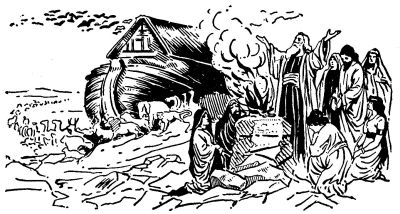
The first thing that Noah did when he came out of the ark, was to give thanks to God for saving all his family when the rest of the people on the earth were destroyed. He built an altar, and laid upon it an offering to the Lord, and gave himself and his family to God and promised to do God’s will.
And God was pleased with Noah’s offering, and God said:
“I will not again destroy the earth on account of men, no matter how bad they may be. From this time no flood shall again cover the earth; but the seasons of spring and summer and fall and winter, shall remain without change. I give to you the earth; you shall be the rulers of the ground and of every living thing upon it.”
Then God caused a rainbow to appear in the sky, and he told Noah and his sons that whenever they or the people after them should see the rainbow, they should remember that God had placed it in the sky and over the clouds as a sign of his promise, that he would always remember the earth, and the people upon it, and would never again send a flood to destroy man from the earth.
So as often as we see the beautiful rainbow, we are to remember that it is the sign of God’s promise to the world.
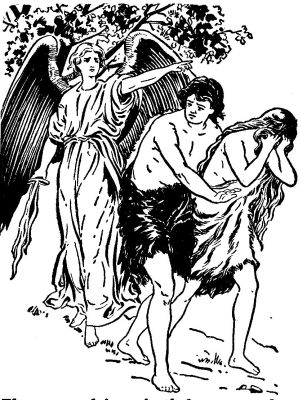
The first man’s name was Adam and his wife he called Eve. They lived in a beautiful Garden away in the East Country which was called Eden, filled with beautiful trees and flowers of all kinds. But they did not live in Eden long for they did not obey God’s command, but ate the fruit of a tree which had been forbidden them. They were driven forth by an angel and had to give up their beautiful home.
They were driven forth by an angel
So Adam and his wife went out into the world to live and to work. For a time they were all alone, but after a while God gave them a little child of their own, the first baby that ever came into the world. Eve named him Cain; and after a time another baby came, whom she named Abel.
When the two boys grew up, they worked, as their father worked before them. Cain, the older brother, chose to work in the fields, and to raise grain and fruits. Abel, the younger brother, had a flock of sheep and became a shepherd.
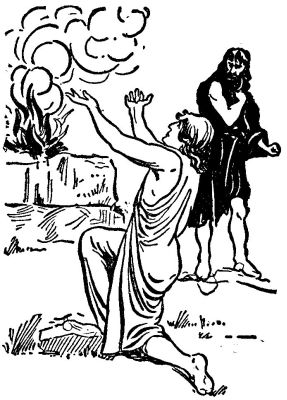
While Adam and Eve were living in the Garden of Eden, they could talk with God and hear God’s voice speaking to them. But now that they were out in the world, they could no longer talk with God freely, as before. So when they came to God, they built an altar of stones heaped up, and upon it, they laid something as a gift to God, and burned it, to show that it was not their own, but was given to God, whom they could not see. Then before the altar they made their prayer to God, and asked God to forgive their sins, all that they had done was wrong; and prayed God to bless them and do good to them.
Each of these brothers, Cain and Abel, offered upon the altar to God his own gift. Cain brought the fruits and the grain which he had grown; and Abel brought a sheep from his flock, and killed it and burned it upon the altar. For some reason God was pleased with Abel and his offering, but was not pleased with Cain and his offering. Perhaps God wished Cain to offer something that had life, as Abel offered; perhaps Cain’s heart was not right when he came before God.
And God showed that He was not pleased with Cain; and Cain, instead of being sorry for his sin, and asking God to forgive him, was very angry with God, and angry also toward his brother Abel. When they were out in the field together Cain struck his brother Abel and killed him. So the first baby in the world grew up to be the murderer of his own brother.
And the Lord said to Cain, “Where is Abel, your brother?”
Cain and Abel
And Cain answered, “I do not know; why should I take care of my brother?”
Then the Lord said to Cain, “What is this that you have done? Your brother’s blood is like a voice crying to me from the ground. Do you see how the ground has opened, like a mouth, to drink your brother’s blood? As long as you live, you shall be under God’s curse for the murder of your brother. You shall wander over the earth, and shall never find a home, because you have done this wicked deed.”
And Cain said to the Lord, “My punishment is greater than I can bear. Thou hast driven me out from among men; and thou hast hid thy face from me. If any man finds me he will kill me, because I shall be alone, and no one will be my friend.”
And God said to Cain, “If any one harms Cain, he shall be punished for it.” And the Lord God placed a mark on Cain, so that whoever met him should know him and should know also that God had forbidden any man to harm him. Then Cain and his wife went away from Adam’s home to live in a place by themselves, and there they had children. And Cain’s family built a city in that land; and Cain named the city after his first child, whom he had called Enoch.



 articlesforchristians