A place to grow your relationship with God
Posts tagged ‘True Worship’
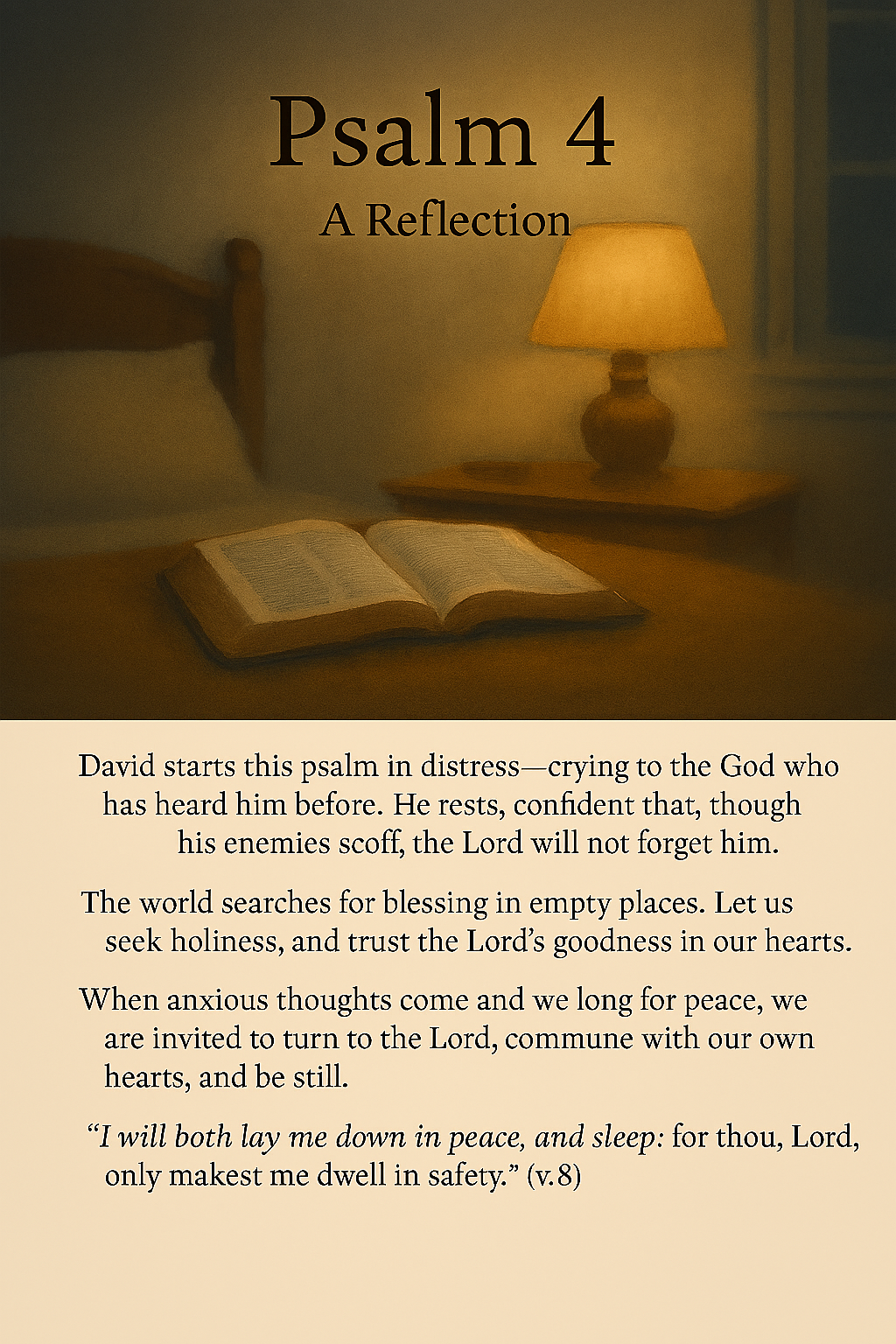
Psalm 4
- Hear me when I call, O God of my righteousness: thou hast enlarged me when I was in distress; have mercy upon me, and hear my prayer.
- O ye sons of men, how long will ye turn my glory into shame? how long will ye love vanity, and seek after leasing? Selah.
- But know that the Lord hath set apart him that is godly for himself: the Lord will hear when I call unto him.
- Stand in awe, and sin not: commune with your own heart upon your bed, and be still. Selah.
- Offer the sacrifices of righteousness, and put your trust in the Lord.
- There be many that say, Who will shew us any good? Lord, lift thou up the light of thy countenance upon us.
- Thou hast put gladness in my heart, more than in the time that their corn and their wine increased.
- I will both lay me down in peace, and sleep: for thou, Lord, only makest me dwell in safety.
- Psalm 4
- 1. Orientation to Psalm 4
- 2. David’s Plea for Mercy (v. 1)
- 3. Confronting the Ungodly (v. 2)
- 4. Confidence for the Godly (v. 3)
- 5. A Call to Self‑Examination and Holiness (v. 4)
- 6. True Worship and Trust (v. 5)
- 7. The World’s Question and the Believer’s Answer (v. 6)
- 8. Joy Rooted in God, Not Circumstances (v. 7)
- 9. Peaceful Rest in God’s Protection (v. 8)
- 10. Key Themes
- 11. Discussion Questions for You to Think About
1. Orientation to Psalm 4
- Author: David.
- Setting: Likely connected to the turmoil of Absalom’s rebellion (same season as Psalm 3), though the psalm speaks broadly to any season of pressure, slander, or uncertainty.
- Theme: Turning from anxiety to quiet trust.
- Key movement: David begins in distress, confronts the ungodly, calls God’s people to holiness, and ends resting in God’s peace.
2. David’s Plea for Mercy (v. 1)
- “Hear me when I call, O God of my righteousness” — David appeals not to his own merit but to God’s character.
- “Thou hast enlarged me when I was in distress” — God has rescued him before; past faithfulness fuels present confidence.
- Teaching emphasis: Prayer begins with remembering who God is and what He has done.
3. Confronting the Ungodly (v. 2)
- “O ye sons of men” — likely nobles or influential people opposing David.
- Three charges:
- Turning God’s glory into shame
- Loving vanity (emptiness)
- Seeking after leasing (lies)
- Selah: Pause to consider the seriousness of rejecting God’s ways.
- Teaching emphasis: Sin often begins with misplaced love—loving what is empty instead of what is true.
4. Confidence for the Godly (v. 3)
- “The Lord hath set apart him that is godly for himself” — God claims His people as His own.
- “The Lord will hear when I call” — assurance rooted in relationship.
- Teaching emphasis: God’s people are not forgotten; they are chosen, known, and heard.
5. A Call to Self‑Examination and Holiness (v. 4)
- “Stand in awe, and sin not” — reverence leads to righteousness.
- “Commune with your own heart… and be still” — quiet reflection before God.
- This quiet reflection needs to include searching your own heart every day. It is good practice to do this before you sleep.
- Search your heart for sin. If any is found, repent.
- Teaching emphasis: Stillness is a spiritual discipline; holiness grows in the quiet places of the heart.
6. True Worship and Trust (v. 5)
- “Offer the sacrifices of righteousness” — not empty ritual, but obedience and integrity.
- Under the Law, sacrifices included numerous animal, grain, and meal offerings.
- David is empasizing the importance of a true sacrifice which is praise and worship from a righteous heart accompanied by sacrifices of joy and thanksgiving.
- Psalm 107:22
- And let them sacrifice the sacrifices of thanksgiving, and declare his works with rejoicing.
- “Put your trust in the Lord” — worship and trust belong together.
- Teaching emphasis: God desires worship that flows from a faithful life.
7. The World’s Question and the Believer’s Answer (v. 6)
- The world’s cry: “Who will shew us any good?” — a restless search for blessing.
- David’s prayer: “Lord, lift thou up the light of thy countenance upon us.”
- Teaching emphasis: True good is not found in circumstances but in God’s presence.
8. Joy Rooted in God, Not Circumstances (v. 7)
- “Thou hast put gladness in my heart” — joy is God‑given.
- Gladness is mentioned forty times in the English translation of the Old Testament.
- The word used for gladness in Psalms is simchah and means “to be glad or joyful.”
- In Judaism, the Torah (the five books of Moses) is read on an annual cycle.
- When the cycle is completed and a new cycle begins, it is called Simchat Torah, meaning “Rejoicing in the Torah.”
- Greater than harvest abundance — God Himself is better than prosperity.
- Teaching emphasis: Spiritual joy surpasses material success.
9. Peaceful Rest in God’s Protection (v. 8)
- “I will both lay me down in peace, and sleep” — the fruit of trust.
- In nature, a sheep can only rest when its surroundings are at peace.
- Jesus is our shepherd that gives us rest. We are the sheep of His pastor.
- Here, the favor and goodness of God bring rest and good sleep.
- “For thou, Lord, only makest me dwell in safety” — God alone secures His people.
- Teaching emphasis: Peace is not the absence of trouble but the presence of God.
10. Key Themes
- Prayer in distress — honest, confident, rooted in God’s character.
- Holiness and self‑examination — stillness before God leads to obedience.
- True blessing — found in God’s presence, not earthly gain.
- Restful trust — God alone gives peace that quiets the heart.
11. Discussion Questions for You to Think About
- What does David remember about God in verse 1 that strengthens his faith?
- How does loving “vanity” and “leasing” show up in today’s world?
- What does it mean to be “set apart” for God?
- How can we “commune with our own heart… and be still” in practical ways?
- Why is God’s presence better than material abundance?
- What helps you rest in God’s peace at the end of the day?
 Articles for Christians