“The Story of Mankind” by Hendrik Willem Van Loon is a historical account written in the early 20th century. This work aims to present the journey of humanity from prehistoric times through ancient civilizations up to the author’s contemporary era, exploring the significant events, cultures, and figures that have shaped human history. By utilizing vivid imagery and an engaging storytelling style, the author invites readers to reflect on both the challenges faced by humanity and the creative ingenuity that has propelled human advancement. Because this is a Christian website, we skip forward in the book and start a chapter 4. For the full book click here.
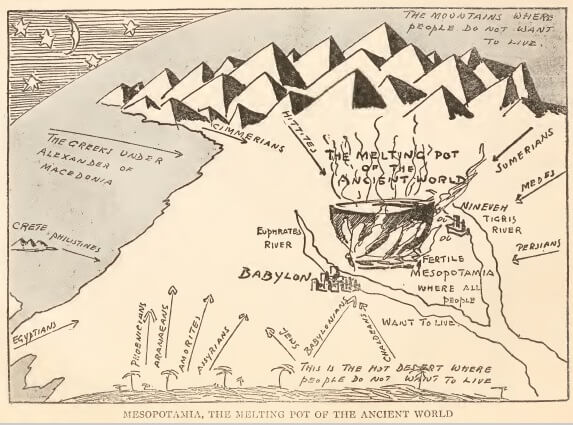
I am going to take you to the top of the highest pyramid and I am going to ask that you imagine yourself possessed of the eyes of a hawk. Way, way off, in the distance, far beyond the yellow sands of the desert, you will see something green and shimmering. It is a valley situated between two rivers. It is the Paradise of the Old Testament. It is the land of mystery and wonder which the Greeks called Mesopotamia—the “country between the rivers.”
The names of the two rivers are the Euphrates (which the Babylonians called the Purattu) and the Tigris (which was known as the Diklat). They begin their course amidst the snows of the mountains of Armenia where Noah’s Ark found a resting place and slowly they flow through the southern plain until they reach the muddy banks of the Persian Gulf. They perform a very useful service. They turn the arid regions of western Asia into a fertile garden.
The valley of the Nile had attracted people because it had offered them food upon fairly easy terms. The “land between the rivers” was popular for the same reason. It was a country full of promise and both the inhabitants of the northern mountains and the tribes which roamed through the southern deserts tried to claim this territory as their own and most exclusive possession.
The constant rivalry between the mountaineers and the desert-nomads led to endless warfare. Only the strongest and the bravest could hope to survive and that will explain why Mesopotamia became the home of a very strong race of people who were capable of creating a civilization which was in every respect as important as that of Egypt.
The river Nile was a kind friend but occasionally it was a hard taskmaster. It taught the people who lived along its banks the noble art of “team-work.” They depended upon each other to build their irrigation trenches and keep their dikes in repair. In this way they learned how to get along with their neighbors and their mutual-benefit-association quite easily developed into an organized state. Then one person grew more powerful than most of their neighbors and became the leader of the community and their commander-in-chief when the envious neighbors of western Asia invaded the prosperous valley. In due course of time this person became their King or Queen and ruled all the land from the Mediterranean to the mountains of the west.
But these political adventures of the old Pharaohs (the word meant “the Person who lived in the Big House”) rarely interested the patient and toiling peasant of the grain fields. Provided they was not obliged to pay more taxes to their King or Queen than they thought just, they accepted the rule of Pharaoh as they accepted the rule of Mighty Osiris.
It was different however when a foreign invader came and robbed people of their possessions. After twenty centuries of independent life, a savage Arab tribe of shepherds, called the Hyksos, attacked Egypt and for five hundred years they were the masters of the valley of the Nile. They were highly unpopular and great hate was also felt for the Hebrews who came to the land of Goshen to find a shelter after their long wandering through the desert and who helped the foreign usurper by acting as his tax-gatherers and his civil servants.
But shortly after the year 1700 B.C. the people of Thebes began a revolution and after a long struggle the Hyksos were driven out of the country and Egypt was free once more.
A thousand years later, when Assyria conquered all of western Asia, Egypt became part of the empire of Sardanapalus. In the seventh century B.C. it became once more an independent state which obeyed the rule of a king who lived in the city of Sais in the Delta of the Nile. But in the year 525 B.C., Cambyses, the king of the Persians, took possession of Egypt and in the fourth century B.C., when Persia was conquered by Alexander the Great, Egypt too became a Macedonian province. It regained a semblance of independence when one of Alexander’s generals set himself up as king of a new Egyptian state and founded the dynasty of the Ptolemies, who resided in the newly built city of Alexandria.
Finally, in the year 89 B.C., the Romans came. The last Egyptian queen, Cleopatra, tried her best to save the country. Her beauty and charm were more dangerous to the Roman generals than half a dozen Egyptian army corps. Twice she was successful in her attacks upon the hearts of her Roman conquerors. But in the year 30 B.C., Augustus, the nephew and heir of Caesar, landed in Alexandria. He did not share his late uncle’s admiration for the lovely princess. He destroyed her armies, but spared her life that he might make her march in his triumph as part of the spoils of war. When Cleopatra heard of this plan, she killed herself by taking poison. And Egypt became a Roman province.
The history of humanity is the record of a hungry creature in search of food. Wherever food was plentiful, thither people have travelled to make their home.
The fame of the Valley of the Nile must have spread at an early date. From the interior of Africa and from the desert of Arabia and from the western part of Asia people had flocked to Egypt to claim their share of the rich farms. Together these invaders had formed a new race which called itself “Remi” or “the Men” just as we sometimes call America “God’s own country.” They had good reason to be grateful to a Fate which had carried them to this narrow strip of land. In the summer of each year the Nile turned the valley into a shallow lake and when the waters receded all the grain fields and the pastures were covered with several inches of the most fertile clay.
In Egypt a kindly river did the work of a million men and made it possible to feed the teeming population of the first large cities of which we have any record. It is true that all the arable land was not in the valley. But a complicated system of small canals and well-sweeps carried water from the river-level to the top of the highest banks and an even more intricate system of irrigation trenches spread it throughout the land.
While people of the prehistoric age had been obliged to spend sixteen hours out of every twenty-four gathering food for themselves and the members of their tribe, the Egyptian peasant or the inhabitant of the Egyptian city found himself possessed of a certain leisure. They used this spare time to make themselves many things that were merely ornamental and not in the least bit useful.
More than that. One day people discovered that their brain was capable of thinking all kinds of thoughts which had nothing to do with the problems of eating and sleeping and finding a home for the children. The Egyptian began to speculate upon many strange problems that confronted people. Where did the stars come from? Who made the noise of the thunder which frightened them so terribly? Who made the River Nile rise with such regularity that it was possible to base the calendar upon the appearance and the disappearance of the annual floods? Who were people, themselves, strange little creatures surrounded on all sides by death and sickness and yet happy and full of laughter?
Humanity asked these many questions and certain people obligingly stepped forward to answer these inquiries to the best of their ability. The Egyptians called them “priests” and they became the guardians of humanity’s thoughts and gained great respect in the community. They were highly learned men who were entrusted with the sacred task of keeping the written records. They understood that it is not good for people to think only of their immediate advantage in this world and they drew attention to the days of the future when humanity’s soul would dwell beyond the mountains of the west and must give an account of their deeds to Osiris, the mighty god who was the Ruler of the Living and the Dead and who judged the acts of men according to their merits. Indeed, the priests made so much of that future day in the realm of Isis and Osiris that the Egyptians began to regard life merely as a short preparation for the Hereafter and turned the teeming valley of the Nile into a land devoted to the Dead. In a strange way, the Egyptians had come to believe that no soul could enter the realm of Osiris without the possession of the body which had been its place of residence in this world. Therefore, as soon as a person was dead their relatives took their corpse and had it embalmed. For weeks it was soaked in a solution of natron and then it was filled with pitch. The Persian word for pitch was “Mumiai” and the embalmed body was called a “Mummy.” It was wrapped in yards and yards of specially prepared linen and it was placed in a specially prepared coffin ready to be removed to its final home. But an Egyptian grave was a real home where the body was surrounded by pieces of furniture and musical instruments (to while away the dreary hours of waiting) and by little statues of cooks and bakers and barbers (that the occupant of this dark home might be decently provided with food and need not go about unshaven).
Originally these graves had been dug into the rocks of the western mountains but as the Egyptians moved northward they were obliged to build their cemeteries in the desert. The desert however is full of wild animals and equally wild robbers and they broke into the graves and disturbed the mummy or stole the jewelry that had been buried with the body. To prevent such unholy desecration the Egyptians used to build small mounds of stones on top of the graves. These little mounds gradually grew in size, because the rich people built higher mounds than the poor and there was a good deal of competition to see who could make the highest hill of stones. The record was made by King Khufu, whom the Greeks called Cheops and who lived thirty centuries before our era. His mound, which the Greeks called a pyramid (because the Egyptian word for high was pir-em-us) was over five hundred feet high.
It covered more than thirteen acres of desert which is three times as much space as that occupied by the church of St. Peter, the largest edifice of the Christian world.
During twenty years, over a hundred thousand men were busy carrying the necessary stones from the other side of the river—ferrying them across the Nile (how they ever managed to do this, we do not understand), dragging them in many instances a long distance across the desert and finally hoisting them into their correct position. But so well did the King’s architects and engineers perform their task that the narrow passage-way which leads to the royal tomb in the heart of the stone monster has never yet been pushed out of shape by the weight of those thousands of tons of stone which press upon it from all sides.
THE EGYPTIANS INVENT THE ART OF WRITING AND THE RECORD OF HISTORY BEGINS
THESE earliest ancestors of ours who lived in the great European wilderness were rapidly learning many new things. It is safe to say that in due course of time they would have given up the ways of savages and would have developed a civilisation of their own. But suddenly there came an end to their isolation. They were discovered.
A traveller from an unknown southland who had dared to cross the sea and the high mountain passes had found his way to the wild people of the European continent. He came from Africa. His home was in Egypt.
The valley of the Nile had developed a high stage of civilisation thousands of years before the people of the west had dreamed of the possibilities of a fork or a wheel or a house. And we shall therefore leave our great-great-grandfathers in their caves, while we visit the southern and eastern shores of the Mediterranean, where stood the earliest school of the human race.
The Egyptians have taught us many things. They were excellent farmers. They knew all about irrigation. They built temples which were afterwards copied by the Greeks and which served as the earliest models for the churches in which we worship nowadays. They had invented a calendar which proved such a useful instrument for the purpose of measuring time that it has survived with a few changes until today. But most important of all, the Egyptians had learned how to preserve speech for the benefit of future generations. They had invented the art of writing.
We are so accustomed to newspapers and books and magazines that we take it for granted that the world has always been able to read and write. As a matter of fact, writing, the most important of all inventions, is quite new. Without written documents we would be like cats and dogs, who can only teach their kittens and their puppies a few simple things and who, because they cannot write, possess no way in which they can make use of the experience of those generations of cats and dogs that have gone before.
In the first century before our era, when the Romans came to Egypt, they found the valley full of strange little pictures which seemed to have something to do with the history of the country. But the Romans were not interested in “anything foreign” and did not inquire into the origin of these queer figures which covered the walls of the temples and the walls of the palaces and endless reams of flat sheets made out of the papyrus reed. The last of the Egyptian priests who had understood the holy art of making such pictures had died several years before. Egypt deprived of its independence had become a store-house filled with important historical documents which no one could decipher and which were of no earthly use to either man or beast.
Seventeen centuries went by and Egypt remained a land of mystery. But in the year 1798 a French general by the name of Bonaparte happened to visit eastern Africa to prepare for an attack upon the British Indian Colonies. He did not get beyond the Nile, and his campaign was a failure. But, quite accidentally, the famous French expedition solved the problem of the ancient Egyptian picture-language.
One day a young French officer, much bored by the dreary life of his little fortress on the Rosetta river (a mouth of the Nile) decided to spend a few idle hours rummaging among the ruins of the Nile Delta. And behold! he found a stone which greatly puzzled him. Like everything else in Egypt it was covered with little figures. But this particular slab of black basalt was different from anything that had ever been discovered. It carried three inscriptions. One of these was in Greek. The Greek language was known. “All that is necessary,” so he reasoned, “is to compare the Greek text with the Egyptian figures, and they will at once tell their secrets.”
The plan sounded simple enough but it took more than twenty years to solve the riddle. In the year 1802 a French professor by the name of Champollion began to compare the Greek and the Egyptian texts of the famous Rosetta stone. In the year 1823 he announced that he had discovered the meaning of fourteen little figures. A short time later he died from overwork, but the main principles of Egyptian writing had become known. Today the story of the valley of the Nile is better known to us than the story of the Mississippi River. We possess a written record which covers four thousand years of chronicled history.
As the ancient Egyptian hieroglyphics (the word means “sacred writing”) have played such a very great role in history, (a few of them in modified form have even found their way into our own alphabet,) you ought to know something about the ingenious system which was used fifty centuries ago to preserve the spoken word for the benefit of the coming generations.
Of course, you know what a sign language is. Every Indian story of our western plains has a chapter devoted to strange messages writter{sic} in the form of little pictures which tell how many buffaloes were killed and how many hunters there were in a certain party. As a rule it is not difficult to understand the meaning of such messages.
Ancient Egyptian, however, was not a sign language. The clever people of the Nile had passed beyond that stage long before. Their pictures meant a great deal more than the object which they represented, as I shall try to explain to you now.
Suppose that you were Champollion, and that you were examining a stack of papyrus sheets, all covered with hieroglyphics. Suddenly you came across a picture of a man with a saw. “Very well,” you would say, “that means of course that a farmer went out to cut down a tree.” Then you take another papyrus. It tells the story of a queen who had died at the age of eighty-two. In the midst of a sentence appears the picture of the man with the saw. Queens of eighty-two do not handle saws. The picture therefore must mean something else. But what?
That is the riddle which the Frenchman finally solved. He discovered that the Egyptians were the first to use what we now call “phonetic writing”—a system of characters which reproduce the “sound” (or phone) of the spoken word and which make it possible for us to translate all our spoken words into a written form, with the help of only a few dots and dashes and pothooks.
Let us return for a moment to the little fellow with the saw. The word “saw” either means a certain tool which you will find in a carpenter’s shop, or it means the past tense of the verb “to see.”
This is what had happened to the word during the course of centuries. First of all it had meant only the particular tool which it represented. Then that meaning had been lost and it had become the past participle of a verb. After several hundred years, the Egyptians lost sight of both these meanings and the picture came to stand for a single letter, the letter S.
A short sentence will show you what I mean. Here is a modern English sentence as it would have been written in hieroglyphics.
The
either means one of these two round objects in your head, which allow you to see or it means “I,” the person who is talking.
A
is either an insect which gathers honey, or it represents the verb “to be” which means to exist. Again, it may be the first part of a verb like “be-come” or “be-have.” In this particular instance it is followed by
which means a “leaf” or “leave” or “lieve” (the sound of all three words is the same).
The “eye” you know all about.
Finally you get the picture of a
It is a giraffe It is part of the old sign-language out of which the hieroglyphics developed.
You can now read that sentence without much difficulty.
“I believe I saw a giraffe.”
Having invented this system the Egyptians developed it during thousands of years until they could write anything they wanted, and they used these “canned words” to send messages to friends, to keep business accounts and to keep a record of the history of their country, that future generations might benefit by the mistakes of the past.
Vocabulary Words:
Culture: The arts, customs, lifestyles, background, and habits that characterize a particular society or nation. Irrigation: The act or process of causing water to flow over lands to nourish plants. Hieroglyphics: A system of phonetic writing using pictures to represent sounds. Greek: The writing system and language of the Greek people, used in Greece, Cyprus, and other Greek communities. Papyrus: A material similar to paper made from the plant of the papyrus. Phonetic: Related to the sounds that make up languages.



 articlesforchristians