Maya Angelou (April 4,1928-May 28, 2014) is an American author, poet, playwright, editor, actress, director, and teacher. She is best known for the first installment of her autobiography, I Know Why the Caged Bird Sings (1970). This work tells the story of a black girl growing up during the Great Depression. Angelou continued to chronicle her life in Gather Together in My Name (1974), Singin’ and Swingin’ and Getting Merry Like Christmas (1976), The Heart of a Woman (1981), and All God’s Children Need Traveling Shoes (1986). Like much of her other writing, Angelou’s autobiographical works are realistic and exuberant.
She has written several collections of poetry, including Just Give Me a Cool Drink of Water ‘fore I Düle (1971) and Oh Pray
My Wings Are Gonna Fit Me Well (1975). She has also performed in several stage productions.
Maya Angelou was born Marguerite Johnson in St. Louis, Missouri. Her brother nicknamed her “Maya” as a child, combining “My” or “Mya Sister” with her first husband’s last name to form her famous name. The younger of two children of Bailey Johnson, a doorman and navy dietitian, and Vivian Baxter Johnson, a nurse and card dealer, she spent her early years in her maternal grandparents’ home. When she was three and her brother four, their parents’ troubled marriage ended, and their father sent them alone by train to Stamps, Arkansas, to live with their paternal grandmother, Annie Henderson. Remarkably, despite the economic struggles African Americans faced at the time, Annie prospered during the Great Depression and World War II, thanks to her general store selling essential goods and her wise, honest investments.
When Angelou was seven and her brother eight, their father suddenly showed up in Stamps and took them back to their mother in St. Louis. At eight, while living with her mother, Angelou was sexually abused by her mother’s boyfriend, Freeman. She confided in her brother, who told the family. Freeman was convicted but spent only a day in jail. Four days after his release, he was killed, likely by Angelou’s uncles. Believing her words had caused his death, she stopped speaking for nearly five years, convinced her voice could kill. During this silence, as noted by biographer Marcia Ann Gillespie and others, Angelou developed an exceptional memory, a passion for literature, and a keen ability to listen and observe.
After Freeman’s death, eight-year-old Angelou and her nine-year-old brother were sent back to live with their grandmother. She attended the Lafayette County Training School in Stamps, a Rosenwald School. Angelou credited a family friend and teacher, Mrs. Bertha Flowers, with helping her find her voice again, challenging her by saying, “You do not love poetry, not until you speak it.” Flowers introduced her to influential writers like Charles Dickens, William Shakespeare, Edgar Allan Poe, Georgia Douglas Johnson, and James Weldon Johnson, as well as notable Black female artists such as Frances Harper, Anne Spencer, and Jessie Fauset, all of whom shaped her life and career.
When Angelou was 14 and her brother 15, they moved back in with their mother, who had relocated to Oakland, California. During World War II, she attended the California Labor School, and at 16, became San Francisco’s first Black female streetcar conductor. She was drawn to the role, captivated by the operators’ sharp uniforms—complete with money-changing belts, cap bibs, and perfect tailoring—so much so that her mother called it her “dream job.” Her mother urged her to go for it, but reminded her she’d have to show up early and work harder than the rest. In 2014, she was honored with a lifetime achievement award from the Conference of Minority Transportation Officials during a session called “Women Who Move the Nation.”
Three weeks after completing school, at the age of 17, she gave birth to her son, Clyde (who later changed his name to Guy Johnson).
Career
Adulthood and early career: 1951–1961
In 1951, Angelou married Tosh Angelos, a Greek electrician, former sailor, and aspiring musician, despite widespread disapproval of interracial relationships and her mother’s objections. During this time, she took modern dance classes and met dancers and choreographers Alvin Ailey and Ruth Beckford. She and Ailey teamed up as “Al and Rita,” performing modern dance at fraternal Black organizations around San Francisco, though they never found much success. Angelou, along with her husband and son, later moved to New York City so she could study African dance with Trinidadian dancer Pearl Primus, but they returned to San Francisco a year later.
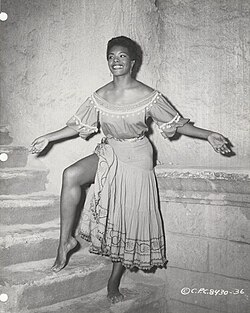
After her marriage ended in 1954, Angelou began dancing professionally in San Francisco clubs, including The Purple Onion, where she performed calypso music. Until then, she had gone by “Marguerite Johnson” or “Rita,” but, encouraged by her managers and supporters, she adopted the distinctive stage name “Maya Angelou,” a nod to her nickname and former married surname. The name captured the spirit of her calypso performances. In 1954 and 1955, she toured Europe with the opera Porgy and Bess, starting her habit of learning the language of each country she visited, eventually becoming proficient in several. In 1957, capitalizing on calypso’s popularity, she recorded her debut album *Miss Calypso*, later reissued on CD in 1996. That same year, she appeared in an off-Broadway revue that inspired the film *Calypso Heat Wave*, in which she sang and performed her own songs.
In 1959, Angelou met novelist John Oliver Killens, who encouraged her to move to New York and focus on her writing. There, she joined the Harlem Writers Guild and connected with prominent African American authors like John Henrik Clarke, Rosa Guy, Paule Marshall, and Julian Mayfield, eventually seeing her first work published. In 1960, after meeting and hearing civil rights leader Martin Luther King Jr. speak, she teamed up with Killens to organize the legendary Cabaret for Freedom in support of the Southern Christian Leadership Conference (SCLC), later becoming its Northern Coordinator. Scholar Lyman B. Hagen described her work as a fundraiser and organizer as both successful and highly effective. Around this time, she also began her pro-Castro and anti-apartheid activism, joining the Fair Play for Cuba Committee and even cheering for Fidel Castro when he arrived at Harlem’s Hotel Theresa during the United Nations 15th General Assembly on September 19, 1960.
Personal life
Evidence suggests that Angelou was partly descended from the Mende people of West Africa through her maternal line. In 2008, DNA testing showed that 45 percent of her ancestry came from Central African peoples of the Congo-Angola region, while 55 percent was from West Africans. A PBS documentary that same year revealed that her maternal great-grandmother, Mary Lee, freed after the Civil War, became pregnant by her former white owner, John Savin. Savin coerced Lee into falsely naming another man as the father of her child. Although Savin was indicted for forcing her to commit perjury, and it was confirmed he was the father, a jury acquitted him. Lee was sent to the Clinton County poorhouse in Missouri with her daughter, Marguerite Baxter, who later became Angelou’s grandmother. Angelou described Lee as “that poor little black girl, physically and mentally bruised.”
The details of Maya Angelou’s life, as told in her seven autobiographies and various interviews, speeches, and articles, were often inconsistent. Critic Mary Jane Lupton noted that Angelou spoke about her life eloquently but informally, without a strict timeline. For instance, though she was married at least twice, she never specified how many times, not wanting to seem frivolous. Her accounts and biographer Gillespie record her marriage to Tosh Angelos in 1951, her marriage to Paul du Feu in 1973 or 1974, and her relationship with Vusumzi Make beginning in 1961, though they never formally married. Angelou worked a variety of jobs, including in the sex trade as a prostitute and madam for lesbians, which she described in her second autobiography, *Gather Together in My Name*. In a 1995 interview, she said:
I wrote about my experiences because I thought too many people tell young folks, “I never did anything wrong. Who, Moi? – never I. I have no skeletons in my closet. In fact, I have no closet.” They lie like that and then young people find themselves in situations and they think, “Damn I must be a pretty bad guy. My mom or dad never did anything wrong.” They can’t forgive themselves and go on with their lives.
Angelou had one son, Guy, whose birth she recounted in her first autobiography, along with a grandson, two great-grandchildren, and, as Gillespie noted, a wide circle of friends and extended family. Her mother, Vivian Baxter, passed away in 1991, and her brother, Bailey Johnson Jr., died in 2000 after a series of strokes; both played significant roles in her life and writings. In 1981, her grandson’s mother disappeared with him, and it took four years to locate him.
Although Angelou never earned a university degree, Gillespie noted that she preferred to be addressed as “Dr. Angelou” by those outside her family and close friends. She owned two homes in Winston-Salem, North Carolina, and a stately brownstone in Harlem purchased in 2004, which housed her ever-growing library of books, decades’ worth of collected artwork, and well-stocked kitchens. According to The Guardian’s Gary Younge, her Harlem home featured African wall hangings and a collection of paintings, including portraits of jazz trumpeters, a watercolor of Rosa Parks, and a Faith Ringgold piece titled *Maya’s Quilt of Life*.
Gillespie recalled that she hosted several celebrations each year at her main home in Winston-Salem, and her legendary kitchen skills ranged from haute cuisine to comforting home-style dishes. The Winston-Salem Journal noted that an invitation to her Thanksgiving dinners, Christmas tree decorating parties, or birthday gatherings was one of the most sought-after in town. The New York Times reported that during her time in New York City, she often held elaborate New Year’s Day parties. She brought together her love for cooking and writing in her 2004 book *Hallelujah! The Welcome Table*, featuring 73 recipes—many passed down from her grandmother and mother—paired with 28 vignettes. In 2010, she released her second cookbook, *Great Food, All Day Long: Cook Splendidly, Eat Smart*, which emphasized weight loss and portion control.
Starting with *I Know Why the Caged Bird Sings*, Angelou followed the same “writing ritual” for years. She’d wake up early, head to a hotel room with the walls stripped of pictures, and write on legal pads while lying on the bed. Her only companions were a bottle of sherry, a deck of cards for solitaire, Roget’s Thesaurus, and the Bible. By early afternoon, she’d leave, having written 10–12 pages, later pared down to three or four in the evening. She used this routine to “enchant” herself, as she put it in a 1989 BBC interview, to relive the agony, anguish, and Sturm und Drang of her past. Even for painful memories, like her rape in *Caged Bird*, she sought to tell “the human truth.” Playing cards helped her slip into that state of enchantment and tap into her memories. “It may take an hour to get into it,” she said, “but once I’m in it—ha! It’s so delicious!” For her, the process wasn’t cathartic; the relief came from simply telling the truth.
Death
Maya Angelou passed away on the morning of May 28, 2014, at the age of 86. Though she had been in poor health and had recently canceled appearances, she was working on another autobiography about her experiences with national and world leaders. At her memorial service at Wake Forest University, her son, Guy Johnson, shared that despite constant pain from her dancing career and respiratory issues, she managed to write four books in her last decade. He noted, “She left this mortal plane with no loss of acuity and no loss in comprehension.”
Artists, entertainers, and world leaders paid tribute to Angelou, including President Obama, whose sister was named after her, and Bill Clinton. Harold Augenbraum of the National Book Foundation praised her legacy as one that writers and readers everywhere can admire and strive for. In the week following her death, *I Know Why the Caged Bird Sings* soared to the top spot on Amazon.com’s bestseller list.
On May 29, 2014, Mount Zion Baptist Church in Winston-Salem, where Angelou had been a member for 30 years, hosted a public memorial in her honor. A private service followed on June 7 at Wait Chapel on Wake Forest University’s campus, broadcast live on local TV in the Winston-Salem/Triad area and streamed on the university’s website, featuring speeches from her son, Oprah Winfrey, Michelle Obama, and Bill Clinton. On June 15, another memorial took place at Glide Memorial Church in San Francisco, where she had also been a longtime member, with remarks from Rev. Cecil Williams, Mayor Lee, and former mayor Willie Brown.

 articlesforchristians
Comments on: "Maya Angelou: An American author" (1)
[…] Weldon Johnson: Activist and Literary Pioneer Maya Angelou: An American author Paul Laurence Dunbar: A Legacy of Poetry and […]