In the beginning, all the Greeks had been equally rich and equally poor. Every person had owned a certain number of cows and sheep. Their mud-hut had been their castle. They had been free to come and go as they wished. Whenever it was necessary to discuss matters of public importance, all the citizens had gathered in the marketplace. One of the elders of the village was elected chairman and it was their duty to see that everybody had a chance to express their views. In case of war, a particularly energetic and self-confident villager was chosen commander-in-chief, but the same people who had voluntarily given this person the right to be their leader, claimed an equal right to deprive them of their job, once the danger had been averted.
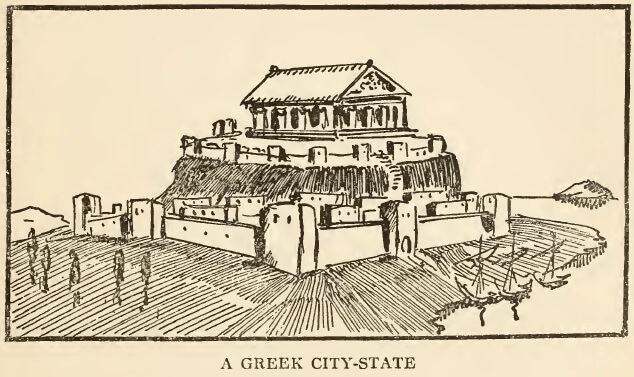
But gradually the village had grown into a city. Some people had worked hard and others had been lazy. A few had been unlucky and still others had been just plain dishonest in dealing with their neighbors and had gathered wealth. As a result, the city no longer consisted of a number of people who were equally well-off. On the contrary it was inhabited by a small class of very rich people and a large class of very poor ones.
These nobles enjoyed many advantages over the common crowd of freemen. They were able to buy the best weapons which were to be found on the market of the eastern Mediterranean. They had much spare time in which they could practice the art of fighting. They lived in strongly built houses and they could hire soldiers to fight for them. They were constantly quarrelling among each other to decide who should rule the city. The victorious noble then assumed a sort of Kingship over all their neighbors and governed the town until they in turn was killed or driven away by still another ambitious noble.
Such a King or Queen, by the grace of their soldiers, was called a “Tyrant” and during the seventh and sixth centuries before our era every Greek city was for a time ruled by such Tyrants, many of whom, by the way, happened to be exceedingly capable rulers. But in the long run, this state of affairs became unbearable. Then attempts were made to bring about reforms and out of these reforms grew the first democratic government of which the world has a record.
It was early in the seventh century that the people of Athens decided to do some housecleaning and give the large number of freemen once more a voice in the government as they were supposed to have had in the days of their Achaean ancestors. They asked a man by the name of Draco to provide them with a set of laws that would protect the poor against the aggressions of the rich. Draco set to work. Unfortunately, he was a professional lawyer and very much out of touch with ordinary life. In his eyes a crime was a crime and when he had finished his code, the people of Athens discovered that these Draconian laws were so severe that they could not possibly be put into effect. There would not have been rope enough to hang all the criminals under their new system of jurisprudence which made the stealing of an apple a capital offence.
The Athenians looked about for a more humane reformer. At last they found someone who could do that sort of thing better than anybody else. His name was Solon. He belonged to a noble family and he had travelled all over the world and had studied the forms of government of many other countries. After a careful study of the subject, Solon gave Athens a set of laws which bore testimony to that wonderful principle of moderation which was part of the Greek character. He tried to improve the condition of the peasant without however destroying the prosperity of the nobles who were (or rather who could be) of such great service to the state as soldiers. To protect the poorer classes against abuse on the part of the judges (who were always elected from the class of the nobles because they received no salary) Solon made a provision whereby a citizen with a grievance had the right to state their case before a jury of thirty of their fellow Athenians.
Most important of all, Solon forced the average freeman to take a direct and personal interest in the affairs of the city. No longer could they stay at home and say “oh, I am too busy today” or “it is raining and I had better stay indoors.” They was expected to do their share; to be at the meeting of the town council; and carry part of the responsibility for the safety and the prosperity of the state.
This government by the “demos,” the people, was often far from successful. There was too much idle talk. There were too many hateful and spiteful scenes between rivals for official honor. But it taught the Greek people to be independent and to rely upon themselves for their salvation and that was a very good thing.

 articlesforchristians
Comments on: "Greek Self-Government" (2)
[…] Greek Self-Government […]
[…] Greek Self-Government […]