CRUX (The Cross)
The Cross Endured
The Hebrew name was Adom, which means cutting off, as in Dan. ix. 26:—“After threescore and two weeks shall Messiah be cut off.” The last letter of the Hebrew alphabet was called Tau, which was anciently made in the form of a cross. The ancient Phœnician was [Symbol: right-tilted cross]; the ancient Hebrew, as found on coins, was [Symbol: right-tilted cross] and [Symbol: vertical cross]; the Aramaic, as found on Egyptian monuments, was a transition [Symbol: tilted cross] or [Symbol: stretched cross], which passed into the present square Hebrew character ת. This letter is called Tau, and means a mark; especially a boundary-mark, a limit or finish. And it is the last letter, which finishes the Hebrew alphabet to this day.
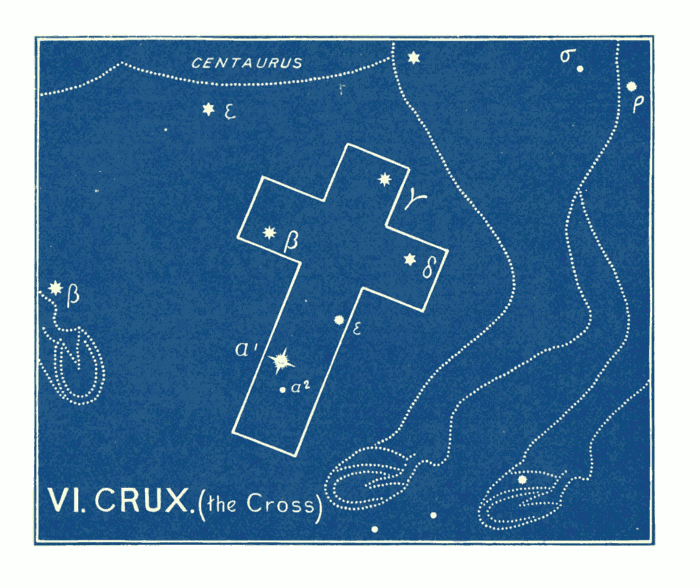
The Southern Cross was just visible in the latitude of Jerusalem at the time of the first coming of our Lord to die. Since then, through the gradual recession of the Polar Star, it has not been seen in northern latitudes. It gradually disappeared and became invisible at Jerusalem when the Real Sacrifice was offered there; and tradition, which preserved its memory, assured travelers that if they could go far enough south it would be again seen. Dante sang of “the four stars never beheld but by the early race of men.” It was not until the sixteenth century had dawned that missionaries and voyagers, doubling the Cape for the first time, and visiting the tropics and southern seas, brought back the news of “a wonderful cross more glorious than all the constellations of the heavens.”
It is a small asterism, containing only about five stars, viz., one of the 1st magnitude, two of the 2nd, one of the 3rd, and one of the 4th. Four of these are in the form of a cross.
Long before the Christian Era this sign of the Cross had lost its true meaning, and had been perverted in Babylon and Egypt as it has since been desecrated by Rome. The Persians and Egyptians worshipped it. The cakes made and eaten in honour of the Queen of Heaven were marked with it. This heathen custom Rome has adopted and adapted in her Good Friday cakes, which are thus stamped. But all are alike ignorant of what it means, viz., “IT IS FINISHED.”
In Egypt, and in the earliest times, it was the sign and symbol of life. To-day, Romanists use it as the symbol of death! But it means life! Natural life given up, and eternal life procured. Atonement, finished, perfect, and complete; never to be repeated, or added to. All who partake of its benefits in Christ now, in grace, by faith “ARE made nigh by the blood of Christ” (Eph. ii. 13), and of them Jesus says, “He that heareth my voice, and believeth on Him that sent me HATH everlasting life, and shall not come into judgment; but IS PASSED from death unto life” (John v. 24). So perfect and complete is the work which Jesus finished on the Cross that we cannot seek to add even our repentance, faith, tears, or prayers, without practically asserting that the work of Christ is not finished, and is not sufficient!
The Hebrew names of this constellation—Adom and Tau—rebuke our Pharisaic spirit, which is the relic and essence of all false religions, and points to the blessed fact that the Sacrifice was offered “once for all,” and the atoning work of Redemption completely finished on Calvary.
“’Tis finished! the Messiah dies!
Cut off for sins, but not His own;
Accomplished is the sacrifice,
The great redeeming work is done.”
In the ancient Egyptian Zodiac of Denderah this first Decan of Libra is represented as a lion with his tongue hanging out of his mouth, as if in thirst, and a female figure holding a cup out to him. Under his fore feet is the hieroglyphic symbol of running water. What is all this but “the Lion of the tribe of Judah” brought down “into the dust of death,” and saying “I am poured out like water … my strength is dried up” (Ps. xxii. 13-18): “I thirst” (John xix. 28): “and in my thirst they gave me vinegar to drink” (Ps. lxix. 21)?
The Egyptian name of this Lion, however, points to his ultimate triumph, for it is called Sera, that is, victory!

 articlesforchristians

Comments on: "Witness of the Stars: Crux (the Cross)" (2)
[…] Part 1: CRUX (The Cross) […]
[…] Witness of the Stars: Crux (the Cross) […]