3. DRACO (The Dragon)
The Old Serpent, or the Devil, cast down from Heaven.
Each of the three great books concludes with this same foreshowing of Apocalyptic truth. The same great enemy is referred to in all these pictures. He is the Serpent; he is the Dragon; “the great dragon, that old serpent, called the Devil and Satan” (Rev. xii. 9). The Serpent represents him as the Deceiver; the Dragon, as the Destroyer.
This First Book concludes with the Dragon being cast down from heaven.
The Second Book concludes with Cetus, the Sea Monster, Leviathan, bound.
The Third Book concludes with Hydra, the Old Serpent, destroyed.
Here, at the close of the First Book, we see not merely a dragon, but the Dragon cast down! That is the point of this great star-picture.
No one has ever seen a dragon; but among all nations (especially in China and Japan), and in all ages, we find it described and depicted in legend and in art. Both Old and New Testaments refer to it, and all unite in connecting with it one and the same great enemy of God and man.
It is against him that the God-Man— “the Son of God—goes forth to war.” It is for him that the eternal fires are prepared. It is he who shall shortly be cast down from the heavens preparatory to his completed judgment. It is of him we read, “The great dragon was cast out, that old serpent, called the Devil, and Satan, which deceiveth the whole world: he was cast out and his angels with him. And I heard a loud voice saying in heaven, Now is come salvation, and strength, and the kingdom of our God, and the power of His Christ; for the accuser of our brethren is cast down” (Rev. xii. 9, 10).
It is of him that David sings: —
“God is my king of old,
Working salvation in the midst of the earth …
Thou brakest the heads of the dragons in the waters.
Thou brakest the heads of leviathan in pieces.”
(Ps. lxxiv. 12-14.)
Of him also the Spirit causes Isaiah to say, “In that day, shall this song be sung in the land of Judah”; —
“In that day the Lord, with his sore, and great, and strong sword,
Shall punish leviathan the piercing (r.v. swift) serpent,
Even leviathan that crooked serpent;
And he shall slay the dragon that is in the sea.”
(Isa. xxvi. 1; xxvii. 1.)
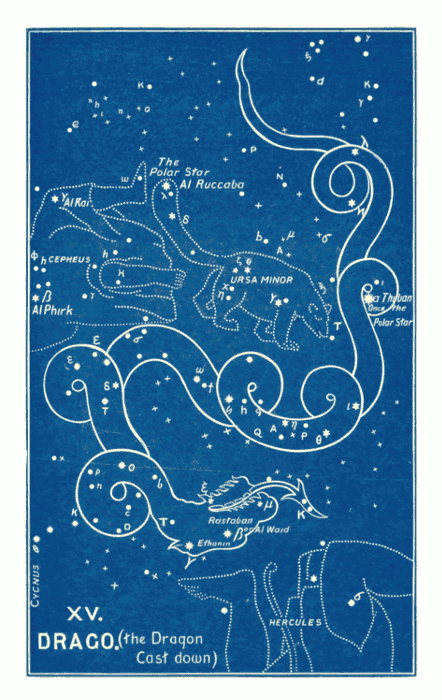
This is exactly what is foreshadowed by this constellation of Draco. Its name is from the Greek, and means trodden on, as in the Septuagint of Ps. xci. 13: “The dragon shalt thou trample under feet,” from the Hebrew דָּרַךְ, Dahrach, to tread.
In the Zodiac of Denderah it is shown as a serpent under the fore-feet of Sagittarius, and is named Her-fent, which means the serpent accursed!
There are 80 stars in the constellation; four of the 2nd magnitude, seven of the 3rd magnitude, ten of the 4th, etc.
The brightest star, α (in one of the latter coils), is named Thuban (Heb.), the subtle. Some 4,620 years ago it was the Polar Star. It is manifest, therefore, that the Greeks could not have invented this constellation, as is confessed by all modern astronomers. It is still a very important star in nautical reckonings, guiding the commerce of the seas, and thus “the god of this world” is represented as winding in his contortions round the pole of the world, as if to indicate his subtle influence in all worldly affairs.
The next star, β (in the head), is called by the Hebrew name Rastaban, and means the head of the subtle (serpent). In the Arabic it is still called Al Waid, which means who is to be destroyed.
The next star, γ (also in the head), is called Ethanin, i.e., the long serpent, or dragon.
The Hebrew names of other stars, not identified, are Grumian, the subtle; Giansar, the punished enemy. Other (Arabic) names are Al Dib, the reptile; El Athik, the fraudful; El Asieh, the bowed down.
And thus the combined testimony of every star (without a single exception) of each constellation, and the constellations of each sign, accords with the testimony of the Word of God concerning the coming Seed of the woman, the bruising of His heel, the crushing of the serpent’s head, “the sufferings of Christ, and the glory which should follow.”
“From far I see the glorious day,
When He who bore our sins away,
Will all His majesty display.
A Man of Sorrows once He was,
No friend was found to plead His cause,
As all preferred the world’s applause.
He groaned beneath sin’s awful load,
For in the sinner’s place He stood,
And died to bring him back to God.
But now He waits, with glory crowned.
While angel hosts His throne surround,
And still His lofty praises sound.
To few on earth His name is dear,
And they who in His cause appear,
The world’s reproach and scorn must bear
Jesus, Thy name is all my boast,
And though by waves of trouble tossed,
Thou wilt not let my soul be lost.
Come then, come quickly from above,
My soul impatient longs to prove,
The depths of everlasting love.”

 articlesforchristians
Comments on: "Witness of the Stars: Draco (the Dragon)" (1)
[…] DRACO (The Dragon) […]