Nuts are actually a type of fruit, defined as dry, single-seeded fruits with high oil content, usually encased in a leathery or hard outer shell. In botanical terms, a true nut has a single seed, a hard shell, and a protective husk—like chestnuts, hazelnuts, pecans, and walnuts. Peanuts and almonds, however, aren’t true nuts; peanuts are legumes, and almonds are surrounded by a fleshy coating similar to a plum. True nut or not, these tasty fruits are enjoyed by people all over the world.
Facts about nuts:
- Types of nuts include hazelnuts, birch nuts, chestnuts, acorns, and hickory nuts.
- Peanuts are not nuts. They are legumes, like peas and beans.
- Coconuts, almonds, macadamia, pistachio, pecan, walnuts, and cashews are also not true nuts.
Acorns
Acorns are the nuts that come from oak trees (Quercus spp.) and were once a staple food for many indigenous peoples of North America. They were especially important in California, where multiple oak species grow in the same areas.
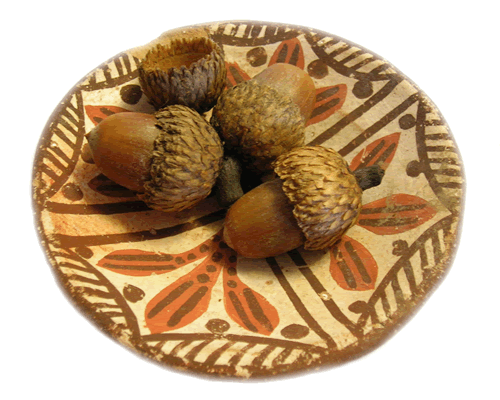
White Oak (Quercus alba). Photo by Larry Stritch.
These hard-shelled fruits were an important food source because if properly treated in the sun, they could be stored for several years and used when needed. Acorns were stored in caches or on tall poles to protect them from being eaten by squirrels. When prepared for use in foods the ground acorn flower was rinsed in a stream to remove bitter tasting tannins.
- Native American tribes used fire to promote the production of acorns within oak groves.
- Ground fires were used to kill the larvae of acorn moths and acorn weevils that can prove disastrous to the acorn crop.
- Burning occurred during the dormancy period in the soil, and the fires released nutrients bound in dead leaves and other plant debris into the soil.
- Most North American oaks tolerate light fires, especially when consistent burning has eliminated woody fuel accumulation around their trunks.
Black Walnuts
Black Walnuts (Juglans nigra) are native to North America. The nuts are primarily used in ice cream and candy.
- Walnut trees are notorious for inhibiting growth of other plants around them. They produce chemicals in their leaves that are leached out by rain and soak into ground around the trunk.
- Farmers planted these trees around farm animals to keep the flies away because they erroneously believed that the trees contained insecticides.
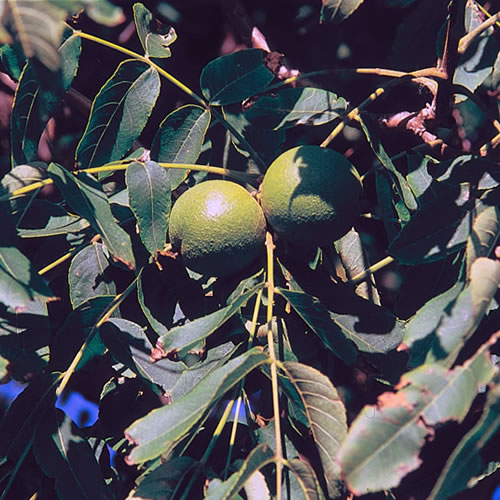
Pecans
Pecans (Carya illinoinensis) are a valuable nut species native to the American Southeast. Today, they’re widely cultivated across the southeastern United States and play a big role in the region’s cuisine.
In the past, native peoples and early American settlers enjoyed pecans because they were easy to find along major waterways and much simpler to shell than other North American nuts.

Pecan (Carya illinoinensis). Photo by Jerry A. Payne, USDA Agricultural Research Service, Bugwood.org.
source: Forest Service
U.S. Department of Agriculture

 articlesforchristians
Comments on: "Understanding Nuts: Nature’s Unique Fruits for Kids" (2)
[…] Understanding Nuts: Nature’s Unique Fruits for Kids […]
[…] Understanding Nuts: Nature’s Unique Fruits for Kids […]