Nimrod lived in ancient Babylon. He was the grandson of Ham. Remember that Ham was the father of Cush and Cush was the father of Nimrod.
Genesis 10:6-8
- And the sons of Ham; Cush, and Mizraim, and Phut, and Canaan.
- And the sons of Cush; Seba, and Havilah, and Sabtah, and Raamah, and Sabtechah: and the sons of Raamah; Sheba, and Dedan.
- And Cush begat Nimrod: he began to be a mighty one in the earth.
- He was a mighty hunter before the Lord: wherefore it is said, Even as Nimrod the mighty hunter before the Lord.
He lived after the flood. The cities that he created are Akkad, Babylon, and Uruk. All are in present day Iraq. The biblical cities of Babylon, Akkad, and Uruk are not pinpointed with modern-day coordinates. However, they are generally believed to be located in the modern-day region of Iraq, specifically in the Mesopotamian area.
- Babylon: Often associated with the modern city of Kuşteşh, Iraq, which is part of the ancient city complex of Babylon.
- Akkad: The exact location of Akkad is debated among historians, but it is commonly believed to be in the modern-day region of Iraq, possibly between the cities of Babylon and Sippar.
- Uruk: Uruk, also known as Tall al Warka, is located in present-day S Iraq.
These cities played significant roles in ancient Mesopotamia, contributing to the development of trade, administration, and culture. Their historical significance continues to be studied and referenced in biblical texts and archaeological findings.
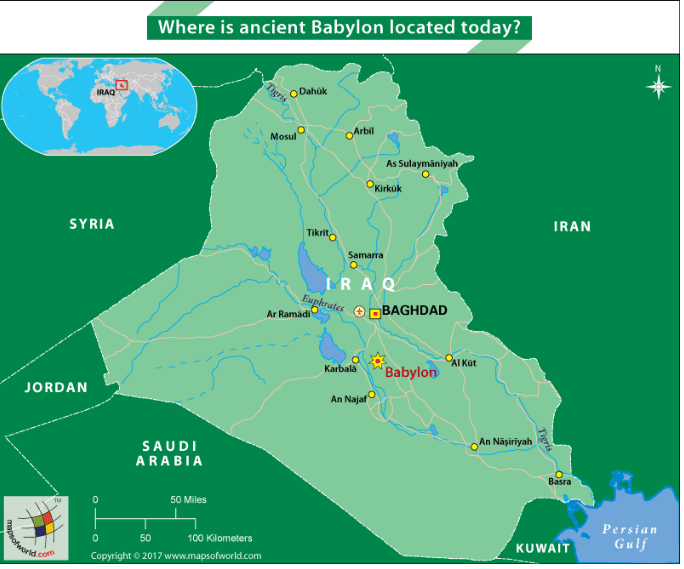
Babylon
- Strong’s H894 – bāḇel
- בָּבֶל Bâbel, baw-bel’; from H1101; confusion; Babel (i.e. Babylon), including Babylonia and the Babylonian empire:—Babel, Babylon.
- Outline of Biblical Usage
- Babel or Babylon = “confusion (by mixing)”
- Babel or Babylon, the ancient site and/or capital of Babylonia (modern Hillah) situated on the Euphrates
- Brown-Driver-Briggs Lexicon
- (in Assyrian written Bab-ilu, gate of god)
The principal cities of Nimrod’s Mesopotamian kingdom were Babel, Erech, Accad, and Calneh in the land of Shinar.
Genesis 10:10
- And the beginning of his kingdom was Babel, and Erech, and Accad, and Calneh, in the land of Shinar.
From the land of Babylon Nimrod went and built Nineveh. This is referenced to in the book of Micah.
Micah 5:6
- And they shall waste the land of Assyria with the sword, and the land of Nimrod in the entrances thereof: thus shall he deliver us from the Assyrian, when he cometh into our land, and when he treadeth within our borders.
Ninevah in what is now present-day Northern Iraq.
The name of Nimrod is probably not of Hebrew origin. The meaning and origin is uncertain. It may be Mesopotamian originating from Akkadian (Northern Babylon) god of war and hunting, Ninurta, who was called “the arrow, the mighty hunter”.
Some scholars believe that Nimrod was Sargon the Great, a powerful ruler over Accad who lived about 2300 BC.
In 1 Chronicles 1:10 (ESV) it refers to Nimrod as the 1st warrior of the land. In other translations it says “He began to be a mighty man on the earth“.
- Cush fathered Nimrod. He was the first on earth to be a mighty man.

 articlesforchristians
Comments on: "Nimrod: Mighty Hunter of Ancient Babylon" (1)
[…] Nimrod: Mighty Hunter of Ancient Babylon […]