Alice Marie Coachman Davis (November 9, 1923 – July 14, 2014) was an American track and field star who excelled in the high jump and made history as the first Black woman to win an Olympic gold medal.
Biography
Early life and education
Alice Coachman was born on November 9, 1923, in Albany, Georgia, the fifth of Fred and Evelyn Coachman’s ten children. She faced significant barriers to athletic training and participation in organized sports due to the color of her skin and the fact that she was a female athlete during a time when women in sports faced strong opposition. Making the most of what she had, she trained by running barefoot along dirt roads near her home and practiced her jumping with homemade equipment.
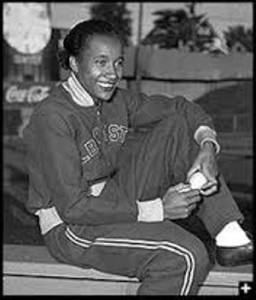
Coachman went to Monroe Street Elementary School, where her 5th grade teacher, Cora Bailey, and her aunt, Carrie Spry, encouraged her even though her parents had doubts. When she started at Madison High School in 1938, she joined the track team and trained with Harry E. Lash to hone her athletic skills. Within a year, she caught the eye of the Tuskegee Institute in Tuskegee, Alabama.
In 1939, at just 16, she entered Tuskegee Preparatory School on a scholarship that required her to work while studying and training. Her duties included cleaning and maintaining sports facilities and repairing uniforms. She graduated from the Tuskegee Institute in 1946 with a degree in dressmaking, then went on to Albany State College the next year. There, she earned a B.S. in Home Economics with a minor in science in 1949, before becoming a teacher and track-and-field instructor.
Athletic career
Before enrolling at Tuskegee Preparatory School, Coachman competed in the Amateur Athletic Union’s (AAU) Women’s National Championships, where she broke both the college and national high jump records while jumping barefoot. Her unique style combined elements of straight jumping and the western roll technique.
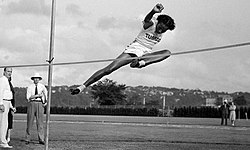
From 1939 to 1948, Coachman dominated the AAU outdoor high jump championships, winning ten straight national titles and earning the nickname “Tuskegee Flash.” While at Tuskegee Institute, she also claimed national championships in the 50-meter dash, 100-meter dash, and as part of the 400-meter relay team. Over nine years, she racked up 26 national titles—second only to her Polish-American rival Stella Walsh—and even won three conference championships as a guard on the women’s basketball team. Unfortunately, her prime years coincided with the canceled 1940 and 1944 Olympic Games due to World War II. As sportswriter Eric Williams put it, had she competed in those Olympics, she might be remembered as the greatest female athlete of all time.
Coachman got her big break on the world stage at the 1948 Olympic Games in London. She made the US Olympic team with a high jump of 5 feet 4 inches (1.63 m), breaking a 16-year-old record by three-quarters of an inch (19 mm). In the finals, she cleared 1.68 m (5 ft 6 in) on her first attempt. Her closest competitor, Great Britain’s Dorothy Tyler, matched the height but only on her second try. Coachman ended up being the only American woman to win an Olympic gold in athletics that year, with King George VI presenting her medal.
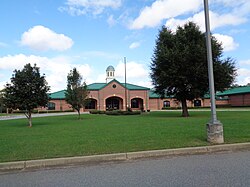
When Coachman returned to the United States after the Olympics, she quickly rose to celebrity status. She met President Harry Truman and former First Lady Eleanor Roosevelt, was celebrated with parades from Atlanta to Albany, and even enjoyed a party hosted by Count Basie. In 1952, she made history as the first African-American woman to endorse an international product, becoming a spokesperson for the Coca-Cola Company and appearing on billboards alongside 1936 Olympic champion Jesse Owens. Back in her hometown, both Alice Avenue and Coachman Elementary School were named in her honor.
Later life
Coachman’s athletic career wrapped up when she was just 24, after which she devoted herself to education and the Job Corps. She passed away in Albany, Georgia, on July 14, 2014, from cardiac arrest following ongoing respiratory issues. A few months earlier, she had suffered a stroke and received care at a nursing home. She had two children with her first husband, N. F. Davis, before their marriage ended in divorce, and her second husband, Frank Davis, died before her.
Legacy
Coachman was inducted into the USA Track and Field Hall of Fame in 1975 and the Georgia Sports Hall of Fame in 1979. She was celebrated as one of the 100 greatest Olympians during the 1996 Summer Olympics in Atlanta. In 1998, she became an honorary member of Alpha Kappa Alpha sorority, and in 2002, she was recognized as a Women’s History Month Honoree by the National Women’s History Project. She was later inducted into the United States Olympic Hall of Fame in 2004.
Coachman has been celebrated for paving the way for future African American track stars like Evelyn Ashford, Florence Griffith Joyner, and Jackie Joyner-Kersee. Since her remarkable Olympic performance, Black women have often made up the majority of the U.S. women’s Olympic track and field team. Reflecting on her impact, she said, “I think I opened the gate for all of them. Whether they believe that or not, they should appreciate someone from the Black community who was able to accomplish these things.”

 articlesforchristians
Comments on: "Alice Coachman: First Black Woman Olympic Champion" (1)
[…] Robinson: A Pioneer for Equality in Sports Alice Coachman: First Black Woman Olympic […]