Throughout the year and most especially near any time of a celebration, there are people who claim that the celebration is pagan. Therefore, Christians cannot participate. The most common scriptures used to support this claim are
- Deuteronomy 4:2 ESV
- You shall not add to the word that I command you, nor take from it, that you may keep the commandments of the Lord your God that I command you.
- Jeremiah 10:2 ESV
- Thus says the Lord: “Learn not the way of the nations, nor be dismayed at the signs of the heavens because the nations are dismayed at them,
- Deuteronomy 12:29-32 ESV
- “When the Lord your God cuts off before you the nations whom you go in to dispossess, and you dispossess them and dwell in their land, take care that you be not ensnared to follow them, after they have been destroyed before you, and that you do not inquire about their gods, saying, ‘How did these nations serve their gods?—that I also may do the same.’ You shall not worship the Lord your God in that way, for every abominable thing that the Lord hates they have done for their gods, for they even burn their sons and their daughters in the fire to their gods. “Everything that I command you, you shall be careful to do. You shall not add to it or take from it.
Unfortunately, these verses are usually taken out of context. When these claims are made, they must be assuming that by doing anything with celebration, you are attempting to worship God with the celebration. They love to use the verse that says don’t “add anything to the word” to support the claim that you can’t participate in any celebration that God has not commanded. I agree with not adding to or taking away from the Word of God. I also believe that all scripture needs to be understood in context.
Other people claim that if something has its roots in paganism it should be avoided. That sounds great until you realize how much that is used every day has its beginnings from paganism. Here are a few examples: names of the months of the year, names of the days of the week, and technology.
Names of the Months of the year
January
January (in Latin, Ianuarius) is named after Janus, the god of beginnings and transitions in ancient Roman religion and mythology.
February
The Roman month Februarius was named after the Latin term februum, which means “purification”, via the purification ritual Februa held on February 15 (full moon) in the old lunar Roman calendar.
- Februa: Lupercalia, also called Lupercal, was a pastoral festival in Ancient Rome held every February 15 to cleanse the city and promote health and fertility. It was originally known as Februa (“Purifications” or “Purgings”), named after the februum used during the celebration. Also called Februatus, it inspired names like Juno Februalis, Februlis, or Februata for the month’s patron goddess, as well as a purification god named Februus, and February (mensis Februarius) itself. Ovid links februare to an Etruscan word meaning “purging.”
March
The name of March comes from Martius, the first month of the earliest Roman calendar. It was named after Mars, the Roman god of war,
April
The Romans called this month Aprilis, but the origin of the name isn’t entirely clear. One common theory traces it to the Latin verb aperire, meaning “to open,” referring to the time when trees and flowers start to bloom—similar to the modern Greek word άνοιξη (ánixi) for spring. Since some Roman months were named after deities, and April was sacred to Venus with her festival, the Veneralia, on the first day, it’s also been suggested that Aprilis came from Aphrilis, linked to her Greek counterpart Aphrodite or the Etruscan goddess Apru. Jacob Grimm even proposed it could be named after a mythical figure, Aper or Aprus.
May
May, known in Latin as Maius, gets its name from the Greek goddess Maia, who was linked to the Roman goddess of fertility, Bona Dea, celebrated with a festival in May. On the other hand, the Roman poet Ovid offered a different origin, saying May was named after the maiores, meaning “elders,” while June was named for the iuniores, or “young people” (Fasti VI.88).
June
June comes from the Latin month name Iunius, named after the Roman goddess Juno. Its current English spelling was shaped by Anglo-Norman forms like join, junye, and junie. In Middle English, it appeared as Iun and Juin, with Iune used until the 17th century. This name eventually replaced the Old English term for June, ærra liþa.
July
It was named by the Roman Senate in honour of Roman general and statesman Julius Caesar in 44 B.C., being the month of his birth. Before then it was called Quintilis, being the fifth month of the calendar that started with March.
August
The month was originally named Sextilis in Latin because it was the 6th month in the original ten-month Roman calendar under Romulus in 753 BC, with March being the first month of the year. About 700 BC, it became the eighth month when January and February were added to the year before March by King Numa Pompilius, who also gave it 29 days. Julius Caesar added two days when he created the Julian calendar in 46 BC (AUC 708), giving it its modern length of 31 days.
In 8 BC, the month was renamed in honor of Emperor Augustus. According to a Senatus consultum quoted by Macrobius, he chose this month because it marked several of his great triumphs, including the conquest of Egypt. A popular but incorrect story claims that August has 31 days because Augustus wanted it to match Julius Caesar’s July, but this was actually invented by the 13th-century scholar Johannes de Sacrobosco. In reality, Sextilis already had 31 days before it was renamed.
Day of the Week
Sunday
The name “Sunday”, the day of the Sun, is derived from the traditional astronomical naming system for days of the week. The English noun Sunday derived sometime before 1250 from sunedai, which itself developed from Old English (before 700) Sunnandæg (literally meaning “sun’s day”)
Monday
Monday as ἡμέρᾱ Σελήνης, diēs Lūnae “day of the Moon”. A lunar deity or moon deity is a deity who represents the Moon, or an aspect of it. These deities can have a variety of functions and traditions depending upon the culture, but they are often related. Lunar deities and Moon worship can be found throughout most of recorded history in various forms.
Tuesday
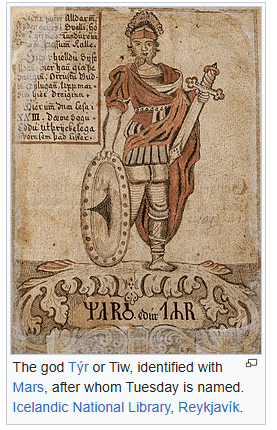
The name Tuesday derives from the Old English Tiwesdæg and literally means “Tiw’s Day”.[2] Tiw is the Old English form of the Proto-Germanic god *Tîwaz, or Týr in Old Norse. *Tîwaz derives from the Proto-Indo-European base *dei-, *deyā-, *dīdyā-, meaning ‘to shine’, whence come such words as “deity”.
Wednesday
In English, the name is derived from Old English Wōdnesdæg and Middle English Wednesdei, ‘day of Woden’, reflecting the religion practised by the Anglo-Saxons, the English equivalent to the Norse god Odin. In many Romance languages, such as the French mercredi, Spanish miércoles or Italian mercoledì, the day’s name is a calque of Latin dies Mercurii ‘day of Mercury’.

Thursday
Thunor’s day
The name is derived from Old English þunresdæg and Middle English Thuresday. It was named after the Old English god Thunor. Thunor and Thor are derived from the name of the Germanic god of thunder, *Thunraz, equivalent to Jupiter in the interpretatio romana.
In most Romance languages, Thursday is named after the Roman god Jupiter, the deity of the sky and thunder. In Latin, it was called Iovis Dies, meaning “Jupiter’s Day.” The genitive form of Jupiter in Latin was Iovis or Jovis, which evolved into the modern words for Thursday in many Romance languages: Italian giovedì, Spanish jueves, French jeudi, Sardinian jòvia, Catalan dijous, Galician xoves, and Romanian joi. This naming pattern also appears in the p-Celtic Welsh dydd Iau.
The astrological and astronomical sign of the planet Jupiter (♃ Jupiter) is sometimes used to represent Thursday.
Most Germanic languages name the day after the Germanic thunder god: Torsdag in Danish, Norwegian, and Swedish; Hósdagur/Tórsdagur in Faroese; Donnerstag in German; and Donderdag in Dutch. Finnish and Northern Sami, both non-Germanic Uralic languages, use the borrowed words “Torstai” and “Duorastat.” In the extinct Polabian Slavic language, it was called peründan, with Perun being the Slavic equivalent of Thor.
Friday
Friday gets its name from the Old English frīġedæġ, meaning “day of Frig,” stemming from an old tradition that linked the Germanic goddess Frigg to the Roman goddess Venus, with whom the day is connected in many cultures. The same pattern appears in Old High German as Frīatag, in modern German as Freitag, and in Dutch as vrijdag.
In Old Norse, the expected cognate for Friday would be friggjar-dagr, but the actual name is frjá-dagr, suggesting the weekday names were borrowed from Low German. Interestingly, the modern Faroese name is fríggjadagur, while in Swedish, Norwegian, and Danish it’s fredag, meaning “Freyja’s day.” The line between Freyja and Frigg in some Germanic myths remains a debated topic.
In most Romance languages, the word for Friday comes from the Latin dies Veneris, meaning “day of Venus,” which translates the Greek Aphrodī́tēs hēméra (Ἀφροδῑ́της Ἡμέρα). Examples include vendredi in French, venres in Galician, divendres in Catalan, vennari in Corsican, venerdì in Italian, vineri in Romanian, and viernes in Spanish, which also influenced Filipino biyernes or byernes and Chamorro betnes. The p-Celtic Welsh language reflects this too, with the word Gwener.
Portuguese, a Romance language, is an exception as it uses the word sexta-feira, meaning “sixth day of liturgical celebration,” derived from the Latin feria sexta found in religious texts where dedicating days to pagan gods was forbidden. Another exception is Sardinian, where the word chenàpura comes from the Latin cena pura, a name given by the Jewish community exiled to the island to describe food prepared specifically for Shabbat eve.
Saturday
No later than the 2nd century AD, the Romans named Saturday diēs Sāturnī (“Saturn’s Day”) for the god Saturn. His planet, Saturn, controlled the first hour of that day, according to Vettius Valens. The day’s name was introduced into West Germanic languages, and is recorded in the Low German languages such as Middle Low German satersdach, saterdach, Middle Dutch saterdag (Modern Dutch zaterdag), and Old English Sæternesdæġ, Sæterndæġ or Sæterdæġ
Technology
Etymology of “Technology”
The word “technology” originates from two Greek words:
- “Techne” (τέχνη) meaning “art, skill, or craft”
- “Logos” (λόγος) meaning “discourse, reason, or study”
Therefore, the literal meaning of “technology” is “study of art or craft.”
Techne is the ancient Greek personified spirit (daimona) of art, craft, and technical skill. She is associated with Hephaestus, the god of craftsmanship, and the Muses, who inspire creativity. Techne is said to be the daughter of Hephaestus and Aphrodite, combining skills of craftsmanship with beauty.
Summary
In daily life, I live in an English-speaking country. Most people when referring to the days of the week or the months of the year, have forgotten the connection to the paganism. I personally use numbers when writing the date. However, when dealing with other people it is useful for me to use the language that those around me are using. Trying to avoid every word that has ever been connected to paganism would be very difficult. God in His commandments was saying, don’t use any traditions, customs, or ideas that the pagans use for worshipping and honoring the pagan gods to worship and honor Him. Remember we are called to live in this world to share the Gospel with others. Here are some scriptures that can help you navigate the complex issue of how to be in the world, but not of the world.
- Romans 12:2
- And be not conformed to this world: but be ye transformed by the renewing of your mind, that ye may prove what is that good, and acceptable, and perfect, will of God.
- 1 Peter 2:11 ESV
- Beloved, I urge you as sojourners and exiles to abstain from the passions of the flesh, which wage war against your soul.
- John 17:16 ESV
- They are not of the world, just as I am not of the world.
- Matthew 5:13-16 ESV
- “You are the salt of the earth, but if salt has lost its taste, how shall its saltiness be restored? It is no longer good for anything except to be thrown out and trampled under people’s feet. “You are the light of the world. A city set on a hill cannot be hidden. Nor do people light a lamp and put it under a basket, but on a stand, and it gives light to all in the house. In the same way, let your light shine before others, so that they may see your good works and give glory to your Father who is in heaven.
Pray about what you should and should not avoid. If something causes you to stumble, avoid it. However, remember what Paul’s answer about eating meat.
1 Corinthians 10:23-33
- All things are lawful for me, but all things are not expedient: all things are lawful for me, but all things edify not.
- Let no man seek his own, but every man another’s wealth.
- Whatsoever is sold in the shambles, that eat, asking no question for conscience sake:
- For the earth is the Lord’s, and the fulness thereof.
- If any of them that believe not bid you to a feast, and ye be disposed to go; whatsoever is set before you, eat, asking no question for conscience sake.
- But if any man say unto you, this is offered in sacrifice unto idols, eat not for his sake that shewed it, and for conscience sake: for the earth is the Lord’s, and the fulness thereof:
- Conscience, I say, not thine own, but of the other: for why is my liberty judged of another man’s conscience?
- For if I by grace be a partaker, why am I evil spoken of for that for which I give thanks?
- Whether therefore ye eat, or drink, or whatsoever ye do, do all to the glory of God.
- Give none offence, neither to the Jews, nor to the Gentiles, nor to the church of God:
- Even as I please all men in all things, not seeking mine own profit, but the profit of many, that they may be saved.

 articlesforchristians
Comments on: "Should Christians Shun Celebrations with Pagan Ties?" (1)
[…] Christians Shun Celebrations with Pagan Ties?: The text discusses misconceptions about celebrating dates rooted in paganism, […]