- CANIS MAJOR (The Dog), or SIRIUS (The Prince)
- The coming Glorious Prince of Princes (Sirius)
This second constellation carries on the teaching, and tells of the glorious Prince who will thus subdue and reign.
In the Denderah Zodiac he is called Apes, which means the head. He is pictured as a hawk (Naz, נַץ, caused to come forth, coming swiftly down). The hawk is the natural enemy of the serpent, and here it has on its head a pestle and mortar, indicating the fact that he shall crush the head of the enemy.
In the Persian planisphere it is pictured as a wolf, and is called Zeeb, which in Hebrew (זְאֵב) has the same meaning. Plutarch translates it Προόπτης, Leader. In Arabic it means coming quickly.
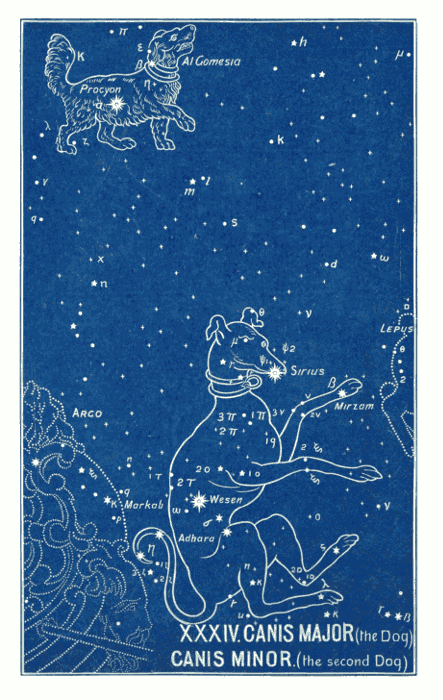
Its ancient name and meaning must be obtained from the names of its stars which have come down to us. There are 64 altogether. Two are of the 1st magnitude, two of the 2nd, four of the 3rd, four of the 4th, etc. Of these α (in the head) is the brightest in the whole heavens! It is called Sirius, the Prince (שַׂר, Sar), as in Isa. ix. 6.
Sirius was, by the ancients, always associated with great heat. And the hottest part of the year we still call “the dog days,” though, through the variation as observed in different latitudes, and the precession of the equinoxes, its rising has long ceased to have any relation to those days. Virgil says that Sirius
“With pestilential heat infects the sky.”
Homer spoke of it as a star
“Whose burning breath
Taints the red air with fevers, plagues, and death.”
It is not, however, of its heat that its name speaks, but of the fact that it is the brightest of all the stars, as He of whom it witnesses is the “Prince of princes,” “the Prince of the Kings of the earth.”
Though this “Dog-Star” came to have an ill-omened association, it was not so in more ancient times. In the ancient Akkadian it is called Kaṡiṡta, which means the Leader and Prince of the heavenly host. While (as Mr. Robert Brown, Junr., points out) “the Sacred Books of Persia contain many praises of the star Tistrya or Tistar (Sirius), ‘the chieftain of the East.’ ”
The next star, β (in the left fore foot), speaks the same truth. It is named Mirzam, and means the prince or ruler. The star δ (in the body) is called Wesen, the bright, the shining. The star ε (in the right hind leg) is called Adhara, the glorious.
Other stars, not identified, bear their witness to the same fact. Their names are—Aschere (Hebrew), who shall come; Al Shira Al Jemeniya (Arabic), the Prince or chief of the right hand! Seir (Egyptian), the Prince; Abur (Hebrew), the mighty; Al Habor (Arabic), the mighty; Muliphen (Arabic), the leader, the chief.
Here there is no conflicting voice; no discord in the harmonious testimony to Him whose name is called “Wonderful, Counsellor, the Mighty God … the Prince of Peace” (Isa. ix. 6).
The names of the stars have no meaning whatever as applied to an Egyptian Hawk, or a Greek Dog. But they are full of significance when we apply them to Him of whom Jehovah says:
“Behold, I have given Him for a witness to the people,
A Leader and commander to the people.”
(Isa. lv. 4.)
This is “the Prince of princes” (Dan. viii. 23, 25) against whom, “when transgressors are come to the full, a king of fierce countenance … shall stand up,” “but he shall be broken without hand,” for he shall be destroyed “with the brightness of His coming” (2 Thess. ii. 8). This is He who shall come forth “King of kings and Lord of Lords” (Rev. xix. 16).
- CANIS MINOR (The Second Dog)
The Exalted Redeemer (Procyon)
The same facts are to be remembered concerning the Greek picture, and Latin name of this constellation.
The Egyptian name in the Denderah Zodiac is Sebak, which means conquering, victorious. It is represented as a human figure with a hawk’s head and the appendage of a tail.
This small constellation has only 14 stars according to the Britannic catalogue. One of the 1st magnitude, one of the 2nd, one of the 4th, etc.
The brightest star, α (in the body), is named Procyon, which means Redeemer, and it tells us that this glorious Prince is none other than the one who was slain. Just as this chapter begins with two persons in one in the Sign (Gemini), one victorious, the other wounded; so, it ends with a representation of two princes, one of whom is seen triumphant and the other as the Redeemer. This is confirmed by the next star, β (in the neck), which is named Al Gomeisa (Arabic), the burthened, loaded, bearing for others. The names of the other stars, not identified, still further confirm the great truth; viz., Al Shira, or Al Shemeliya (Arabic), the prince or chief of the left hand, answering to the star in Sirius. One right, the other left, as the two united youths are placed. Al Mirzam, the prince or ruler; and Al Gomeyra, who completes or perfects.
This does, indeed, complete and perfect the presentation of this chapter: Messiah’s reign as Prince of Peace; the enemy trodden under foot by the glorious “Prince of princes,” who is none other than the glorified Redeemer.
This is also what is written in the Book:
“Shall the prey be taken from the mighty,
Or the lawful captives be delivered?
But thus saith the Lord,
Even the captives of the mighty shall be taken away,
And the prey of the terrible shall be delivered:
For I will contend with him that contendeth with thee,
And I will save thy children.
And I will feed them that oppress thee with their own flesh;
And they shall be drunken with their own blood as with sweet wine;
And all flesh shall know that I the Lord am thy Saviour,
And thy REDEEMER—the Mighty One of Jacob.”
(Isa. xlix. 24-26, r.v.)
“When the enemy shall come in like a flood,
The Spirit of the Lord shall lift up a standard against him,
And the REDEEMER shall come to Zion.”
(Isa. lix, 19, 20.)
“And He shall divide the spoil with the strong,
Because He hath poured out His soul unto death.”
(Isa. liii. 12.)

 articlesforchristians
Comments on: "Witness of the Stars: CANIS MAJOR (The Dog), or SIRIUS (The Prince) & CANIS MINOR (The Second Dog)" (1)
[…] CANIS MAJOR (The Dog), or SIRIUS (The Prince) & CANIS MINOR (The Second Dog) […]