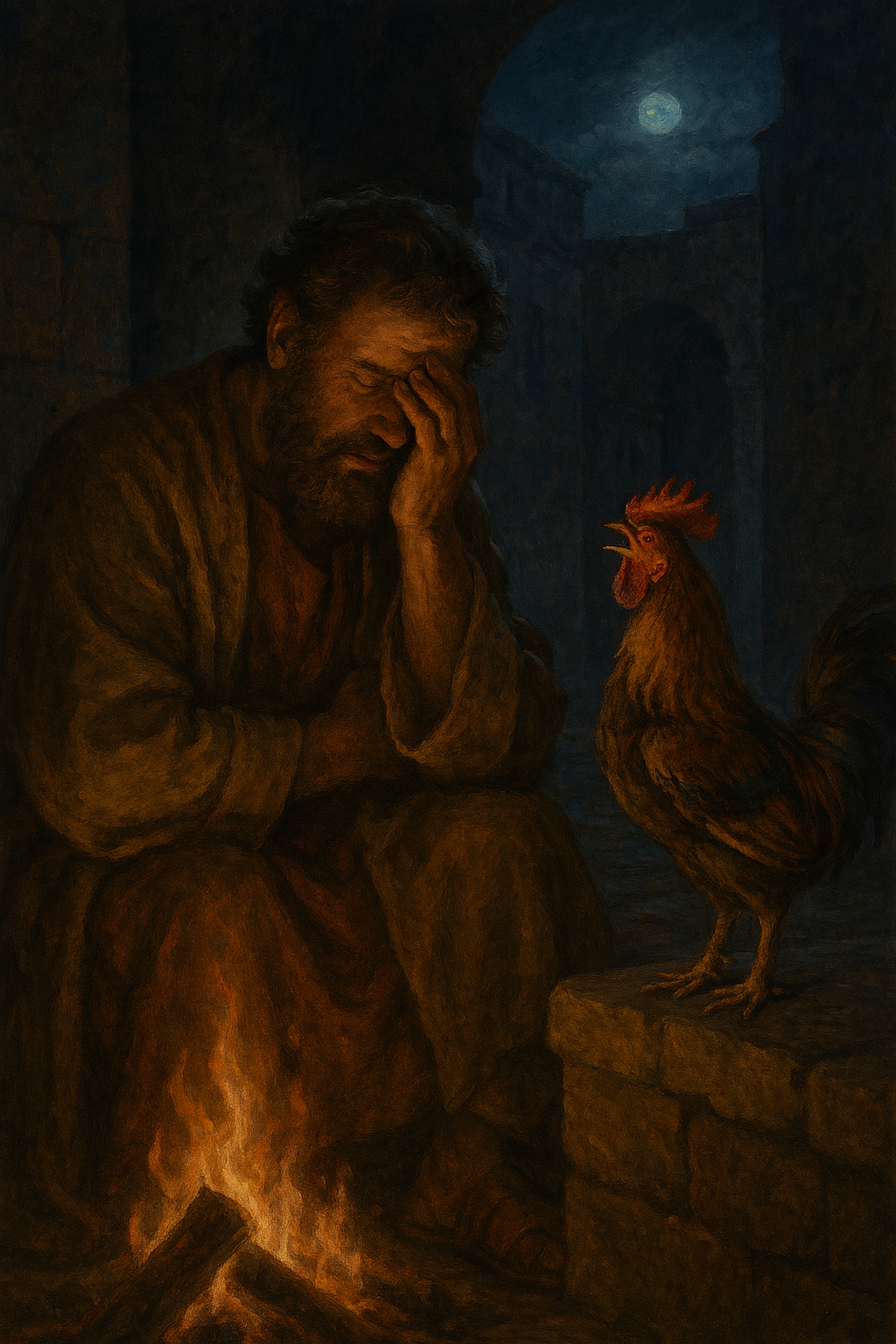
Matthew 26:69-75
- Now Peter sat without in the palace: and a damsel came unto him, saying, Thou also wast with Jesus of Galilee.
- But he denied before them all, saying, I know not what thou sayest.
- And when he was gone out into the porch, another maid saw him, and said unto them that were there, This fellow was also with Jesus of Nazareth.
- And again he denied with an oath, I do not know the man.
- And after a while came unto him they that stood by, and said to Peter, Surely thou also art one of them; for thy speech bewrayeth thee.
- Then began he to curse and to swear, saying, I know not the man. And immediately the cock crew.
- And Peter remembered the word of Jesus, which said unto him, Before the cock crow, thou shalt deny me thrice. And he went out, and wept bitterly.
Peter’s denial in Matthew 26:69–75 is one of the most sobering and hope‑filled moments in the Gospels. It shows the frailty of even the strongest disciple—and the faithfulness of Jesus’ words and mercy.
What happens in the passage
Peter, who only hours earlier vowed he would never deny Jesus, now finds himself in the courtyard outside the high priest’s palace. Three escalating accusations come:
- A servant girl recognizes him — Peter denies even understanding what she means.
- Another maid identifies him — Peter denies again, this time with an oath.
- Bystanders confront him — His Galilean accent gives him away, and he responds with cursing and swearing, insisting, “I know not the man.”
Immediately the rooster crows, and Peter remembers Jesus’ prophecy. The weight of his failure breaks him, and he goes out and weeps bitterly.
Why this moment matters
1. Human weakness is real—even in the devoted
Peter loved Jesus deeply. He was bold, loyal, and sincere. Yet fear, pressure, and the shock of Jesus’ arrest overwhelmed him. Scripture never hides the truth that even the strongest believers can fall.
This is not to shame Peter but to show the truth about all of us:
The spirit is willing, but the flesh is weak.
2. Jesus’ foreknowledge shows His sovereignty
Jesus predicted Peter’s denial—not to condemn him, but to prepare him. When the rooster crowed, Peter realized Jesus knew his weakness and still loved him.
This moment becomes the turning point that leads to Peter’s restoration.
3. Peter’s tears show genuine repentance
“Wept bitterly” is not despair—it is the grief of a heart that loves God and knows it has failed Him. This is the kind of sorrow that leads to restoration, not destruction.
And in John 21, Jesus does restore him—three affirmations of love for three denials.
4. God uses broken people
After this failure, Peter becomes:
- A bold preacher at Pentecost
- A pillar of the early church
- A writer of Scripture
- A shepherd of God’s people
His story proves that failure is not final when grace is real.
Themes worth reflecting on
- Courage vs. fear — Peter’s fear of people overcame his love for Christ in that moment.
- Identity — His speech “bewrayed” him; belonging to Jesus cannot be hidden forever.
- Grace — Jesus knew Peter’s weakness and still chose him.
- Restoration — God does not discard repentant hearts.
A gentle question for your reflection
Is there a part of Peter’s story—his fear, his failure, or his restoration—that speaks to something God is doing in your heart right now?
For Further study
Feed My Sheep: A Call Born of Love (coming soon)

2 responses to “Peter’s Three Denials”
[…] Major Events of Holy Week in 30 AD The Events of Holy Week: A Journey to Calvary Jesus’ Final Prayer: Insights from John 17 The Cleansing of the Temple at Passover The Three Prayers in the Garden Peter’s Three Denials […]
[…] Peter’s Three Denials […]