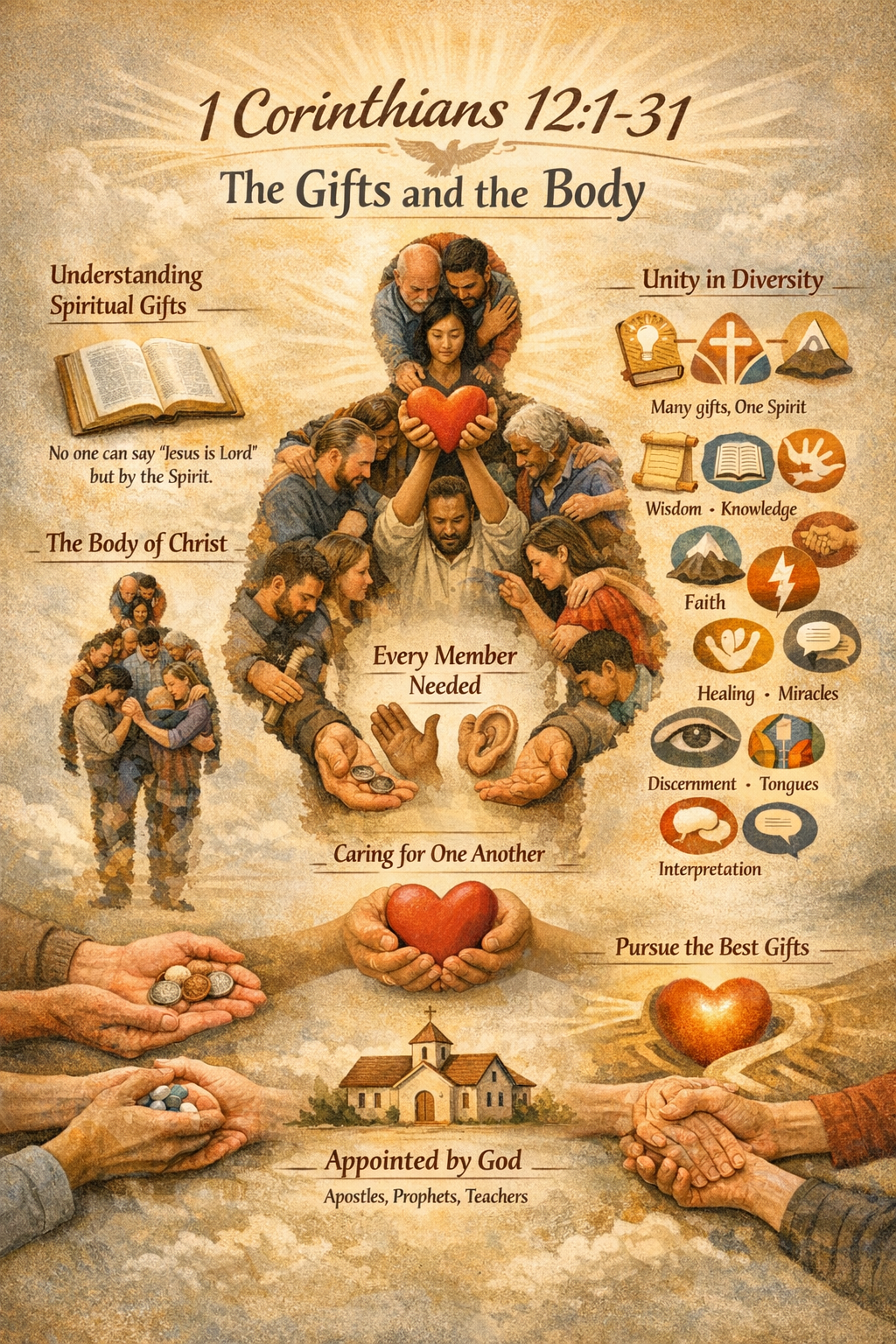
Outline of 1 Corinthians 12:1–31 — The Gifts and the Body
I. Introduction: Understanding Spiritual Gifts (vv. 1–3)
- Paul’s desire: Believers should not be ignorant about spiritual gifts.
- Former condition: They once followed mute idols without discernment.
- True spiritual discernment:
- No one speaking by the Spirit of God curses Jesus.
- No one can truly confess “Jesus is Lord” except by the Holy Spirit.
II. The Source and Purpose of Spiritual Gifts (vv. 4–7)
- Diversity, yet unity:
- Different gifts — same Spirit.
- Different ministries — same Lord.
- Different operations — same God.
- Purpose: The Spirit’s manifestation is given to each believer for the profit of all.
III. The List of Spiritual Gifts (vv. 8–11)
- Gifts given by the Spirit:
- Word of wisdom
- Word of knowledge
- Faith
- Gifts of healing
- Working of miracles
- Prophecy
- Discerning of spirits
- Divers kinds of tongues
- Interpretation of tongues
- Key truth: One and the same Spirit distributes these gifts as He wills.
- Understanding Spiritual Gifts in the Church
IV. The Body of Christ: One Body, Many Members (vv. 12–14)
- Analogy: The human body has many members but is one body.
- Application: So is Christ’s body—the Church.
- Unity through the Spirit: All believers (Jew/Gentile, bond/free) are baptized into one body and drink of one Spirit.
V. The Necessity of Every Member (vv. 15–20)
- No inferiority:
- The foot cannot exclude itself because it is not a hand.
- The ear cannot exclude itself because it is not an eye.
- Design of God:
- If the whole body were one part, it could not function.
- God has placed each member as it pleased Him.
VI. The Interdependence of the Body (vv. 21–26)
- No superiority:
- The eye cannot say to the hand, “I have no need of you.”
- The head cannot say to the feet, “I have no need of you.”
- Hidden strength:
- “Feeble” members are necessary.
- “Less honorable” members receive greater honor.
- Purpose of God’s design:
- No division in the body.
- Members care for one another.
- When one suffers, all suffer; when one is honored, all rejoice.
VII. The Church’s Appointed Roles (vv. 27–28)
- Identity: Believers are the body of Christ, each a particular member.
- God’s appointments in the church:
- Apostles
- Prophets
- Teachers
- Miracles
- Gifts of healings
- Helps
- Governments
- Diversities of tongues
VIII. Not All Have the Same Gift (vv. 29–30)
- Rhetorical questions emphasize diversity:
- Are all apostles?
- Are all prophets?
- Are all teachers?
- Do all work miracles?
- Do all have gifts of healing?
- Do all speak with tongues?
- Do all interpret?
- Implied answer: No—God distributes as He wills.
IX. Final Exhortation (v. 31)
- Pursue earnestly the best gifts.
- Yet: Paul will show them “a more excellent way”—leading into chapter 13, the way of love.
