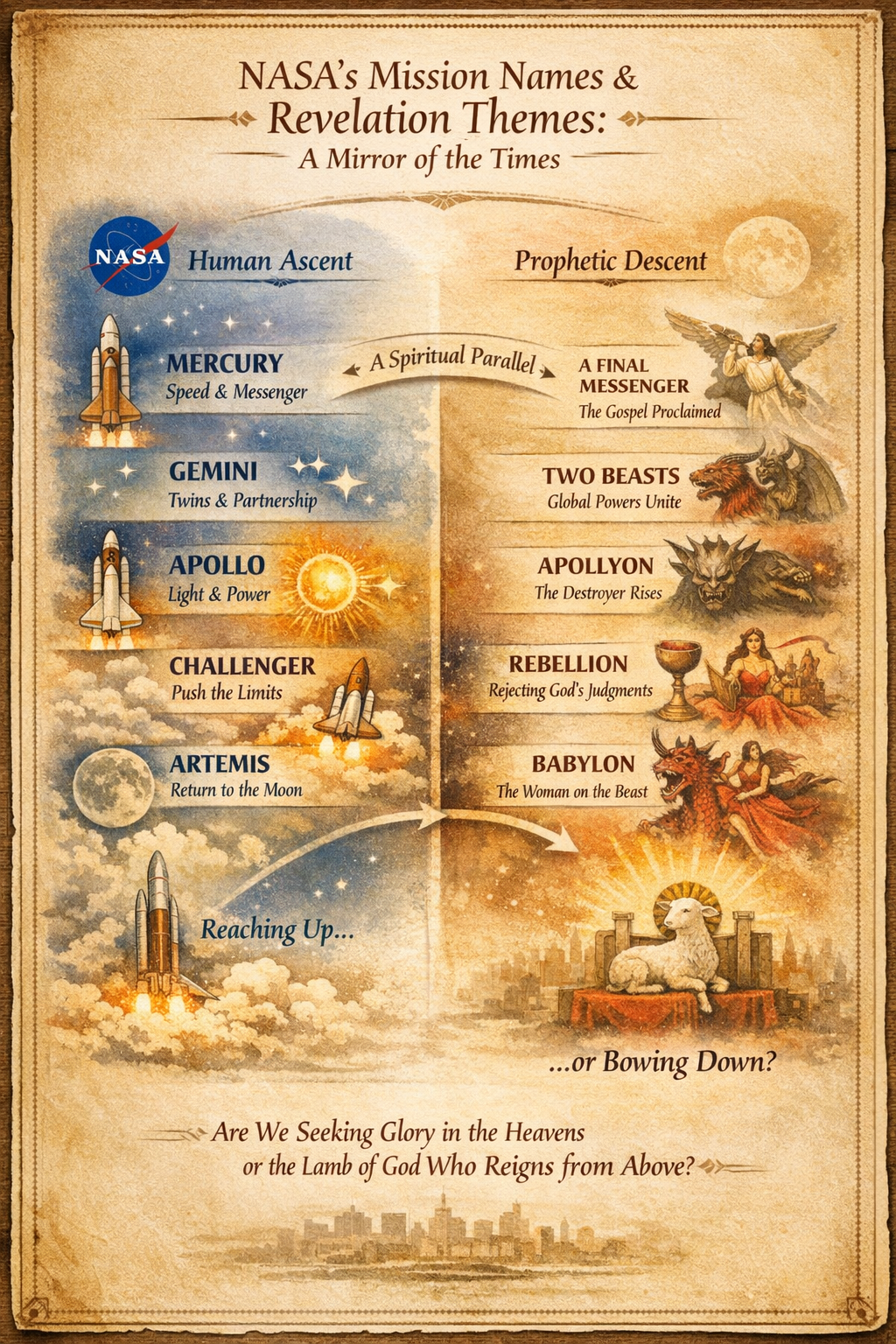
✨ A Mirror of the Times
This study does not claim that NASA or its missions fulfill any direct biblical prophecy.
The Word of God stands complete, and its end‑time revelations concern the spiritual condition of humanity, not the naming of rockets or programs.
Yet, when we look at the pattern of names and timing — Mercury, Gemini, Apollo, Challenger, Artemis — we see something worth noticing.
Each name draws from ancient mythology, each points upward toward the heavens, and each reflects a cultural tone of human ascent and self‑exaltation.
In that way, NASA’s naming tradition becomes a mirror of the spiritual climate around us:
a generation fascinated by power, progress, and transcendence, yet often forgetting the Creator who made the heavens we explore.
This timeline is not about condemnation; it’s about discernment.
It invites us to ask:
Are we reaching up in worship — or reaching up in pride?
The contrast between humanity’s upward ambition and Scripture’s call to humility reveals the same tension the Book of Revelation describes — a world striving for glory while God calls His people to bow before the Lamb.
🌙 Overlay: NASA Mission Names and Revelation Themes
| NASA Mission | Mythological Symbolism | Revelation / End‑Time Parallel | Spiritual Tone |
|---|---|---|---|
| Mercury (Messenger god) | Speed, communication, ascent | Revelation 14:6 — “An angel flying in mid‑heaven having the everlasting gospel to proclaim…” | Humanity sends its own “messengers” into the heavens, while God sends His true messenger with the gospel. |
| Gemini (Twins in the stars) | Duality, partnership, celestial identity | Revelation 13 — Two beasts (political and religious powers) working together | The twin imagery mirrors the rise of dual systems — earthly and spiritual — that cooperate in the end‑time drama. |
| Apollo (Sun god) | Light, enlightenment, power | Revelation 9:11 — “They had as king over them the angel of the abyss, whose name in Hebrew is Abaddon, and in Greek, Apollyon.” | “Apollo” and “Apollyon” share linguistic roots; both represent destructive light — false enlightenment. |
| Challenger | Testing limits, defying boundaries | Revelation 16 — Humanity challenges God’s judgments, refusing to repent despite plagues. | The name embodies the spirit of defiance that characterizes the world’s final rebellion. |
| Artemis (Moon goddess) | Cycles, fertility, feminine power | Revelation 17 — The woman clothed in purple and scarlet, riding the beast | The feminine deity imagery parallels the rise of a global spiritual system clothed in beauty but rooted in idolatry. |
🔥 Patterns That Emerge
1. Humanity’s ascent mirrors Revelation’s descent
As NASA’s missions rise higher — Mercury → Gemini → Apollo → Artemis — Revelation describes humanity’s moral and spiritual descent:
- From curiosity → pride → rebellion → judgment.
2. Mythological names echo the ancient gods revived in the end times
Revelation 9 and 13 describe spiritual powers returning to influence humanity.
The reuse of ancient names (Apollo/Apollyon, Artemis of Ephesus) mirrors that revival of old spiritual identities.
3. The Challenger tragedy stands as a prophetic warning
A moment of human pride met by sudden destruction — echoing 1 Thessalonians 5:3:
“When they say, ‘Peace and safety,’ then sudden destruction comes upon them.”
4. Artemis and Passover
The Artemis II launch aligning with Passover forms a symbolic contrast:
- Passover = God’s deliverance through humility and blood.
- Artemis = humanity’s ascent through pride and technology.
It’s the same tension Revelation portrays between the Lamb and Babylon.
🧭 A Grounded Conclusion
As we look across this timeline — from Mercury to Artemis, from the first steps into orbit to the renewed ambition of returning to the Moon — we begin to see more than technology and exploration. We see a story about the human heart. Not a fulfillment of prophecy, but a reflection of the same spiritual patterns Scripture describes: a world fascinated with ascent, enamored with its own brilliance, and eager to write its own narrative in the heavens.
Revelation shows us a humanity that grows increasingly confident in its own power, increasingly dismissive of its Creator, and increasingly united around symbols that celebrate human greatness. NASA’s mission names do not cause this climate, nor do they fulfill any specific prophecy — but they do illustrate the atmosphere of our age: a generation reaching upward with remarkable skill, yet often without reverence.
And so this timeline becomes a gentle reminder for us as believers.
Not to fear.
Not to speculate.
But to stay awake.
To recognize the difference between human ascent and holy worship.
To remember that the heavens are not a monument to human achievement, but the handiwork of God.
And to anchor our hope not in rockets or progress or exploration, but in the Lamb who reigns over every star, every nation, and every age.
In the end, the question is not whether humanity will reach the Moon again.
The question is whether we will bow before the One who made it.
