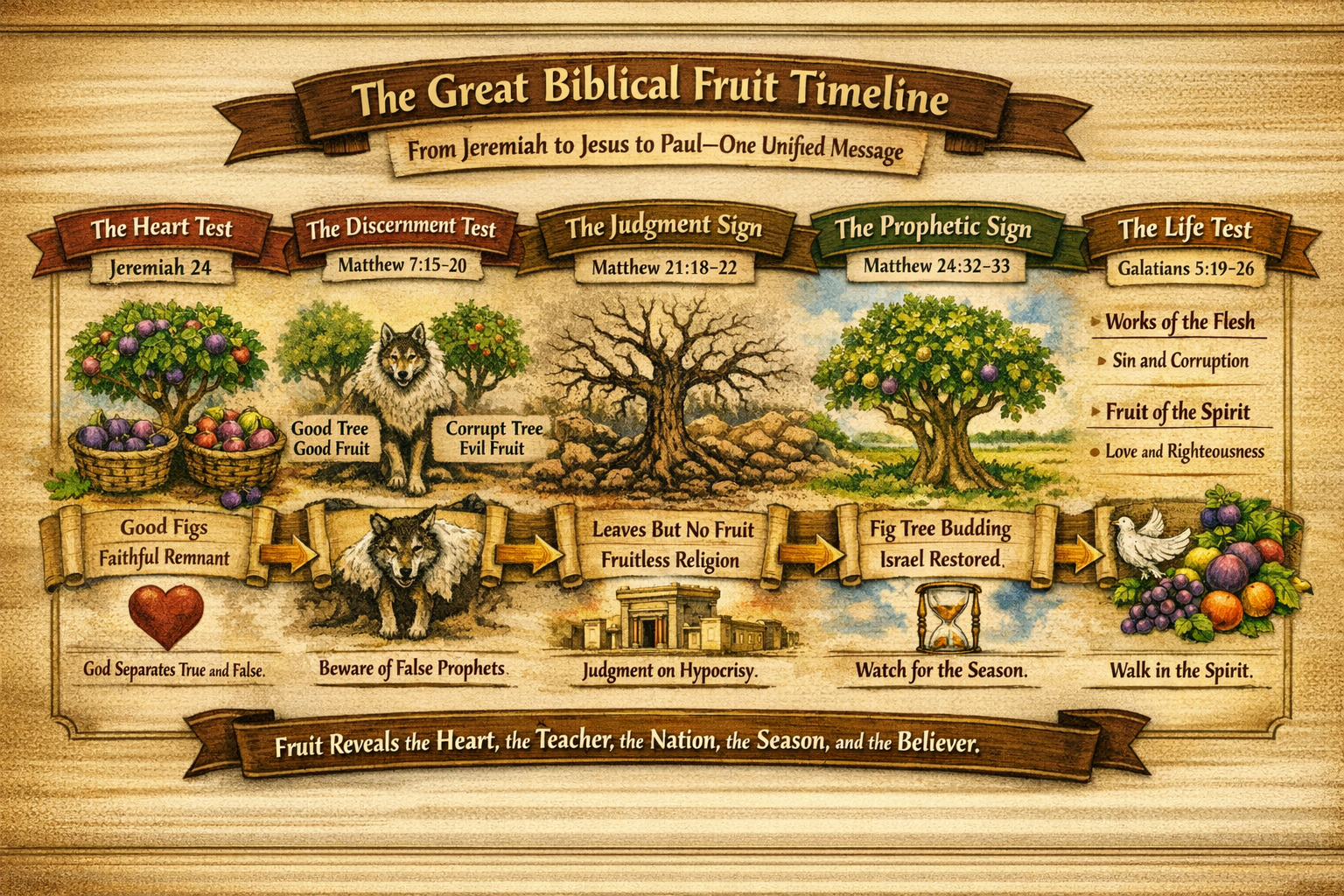
From the earliest pages of Scripture, God uses fruit to uncover what lies within the heart.
In Jeremiah 24, two baskets of figs show the difference between those who trust Him and those who turn away.
In Matthew 7, Jesus warns that false prophets will be known by their fruit — good or corrupt.
In Matthew 21, the fruitless fig tree stands as a living parable of empty religion, while in Matthew 24, the budding fig tree signals the nearness of His return.
Finally, Galatians 5 reveals the daily test of every believer: the works of the flesh versus the fruit of the Spirit.
Across these passages, the message is clear — fruit reveals truth.
It exposes the heart, unmasks hypocrisy, and announces the season of God’s plan.
Those who walk in the Spirit bear fruit that endures; those who cling to the flesh wither away.
This study invites us to trace that story — from the prophets to the Messiah to the Church — and to ask ourselves:
Are we bearing fruit that glorifies God and prepares us for His coming?
🌿 1. Jeremiah 24 — Good Figs vs. Bad Figs
Theme: God separates the faithful from the false.
- Good figs → faithful remnant
- Bad figs → rebellious, corrupt, unrepentant
- Fruit = evidence of the heart
This is the Old Testament foundation for the fruit imagery Jesus uses.
🌳 2. Matthew 7:15–20 — False Prophets & Fruitless Trees
Theme: You will know them by their fruits.
Jesus warns:
- False prophets look like sheep but act like wolves
- A good tree cannot produce bad fruit
- A corrupt tree cannot produce good fruit
- Every fruitless tree is cut down and burned
This is the same message as Jeremiah 24 — but now applied to teachers, leaders, and prophets.
Fruit = doctrine + character + obedience.
🌱 3. Matthew 21 — The Cursed Fig Tree
Theme: Judgment on fruitless religion.
The fig tree had leaves but no fruit — outward appearance without inward reality.
Just like:
- the corrupt priests
- the moneychangers
- the religious system that rejected Jesus
This is Jeremiah 24 and Matthew 7 in action.
Fruitlessness = judgment.
🌼 4. Matthew 24:32–33 — The Parable of the Fig Tree
Theme: Discern the season. Be ready.
Jesus commands:
“Learn the parable of the fig tree.”
When the fig tree buds:
- summer is near
- the prophetic season is unfolding
- His return is close
This is not about individual fruit — it’s about national and prophetic fruit.
Israel’s restoration = the fig tree budding.
🍇 5. Galatians 5:19–26 — Works of the Flesh vs. Fruit of the Spirit
Theme: True believers bear true fruit.
Paul lists:
Works of the flesh (fruit of corruption):
- adultery
- fornication
- idolatry
- witchcraft
- hatred
- strife
- heresies
- envyings
- drunkenness
- and more
These match the bad figs, the corrupt trees, and the fruitless religion Jesus condemned.
Fruit of the Spirit (fruit of righteousness):
- love
- joy
- peace
- longsuffering
- gentleness
- goodness
- faith
- meekness
- temperance
These match the good figs, the faithful remnant, and the watchful believers ready for Christ’s return.
Paul then says:
“They that are Christ’s have crucified the flesh.”
Meaning: True fruit comes from a crucified life — not outward religion.
🔥 How All These Passages Fit Together
Here’s the unified prophetic pattern:
Jeremiah 24
God separates good figs from bad figs → true vs. false hearts
Matthew 7
Jesus separates good trees from corrupt trees → true vs. false prophets
Matthew 21
Jesus curses the fruitless fig tree → true vs. false religion
Matthew 24
Jesus commands us to learn the fig tree → true vs. false readiness
Galatians 5
Paul shows the fruit of the Spirit vs. works of the flesh → true vs. false believers
🌟 The Big Picture
The Bible uses figs, trees, and fruit to reveal:
1. Who belongs to God
(good figs, good trees, fruit of the Spirit)
2. Who is false
(bad figs, corrupt trees, works of the flesh)
3. What God will judge
(fruitless religion, false prophets, unrepentant hearts)
4. What God will restore
(the fig tree budding — Israel and the end‑time season)
5. How believers must live
(watchful, fruitful, Spirit‑led)
✨ Summary
From Jeremiah to Jesus to Paul, fruit reveals everything — the heart, the teacher, the nation, the season, and the believer.
