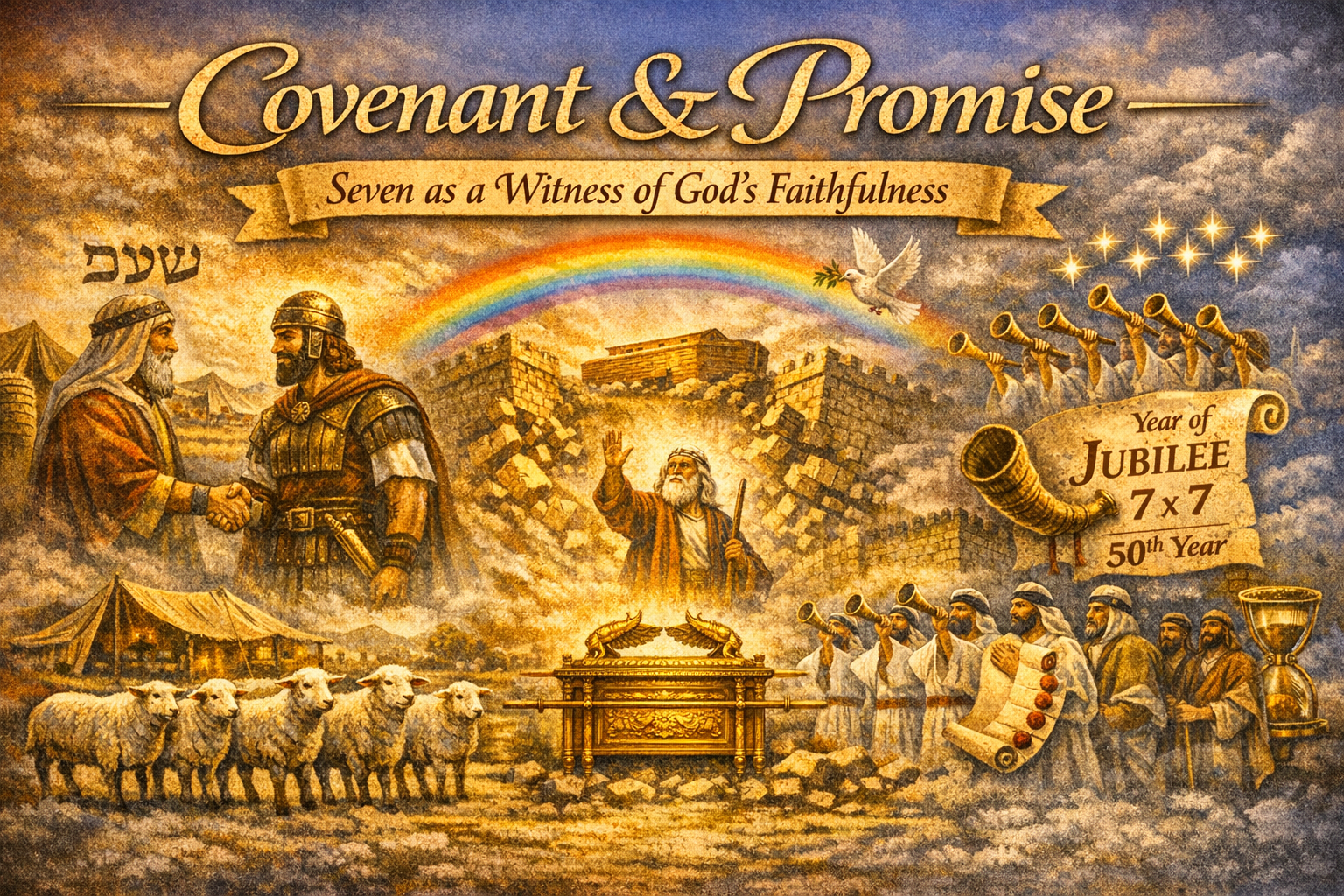
🟫 Covenant and Promise: Seven as a Witness of God’s Faithfulness
The number seven is deeply tied to covenant-making and promise-keeping throughout Scripture. It’s not just symbolic — it’s ritual, legal, and prophetic.
1. Seven in Abraham’s Covenant
- In Genesis 21:28–30, Abraham sets aside seven ewe lambs as a witness to a covenant with Abimelech.
- The Hebrew word for “swear” (שָׁבַע shaba) is rooted in the word for “seven” (שֶׁבַע sheva).
- To “seven oneself” was to make a solemn oath.
Teaching Point:
Seven is not just a number — it’s a covenant action, a way of saying “this promise is complete and binding.”
2. Noah’s Covenant and the Rainbow
- After the flood, God gives Noah a seven-colored rainbow as a sign of His covenant never to destroy the earth by water again (Genesis 9:12–17).
- The rainbow is a visual sevenfold witness of mercy and restraint.
Teaching Point:
Seven marks divine restraint, mercy, and faithfulness to promises.
3. Jubilee: Seven Times Seven
- In Leviticus 25, God commands a Jubilee year after seven cycles of seven years.
- On the 50th year, slaves are freed, debts are forgiven, and land is restored.
- It begins with the blowing of a trumpet — just like Jericho.
Teaching Point:
Seven leads to freedom, restoration, and new beginnings.
4. Oaths and Blessings
- In Genesis 2, God blesses the seventh day and sanctifies it.
- In Genesis 12, God gives seven blessings to Abraham.
- In Revelation, the Lamb is worthy to receive sevenfold praise (Revelation 5:12).
Teaching Point:
Seven is the number of blessed covenant, where God initiates and fulfills.
5. Jericho as a Covenant Ceremony
- The seven priests, seven trumpets, seven days, and seven circuits were not just military instructions — they were covenant rituals.
- The ark of the covenant was present.
- The trumpet blasts echoed Jubilee.
- The silence and shout mirrored divine timing.
Teaching Point:
Jericho was not just a conquest — it was a covenant renewal, a declaration that God’s promises were being fulfilled.
