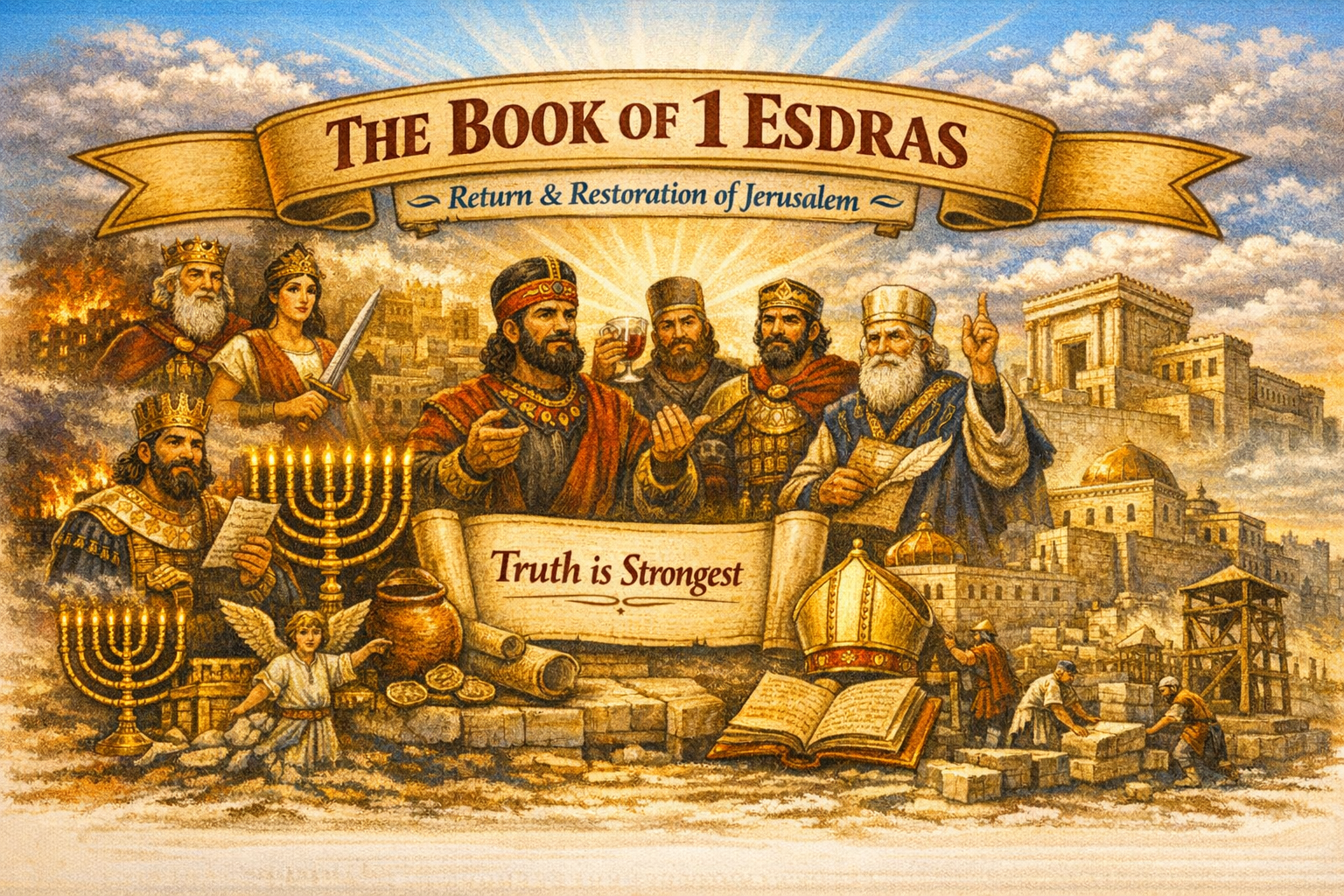
📘 Outline of the Book of 1 Esdras (9 Chapters)
Setting: Post‑exilic period, 6th–5th century BCE
Themes: Restoration, repentance, divine wisdom, and renewal of worship
I. Josiah’s Passover and the Fall of Jerusalem (Ch. 1)
- Begins with King Josiah’s great Passover celebration (from 2 Chronicles 35–36).
- Chronicles the decline of Judah, the Babylonian conquest, and the exile.
- Establishes the historical bridge between Chronicles and Ezra.
II. Cyrus’s Decree and the Return (Ch. 2)
- Cyrus of Persia fulfills Jeremiah’s prophecy, allowing Jews to return.
- Lists the leaders and families who go back to Jerusalem.
- Emphasizes God’s faithfulness in restoring His people.
III. The Contest of the Three Guardsmen (Ch. 3–4)
- Unique to 1 Esdras — not found in the Hebrew Ezra‑Nehemiah.
- Three guardsmen debate before King Darius what is strongest in the world:
- Wine
- The king
- Women and truth
- Zerubbabel wins by declaring that truth is strongest, earning Darius’s favor.
- Darius decrees the rebuilding of Jerusalem and the Temple.
IV. Rebuilding the Temple (Ch. 5–6)
- The exiles return and lay the foundation of the Temple.
- Opposition arises from neighboring peoples.
- Darius reaffirms the decree, and the Temple is completed and dedicated.
V. Ezra’s Mission and Reform (Ch. 7–9)
- Ezra the priest leads a second group from Babylon to Jerusalem.
- He restores worship and teaching of the Law.
- Confronts the issue of intermarriage with foreign wives; the people repent.
- Ends with Ezra’s prayer of confession and the renewal of covenant purity.
📜 Canonical Status
| Tradition | Status | Reason |
|---|---|---|
| Jewish (Tanakh) | ❌ Not Canon | Absent from Hebrew Bible; overlaps with Ezra‑Nehemiah |
| Protestant | ❌ Apocrypha | Listed among Apocrypha; valued for history but not inspired |
| Catholic | ❌ Apocrypha | Jerome excluded it from the Vulgate canon; considered useful but non‑canonical |
| Eastern Orthodox | ✔️ Canonical | Included in the Septuagint as Esdras A; used liturgically and historically |
🕊️ Summary Insight
1 Esdras retells the story of return and restoration with a focus on truth and divine wisdom.
Its distinctive “Contest of the Three Guardsmen” highlights the triumph of truth over worldly power — a theme cherished in Orthodox tradition and admired by scholars for its literary beauty.
The Book of 1 Esdras is not included in the Jewish canon because it was written and preserved primarily in Greek, not Hebrew or Aramaic, and it largely duplicates material already found in Ezra–Nehemiah. Jewish scribes and rabbis considered the Hebrew versions of those books authoritative and saw 1 Esdras as a later Greek adaptation rather than an original inspired text.
🕎 Historical and Canonical Reasons
- Language and Origin
- 1 Esdras was composed in Greek, probably between the 2nd century BCE and 1st century CE, while the Hebrew canon was finalized using Hebrew and Aramaic texts.
- Because it was not part of the Hebrew manuscript tradition, it was excluded when the rabbis standardized the Tanakh around the 1st century CE.
- Overlap with Canonical Books
- The book retells events from 2 Chronicles 35–36, Ezra 1–10, and Nehemiah 8, adding only one unique story — the “Contest of the Three Guardsmen.”
- Since most of its content already existed in canonical Hebrew texts, Jewish scholars viewed it as redundant or secondary.
- Greek Septuagint Context
- 1 Esdras was included in the Septuagint, the Greek translation of the Hebrew Scriptures used by Jews in the diaspora, but never in the Hebrew Bible itself.
- When the Hebrew canon was finalized, books found only in Greek were generally excluded.
- Rabbinic and Historical Tradition
- Jewish tradition recognized Ezra–Nehemiah as one unified canonical book.
- 1 Esdras, being a variant Greek version, was not considered authoritative for worship or teaching.
✡️ Summary
In essence, 1 Esdras was excluded from the Jewish canon because:
- It was written in Greek, not Hebrew.
- It duplicates canonical material.
- It originated outside the rabbinic textual tradition.
- It was preserved in the Septuagint, not the Hebrew Bible.
- It was not included in the Protestant canon because it was not included in the Jewish canon.
