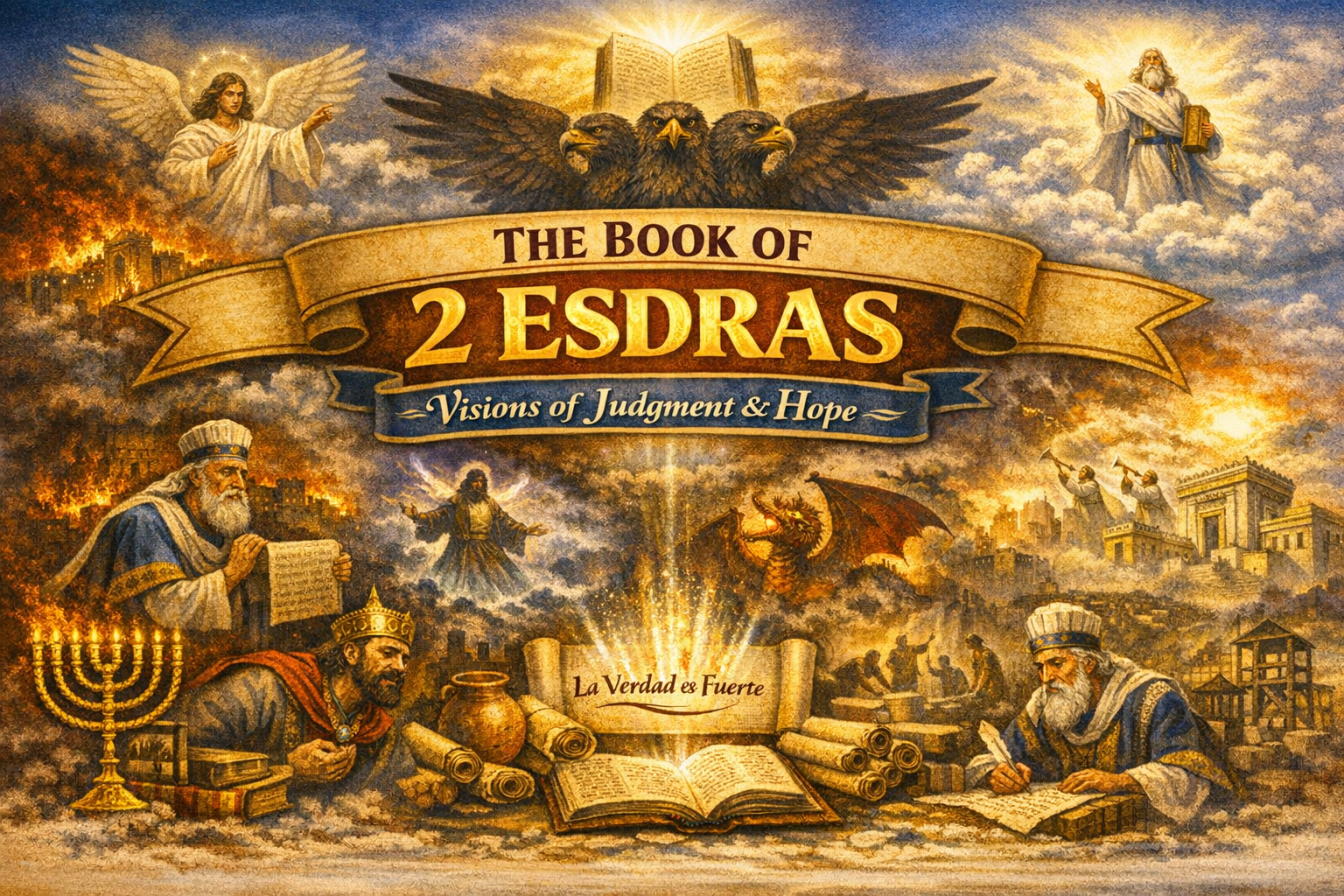
The Book of 2 Esdras (also called 4 Esdras or Apocalypse of Ezra) is one of the most profound apocalyptic writings in the Apocrypha. It wrestles with divine justice, suffering, and hope after the destruction of Jerusalem in 70 CE.
📘 Outline of the Book of 2 Esdras (16 Chapters)
Setting: After the fall of Jerusalem, c. 100 CE
Themes: Theodicy, divine revelation, messianic hope, and restoration
I. God’s Rebuke and Promise (Ch. 1–2 = 5 Esdras)
- A Christian addition written later (2nd century CE).
- God rebukes Israel for disobedience and promises the kingdom to a new, faithful people — interpreted as Gentile believers.
- Ends with visions of reward for the righteous and condemnation of the wicked.
II. Ezra’s Lament and the Seven Visions (Ch. 3–14 = 4 Esdras)
- The core Jewish apocalypse, written soon after 70 CE.
- Ezra mourns the destruction of Jerusalem and questions why the righteous suffer while the wicked prosper.
- The angel Uriel answers through seven visions:
- The Problem of Evil — Ezra asks why God allows injustice.
- The Limits of Human Understanding — Uriel teaches that divine wisdom surpasses human reason.
- The Woman and Zion — A mourning woman transforms into the heavenly city, symbolizing Jerusalem’s renewal.
- The Eagle Vision — A terrifying eagle with twelve wings and three heads represents the Roman Empire and its downfall.
- The Man from the Sea — A messianic figure rises from the sea, conquering evil with divine power.
- The Judgment of the Nations — Ezra sees the final judgment and resurrection.
- The Restoration of Scripture — Ezra miraculously dictates 94 books:
- 24 public (the Hebrew Bible)
- 70 secret (for the wise and faithful)
III. Prophecies of Woe and Destruction (Ch. 15–16 = 6 Esdras)
- Another Christian addition, echoing Revelation.
- Foretells wars, plagues, and divine wrath upon the nations.
- Ends with a call to repentance and endurance.
📜 Canonical Status
| Tradition | Status | Reason |
|---|---|---|
| Jewish (Tanakh) | ❌ Not Canon | Post‑biblical apocalypse; not part of Hebrew tradition |
| Protestant | ❌ Apocrypha | Excluded; valued for theology but not inspired |
| Catholic | ❌ Apocrypha | Jerome placed it in the Vulgate appendix; not canonical |
| Eastern Orthodox | ✔️ Canonical (varies) | Included in Slavonic and Ethiopian Orthodox canons |
| Ethiopian Orthodox | ✔️ Canonical | Regarded as inspired Scripture; called Ezra Sutu’el |
🕊️ Summary Insight
2 Esdras is a dialogue between faith and doubt.
Ezra’s struggle mirrors humanity’s search for meaning amid suffering.
Its visions of the Messiah, resurrection, and divine justice influenced later Jewish and Christian apocalyptic thought — including Revelation.
The Book of 2 Esdras (also known as 4 Esdras or Apocalypse of Ezra) is not included in the Jewish canon because it was written too late, outside the Hebrew language tradition, and after the closure of the Tanakh.
🕎 Historical and Canonical Reasons
- Date of Composition
- Scholars place 2 Esdras around 70–100 CE, after the destruction of the Second Temple.
- By that time, the Hebrew canon was already closed (around the late 1st century CE).
- Jewish authorities considered only texts written before the prophetic era ended (roughly 400 BCE) as inspired Scripture.
- Language and Transmission
- 2 Esdras was composed in Greek or possibly Latin, not Hebrew or Aramaic.
- It circulated mainly among diaspora Jews and early Christians, not within rabbinic Judaism.
- The Hebrew manuscript tradition never included it, so it was excluded from the Tanakh.
- Apocalyptic and Theological Style
- The book’s apocalyptic visions resemble later writings like Enoch and Revelation, focusing on divine judgment and messianic hope.
- Rabbinic Judaism generally avoided apocalyptic speculation after the Temple’s fall, emphasizing Torah study and halakhic tradition instead.
- Association with Christian Circles
- Parts of 2 Esdras (chapters 1–2 and 15–16) are Christian additions, referencing Gentile believers and end‑time prophecies.
- This further distanced the text from Jewish acceptance.
✡️ Summary
In essence, 2 Esdras was excluded from the Jewish canon because:
- It was written after the prophetic age and after the canon closed.
- It was composed in Greek/Latin, not Hebrew.
- It reflects apocalyptic theology foreign to rabbinic Judaism.
- It was preserved mainly by Christians, not Jewish scribes.
More information
- Comparison of 2 Esdras with Biblical Apocalyptic Books
