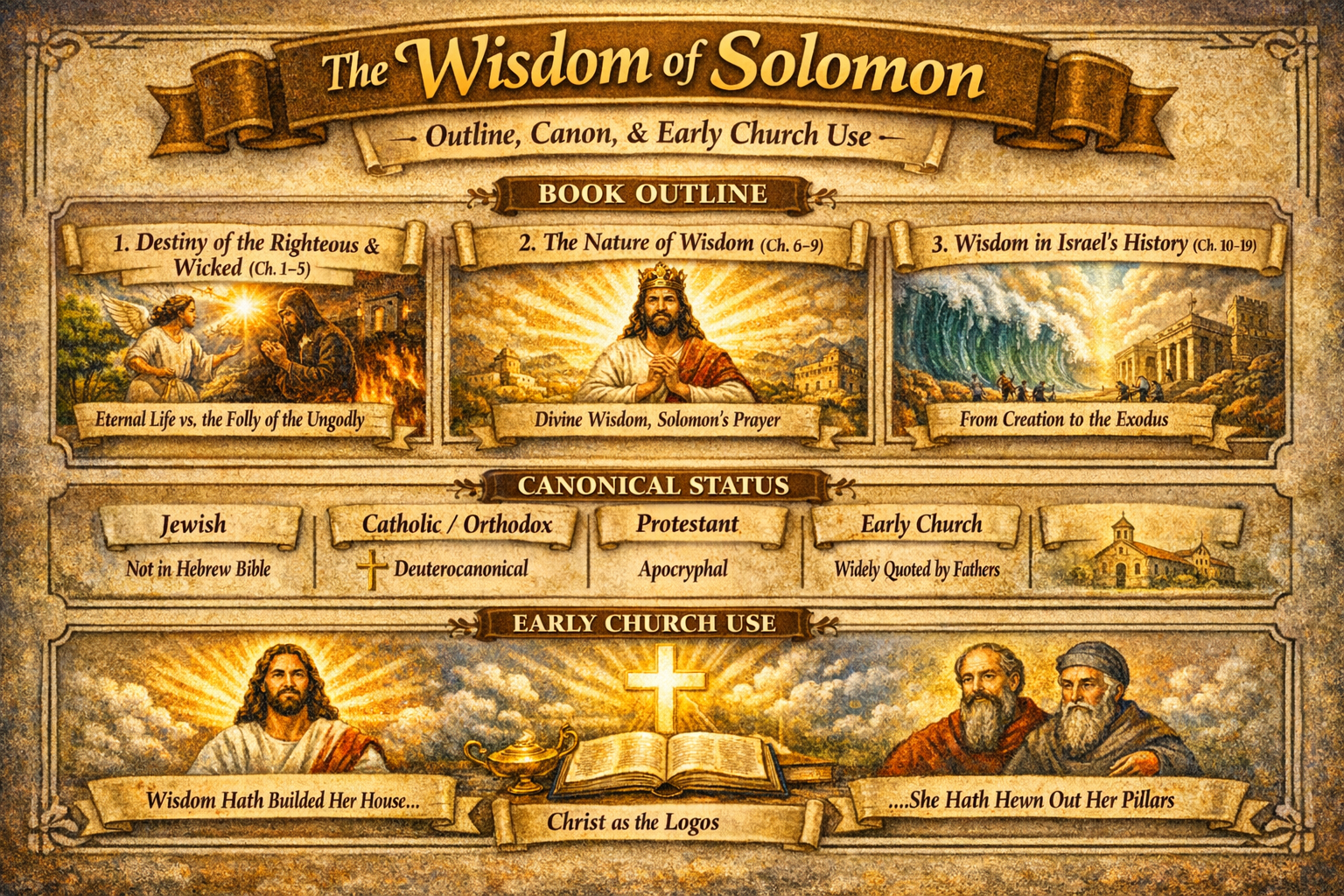
The Book of the Wisdom of Solomon—also called The Book of Wisdom—is one of the most profound works of Jewish theology from the late Second Temple period. It bridges Hebrew faith and Greek philosophy, shaping early Christian thought about divine wisdom, immortality, and righteousness.
🕊 Outline of the Book
Scholars and early church fathers generally divide the book into three major sections, each with distinct themes and literary style.
I. The Destiny of the Righteous and the Wicked (Chapters 1–5)
- Theme: Moral contrast between the righteous and the ungodly.
- Key ideas:
- God’s justice and the immortality of the righteous (3:1–4).
- The folly of the wicked who deny life after death.
- Divine vindication of the righteous in eternity.
- Purpose: To comfort persecuted believers and affirm that righteousness leads to eternal life.
II. The Nature and Power of Wisdom (Chapters 6–9)
- Theme: Solomon’s poetic praise and prayer for Wisdom.
- Key ideas:
- Wisdom as divine, eternal, and active in creation (7:22–8:1).
- Wisdom’s role in guiding rulers and nations (6:1–11).
- Solomon’s personal prayer for wisdom (9:1–18).
- Purpose: To show that true leadership and understanding come from divine Wisdom, not human intellect.
III. Wisdom in Israel’s History (Chapters 10–19)
- Theme: Wisdom guiding God’s people through history.
- Key ideas:
- Wisdom’s presence from Adam to the Exodus.
- Deliverance of Israel and judgment on Egypt.
- Condemnation of idolatry and folly.
- Purpose: To demonstrate that Wisdom has always been the agent of God’s providence and justice.
📜 Canonical Issues
Jewish and Early Christian Context
- Written in Greek, likely in Alexandria, Egypt, between 50 BC – 30 AD by a Jewish sage writing under Solomon’s persona.
- Included in the Septuagint (LXX), the Greek Old Testament used by Jesus and the Apostles.
- Found in early Christian manuscripts such as Codex Vaticanus and Codex Sinaiticus, where it appears as Scripture.
Canonical Status Across Traditions
| Tradition | Canonical Status | Notes |
|---|---|---|
| Jewish Canon (Tanakh) | Not included | Written in Greek, outside Hebrew canon. |
| Catholic & Orthodox Churches | Canonical | Included among the Deuterocanonical books. |
| Protestant Churches | Apocryphal | Retained in the 1611 KJV Apocrypha but later removed. |
| Early Church Fathers | Widely used | Quoted by Origen, Augustine, Ambrose, and others as inspired. |
Summary: The book was considered inspired by many early Christians but excluded from the Hebrew canon due to its Greek origin and philosophical tone.
🕊 Use in the Early Church
1. Theological Influence
- Paul’s Epistles: Echoes of Wisdom of Solomon appear in Romans 1 and 2 (idolatry and moral blindness) and 1 Corinthians 15 (immortality).
- Christology: The book’s portrayal of Wisdom as eternal and active in creation influenced early Christian understanding of Christ as the Logos (John 1:1–3).
- Moral Teaching: Its emphasis on righteousness and divine justice shaped early Christian ethics and homiletics.
2. Patristic Usage
- Origen, Augustine, and Ambrose cited it as Scripture.
- Jerome acknowledged its spiritual value but excluded it from the Hebrew canon, calling it Liber Sapientiae in the Vulgate.
- Epiphanius and Athanasius referred to it as Panaretos Sophia (“All‑Virtuous Wisdom”), alongside Proverbs and Sirach.
3. Liturgical and Doctrinal Role
- Used in early Christian catechesis and funeral liturgies for its teaching on immortality.
- Influenced Trinitarian theology, especially the identification of Wisdom with the Son and Spirit.
🌾 Summary Insight
The Wisdom of Solomon stands as a bridge between the Old and New Testaments:
- It unites Hebrew moral theology with Greek philosophical language.
- It anticipates Christian revelation, portraying Wisdom as divine, eternal, and redemptive.
- Though not universally canonical, it profoundly shaped the early church’s understanding of Christ as the embodiment of divine Wisdom.
