Teaching Section: When the Crowd Can’t Tell the Difference
Discernment in an Emotional Church Culture
1. The Story That Reveals a Deeper Problem
My grandfather once told me something that stayed with me for years.
During a season of his life as a traveling evangelist, he sometimes preached while intoxicated. What shocked him was not his own condition — it was the congregation’s response. Those were the services where people shouted the loudest, cried the hardest, and insisted “the Spirit was moving.”
But there was another layer to the story.
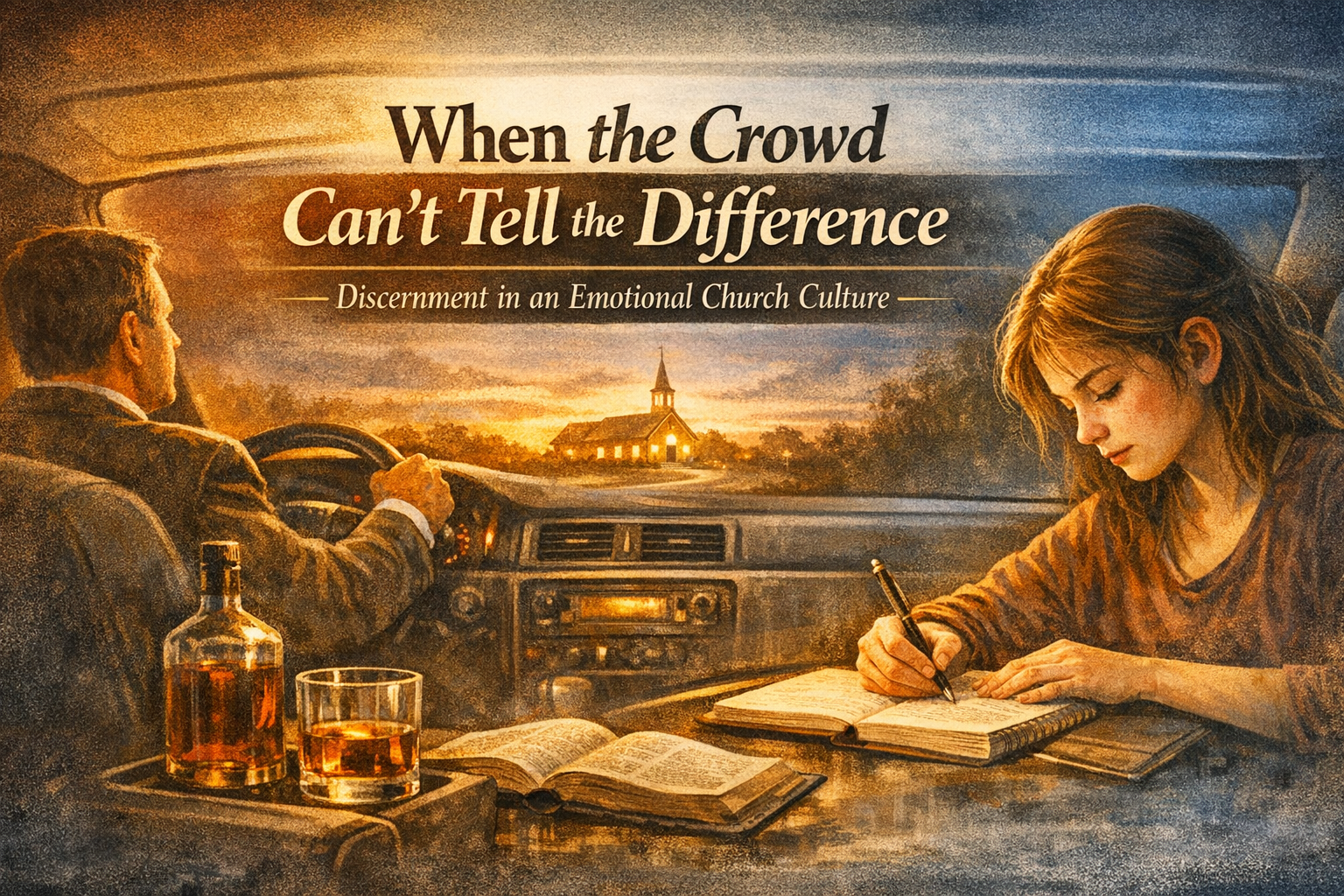
On those occasions, my mother — only about sixteen years old — wrote the sermons for him in the car on the way to church while he drove, whiskey beside him.
She tried to write good, simple messages from the Bible, hoping something true would still reach the people. He would stand and preach what she wrote, and the crowd would respond as though heaven itself had touched the room.
He said it grieved him that no one could tell the difference.
This story is not about him.
It’s about the spiritual blindness of a crowd that confused emotional intensity with the presence of God.
2. Why Emotional Environments Can Be Deceptive
Many church cultures have been trained — often unintentionally — to equate the Holy Spirit with:
- volume
- excitement
- tears
- dramatic preaching
- physical reactions
- atmosphere
But Scripture never defines the Spirit by emotional temperature.
The Holy Spirit is recognized by fruit, truth, sobriety, and discernment.
“You will know them by their fruits.”
Matthew 7:16
Emotion is not evil.
But emotion is not evidence.
When a congregation cannot distinguish between a drunk preacher and a Spirit-filled one — or between a seasoned evangelist and a teenager’s handwritten sermon — something has gone deeply wrong.
3. What This Reveals About Discernment
Your grandfather’s grief exposes a biblical truth:
People can be spiritually stirred without being spiritually led.
Crowds are easily moved by:
- charisma
- storytelling
- rhythm
- music
- atmosphere
- personality
But the Spirit is not identified by performance.
He is identified by truth, holiness, and transformation.
Discernment is the ability to see past the surface and recognize what is actually happening in the spirit.
4. Why This Matters for Today’s Church
Many believers have never been taught to test what they feel.
They assume:
- “If it feels powerful, it must be God.”
- “If the preacher is intense, he must be anointed.”
- “If the room is emotional, the Spirit must be moving.”
But Scripture teaches the opposite:
“Beloved, do not believe every spirit, but test the spirits to see whether they are from God.”
1 John 4:1
Testing is not suspicion.
Testing is obedience.
A church that cannot tell the difference between intoxication and anointing is a church that has lost its spiritual senses.
5. The Warning Hidden in His Story
My grandfather wasn’t just sharing a memory.
He was passing down a warning:
“Don’t mistake emotional energy for the Holy Spirit.”
He had seen firsthand how easily people can be swept up in a moment and call it God.
His grief was a teacher.
His confession was a caution.
His story is a mirror for the modern church.
And the fact that a sixteen‑year‑old girl could write sermons in a car while her father drove drunk — and those sermons produced the same emotional response — only underscores the point:
The crowd wasn’t discerning the Spirit — they were reacting to the atmosphere.
6. What True Spiritual Discernment Looks Like
Discernment is not about judging people.
It is about recognizing what spirit is influencing a moment.
True discernment asks:
- Does this produce the fruit of the Spirit?
- Does this align with Scripture?
- Does this lead to repentance, humility, and obedience?
- Does this glorify Christ or the preacher?
- Does this bring clarity or confusion?
- Does this strengthen the weak or manipulate the vulnerable?
The Holy Spirit does not need theatrics.
He does not need emotional hype.
He does not need a crowd to be stirred.
He moves in truth, not performance.
7. A Call to a Mature, Sober Church
The church needs believers who can:
- recognize the difference between charisma and character
- distinguish emotionalism from anointing
- value fruit over fireworks
- stay grounded when the room gets loud
- remain sober-minded even in spiritual environments
This is not cynicism.
This is maturity.
“Be sober-minded; be watchful.”
1 Peter 5:8
A sober church is a safe church.
A discerning church is a protected church.
A mature church is a Spirit-led church.
8. The Legacy of His Story
My grandfather’s grief became my discernment.
And my mother’s quiet role — a teenage girl writing sermons in a car beside a whiskey bottle — reveals something else:
God can use the humble, the young, the unseen, and the overlooked to speak truth.
And sometimes the crowd still won’t know the difference.
I learned early that:
- not every “move of God” is God
- not every preacher is sober in spirit
- not every emotional service is spiritual
- not every crowd knows what they’re witnessing
9. When Truth Finally Spoke Up
For years, no one called my grandfather out.
But one day, his first cousin James, who served as the district overseer, decided to visit one of his services.
Afterward, James asked him to come to his office the next morning.
There, he spoke plainly:
“You will either resign or be called before the church Board.”
My grandfather didn’t argue.
He quietly resigned and handed his preaching license to James.
That moment mattered.
It was the first time someone with authority recognized what was wrong and acted with integrity.
It was painful — but it was also redemptive.
Because accountability is mercy.
Correction is grace.
And truth, when spoken in love, can stop a counterfeit from continuing.
This story reminds us that:
- God still raises up overseers who will confront deception.
- Real love doesn’t stay silent when holiness is compromised.
- Restoration begins when someone is brave enough to say, “This must stop.”
10. When Repentance Is Counterfeit
After resigning, my grandfather never truly repented.
Instead, he turned his intelligence into a new pursuit — he made a career out of attending college.
He had a remarkably high IQ, and his brilliance became a tool for manipulation. He even created a fake birth certificate for my mother so she could enroll with him. He took her entrance exam himself, replacing her real one with the forged version.
During that season, he performed a ceremony to sell his soul to the devil.
It was the darkest turn in his story — a deliberate exchange of truth for power, intellect for deception.
Years later, he wanted to come back to God.
He began visiting churches across the region, telling the same story everywhere he went:
“I am a preacher who fell away from God. I want to come back.”
Each time, the pastor would pray for him.
Each time, he would speak in tongues.
Each time, the congregation rejoiced — “Another one has come home!”
But afterward, when my mother asked him if it was real, he always said the same thing:
“Wrong tongues.”
He had faked it.
11. The Tragedy of False Fire

This part of the story reveals something sobering:
It is possible to imitate repentance without experiencing redemption.
He knew the words.
He knew the motions.
He knew the emotional cues that would convince a crowd.
But he never surrendered his heart.
He had learned how to counterfeit the Spirit — and the people, once again, couldn’t tell the difference.
12. The Warning for the Church
This story isn’t just about one man.
It’s about a spiritual culture that celebrates emotion over truth.
When churches rejoice over appearances instead of fruit, they become vulnerable to deception.
When leaders fail to test the spirit behind the manifestation, they bless what God has not approved.
“These people honor Me with their lips, but their hearts are far from Me.”
Matthew 15:8
Discernment means recognizing that not every tear is repentance, not every tongue is Spirit-born, and not every return is restoration.
14. The Hope Hidden in the Darkness
Even though my grandfather never found true repentance, his story still teaches something vital:
- God’s mercy remains open — even to those who have faked it.
- The Spirit still calls — even when the heart resists.
- And discernment still matters — because it protects the church from counterfeit conversions.
His story is a warning, but it’s also a mirror.
It asks every believer: Is my repentance real, or rehearsed?
