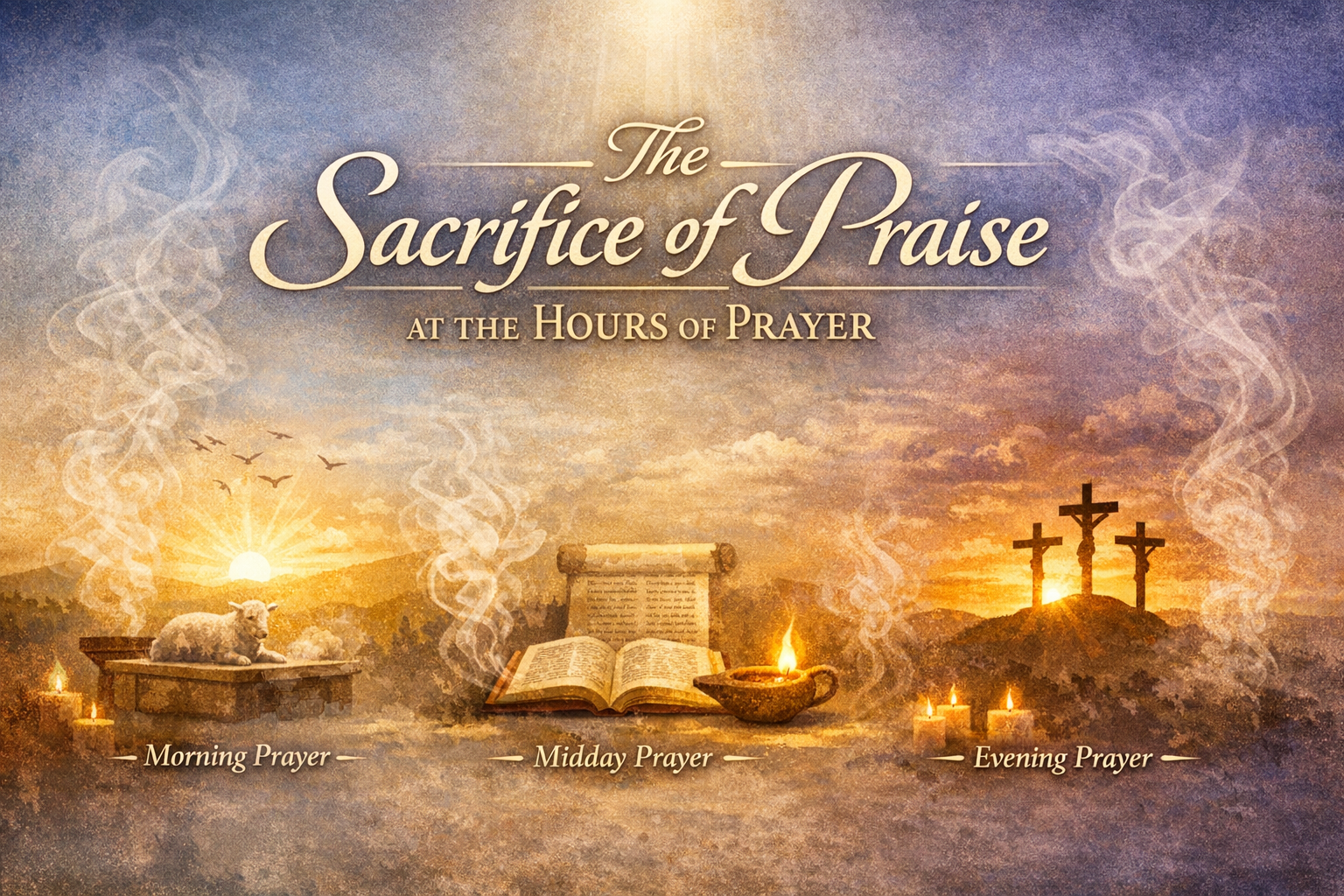
When Exodus 29 establishes the continual morning and evening sacrifices, it sets a rhythm of worship that shaped Israel’s life with God. Hebrews 13 does not abolish this rhythm—it transforms it. Through Jesus, the once‑daily lambs become the believer’s continual sacrifice of praise. This handout shows how the Old Covenant pattern is fulfilled in the New Covenant life of prayer, praise, and goodness.
The Old Testament Pattern
- Morning Sacrifice (Third Hour – 9 AM) — A lamb was offered, incense burned, and prayers rose to God (Exodus 29:38–39; Psalm 141:2).
- Evening Sacrifice (Ninth Hour – 3 PM) — The day closed with another offering, symbolizing continual devotion.
- These sacrifices marked the rhythm of Israel’s worship: beginning and ending each day with God.
The Continual Sacrifice in Exodus 29
Exodus 29:38–39 describes the daily offerings:
- Two lambs offered day by day continually
- One in the morning
- One in the evening
Purpose of the Daily Sacrifice
- To keep Israel in continual fellowship with God
- To anchor the day in worship
- To symbolize dependence on God’s mercy
- To provide a rhythm of devotion for the whole nation
This rhythm becomes the foundation for the hours of prayer.
Daniel’s Rhythm of Prayer
- Daniel 6:10 — Daniel prayed three times a day: morning, midday, and evening.
- Even in exile, Daniel aligned his life with the Temple’s rhythm of sacrifice.
- His devotion shows that prayer can replace sacrifice when the heart remains faithful.
| Time | Hour | Meaning |
| Morning | 3rd hour (9 AM) | Offering the day to God |
| Midday | 6th hour (12 PM) | Re-centering and dependence |
| Evening | 9th hour (3 PM) | Thanksgiving and remembrance |
✝️ The Fulfillment in Christ
Hebrews 13 picks up that same language but shifts the focus:
“We have an altar…” “Jesus also… suffered without the gate…” “Let us go forth therefore unto Him…” “By Him therefore let us offer the sacrifice of praise…”
The writer is saying:
- The altar still exists — but it’s now the cross.
- The lambs still exist — but it’s now Christ, offered once for all.
- The sacrifice continues — but it’s now praise and prayer, not blood.
So, the writer is calling believers to continue the sacrifices, but in their fulfilled form. The rhythm remains; the substance changes.
🔥 The Continuity of Worship
Notice the parallel:
| Old Covenant | New Covenant |
|---|---|
| Morning and evening lambs | Morning and evening prayer and praise |
| Blood on the altar | Christ’s blood once for all |
| Priests offering daily | Believers offering continually |
| Physical altar in the Temple | Spiritual altar in the heart |
| Smoke rising as incense | Praise rising as worship |
The writer of Hebrews is not rejecting the pattern — he’s redeeming it. He’s saying: Keep the continual offering, but let it be the fruit of your lips.
Examples from the New Testament
- Matthew 27:45–50 — Jesus dies at the ninth hour, fulfilling the evening sacrifice.
- Now from the sixth hour there was darkness over all the land unto the ninth hour.
- And about the ninth hour Jesus cried with a loud voice, saying, Eli, Eli, lama sabachthani? that is to say, My God, my God, why hast thou forsaken me?
- Some of them that stood there, when they heard that, said, This man calleth for Elias.
- And straightway one of them ran, and took a spunge, and filled it with vinegar, and put it on a reed, and gave him to drink.
- The rest said, Let be, let us see whether Elias will come to save him.
- Jesus, when he had cried again with a loud voice, yielded up the ghost.
- Acts 2:1–4 & 14-16 – 3rd hour
- And when the day of Pentecost was fully come, they were all with one accord in one place.
- And suddenly there came a sound from heaven as of a rushing mighty wind, and it filled all the house where they were sitting.
- And there appeared unto them cloven tongues like as of fire, and it sat upon each of them.
- and they were all filled with the Holy Ghost, and began to speak with other tongues, as the Spirit gave them utterance.
- But Peter, standing up with the eleven, lifted up his voice, and said unto them, Ye men of Judaea, and all ye that dwell at Jerusalem, be this known unto you, and hearken to my words:
- For these are not drunken, as ye suppose, seeing it is but the third hour of the day.
- But this is that which was spoken by the prophet Joel;
- Acts 3:1 — Peter and John go to the Temple at the hour of prayer (9thhour).
- Now Peter and John went up together into the temple at the hour of prayer, being the ninth hour.
- Acts 10:1-3 — Cornelius prays at the 9th hour.
- There was a certain man in Caesarea called Cornelius, a centurion of the band called the Italian band,
- A devout man, and one that feared God with all his house, which gave much alms to the people, and prayed to God alway.
- He saw in a vision evidently about the ninth hour of the day an angel of God coming in to him, and saying unto him, Cornelius.
- Acts 10:8-9 — Peter prays at the sixth hour.
- And when he had declared all these things unto them, he sent them to Joppa.
- On the morrow, as they went on their journey, and drew nigh unto the city, Peter went up upon the housetop to pray about the sixth hour:
The apostles continued the rhythm of prayer, now centered on Christ’s finished work.
The apostles continued the prayer hours without being told to.
The early church didn’t treat these hours as optional or random. They treated them as the inherited rhythm of worship.
So, the New Testament doesn’t command the hours — it assumes them.
🌅 The Hours of Prayer as Living Sacrifice
When believers pray morning, midday, and evening, they are walking in the same rhythm that began in Exodus and was fulfilled in Christ.
- Morning prayer — aligns with the morning lamb
- Midday prayer — echoes Daniel’s devotion
- Evening prayer — remembers the Lamb who died at the ninth hour
Each prayer becomes a living sacrifice, offered through Jesus, our High Priest.
🌅 Morning: The Third Hour — A Sacrifice of Beginning
In the Old Testament, the morning sacrifice was offered around the third hour (9 AM).
A lamb was placed on the altar. Incense rose. The people prayed.
This was Israel’s way of saying:
“Before anything else, we turn our hearts toward You.”
Daniel kept this rhythm even in Babylon.
The apostles kept it after the resurrection.
Pentecost itself happened at the third hour.
For us, the morning becomes a place of offering:
- our first thoughts
- our first breath of gratitude
- our first surrender of the day
We bring the sacrifice of praise, trusting that Jesus—the true Lamb—has already opened the way.
☀️ Midday: The Sixth Hour — A Sacrifice of Dependence
The sixth hour (12 PM) was not a time of sacrifice in the Temple, but it became a sacred hour of prayer for God’s people.
Midday prayer is the prayer of re-centering:
- when the day is half spent
- when our strength feels thin
- when distractions pull hard
- when we need fresh mercy
This hour reminds us that worship is not confined to a sanctuary.
It is the quiet turning of the heart in the middle of ordinary life.
Our midday praise becomes a sacrifice of dependence—a way of saying:
“I cannot finish this day without You.”
The sixth hour (noon) becomes important in the New Testament:
- Peter goes up to pray at the sixth hour (Acts 10:9).
- Jesus is on the cross from the third hour to the ninth hour, and darkness falls from the sixth hour to the ninth hour (Matthew 27:45).
🌇 Evening: The Ninth Hour — A Sacrifice of Remembrance
The evening sacrifice was offered at the ninth hour (3 PM).
It was the second daily lamb, the closing act of the Temple day.
And at that very hour, Jesus breathed His last.
The Lamb of God died at the time of the evening sacrifice,
and the curtain tore from top to bottom.
The apostles continued to pray at this hour—not out of ritual,
but because this was the hour when redemption was finished.
Evening prayer becomes a place of:
- remembering God’s faithfulness
- releasing the burdens of the day
- returning thanks for His mercy
- resting in the finished work of Christ
Our evening praise becomes a sacrifice of trust—a way of saying:
💛 The Heart Established with Grace
Hebrews 13:9 says:
“It is a good thing that the heart be established with grace; not with meats…”
That’s the key. The old sacrifices fed the priests physically; the new sacrifice feeds the heart spiritually. Grace replaces ritual. Praise replaces blood. Communion replaces consumption.
🌿 The Sacrifice God Still Desires
Verse 16 completes the thought:
“To do good and to communicate forget not: for with such sacrifices God is well pleased.”
So, the “sacrifice of praise” isn’t only words — it’s a life of worship and compassion. Prayer and praise are the altar; good works and generosity are the offering.
✨ Summary
Hebrews teaches that the continual sacrifices of Exodus are continued in spirit — transformed into continual prayer, praise, and goodness through Christ.
The altar remains. The offering continues. The worship endures. But the Lamb has changed everything.
